
Causes of hypotension
Hypotension (low blood pressure, typically <90/60 mmHg) has several broad categories of causes:
- Hypovolemia - dehydration, hemorrhage, burns, vomiting/diarrhea
- Cardiac causes - heart failure, MI, arrhythmias, cardiac tamponade
- Distributive - sepsis, anaphylaxis, neurogenic shock (spinal injury)
- Obstructive - pulmonary embolism, tension pneumothorax
- Medications - antihypertensives, diuretics, beta-blockers, vasodilators
- Endocrine - Addison's disease, hypothyroidism
- Orthostatic - autonomic dysfunction, prolonged bed rest
Searching sources...
Reading File
Finding Sources
Finding Sources
The "Frameworks for Internal Medicine" book has dedicated sections for each category. Let me read those in parallel.
Reading File
Reading File
There's a great diagram at line 5030. Let me fetch that image and also read the cardiogenic, distributive, and obstructive sections.
Loading Image
Reading File
Reading File
Reading File
Now let me fetch the full summary diagram showing all four categories:
Loading Image
Excellent - I now have comprehensive textbook content. Here is the complete, well-organized answer:
Causes of Hypotension
Hypotension is traditionally classified into four mechanistic categories. In patients presenting with shock, distributive causes account for ~65% of cases, hypovolemic and cardiogenic ~15% each, and obstructive <5%.
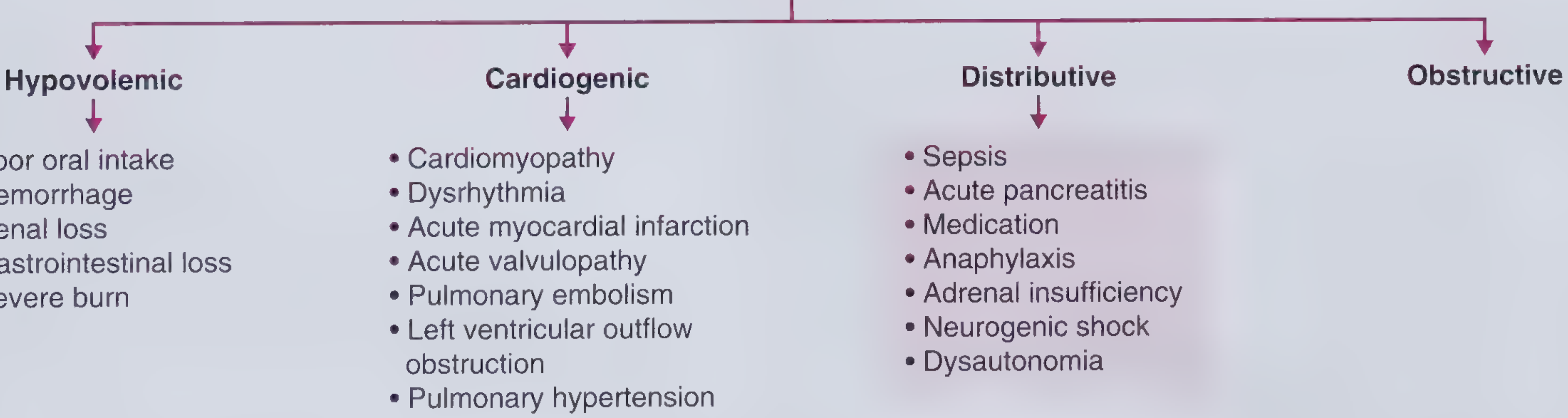
1. Hypovolemic Hypotension
Mechanism: Decreased intravascular volume → reduced cardiac preload → reduced cardiac output. Characteristically presents with low JVP, low CO, high SVR, and cool extremities (compensatory vasoconstriction).
| Cause | Examples |
|---|---|
| Poor oral intake | Anorexia, delirium, obstruction, socioeconomic factors |
| Hemorrhage | Trauma; occult bleeding in retroperitoneum, pelvis, thigh |
| Renal salt wasting | Diuretic use, primary adrenal insufficiency (urine Na >20-30 mEq/L) |
| GI losses | Vomiting, diarrhea |
| Severe burns | Massive fluid loss through skin |
2. Cardiogenic Hypotension
Mechanism: Pump failure - the heart cannot generate adequate cardiac output despite normal or elevated filling pressures.
- Cardiomyopathy (dilated, hypertrophic, restrictive)
- Dysrhythmia (tachyarrhythmia or bradyarrhythmia)
- Acute Myocardial Infarction - especially inferior STEMI (RV involvement)
- Acute Valvulopathy - e.g., acute aortic regurgitation (wide pulse pressure, diastolic murmur)
- Left Ventricular Outflow Tract Obstruction - e.g., severe aortic stenosis, HOCM
- Pulmonary Hypertension - right heart failure, loud P2, RV heave
- Pulmonary Embolism - acute right heart strain (also listed under obstructive)
3. Distributive Hypotension
Mechanism: Pathological vasodilation causing a decrease in systemic vascular resistance (SVR). Presents with warm extremities (vasodilation), high CO early, and low SVR - in contrast to the other categories.
- Sepsis - by far the most common cause of shock overall (~65% of all shock)
- Anaphylaxis - accompanied by bronchoconstriction and urticaria
- Acute pancreatitis - cytokine-mediated vasodilation
- Medications - antihypertensives (especially in patients with restarted home meds after poor adherence), vasodilators
- Primary adrenal insufficiency (Addison's disease) - hyperpigmentation + hyponatremia + hyperkalemia
- Neurogenic shock - sudden loss of autonomic tone after spinal cord injury
- Dysautonomia - e.g., Parkinson's disease, orthostatic hypotension with no compensatory HR rise
4. Obstructive Hypotension
Mechanism: Physical obstruction to blood flow prevents adequate cardiac output despite normal pump function and volume.
| Cause | Key Findings |
|---|---|
| Cardiac tamponade | Beck's triad: tachycardia + hypotension + elevated JVP + muffled heart sounds; pulsus paradoxus >10 mmHg; enlarged cardiac silhouette on CXR |
| Tension pneumothorax | Tracheal deviation on CXR; absent breath sounds; requires emergency needle thoracostomy |
| Constrictive pericarditis | Kussmaul's sign + pericardial knock (high-pitched, closer to S2 than S3) |
| Massive pulmonary embolism | Acute RV strain, elevated JVP |
Additional/Special Causes
- Orthostatic hypotension - defined as a drop of ≥20 mmHg systolic or ≥10 mmHg diastolic within 3 minutes of standing. Causes include dehydration, autonomic neuropathy (diabetes, Parkinson's), prolonged bed rest, age-related changes.
- Toxicologic - drugs causing bradycardia and hypotension include beta-blockers, calcium channel blockers, digoxin, opioids, alpha-2 agonists.
- Endocrine - hypothyroidism (myxedema coma), pheochromocytoma crisis.
- Intradialytic hypotension - seen in patients on hemodialysis due to rapid volume removal.
Source: Frameworks for Internal Medicine (Wolters Kluwer); Miller's Anesthesia 10e; Tintinalli's Emergency Medicine; Rosen's Emergency Medicine
This is a shared conversation. Sign in to Orris to start your own chat.