Management of hiv patient pharmacology

Reading File
Finding Sources
Finding Sources
Searching PubMed

"HIV" AND "antiretroviral therapy"

Reading File
Reading File
Finding Sources
Reading File
Finding Sources
Searching Images

HIV antiretroviral drug classes mechanism of action diagram
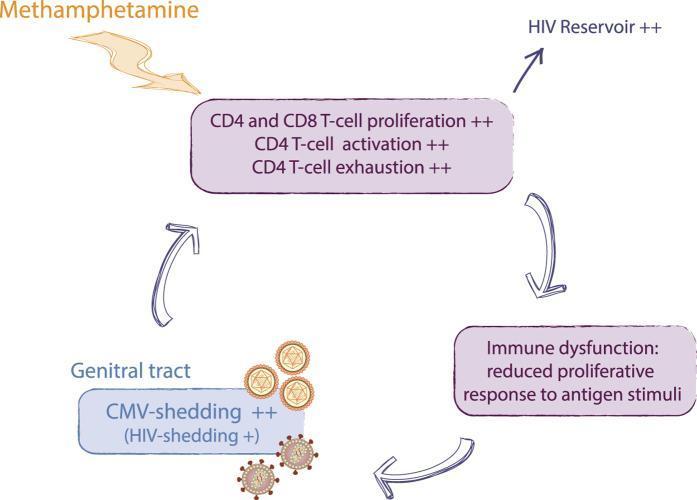
This pathophysiology diagram illustrates a proposed circular mechanism explaining how methamphetamine use impacts immune health in HIV-infected, antiretroviral therapy (ART)-suppressed individuals. The flow begins with 'Methamphetamine' influencing a central box showing increased ('++') CD4 and CD8 T-cell proliferation, as well as increased CD4 T-cell activation and exhaustion. This state of persistent activation leads to an outcome labeled 'HIV Reservoir ++'. Structurally, the diagram follows a cyclic pathway where immune activation and exhaustion result in 'Immune dysfunction: reduced proliferative response to antigen stimuli.' This dysfunction leads to a failure in controlling latent viral replication, specifically noted as 'CMV-shedding ++' and 'HIV-shedding +' in the genital tract. The cycle completes as these viral sheddings feed back into the system, further driving immune activation and exhaustion. This model highlights the complex interplay between drug use, chronic inflammation, and viral reservoirs in clinical immunology and infectious disease specialties, suitable for intermediate-level medical education on HIV disease progression and co-morbidities.
This pathophysiology diagram illustrates a proposed circular mechanism explaining how methamphetamine use impacts immune health in HIV-infected, antiretroviral therapy (ART)-suppressed individuals. The flow begins with 'Methamphetamine' influencing a central box showing increased ('++') CD4 and CD8 T-cell proliferation, as well as increased CD4 T-cell activation and exhaustion. This state of persistent activation leads to an outcome labeled 'HIV Reservoir ++'. Structurally, the diagram follows a cyclic pathway where immune activation and exhaustion result in 'Immune dysfunction: reduced proliferative response to antigen stimuli.' This dysfunction leads to a failure in controlling latent viral replication, specifically noted as 'CMV-shedding ++' and 'HIV-shedding +' in the genital tract. The cycle completes as these viral sheddings feed back into the system, further driving immune activation and exhaustion. This model highlights the complex interplay between drug use, chronic inflammation, and viral reservoirs in clinical immunology and infectious disease specialties, suitable for intermediate-level medical education on HIV disease progression and co-morbidities.

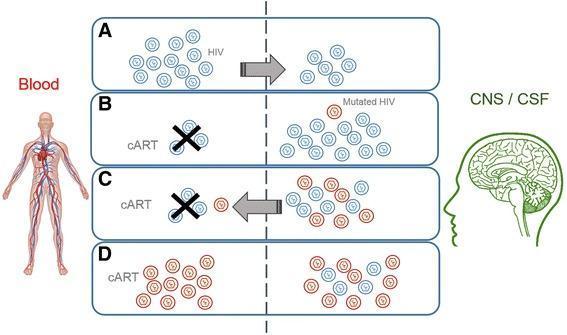
This pathophysiology diagram illustrates the development of HIV drug resistance using the central nervous system (CNS) as a sanctuary reservoir. The diagram is divided into four chronological stages (A-D) across two compartments: Blood and CNS/CSF. Stage A shows the initial phase where blue (wild-type) HIV virions replicate in the blood and cross the blood-brain barrier. Stage B depicts the initiation of combination antiretroviral therapy (cART), indicated by a crossed-out virion in the blood, while the virus continues to replicate in the CNS due to poor drug penetration, leading to a red 'mutated HIV' variant. Stage C shows the mutated virus re-entering the bloodstream despite continued cART. Stage D illustrates treatment failure, where drug-resistant mutant virions (red) dominate both compartments, replicating efficiently despite therapy. The diagram emphasizes viral compartmentalization and the role of the CNS in maintaining proviral load, which contributes to neurologic abnormalities in HIV-infected patients.
This pathophysiology diagram illustrates the development of HIV drug resistance using the central nervous system (CNS) as a sanctuary reservoir. The diagram is divided into four chronological stages (A-D) across two compartments: Blood and CNS/CSF. Stage A shows the initial phase where blue (wild-type) HIV virions replicate in the blood and cross the blood-brain barrier. Stage B depicts the initiation of combination antiretroviral therapy (cART), indicated by a crossed-out virion in the blood, while the virus continues to replicate in the CNS due to poor drug penetration, leading to a red 'mutated HIV' variant. Stage C shows the mutated virus re-entering the bloodstream despite continued cART. Stage D illustrates treatment failure, where drug-resistant mutant virions (red) dominate both compartments, replicating efficiently despite therapy. The diagram emphasizes viral compartmentalization and the role of the CNS in maintaining proviral load, which contributes to neurologic abnormalities in HIV-infected patients.

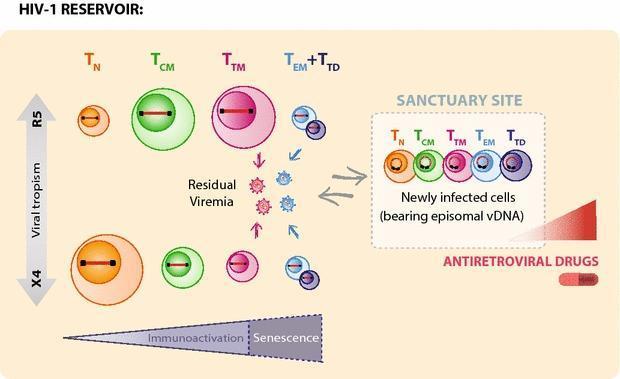
This pathophysiology diagram illustrates a proposed model for HIV-1 reservoirs during antiretroviral therapy (ART), highlighting the dynamics of viral tropism and anatomical compartmentalization. The schematic categorizes CD4+ T-cell subsets into Naïve (TN), Central Memory (TCM), Transitional Memory (TTM), and Effector Memory/Terminally Differentiated (TEM+TTD). A vertical axis compares R5 and X4 viral tropism, demonstrating that X4-tropism significantly increases the reservoir size in TN cells compared to R5-tropism. TTM and TEM+TD cells are depicted as the primary contributors to 'Residual Viremia' in the periphery. A distinct 'Sanctuary Site' (representing lymphoid tissue) is shown, characterized by suboptimal antiretroviral drug concentrations and 'Newly infected cells' bearing episomal vDNA. These cells are illustrated migrating between the sanctuary site and peripheral blood. The diagram also correlates cellular differentiation with a gradient of immunoactivation and senescence. This model emphasizes that residual plasma viremia is genetically distinct from de novo infection events occurring within anatomical sanctuaries, contributing to viral persistence under suppressive ART.

This pathophysiology diagram illustrates a proposed model for HIV-1 reservoirs during antiretroviral therapy (ART), highlighting the dynamics of viral tropism and anatomical compartmentalization. The schematic categorizes CD4+ T-cell subsets into Naïve (TN), Central Memory (TCM), Transitional Memory (TTM), and Effector Memory/Terminally Differentiated (TEM+TTD). A vertical axis compares R5 and X4 viral tropism, demonstrating that X4-tropism significantly increases the reservoir size in TN cells compared to R5-tropism. TTM and TEM+TD cells are depicted as the primary contributors to 'Residual Viremia' in the periphery. A distinct 'Sanctuary Site' (representing lymphoid tissue) is shown, characterized by suboptimal antiretroviral drug concentrations and 'Newly infected cells' bearing episomal vDNA. These cells are illustrated migrating between the sanctuary site and peripheral blood. The diagram also correlates cellular differentiation with a gradient of immunoactivation and senescence. This model emphasizes that residual plasma viremia is genetically distinct from de novo infection events occurring within anatomical sanctuaries, contributing to viral persistence under suppressive ART.

Reading File
Finding Sources
Reading File
Finding Sources
Your credits are exhausted. You can purchase a top-up or subscribe to a plan to continue using Orris. If you're already subscribed, your daily credits will reset tomorrow.

Generate a comprehensive guide on ART drug classes and mechanisms

Your credits are exhausted. You can purchase a top-up or subscribe to a plan to continue using Orris. If you're already subscribed, your daily credits will reset tomorrow.
This is a shared conversation. Sign in to Orris to start your own chat.