
PMOS
Asking for Preferences
What would you like to know about PMOS?
Poly Endocrine Metabolic Ovarian Syndrome
PCOS (Polycystic Ovary Syndrome) is the correct and widely used term - it is a common endocrine-metabolic disorder in women of reproductive age, characterized by hyperandrogenism, ovulatory dysfunction, and polycystic ovarian morphology.
Searching sources...
Reading File
Finding Sources
Searching PubMed
"polycystic ovary syndrome"[MeSH Terms] AND diagnosis
Reading File
Reading File
Reading File
Reading File
Finding Sources
Reading File
Reading File
Reading File
Loading Image
Reading File
Here is a comprehensive overview of PCOS (Polycystic Ovary Syndrome) - note that "PMOS" is not a standard medical abbreviation; the correct term is PCOS.
Polycystic Ovary Syndrome (PCOS)
Definition and Epidemiology
PCOS is the most common endocrine disorder in women of reproductive age, affecting 5-10% of women worldwide. It is a familial disorder with complex polygenic/multifactorial inheritance, first described by Stein and Leventhal in 1935 as the association of amenorrhea with bilateral polycystic ovaries and obesity. It is the leading cause of:
-
Hyperandrogenism (HA)
-
Hirsutism
-
Anovulatory infertility in developed countries
-
Berek & Novak's Gynecology, p. 1919; Textbook of Family Medicine 9e, p. 1052
Diagnostic Criteria
PCOS is a diagnosis of exclusion - other causes must be ruled out first.
Rotterdam 2003 Criteria (currently used): 2 out of 3 required
| Criterion | Details |
|---|---|
| 1. Oligoovulation / anovulation | Irregular or absent periods |
| 2. Clinical and/or biochemical hyperandrogenism | Hirsutism, acne, male-pattern alopecia; elevated androgens |
| 3. Polycystic ovarian morphology on ultrasound | ≥20 follicles (2-9 mm) in either ovary and/or ovarian volume >10 mL |
This gives 4 phenotypes: (1) HA + ovarian dysfunction + PCO morphology, (2) HA + ovarian dysfunction, (3) HA + PCO morphology, (4) ovarian dysfunction + PCO morphology.
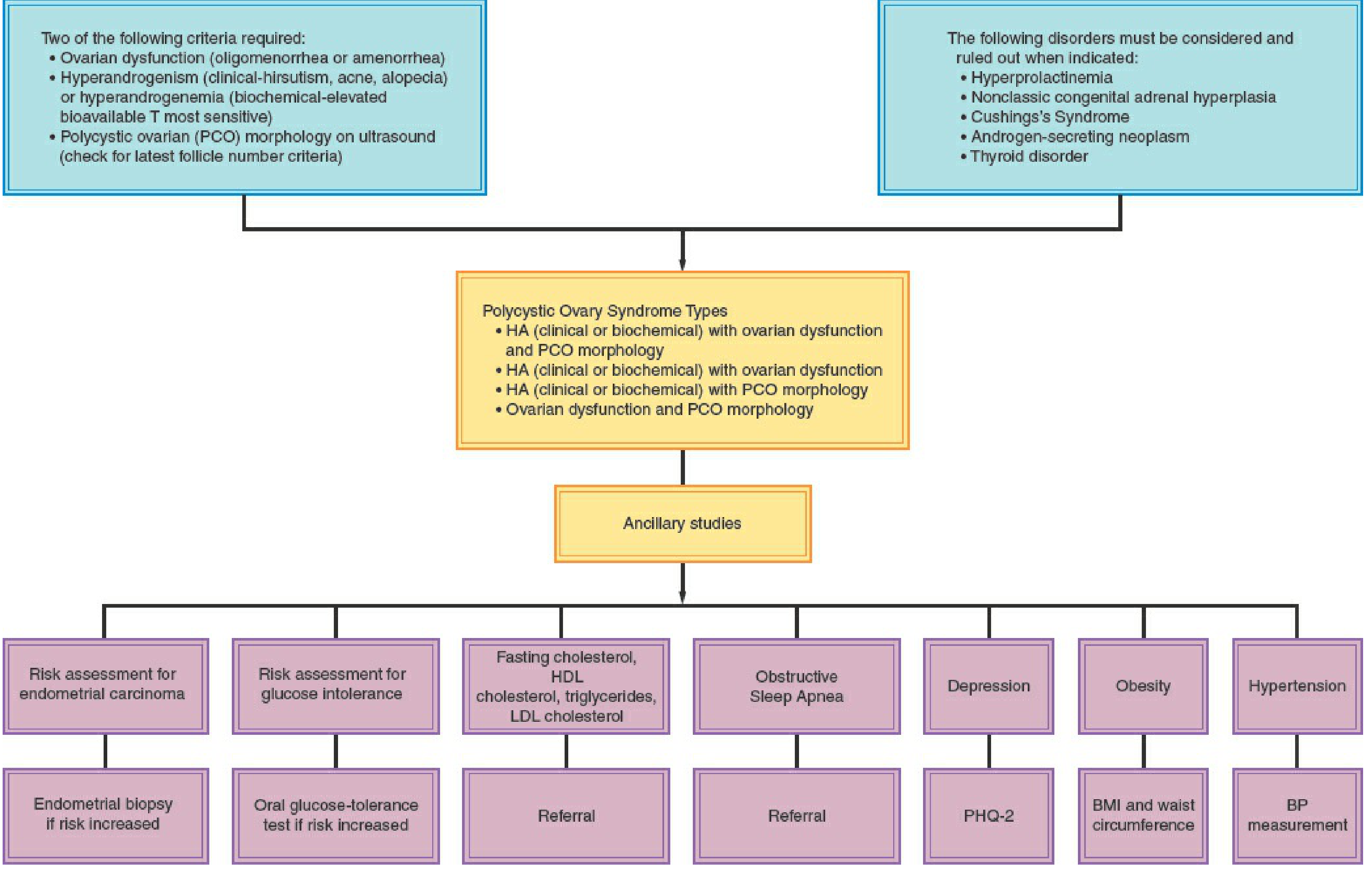
- Berek & Novak's Gynecology, p. 1920
Must exclude:
- Hyperprolactinemia
- Non-classic congenital adrenal hyperplasia (check basal 17-OHP)
- Cushing syndrome
- Androgen-secreting neoplasm
- Thyroid disease
- Hypo/hypergonadotropic disorders
Pathophysiology
PCOS is a heterogeneous endocrine-metabolic disorder driven by several interacting mechanisms:
1. Hyperandrogenism
- Elevated LH stimulates theca cells to overproduce androgens
- Elevated LH:FSH ratio (seen in ~2/3 of cases)
- Androgens inhibit follicular maturation → anovulation
- Hirsutism occurs in ~70% of US patients with PCOS (but only 10-20% in Japan due to genetic differences in skin 5α-reductase activity)
2. Insulin Resistance (IR)
- Present in the majority of PCOS patients, especially obese women
- Hyperinsulinemia stimulates androgen production by theca cells
- 40-50% of obese PCOS women have impaired glucose tolerance (IGT) or type 2 DM
- 10% of non-obese PCOS women also have IGT
- HAIR-AN syndrome = Hyperandrogenism + Insulin Resistance + Acanthosis Nigricans (a severe variant; testosterone >150 ng/dL, fasting insulin >25 μIU/mL)
3. Ovarian Dysfunction
- Arrested follicular development - the "cystic" appearance is actually multiple small antral follicles (not true cysts)
- Anovulation causes irregular menses ranging from oligomenorrhea to amenorrhea
- Anti-Müllerian hormone (AMH) is elevated and is a reliable predictor of antral follicle count
- Berek & Novak's Gynecology, pp. 1920-1928; Goldman-Cecil Medicine
Clinical Features
| System | Features |
|---|---|
| Menstrual | Oligomenorrhea, amenorrhea (rarely primary), irregular cycles from menarche |
| Dermatologic | Hirsutism (~70%), acne, androgenic alopecia, acanthosis nigricans |
| Metabolic | Obesity (~50%), insulin resistance, dyslipidemia (up to 70% in US), metabolic syndrome |
| Reproductive | Anovulatory infertility, increased miscarriage risk |
| Psychological | Depression, anxiety |
| Pregnancy complications | Gestational diabetes, gestational hypertension, preeclampsia, preterm birth |
| Long-term | Cardiovascular disease risk, endometrial cancer risk (unopposed estrogen from anovulation) |
Investigations
- Androgens: Total testosterone, free testosterone (bioavailable T is most sensitive), DHEAS
- LH, FSH: Elevated LH:FSH ratio
- 17-OHP (follicular phase): To exclude non-classic CAH
- Pelvic ultrasound: PCO morphology
- Metabolic screen: Fasting glucose, HbA1c or 75g OGTT (preferred - detects IGT early), fasting lipid profile
- Prolactin and TSH: To exclude other causes
- Endometrial biopsy: If prolonged anovulation raises endometrial carcinoma risk
Management
Management is guided by the patient's primary concern (menstrual regulation, hyperandrogenism, fertility, or metabolic risk):
1. Lifestyle Modification (First-line for all)
- 5-10% weight loss in overweight/obese women reduces IR by ~40% and testosterone by ~35%
- Reduced-calorie diet (500-1000 kcal/day reduction)
- Structured exercise >30 min/day
- Bariatric surgery if BMI >40 (or >35 with comorbidities) after failure of other measures
2. Menstrual Regulation and Endometrial Protection
- Combined oral contraceptive pill (OCP) - first line; reduces androgens by raising SHBG, regulates cycles
- Progestins (medroxyprogesterone acetate 10 mg or progesterone 200 mg for 10-14 days every 3 months) or levonorgestrel IUD - alternative for endometrial protection
3. Hyperandrogenism (Hirsutism/Acne)
- OCP is first-line; reassess at 6 months
- If inadequate response: add spironolactone or flutamide (anti-androgens)
- Topical/cosmetic options for hirsutism
4. Metabolic Risk
- Metformin: Reduces IR and cardiometabolic risk factors in overweight/obese PCOS; NOT recommended alone for endometrial protection, infertility, or gestational diabetes prevention
- Screen for hypertension, dyslipidemia, depression, glycemic control at diagnosis and regular intervals
5. Ovulation Induction (for fertility)
- Letrozole (aromatase inhibitor) - first-line
- Clomiphene citrate ± metformin - second-line
- Injectable gonadotropins - used cautiously due to hyperstimulation risk
- Ovarian drilling (laparoscopic) - surgical option in clomiphene-resistant cases
- Harrison's Principles of Internal Medicine 22E, p. 3179; Berek & Novak's Gynecology, pp. 1929-1931
Recent Evidence (2024-2025)
- A 2024 meta-analysis (PMID 39178623) found GLP-1 receptor agonists (e.g., semaglutide, liraglutide) are effective in PCOS women with obesity for weight loss and hormonal regulation - an emerging treatment option beyond traditional metformin.
- A 2024 systematic review (PMID 38944177) confirms elevated AMH as a reliable diagnostic biomarker for both PCOS and PCO morphology, potentially useful alongside Rotterdam criteria.
- A 2024 systematic review (PMID 39599701) found probiotics/synbiotics show promise for managing insulin resistance and hormonal imbalance in PCOS, though evidence is still evolving.
Summary
PCOS is fundamentally a triad of hyperandrogenism, ovulatory dysfunction, and polycystic ovarian morphology, underpinned by insulin resistance and gonadotropin dysregulation. Its consequences extend far beyond reproductive health into metabolic and cardiovascular domains. Management must be individualized and address each woman's primary concern - menstrual regularity, cosmetic symptoms, fertility, or long-term cardiometabolic risk.
This is a shared conversation. Sign in to Orris to start your own chat.