
Why acetylcholine increases in parkinson
Reading File
Finding Sources
Finding Sources
Reading File
Reading File
Loading Image
Here is a clear explanation based on authoritative textbook sources:
Why Acetylcholine Increases in Parkinson's Disease
The answer comes down to the loss of dopamine's inhibitory control over cholinergic neurons in the neostriatum (basal ganglia).
Normal Physiology
In a healthy brain, there is a balanced interplay between two opposing systems in the neostriatum:
| System | Neurotransmitter | Effect |
|---|---|---|
| Substantia nigra → neostriatum | Dopamine (DA) | Inhibitory — suppresses ACh neurons |
| Cholinergic interneurons (aspiny neurons) | Acetylcholine (ACh) | Excitatory — promotes motor activity |
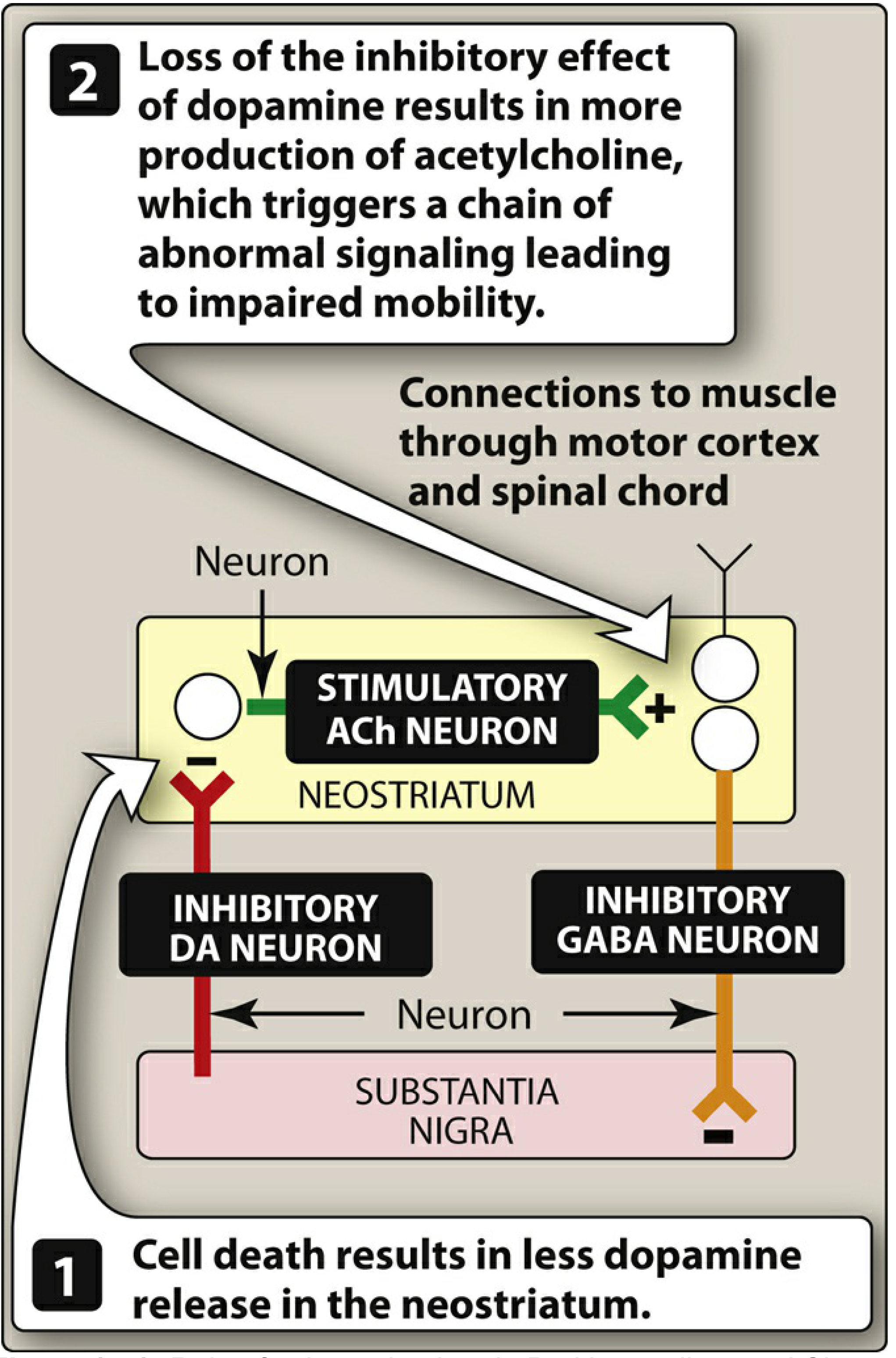
Dopaminergic neurons from the substantia nigra fire tonically, providing a sustained inhibitory influence on the ACh-producing neurons in the neostriatum. This keeps acetylcholine activity in check.
What Happens in Parkinson's Disease
- Dopaminergic neurons in the substantia nigra degenerate — this is the hallmark pathology of PD.
- With fewer dopamine neurons, the inhibitory influence on cholinergic (ACh) neurons is lost.
- Without dopamine's "brake," cholinergic neurons become relatively overactive — they fire more than normal.
- This relative excess of ACh triggers a chain of abnormal signaling in the basal ganglia → leading to impaired motor control (rigidity, tremor, bradykinesia).
"Destruction of cells in the substantia nigra results in degeneration of nerve terminals that secrete dopamine in the neostriatum. Thus, the normal inhibitory influence of dopamine on cholinergic neurons is significantly diminished, resulting in overproduction, or a relative overactivity, of acetylcholine by the stimulatory neurons." — Lippincott Illustrated Reviews: Pharmacology
Key Concept: Relative, Not Absolute Excess
ACh doesn't actually increase in absolute terms — rather, it becomes relatively overactive because dopamine is no longer there to oppose it. The striatal ACh interneurons (large aspiny neurons) preferentially excite the indirect pathway of the basal ganglia, which ultimately causes net inhibition of the thalamus and reduced movement.
Therapeutic Implication
This imbalance is why two therapeutic strategies exist in PD:
- Restore dopamine — levodopa/carbidopa, dopamine agonists
- Block ACh — anticholinergic drugs (e.g., benztropine, trihexyphenidyl) reduce the relative excess of ACh and can help particularly with tremor
— Lippincott Illustrated Reviews: Pharmacology, p. 512–514 | Neuroanatomy through Clinical Cases, 3rd Ed., p. 778
This is a shared conversation. Sign in to Orris to start your own chat.