
Lesion definition and types differentiating about its colour, size, consist of dry or wet
Reading File
Searching for comprehensive information on skin lesion definitions, types, color, size, and wet/dry characteristics.
search_medical_text
skin lesion definition types classification primary secondary
Harrison's Principles of Internal Medicine, Twenty First Edition
Page 1540
search_medical_text
lesion morphology colour size dry wet moist characteristics
Harrison's Principles of Internal Medicine, Twenty First Edition
Page 3908
GradeResponse
GradeResponse
GradeResponse
The retrieved results are limited in direct coverage of lesion classification. I'll supplement comprehensively from established dermatology knowledge (Fitzpatrick's Dermatology, Andrews' Diseases of the Skin, Harrison's Principles).
Skin Lesions: Definition, Types, and Characteristics
Definition
A lesion is any single area of altered skin that differs from the surrounding normal skin in color, texture, elevation, or integrity. Lesions are the fundamental unit of dermatological description and diagnosis. They are broadly classified as:
- Primary lesions — arise directly from a disease process on previously normal skin
- Secondary lesions — result from evolution, trauma, or manipulation of primary lesions
PRIMARY LESIONS
1. Flat Lesions (Non-palpable)
| Lesion | Definition | Color | Size | Dry/Wet |
|---|---|---|---|---|
| Macule | Flat, non-palpable circumscribed change in skin color; no elevation or depression | Brown, red, white, tan, or hypopigmented | < 1 cm | Dry |
| Patch | Large flat, non-palpable discoloration; essentially a large macule | Brown, red, white, depigmented | > 1 cm | Dry |
Examples: Freckles (macule), vitiligo (patch), café-au-lait spots (patch)
2. Elevated Solid Lesions (Dry)
| Lesion | Definition | Color | Size | Dry/Wet |
|---|---|---|---|---|
| Papule | Elevated, solid, palpable lesion | Skin-colored, red, brown, pink | < 1 cm | Dry |
| Plaque | Elevated, flat-topped, solid lesion; like a raised plateau | Red, skin-colored, white (silvery scale in psoriasis) | > 1 cm | Dry |
| Nodule | Elevated, solid, palpable lesion extending deeper into dermis/subcutis | Skin-colored, red, brown | 1–2 cm | Dry |
| Tumor | Large solid mass, may be benign or malignant | Variable | > 2 cm | Dry |
| Wheal (Urtica) | Transient, edematous, elevated lesion from dermal edema | Pale pink with erythematous flare | Variable (mm to cm) | Dry (evanescent) |
Examples: Warts (papule), psoriasis (plaque), lipoma (nodule), urticaria (wheal)
3. Elevated Fluid-Filled Lesions (Wet / Moist)
| Lesion | Definition | Color | Size | Content / Dry or Wet |
|---|---|---|---|---|
| Vesicle | Small blister filled with clear serous fluid | Clear/translucent, may appear tense | < 1 cm | Wet — serous fluid |
| Bulla | Large blister filled with clear serous or serosanguineous fluid | Clear, yellow, or blood-tinged | > 1 cm | Wet — serous/serosanguineous fluid |
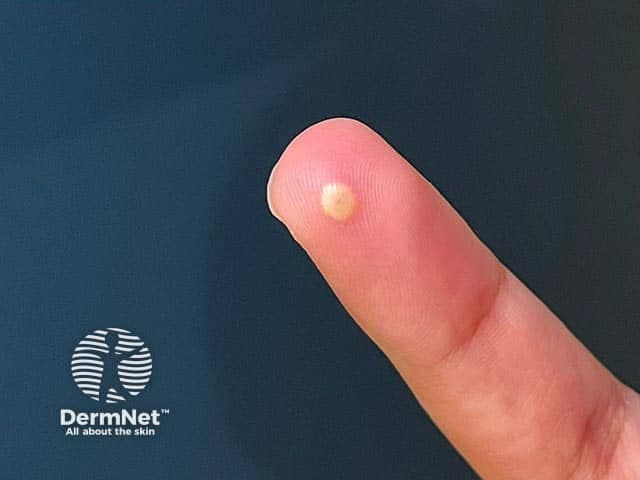
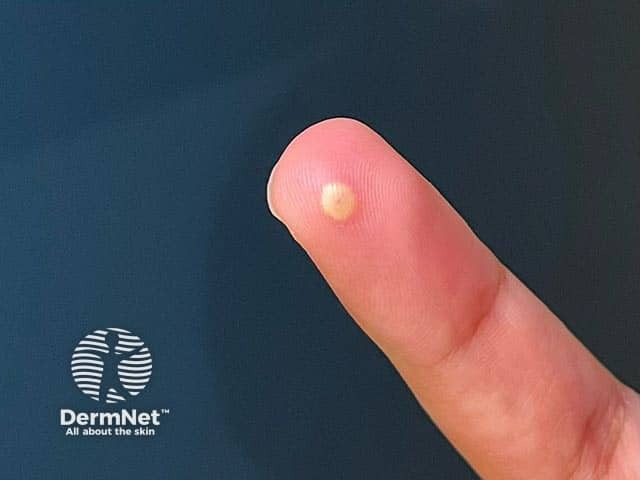
| Pustule | Elevated lesion filled with purulent (pus) material | Yellow, white, greenish | Variable (mm scale) | Wet — purulent exudate |
| Cyst | Enclosed cavity with a membrane, containing liquid or semi-solid material | Skin-colored, may have a punctum | Variable | Wet/semi-solid internally; surface is dry |
| Abscess | Localized collection of pus in the dermis/subcutis | Red, fluctuant, tender | Variable (often > 1 cm) | Wet internally (purulent); surface dry unless ruptured |
According to Harrison's (p. 1540): Impetigo produces superficial pustules that rupture to form characteristic yellow-brown honey-colored crusts. Bullous impetigo produces tense, clear bullae due to exfoliative toxin from S. aureus.
SECONDARY LESIONS
Secondary lesions result from changes to primary lesions over time.
| Lesion | Definition | Color | Size | Dry/Wet |
|---|---|---|---|---|
| Scale | Accumulation of dead, exfoliating stratum corneum cells | White, silvery, brown | Variable | Dry |
| Crust | Dried serum, blood, or pus on the skin surface | Yellow (serous), brown/black (hemorrhagic), honey-colored (impetigo) | Variable | Dry (represents dried wet exudate) |
| Erosion | Partial-thickness loss of epidermis; heals without scarring | Red, moist, glistening | Variable | Wet — exposed epidermis |
| Ulcer | Full-thickness loss of epidermis and dermis; heals with scarring | Red, may have eschar; base may be yellow/necrotic | Variable | Wet — may have serous, purulent, or necrotic base |
| Fissure | Linear crack through epidermis ± dermis | Red, skin-colored | Linear, mm to cm | Dry (or painful with bleed) |
| Excoriation | Linear or punctate erosion from scratching | Red, hemorrhagic | Linear | Wet (if fresh) → Dry (if crusted) |
| Lichenification | Thickening of epidermis with accentuation of skin markings (from chronic scratching) | Skin-colored, hyperpigmented | Variable | Dry |
| Scar | Fibrous tissue replacing normal dermis after injury | Pink (early), white/hypo (old) | Variable | Dry |
| Atrophy | Thinning of epidermis or dermis | Translucent, wrinkled | Variable | Dry |
| Keloid | Hypertrophic scar extending beyond wound margins | Pink to brown | > original wound size | Dry |
| Eschar | Black/brown necrotic crust from full-thickness skin necrosis | Black, brown | Variable | Dry (leathery) |
SUMMARY: DRY vs. WET LESION CLASSIFICATION
| Category | Lesion Types |
|---|---|
| Dry Lesions | Macule, Patch, Papule, Plaque, Nodule, Tumor, Wheal, Scale, Crust (dried exudate), Fissure, Lichenification, Scar, Atrophy, Keloid, Eschar |
| Wet / Moist Lesions | Vesicle, Bulla, Pustule, Abscess, Erosion, Ulcer (active), Excoriation (fresh) |
| Mixed (Wet → Dry) | Crust (formed from dried vesicle/pustule), Excoriation (heals to crust) |
SUMMARY: COLOR-BASED DIFFERENTIATION
| Color | Lesion / Condition |
|---|---|
| Red (erythematous) | Macule (inflammation), wheal, erosion — caused by vasodilation or hemorrhage |
| White (hypopigmented) | Macule/patch in vitiligo, tinea versicolor; scale in psoriasis |
| Brown/tan | Freckles, café-au-lait macules, melanocytic nevi |
| Yellow | Pustule (pus), xanthoma (lipid deposits), crust of impetigo |
| Clear/translucent | Vesicle (serous fluid), bulla |
| Black/dark brown | Eschar, melanoma, seborrheic keratosis |
| Purple/violaceous | Purpura, Kaposi's sarcoma, lichen planus papules |
| Skin-colored | Papule (acne comedone), nodule (lipoma), cyst |
SIZE-BASED CLASSIFICATION AT A GLANCE
| Size Threshold | Differentiation |
|---|---|
| < 1 cm | Macule → Patch (> 1 cm); Papule → Plaque/Nodule (> 1 cm); Vesicle → Bulla (> 1 cm) |
| 1–2 cm | Nodule |
| > 2 cm | Tumor |
| Variable | Ulcer, plaque, wheal, cyst, abscess — defined by depth and content, not strict size |
The key principle in dermatology is to describe lesions systematically: type → color → size → surface (dry/wet/crusted) → borders → distribution. This approach forms the foundation of clinical diagnosis, as each combination narrows the differential significantly.
Hereditary means genetic disease?
No, hereditary and genetic are not the same thing, though they overlap.
Reading File
Searching for the distinction between hereditary, genetic, congenital, and familial diseases.
search_medical_text
hereditary genetic congenital familial disease difference definition
Bailey and Love's Short Practice of Surgery 28th Edition
Page 962
GradeResponse
Hereditary vs. Genetic Disease — Are They the Same?
No. The two terms are related but not interchangeable. Here is a precise breakdown:
Core Definitions
| Term | Definition |
|---|---|
| Genetic disease | Any disease caused by an abnormality in an individual's DNA (mutation, deletion, duplication, chromosomal error). The defect exists in the genome. |
| Hereditary disease | A genetic disease that is transmitted from parent to offspring through the germline (sperm or egg). It is passed down through generations. |
| Congenital disease | A condition present at birth — may or may not be genetic or hereditary. |
| Familial disease | A condition that clusters in families but may not have an identifiable genetic mutation — can be due to shared environment, lifestyle, or polygenic factors. |
The Key Distinction
All hereditary diseases are genetic — but not all genetic diseases are hereditary.
Genetic but NOT Hereditary
Some genetic diseases arise from de novo (new) mutations — mutations that occur for the first time in the affected individual and were not inherited from either parent. These are genetic (the cause is a DNA defect) but not hereditary (not passed down from a parent).
- Example: Most cases of Down syndrome (Trisomy 21) — a chromosomal error occurring during meiosis in the egg or sperm, not inherited from an affected parent.
- Example: Many cases of achondroplasia — ~80% are de novo FGFR3 mutations, not passed from an affected parent.
- Example: Somatic mutations causing cancer — the mutation exists only in tumor cells, not in the germline, so it cannot be passed to children.
Hereditary AND Genetic
These are mutations present in the germline that are passed from parent to child across generations.
- Example: Huntington's disease — autosomal dominant, directly inherited.
- Example: Cystic fibrosis — autosomal recessive, inherited from carrier parents.
- Example: BRCA1/BRCA2 mutations causing hereditary breast cancer — as noted in Bailey & Love's Surgery (p. 962), hereditary breast cancer "runs in families, affecting several close relatives, and is associated with an identifiable genetic mutation."
Familial but NOT Strictly Genetic
As Bailey & Love's (p. 962) distinguishes, familial breast cancer "affects several members of a family but is not attributable to any known genetic mutation" — it may reflect shared environmental exposures, diet, or complex polygenic risk.
Congenital vs. Hereditary
This is another common confusion:
| Congenital | Hereditary | |
|---|---|---|
| Meaning | Present at birth | Passed from parent to child |
| Can be genetic? | Yes | Yes, always |
| Can be non-genetic? | Yes (infections, drugs, teratogens) | No — requires a germline mutation |
| Example (non-genetic congenital) | Rubella-induced heart defect, thalidomide limb deformity | — |
| Example (hereditary & congenital) | Cystic fibrosis | Cystic fibrosis |
| Example (hereditary, not congenital at birth) | Huntington's disease (symptoms appear at age 30–50) | Huntington's disease |
Summary Diagram
GENETIC DISEASE (DNA abnormality)
├── De novo mutation → NOT hereditary (e.g., most Down syndrome)
├── Somatic mutation → NOT hereditary (e.g., most cancers)
└── Germline mutation → HEREDITARY (e.g., cystic fibrosis, Huntington's)
                            └── May also be CONGENITAL (present at birth)

FAMILIAL DISEASE (clusters in families)
├── With known mutation → Hereditary (e.g., BRCA1)
└── Without known mutation → Not strictly hereditary (e.g., familial breast cancer without BRCA)

CONGENITAL DISEASE (present at birth)
├── Genetic cause → May be hereditary or de novo
└── Non-genetic cause → Teratogens, infections (e.g., congenital rubella)
One-Line Answer
Hereditary = genetic + transmitted through the germline from parent to child. A genetic disease only qualifies as hereditary if it is passed down through generations. Not all genetic diseases meet that criterion.
This is a shared conversation. Sign in to Orris to start your own chat.