
find out Total RBC Count of your's own blood Find out abnormal constituents of urine sample 2nd
Checking Date & Time
Reading File
The question appears to be about a practical/lab exercise — specifically:
- Finding the Total RBC Count (likely a haemocytometer/Neubauer chamber practical)
- Finding abnormal constituents of urine sample 2 (routine urine examination practical)
Let me search the medical library for both topics simultaneously.
Finding Sources
Finding Sources
Good results found. Let me read the relevant sections from the Tietz Textbook (for RBC count normal values and methodology) and Brenner & Rector's The Kidney / Campbell-Walsh Urology (for urine examination abnormal constituents).
Reading File
Reading File
Good start. Let me now read more of the urine abnormal constituents section and get the normal RBC count values from Goldman-Cecil or Tietz.
Reading File
Reading File
I now have the normal RBC count values and good urine content. Let me also read more of the urine constituents section (proteins, glucose, ketones, etc.) and look for the haemocytometer/Neubauer chamber counting method.
Reading File
Finding Sources
Excellent! Now let me read the hemocytometer manual counting method from Henry's Clinical Diagnosis and the abnormal urine sediment section.
Reading File
Reading File
Let me now read the hemocytometer manual RBC counting procedure and the urine microscopy/sediment abnormal constituents section from Henry's.
Reading File
Finding Sources
Now let me get the specific RBC manual counting procedure and the full list of abnormal urine constituents from Henry's.
Finding Sources
Reading File
I now have comprehensive information to answer both parts of the question. Let me also quickly get the manual RBC counting procedure from Henry's block 12 (the Neubauer chamber section).
Reading File
I now have all the information needed. Let me also fetch the Neubauer diagram image to include in the answer.
Loading Image
I have all the information needed. Here is the comprehensive answer to both parts:
Part 1: Total RBC Count (Manual Method — Haemocytometer/Neubauer Chamber)
Note: As an AI, I don't have blood of my own. This question is a standard practical exercise in haematology. The answer below covers the complete methodology and normal values.
Principle
RBCs are counted manually using an improved Neubauer haemocytometer — a thick glass slide with a ruled platform of known area (3 mm × 3 mm grid) and precisely controlled chamber depth of 0.1 mm under the coverslip.
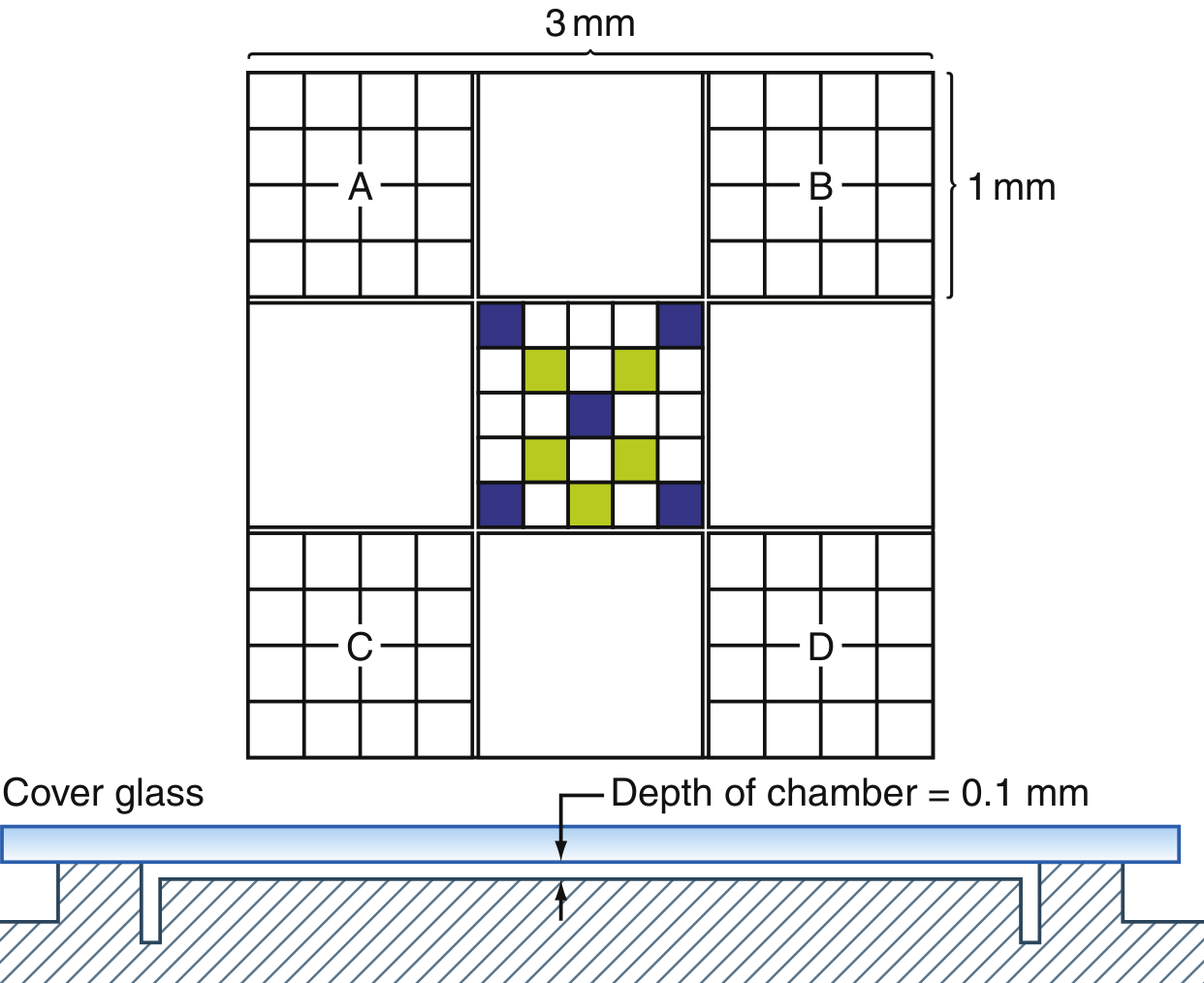
Procedure
| Step | Details |
|---|---|
| Dilution | Blood is diluted 1:200 (sometimes 1:100 or 1:500) in Hayem's fluid (or isotonic saline). This lyses WBCs and preserves RBCs |
| Loading | The diluted sample is loaded into the counting chamber using a Pasteur pipette |
| Settling | Cells are allowed to settle for 2–3 minutes |
| Counting area | 5 small squares in the central large square are counted (the 4 corner + 1 middle small squares of the central 1 mm²) under high-power objective (40×) |
| Cell distribution | Verify uniform distribution under low power (10×) first |
Calculation Formula
$$\text{RBC Count} = \frac{N \times D \times 10}{A}$$
Where:
- N = Total cells counted in 5 small squares
- D = Dilution factor (200)
- 10 = Depth correction factor (chamber depth = 0.1 mm, so multiply by 1/0.1 = 10)
- A = Area counted (5 small squares = 5 × 1/25 mm² = 0.2 mm²)
Simplified: RBC/mm³ = Cells counted in 5 small squares × 10,000 (for 1:200 dilution)
Normal Reference Values
| Parameter | Female | Male |
|---|---|---|
| RBC Count | 4.0–5.4 × 10⁶/μL (4.0–5.4 × 10¹²/L) | 4.5–6.0 × 10⁶/μL (4.5–6.0 × 10¹²/L) |
| Hemoglobin | 12–16 g/dL | 13.5–17.5 g/dL |
| Hematocrit | 36–48% | 40–52% |
| MCV | 81–99 fL | 81–99 fL |
— Goldman-Cecil Medicine, Table 144-2; Henry's Clinical Diagnosis, p. 629
Sources of Error
- Incomplete mixing before dilution
- Uneven cell distribution in chamber
- Touching ruled surfaces (causes scratching)
- Cold agglutinins (cause spuriously decreased RBC count due to clumping)
- High WBC count → may spuriously increase RBC count in anemic patients
Part 2: Abnormal Constituents of Urine (Sample 2 — Routine Urine Examination)
Routine urine examination (urinalysis) screens for both chemical and microscopic abnormal constituents. Normal urine contains water, urea, creatinine, uric acid, electrolytes, and trace proteins only.
A. Physical/Chemical Abnormalities (Dipstick / Reagent Strip)
| Constituent | Normal | Abnormal Finding | Clinical Significance |
|---|---|---|---|
| Glucose (Glycosuria) | Absent | Present | Diabetes mellitus, renal glycosuria, Fanconi syndrome |
| Protein (Proteinuria) | Trace or absent (<150 mg/day) | >150 mg/day (dipstick ≥1+) | Glomerulonephritis, nephrotic syndrome, UTI, myeloma (Bence Jones) |
| Ketones (Ketonuria) | Absent | Present | Diabetic ketoacidosis, starvation, vomiting, alcoholism |
| Bilirubin (Bilirubinuria) | Absent | Present (conjugated) | Obstructive jaundice, hepatocellular disease |
| Urobilinogen | Trace (up to 1 EU/dL) | Increased | Haemolysis, liver disease; Absent in complete biliary obstruction |
| Blood/Haemoglobin | Absent | Present | Haematuria (RBCs), haemoglobinuria (free Hb), myoglobinuria |
| Nitrites | Absent | Present | Gram-negative bacterial UTI |
| Leukocyte esterase | Absent | Present | Pyuria, UTI |
| pH | 4.5–7.8 | <4.5 or >7.8 | Acidosis, alkalosis, UTI (alkaline) |
| Specific gravity | 1.003–1.030 | Fixed at 1.010 (isosthenuria) | CKD; very low → diabetes insipidus |
B. Microscopic Abnormalities (Urine Sediment)
Cells
| Cell Type | Normal | Abnormal (>normal) | Significance |
|---|---|---|---|
| RBCs (Erythrocytes) | 0–2/hpf | >3/hpf | Glomerulonephritis, calculus, tumour, UTI, renal vein thrombosis, trauma |
| WBCs (Leucocytes) | 0–4/hpf | >5/hpf (pyuria) | UTI, pyelonephritis, interstitial nephritis |
| Epithelial cells | Few (squamous) | Renal tubular cells | ATN, nephrotic syndrome, heavy metal toxicity |
| Dysmorphic RBCs | Absent | Present (>20%) | Glomerular bleeding (glomerulonephritis) |
Casts
| Cast | Significance |
|---|---|
| Hyaline casts | Normal in small numbers; increased in dehydration, fever |
| RBC casts | Pathognomonic of glomerulonephritis or vasculitis |
| WBC casts | Pyelonephritis, interstitial nephritis |
| Granular casts | ATN, glomerulonephritis (non-specific) |
| Waxy/Broad casts | Advanced CKD (renal failure) |
| Fatty casts | Nephrotic syndrome |
| Epithelial cell casts | ATN, heavy metal toxicity |
Crystals (Abnormal)
| Crystal | Significance |
|---|---|
| Calcium oxalate | Hyperoxaluria, ethylene glycol poisoning |
| Uric acid | Gout, high cell turnover |
| Cystine | Cystinuria (rare, genetic) |
| Triple phosphate (struvite) | UTI with urease-positive organisms |
| Tyrosine/leucine | Severe liver disease |
Other Abnormal Constituents
- Bacteria — UTI (significant if >10⁵ organisms/mL)
- Yeast (Candida) — Candidiasis, diabetes mellitus
- Parasites — Trichomonas vaginalis, Schistosoma haematobium ova
- Fat droplets / lipiduria — Nephrotic syndrome
Colour Abnormalities as Clues
| Urine Colour | Cause |
|---|---|
| Dark yellow/amber | Concentrated urine, dehydration, urobilinogen |
| Red/pink | Haematuria, haemoglobinuria, myoglobinuria, drugs (rifampicin), beets |
| Orange | Bilirubin, bile salts, pyridium |
| Brown/black | Melanin (melanoma), homogentisic acid (alkaptonuria), severe haemolysis |
| Green/blue | Pseudomonas UTI, biliverdin, methylene blue |
| Cloudy | Pyuria, bacteriuria, phosphaturia |
| Frothy | Proteinuria (nephrotic syndrome) |
| Fruity/sweet odour | Ketones (DKA) |
— Brenner and Rector's The Kidney; Henry's Clinical Diagnosis and Management by Laboratory Methods; Barash's Clinical Anesthesia
Summary for the Practical Report:
- RBC Count (your own sample): Record the actual count obtained from the Neubauer chamber. Compare with normal range: Male: 4.5–6.0 × 10⁶/μL | Female: 4.0–5.4 × 10⁶/μL
- Urine Sample 2 abnormal constituents: Report whichever of the above are detected on dipstick and microscopy — document presence/absence of protein, glucose, ketones, blood, nitrites, and any cells/casts/crystals seen on microscopy.
This is a shared conversation. Sign in to Orris to start your own chat.