
Heat rashes management
Reading File
Finding Sources
Finding Sources
Reading File
Reading File
Reading File
Reading File
Reading File
Reading File
Reading File
I now have sufficient information from multiple authoritative sources to compile a comprehensive answer. Let me also fetch a relevant clinical image.
Loading Image
Heat Rash (Miliaria) — Management
Overview
Miliaria results from obstruction of eccrine sweat ducts due to heat and humidity, causing sweat to escape into surrounding tissue. Three distinct types are recognized based on the depth of ductal obstruction.
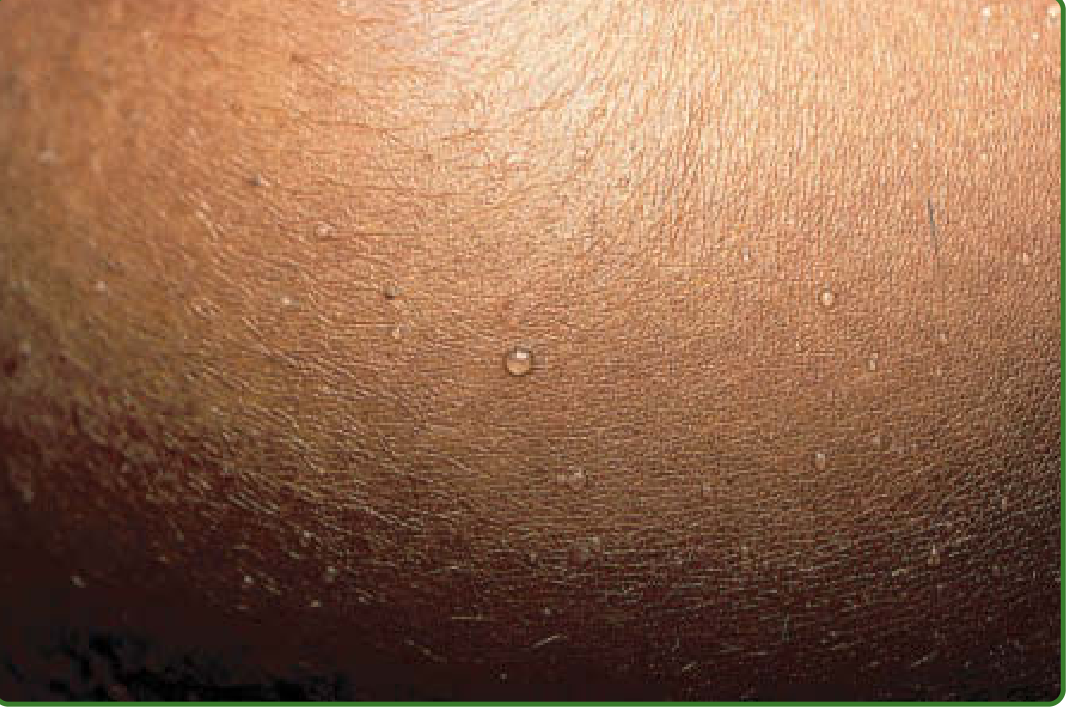
Types and Clinical Features
| Type | Obstruction Level | Lesions | Symptoms |
|---|---|---|---|
| Crystallina | Stratum corneum | Clear, fragile 1 mm vesicles | Asymptomatic; rupture easily |
| Rubra (prickly heat) | Mid-epidermis | Erythematous 1–3 mm papulovesicles; may become pustular | Pruritic, prickling/burning sensation |
| Profunda | Dermal–epidermal junction | Flesh-colored/white 1–3 mm papules | Asymptomatic; resolves within 1–2 hrs of stopping exertion |
Management by Type
Miliaria Crystallina
- No treatment required — lesions are self-limited, rupture spontaneously with minimal trauma, and carry no systemic risk. — Andrews' Diseases of the Skin, p. 34
Miliaria Rubra
The cornerstone of management is environmental control:
- Move to a cool environment — even a single night in an air-conditioned room substantially relieves symptoms. This is the most effective measure.
- Air circulation — fans to cool the skin surface.
- Remove occlusive clothing — avoid tight or non-breathable fabrics.
- Treat underlying febrile illness if present.
- Soothing baths — colloidal oatmeal or cornstarch baths used in moderation.
- Dusting powders — cornstarch or baby talcum powder for mild cases.
- Hydrophilic ointment — helps dissolve keratinous plugs and facilitates normal sweat flow.
Miliaria Profunda
- Anhydrous lanolin applied topically has produced dramatic improvement — it resolves poral occlusion and may help restore normal sweat secretion.
- Relocate to a cool environment; lesions typically subside within 1–2 hours of cessation of sweating.
— Andrews' Diseases of the Skin, p. 35; Fitzpatrick's Dermatology, p. 1496
General Principles for All Types
| Intervention | Rationale |
|---|---|
| Cool environment / air conditioning | Reduces sweating stimulus; allows duct occlusion to resolve |
| Remove occlusive dressings/clothing | Eliminates maceration of stratum corneum that causes duct blockage |
| Avoid excessive heat/humidity exposure | Primary prevention and treatment |
| Treat fever | Reduces sweating that perpetuates occlusion |
Special Populations
- Neonates: Place in a cooler environment or remove tight clothing/swaddling. Incubator-related cases resolve once temperature is adjusted. — Harriet Lane Handbook, p. 286
- Tropical climates / repeated bouts: Miliaria rubra can progress to miliaria profunda. Individuals with extensive profunda are at risk for thermoregulatory failure (tropical anhidrotic asthenia) due to widespread anhidrosis — cooling and avoidance of exertion in heat are critical.
Postmiliarial Hypohidrosis
An important complication: sweating may be depressed to half normal for up to 3 weeks after resolution, impairing heat tolerance. Affected individuals may experience irritability, vertigo, anorexia, and headache. Avoid heat stress during the recovery period.
— Andrews' Diseases of the Skin, p. 35
What to Avoid
- Topical corticosteroids are not indicated for routine heat rash.
- Avoid continued occlusion (tight clothing, adhesive dressings).
- Excessive use of powders can paradoxically worsen occlusion if overused.
Sources: Andrews' Diseases of the Skin (9780323547536) | Fitzpatrick's Dermatology Vol. 1–2 (9780071837781) | Dermatology 2-Volume Set 5e (9780702082252) | Harriet Lane Handbook 23e (9780323876988)
This is a shared conversation. Sign in to Orris to start your own chat.