
Sebaceous gland vs modified Sebaceous glands vs sweat gland
Reading File
Now let me search the library for sebaceous glands, modified sebaceous glands, and sweat glands in parallel.
Finding Sources
Finding Sources
Reading File
Finding Sources
Finding Sources
Reading File
Reading File
Reading File
Reading File
Reading File
Finding Sources
Reading File
Reading File
Now let me fetch the key diagrams and get apocrine gland details:
Reading File
Loading Image
Loading Image
Now I have everything needed for a comprehensive comparison. Let me compile the full answer.
Sebaceous Glands vs. Modified Sebaceous Glands vs. Sweat Glands
Here is a structured comparison drawn from authoritative histology and dermatology textbooks.
1. Sebaceous Glands
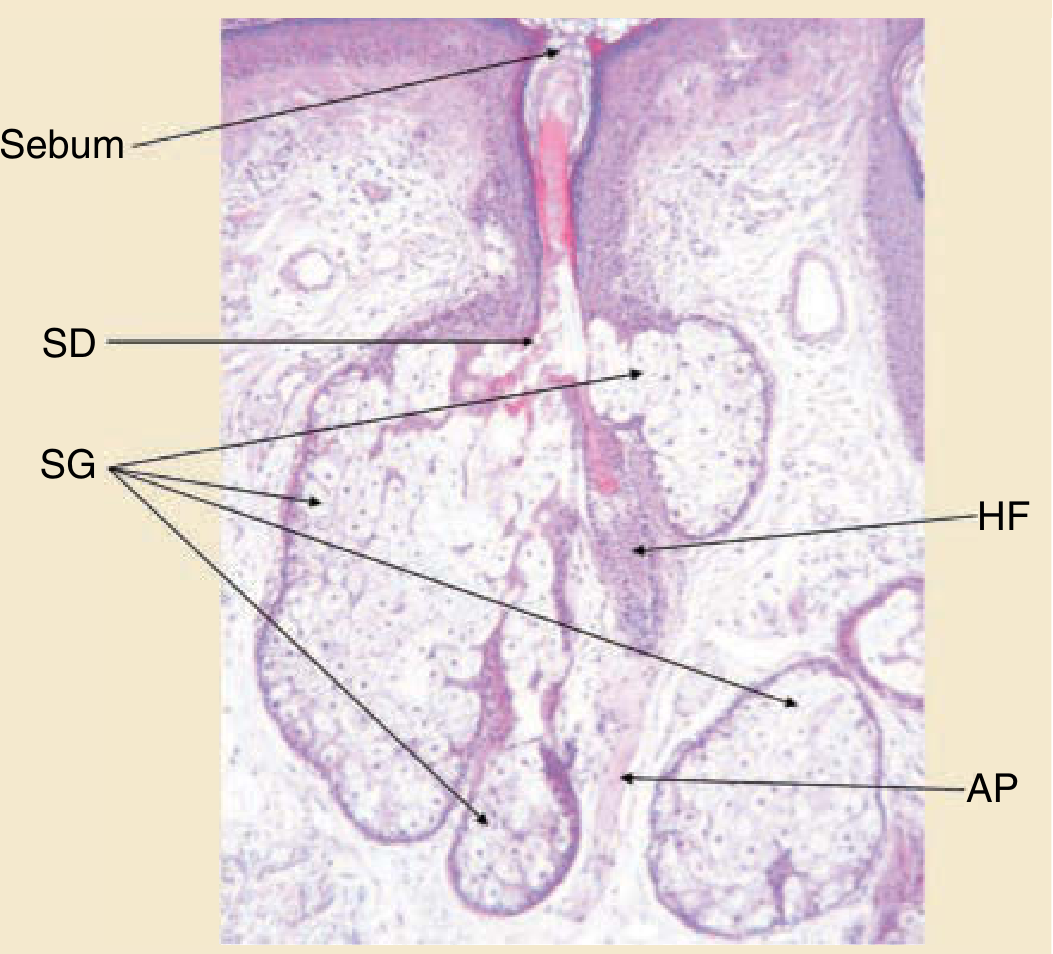
Structure
- Simple branched acinar (alveolar) glands; typically multilobular (multiacinar)
- Each lobe (acinus) is a cluster of sebocytes - cells with a washed-out, finely reticulated cytoplasm due to lipid content dissolved during tissue processing
- Peripheral basal cells (germinative layer) continuously divide; daughter cells migrate centrally and differentiate in stages (early, advanced, fully differentiated sebocyte), accumulating lipid droplets as they go
- Drain via a sebaceous duct (SD) into the pilosebaceous canal of the hair follicle, not directly onto the skin surface
- No myoepithelial cells (unlike sweat glands)
Secretion type: Holocrine
- The entire cell fills with lipid, undergoes a lysosomal DNase2-mediated form of programmed cell death (distinct from apoptosis), and disintegrates - releasing both secretory product and cell debris into the duct
- This requires constant cell replenishment from the basal layer
Secretory product: Sebum
- A complex lipid mixture: triglycerides, wax esters, squalene, cholesterol, cholesterol esters
- As sebum travels through the hair canal, bacterial lipases hydrolyze triglycerides into free fatty acids (relevant to acne pathogenesis)
- Functions: lubricates hair and skin, mild antimicrobial activity, contributes to the skin barrier
Distribution
- Found everywhere except the palms and soles (hairy skin)
- Highest density on face and scalp
- In "sebaceous follicles" (face/chest/back), the follicle is vestigial and the gland dominates - this is the primary site of acne
Regulation
-
Androgens (testosterone, DHT) are the dominant stimulatory hormones, acting on sebocyte androgen receptors
-
Sebum production begins in utero (stimulated by maternal androgens), drops after birth, rises sharply at adrenarche/puberty
-
Fitzpatrick's Dermatology, p. 101-104
-
Histology: A Text and Atlas (Junqueira/Ross), p. 1397
2. Modified Sebaceous Glands
These are sebaceous glands that have been structurally adapted for specialized locations. They retain the holocrine secretion mechanism and lipid-rich product but differ in their anatomy, duct drainage, and specific function.
| Modified Gland | Location | What makes it "modified" | Key Clinical Note |
|---|---|---|---|
| Meibomian glands (tarsal glands) | Embedded in tarsal plates of upper (~25) and lower (~20) eyelids | Unusually elongated; no associated hair follicle; duct opens directly at the lid margin | Secretion forms the oily outer layer of the tear film, preventing tear evaporation. Blockage causes chalazion (tarsal gland lipogranuloma) |
| Glands of Zeis | Associated with eyelash follicles | Small; empty into the eyelash hair follicle (not the lid margin directly) | Bacterial infection causes an external hordeolum (stye) |
| Fordyce spots (Fordyce glands) | Vermilion border of lips, oral mucosa, genital skin | Ectopic sebaceous glands; no associated hair follicle; open directly onto mucous membrane | Appear as yellowish papules; a normal anatomical variant, not pathological |
| Montgomery tubercles (areolar glands) | Areola of the breast | Large sebaceous glands with rudimentary mammary elements; open independently onto the areolar surface | Enlarge during pregnancy; lubricate the nipple-areolar complex during breastfeeding |
From Histology (Ross), p. 2439: "Glands of Zeis are small, modified sebaceous glands that are connected with and empty their secretion into the follicles of the eyelashes." From Fitzpatrick's Dermatology: "Lipids from modified sebaceous glands in the eye, called meibomian glands, help prevent dry eyes by hindering tear evaporation." From Gray's Anatomy for Students: Meibomian glands "secrete an oily substance that increases the viscosity of the tears and decreases the rate of evaporation."
3. Sweat Glands
Sweat glands are fundamentally different from sebaceous glands - they are tubular rather than acinar, and produce watery secretions rather than lipids. There are two types:
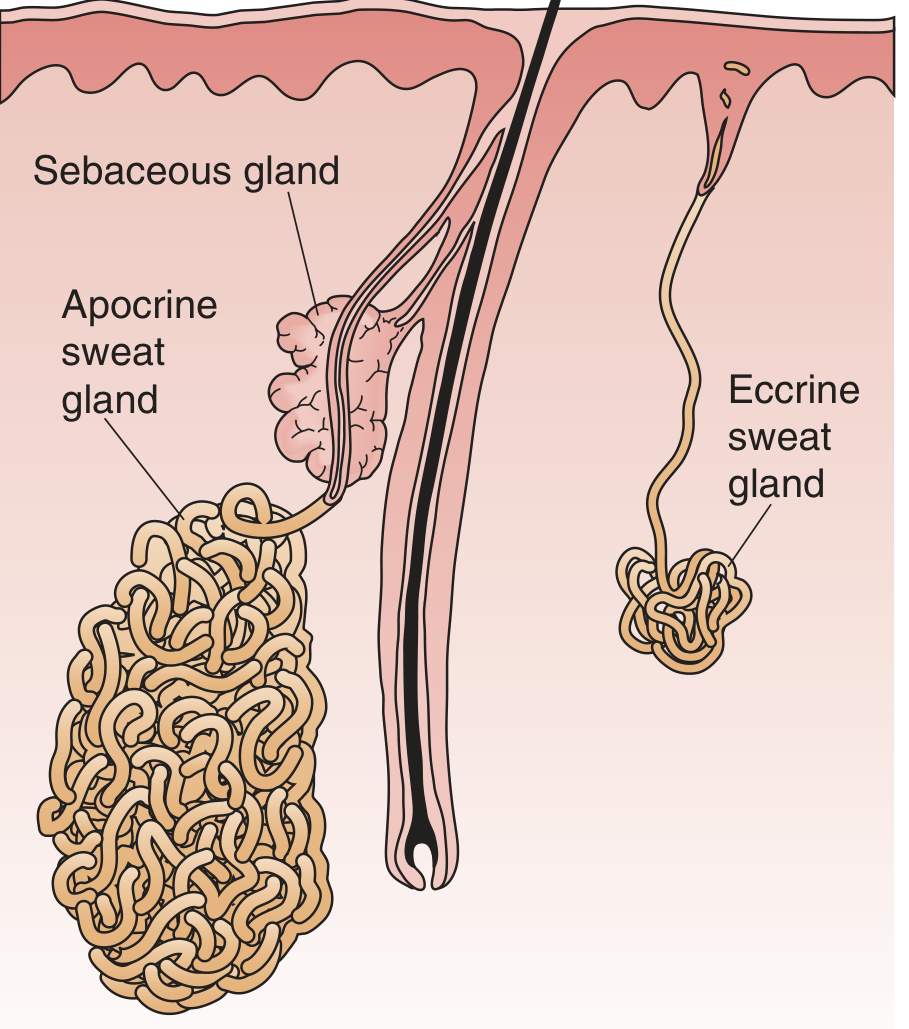
A. Eccrine (Merocrine) Sweat Glands
Structure
- Simple coiled tubular glands - the most abundant type (~3-4 million total)
- Independent of hair follicles; arise as a downgrowth from fetal epidermis
- Two segments:
- Secretory coil: located deep in the dermis/upper hypodermis; contains two cell types - dark cells (closer to lumen, secretory granules) and clear cells (closer to base, rich in glycogen and mitochondria, contact intercellular canaliculi); surrounded by myoepithelial cells
- Duct: less coiled; passes through dermis and epidermis; lined by two layers of small cuboidal cells (no myoepithelial cells); opens as a sweat pore directly onto the skin surface
Secretion type: Merocrine (exocytosis) - the cell is not destroyed
Mechanism
- Innervated by postganglionic sympathetic cholinergic fibers (acetylcholine → muscarinic receptors → PLC → PKC + ↑Ca²⁺ → Cl⁻ secretion)
- Primary secretion is nearly isotonic with plasma (NaCl + urea + lactate)
- Duct cells reabsorb Na⁺ via ENaC and Cl⁻ via CFTR - final sweat is hypotonic
- CFTR deficiency in cystic fibrosis → impaired duct reabsorption → NaCl-rich sweat (the basis of the sweat chloride test)
- Hydrostatic pressure in the gland can exceed 500 mm Hg
Distribution: Whole body except vermilion of lips, nail beds, labia minora, glans penis/clitoris. Highest density: palms, soles, axillae, forehead
Function: Thermoregulation (evaporative cooling); sweat on palms/soles increases grip; minor excretory role (urea, uric acid, ammonia)
B. Apocrine Sweat Glands
Structure
- Coiled tubular glands (sometimes branched) with a characteristically very wide lumen - the most easily recognized histological feature
- Develop from the same hair follicle downgrowths as eccrine glands, but retain the follicular connection - their duct empties into the hair follicle above the sebaceous duct opening
- Secretory portion: simple epithelium with only one cell type (cuboidal-to-columnar, eosinophilic cytoplasm); cells show apical bleb-like protrusions (the old naming of "apocrine" was based on the mistaken belief that this apical portion pinched off - TEM confirms the secretion is actually merocrine/exocytotic)
- Also have myoepithelial cells (aid in expulsion)
- Duct lined by stratified cuboidal epithelium
- Luminal storage of secretory product (unlike eccrine glands)
Distribution: Axilla, areola/nipple, perianal skin, external genitalia
- Modified apocrine equivalents: ceruminous glands (external auditory canal), glands of Moll (eyelashes)
Function: Not thermoregulatory; secretion is odorless initially but becomes odoriferous after bacterial breakdown on the skin surface. Likely vestigial pheromone glands in humans. Become active at puberty (androgen-dependent).
Side-by-Side Summary Table
| Feature | Sebaceous Gland | Modified Sebaceous Gland | Eccrine Sweat Gland | Apocrine Sweat Gland |
|---|---|---|---|---|
| Gland type | Simple branched acinar | Acinar (modified) | Simple coiled tubular | Simple coiled tubular |
| Secretion type | Holocrine | Holocrine | Merocrine (exocytosis) | Merocrine (exocytosis)* |
| Product | Sebum (lipids) | Lipid-based (site-specific) | Hypotonic watery sweat | Viscous, protein-rich fluid |
| Duct opens into | Hair follicle (pilosebaceous canal) | Hair follicle or directly onto surface | Directly on skin (sweat pore) | Hair follicle (above sebaceous duct) |
| Hair follicle association | Yes (always) | Variable | No | Yes |
| Myoepithelial cells | Absent | Absent | Present | Present |
| Cell types in secretory unit | Sebocytes (multiple stages) | Sebocytes | Dark cells + clear cells | Single cell type |
| Lumen size | Small-moderate | Varies | Narrow | Wide (key histological feature) |
| Distribution | Hairy skin (face/scalp dominant) | Specific sites (eyelid, lips, areola) | Whole body (except lips, nail beds, parts of genitalia) | Axilla, areola, perianal, genitalia |
| Innervation | Hormonal (androgens) | Hormonal | Sympathetic cholinergic | Sympathetic adrenergic |
| Primary function | Lubricate skin/hair, barrier | Site-specific (e.g., tear film) | Thermoregulation | Body odor (vestigial pheromone?) |
| Examples | Standard pilosebaceous glands | Meibomian, Zeis, Fordyce, Montgomery | Most body sweat glands | Axillary, ceruminous, glands of Moll |
| Clinical relevance | Acne, sebaceous cysts, rosacea | Chalazion, stye, dry eye | Hyperhidrosis, CF (sweat test) | Hidradenitis suppurativa, Fox-Fordyce |
*Apocrine secretion is technically merocrine despite the name - the "apocrine" name is historical and based on a misinterpretation of the apical blebs.
Sources: Histology: A Text and Atlas with Correlated Cell and Molecular Biology (Ross/Pawlina), pp. 1362-1372, 1397; Fitzpatrick's Dermatology, pp. 101-104; Medical Physiology (Boron & Boulpaep), pp. 1778-1779; Gray's Anatomy for Students; Junqueira's Basic Histology.
Why breast modified sweat gland
The mammary gland (breast) is classified as a modified sweat gland because embryologically and structurally it shares the same developmental origin as sweat glands - both arise from the ectoderm. Let me get the full textbook explanation.
Searching sources...
Finding Sources
Finding Sources
Reading File
Reading File
Reading File
Loading Image
Loading Image
Here is the full explanation with textbook backing:
Why the Mammary Gland is a Modified Sweat Gland
The answer lies in three things that link them: shared embryological origin, structural parallels, and secretory mechanism.
1. Embryological Origin - the Core Reason
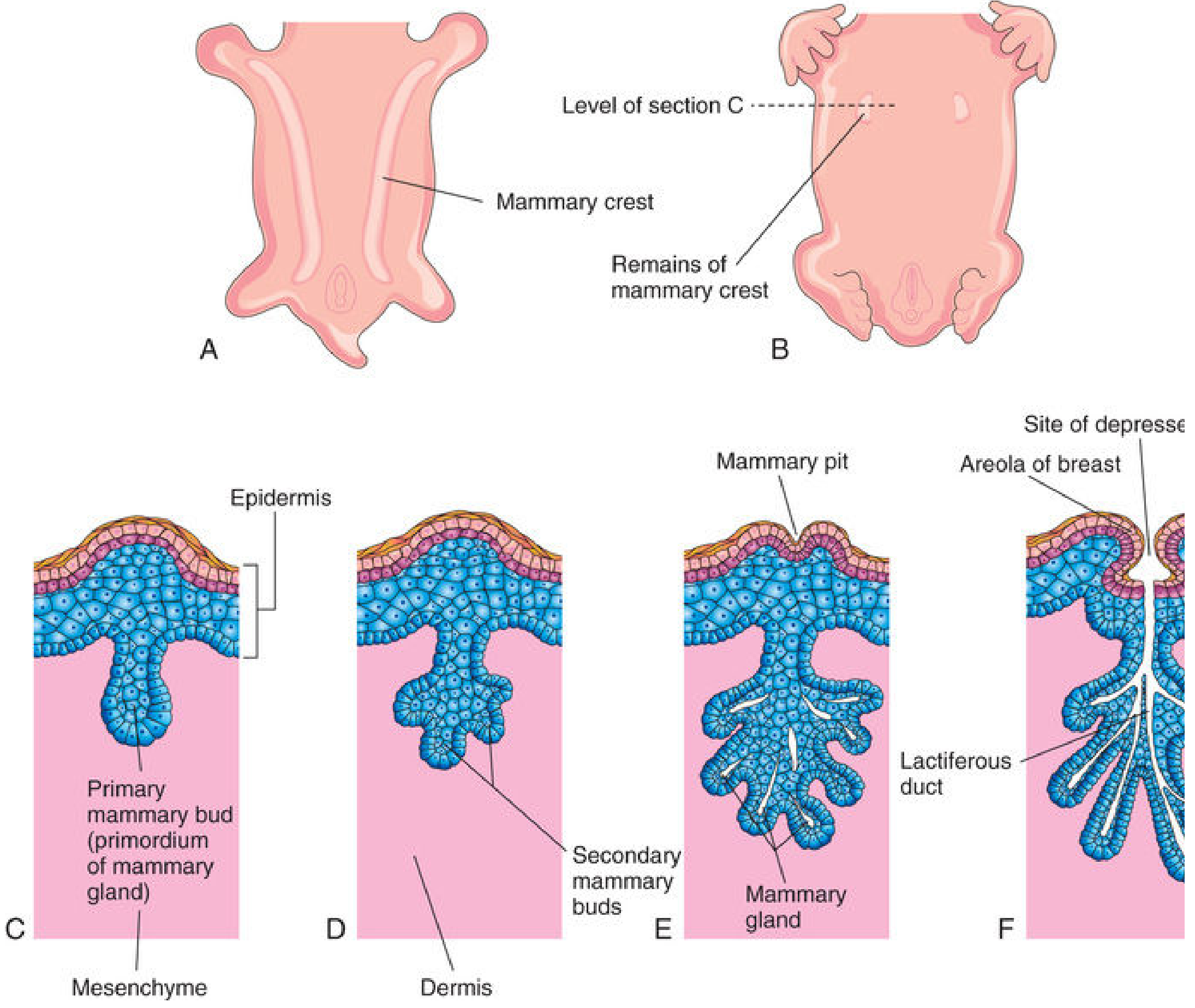
Both mammary glands and sweat glands originate from the surface ectoderm (epidermis). Their shared developmental pathway:
- Week 4: Bilateral thickened ectodermal bands called mammary crests (milk lines) form on the ventral surface, running from axilla to groin - exactly the same ectodermal territory where sweat glands also arise
- Week 5: Most of the crest involutes; only the pectoral portion persists as a primary mammary bud - a solid downgrowth of epidermal cells into the underlying mesenchyme (this is mechanistically identical to how sweat glands form)
- Weeks 10-16: The primary bud gives rise to secondary mammary buds, which canalize under the influence of placental sex hormones, forming 15-19 lactiferous ducts - the entire ductal system grows from this inward epidermal invagination
"Mammary glands are modified and highly specialized types of sweat glands... The first evidence of mammary development appears in the fourth week when mammary crests develop along each side of the ventral surface." - The Developing Human (Moore), p. 1185
"The tubuloalveolar mammary glands, derived from modified sweat glands in the epidermis, lie in the subcutaneous tissue." - Histology: A Text and Atlas (Ross), p. 2302
2. Structural Parallels
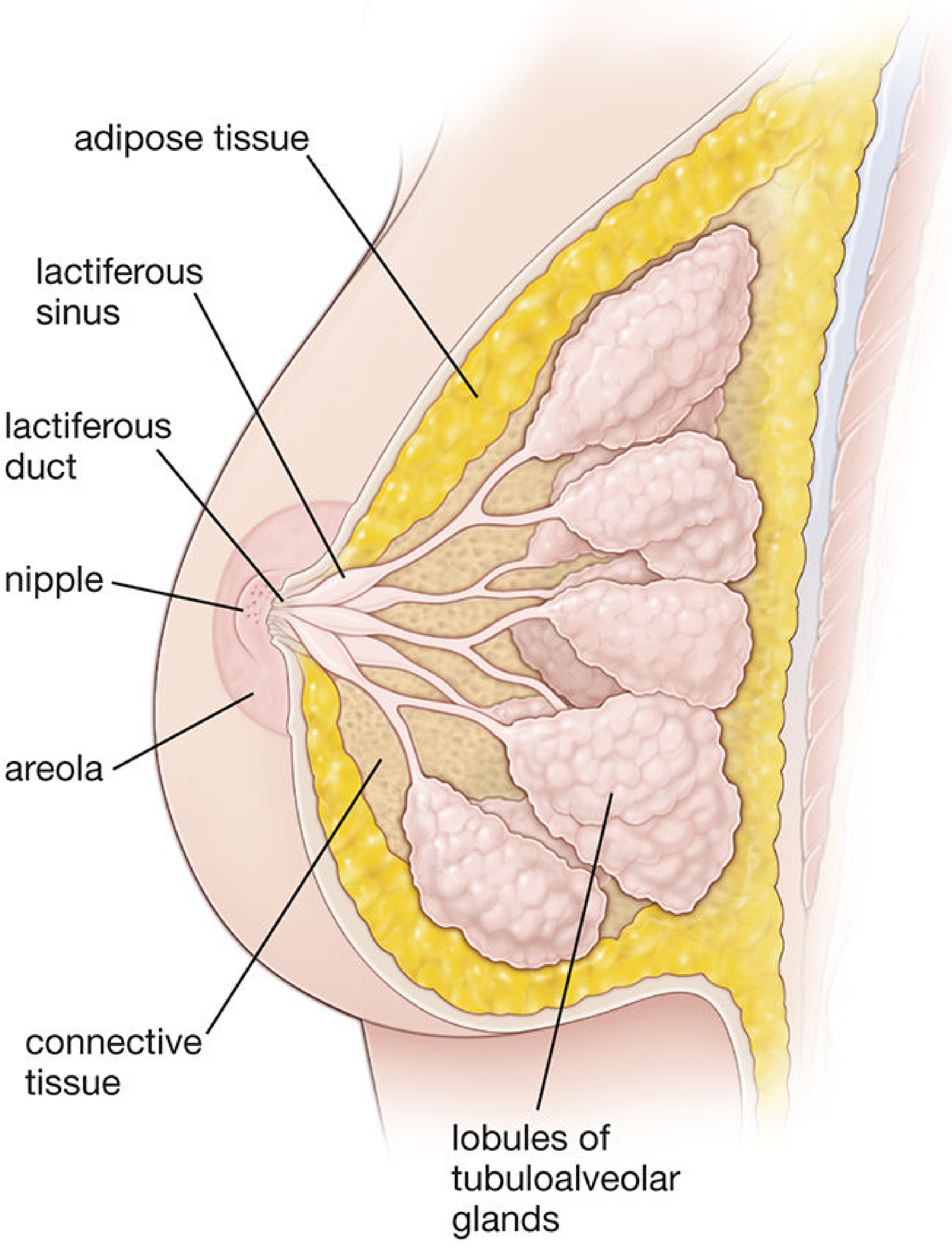
| Feature | Apocrine Sweat Gland | Mammary Gland |
|---|---|---|
| Embryological origin | Ectodermal downgrowth | Ectodermal downgrowth (mammary crest) |
| Gland type | Coiled tubular | Compound tubuloalveolar (much more elaborate) |
| Duct opens | Into hair follicle / skin surface | Onto nipple via lactiferous ducts (15-20 per breast) |
| Myoepithelial cells | Present | Present (essential for milk ejection) |
| Secretory cells | Simple epithelium | Simple cuboidal/columnar epithelium |
| Stromal component | Dermis | Cooper ligaments + adipose tissue + fibrous stroma |
The mammary gland is essentially a massively elaborated version of an apocrine sweat gland - same basic plan (ectodermal tubular epithelium with myoepithelial cells), but branched enormously into 15-20 lobes, each subdivided into terminal duct lobular units (TDLUs).
"In humans, one set of glands resembling highly modified apocrine sweat glands persists on each side of the chest. Each mammary gland consists of 15-20 lobes of the compound tubuloacinar type." - Junqueira's Basic Histology, p. 1155
3. Secretory Mechanism - Still Apocrine
The mammary gland shares its secretory type with apocrine sweat glands:
- Both classified as apocrine-type glands - secretory product is discharged from apical blebs (historically; TEM confirms merocrine/exocytotic mechanism for the protein component)
- Milk secretion involves:
- Merocrine/exocytosis: for protein (casein, whey) and lactose components
- Apocrine mechanism: for lipid (fat droplets bud off with a membrane coating from the apical cell surface) - this is the one genuinely apocrine component in lactation
- Myoepithelial cells contract to eject milk (just as they do in apocrine sweat glands), stimulated by oxytocin
4. Why "Modified" and Not Just a Sweat Gland?
The mammary gland is called "modified" because it has been heavily specialized beyond a basic sweat gland:
| What changed | How |
|---|---|
| Scale | From a single small coil to 15-20 compound lobes |
| Product | From salty watery sweat to complex milk (proteins, fats, lactose, immunoglobulins) |
| Hormonal control | Responds to estrogen, progesterone, prolactin, oxytocin - not just autonomic nerves |
| Cyclical remodeling | Undergoes massive growth in pregnancy, peak activity in lactation, regression after weaning - no sweat gland does this |
| Location | Migrated away from skin surface into deep subcutaneous tissue |
Polythelia and Polymastia - Proof of the Sweat Gland Origin
The strongest clinical evidence that the breast is a modified sweat gland comes from accessory nipples (polythelia) and accessory breasts (polymastia). Because the mammary crest ran from axilla to groin (the same ectodermal sweat gland territory), remnants of the crest that fail to involute can develop into ectopic nipples or functional breast tissue anywhere along this "milk line." This is only possible because the crest is part of the same ectodermal sweat gland-forming region.
Summary in one sentence: The mammary gland is called a modified sweat gland because it develops from the same ectodermal downgrowth as sweat glands, retains the same basic tubular epithelium + myoepithelial cell architecture, uses the same apocrine secretory mechanism for lipid release, but has been enormously elaborated and repurposed to produce milk instead of sweat.
Sources: The Developing Human (Moore), p. 1185; Histology: A Text and Atlas (Ross), pp. 2302-2303; Junqueira's Basic Histology, p. 1155; Langman's Medical Embryology
This is a shared conversation. Sign in to Orris to start your own chat.