
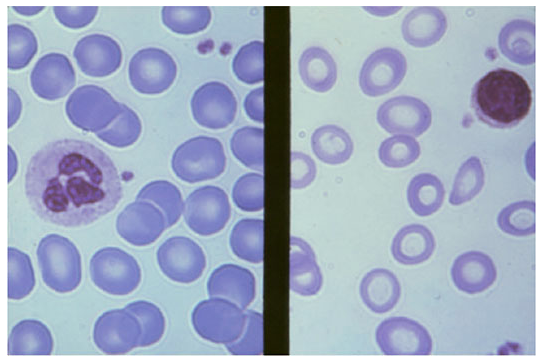
So normally, the RBCs are biconcave shape, so the edges have more of hemoglobin and the center has like less hemoglobin. That if you look into the microscope, comes with a round RBC with the center being pallor because that's what saying the center wants thin and no much hemoglobin there and the peripheral is completely pink, so defining that that's the hemoglobin, which we see in another microscope. But what happens in case of a target cell? So target cell is formed when there is a small dot in the center, instead of small dot of pink hemoglobin in the center, instead of a central pallor. But why is it happening? Because if you remember an example of basketball, if you try to press it, there will be no indentation on the surface. But if you remove little air from the basketball and then try to press it, there might be some indent happening in the basketball. Same concept I want to put here. In general, if there is the right amount of hemoglobin or sufficient amount of hemoglobin in an RBC, that is nothing but in the cytoplasm, then we cannot make an indent. So the targets, target cells won't occur. But if there is, let's see, there is some decreased amount of hemoglobin or microcytic and hypochromic RBC, then same like a basketball, you can make an indentation. So in the middle, a bleb forms and where the hemoglobin also settles there. That is the reason why we see in the microscope a small dot in the center, which is replacing the central pallor. So can you explain me my concept into some understanding notes?
target cell RBC peripheral blood smear microscopy
target cell codocyte thalassemia iron deficiency anemia smear
Target Cells (Codocytes) — Concept Notes
1. Normal RBC Morphology — The Baseline
- The periphery is thicker → more hemoglobin → stains deep pink
- The center is thinner → less hemoglobin → appears as a pale/white zone called central pallor
- Central pallor normally occupies about 1/3 of the cell diameter
2. The Basketball Analogy — Why the Bleb Forms
| Condition | Basketball Equivalent | RBC Equivalent |
|---|---|---|
| Normal RBC (adequate Hb) | Fully inflated — firm, cannot be indented | Enough hemoglobin fills the cytoplasm; cell holds its shape tightly |
| Abnormal RBC (low Hb) | Partially deflated — soft, easy to indent | Reduced hemoglobin = less cytoplasmic "content" = cell membrane has excess surface area relative to its volume |
3. What a Target Cell Looks Like on Smear
- Outer pink rim (peripheral hemoglobin)
- Pale ring in between (thin zone)
- Central pink dot (hemoglobin pooled in the central bleb/fold)
4. The Core Mechanism — Excess Membrane : Volume Ratio
A) Decreased Hemoglobin Content (your basketball mechanism)
- Less hemoglobin → less cytoplasmic volume → membrane is "too big" for the content
- The cell folds inward at the center → central bleb → hemoglobin collects there
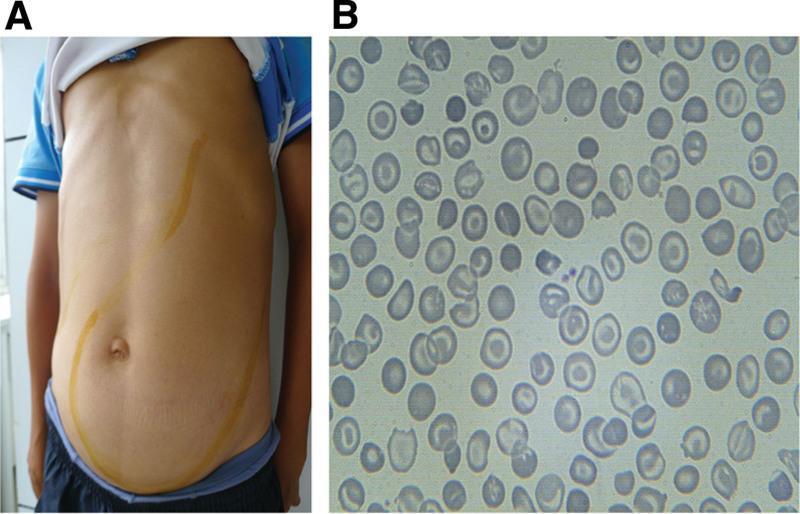
- Causes: Iron deficiency anemia, thalassemia, sideroblastic anemia
- These cells are also microcytic and hypochromic
B) Increased Membrane Lipid
- Extra cholesterol/phospholipid gets inserted into the membrane → membrane expands → same effect (too much membrane, not enough volume)
- Causes: Liver disease, obstructive jaundice, post-splenectomy
- Note: In liver disease, the cells may be normocytic but still form targets — purely from membrane excess, not hemoglobin deficiency
5. Causes at a Glance
| Category | Examples |
|---|---|
| Microcytic / hypochromic | Iron deficiency, thalassemia (alpha and beta), HbC/HbE disease, sideroblastic anemia |
| Liver disease | Obstructive jaundice, chronic liver disease (lipid membrane changes) |
| Post-splenectomy | Spleen normally removes excess membrane; without it, targets accumulate |
| Hemoglobinopathies | HbC disease (most target cells), HbSC disease, HbE |
6. Summary Table
| Feature | Normal RBC | Target Cell |
|---|---|---|
| Shape | Biconcave disc | Flat with central bleb |
| Smear appearance | Pink rim + central pallor | Pink rim + pale ring + central pink dot |
| Central pallor | Present (1/3 diameter) | Replaced by central pink dot |
| Cause | — | ↓ Hb content OR ↑ membrane lipid |
| Mechanism | Balanced membrane:volume ratio | Excess membrane relative to content → central fold |
7. The One-Line Summary
A target cell forms when the RBC membrane is too large for its cytoplasmic content — just like a deflated basketball that can be indented. The excess membrane folds inward at the center, and hemoglobin pools into that fold, replacing the central pallor with a central pink dot, creating the classic bull's-eye appearance on smear.
can you show a central bleb imagination pic
Medical diagram showing the formation of a target cell (codocyte) from a normal RBC. Split into two panels side by side. Left panel: normal biconcave RBC viewed from above and from the side - top view shows a pink disc with central pallor (pale center), side view shows classic biconcave dumbbell shape, labeled "Normal RBC - adequate hemoglobin - central pallor". Right panel: target cell formation - the RBC has reduced hemoglobin content so the membrane is excess relative to volume, the center folds inward creating a central bleb, hemoglobin pools into the bleb - top view shows the bull's eye appearance: outer pink rim, pale ring, central pink dot - side view shows the cell with a central inward fold/bleb like a partially deflated disc, labeled "Target Cell - reduced hemoglobin - excess membrane folds inward - central bleb with hemoglobin". Include a small basketball analogy at the bottom: fully inflated basketball = normal RBC (cannot be indented), partially deflated basketball = hypochromic RBC (can be indented, bleb forms). Clean, educational, medical illustration style with labels and arrows.
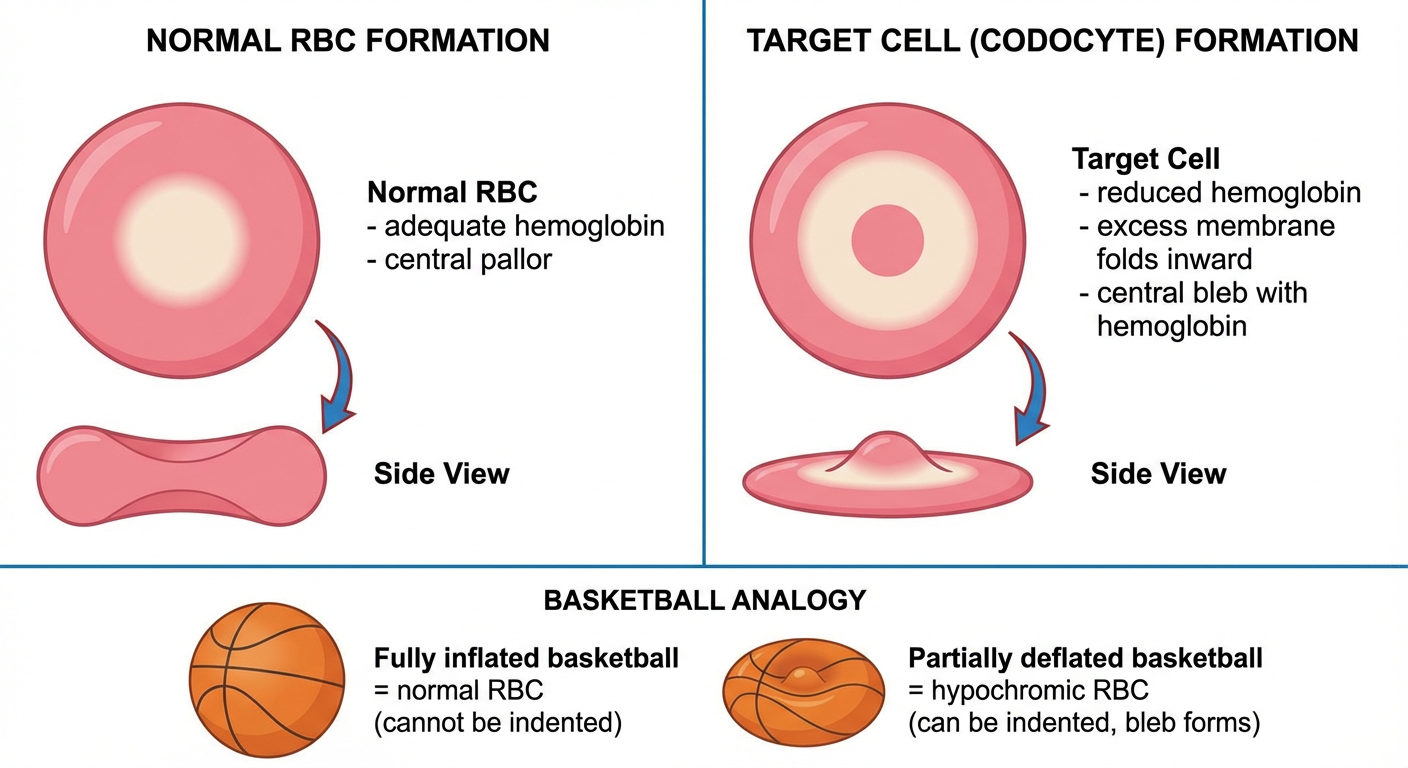
- Left — Normal RBC: fully "inflated" with hemoglobin, biconcave shape holds firmly, central pallor on smear
- Right — Target cell: reduced hemoglobin = membrane is excess relative to content → center folds/blebs inward → hemoglobin pools into that central bleb → bull's-eye on smear (outer pink → pale ring → central dot)
a 3d bleb
3D medical illustration of a red blood cell forming a central bleb to become a target cell. Show two 3D cells floating in space side by side. Left cell: a normal biconcave red blood cell, smooth donut-like shape, vibrant red, shiny surface, slightly transparent showing hemoglobin inside, labeled "Normal RBC". Right cell: a target cell where the center of the top surface is pushed inward forming a small dome-shaped bleb or dimple in the very center of the disc, like someone pressed a finger into the middle of a soft disc, the bleb pools hemoglobin creating a visible pink-red raised central dot, the surrounding area is pale and thin, then the outer rim is thick and red again — 3D render showing the inward central fold clearly, labeled "Target Cell - central bleb". Render in high quality 3D, realistic cell membrane texture, soft studio lighting with subtle shadows to emphasize the 3D depth of the central bleb indentation. Scientific visualization style.