
Ovarian changes during menstrual cycle for 10 marks. With diagrams and flowcharts.
Reading File
Now let me search the medical library for ovarian changes during the menstrual cycle.
Finding Sources
Finding Sources
Finding Sources
Finding Sources
Excellent! I have multiple great sources. Let me read the most relevant sections in parallel.
Reading File
Reading File
Reading File
Excellent! I have rich content. Now let me read more of the Medical Physiology section and fetch the key images.
Reading File
Loading Image
Loading Image
Let me fetch more images and read the histology textbook's follicle development section.
Reading File
Reading File
Now let me fetch the hypothalamic-pituitary-ovarian axis diagram and the Berek & Novak's menstrual cycle diagram.
Loading Image
Reading File
Loading Image
Reading File
I now have all the content and images needed. Let me compose a comprehensive 10-mark answer.
Ovarian Changes During the Menstrual Cycle
Overview
The ovarian cycle is a series of structural and hormonal changes that occur in the ovary during each 28-day menstrual cycle. It is driven by the hypothalamic-pituitary-ovarian (HPO) axis and consists of four key events: folliculogenesis, ovulation, corpus luteum formation, and corpus luteum regression.
The ovarian cycle is divided into two major phases:
- Follicular phase - Days 1-14 (variable, 10-14 days)
- Luteal phase - Days 14-28 (fixed, ~14 days)
Diagram 1: HPO Axis - Hormonal Control Flowchart
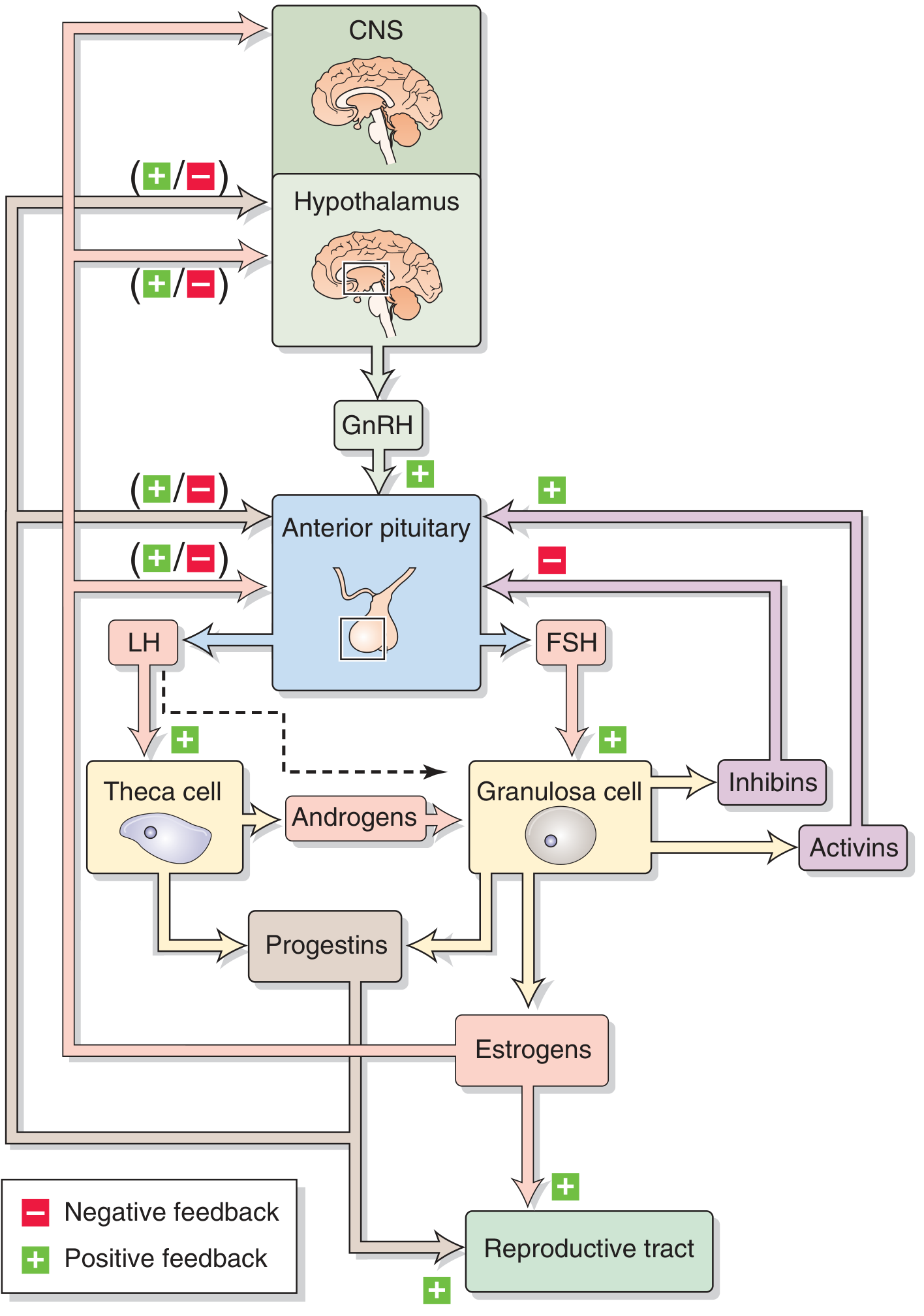
Figure 55-3: The hypothalamic-pituitary-ovarian axis. GnRH from the hypothalamus stimulates gonadotrophs in the anterior pituitary to release FSH and LH. LH acts on theca cells (androgens), while FSH acts on granulosa cells (aromatase -> estrogens). Feedback from estrogens, inhibins, and activins regulates the cycle. - Medical Physiology
Diagram 2: Ovarian & Endometrial Cycle Timeline

Diagram 3: Complete Hormonal Changes During the Menstrual Cycle
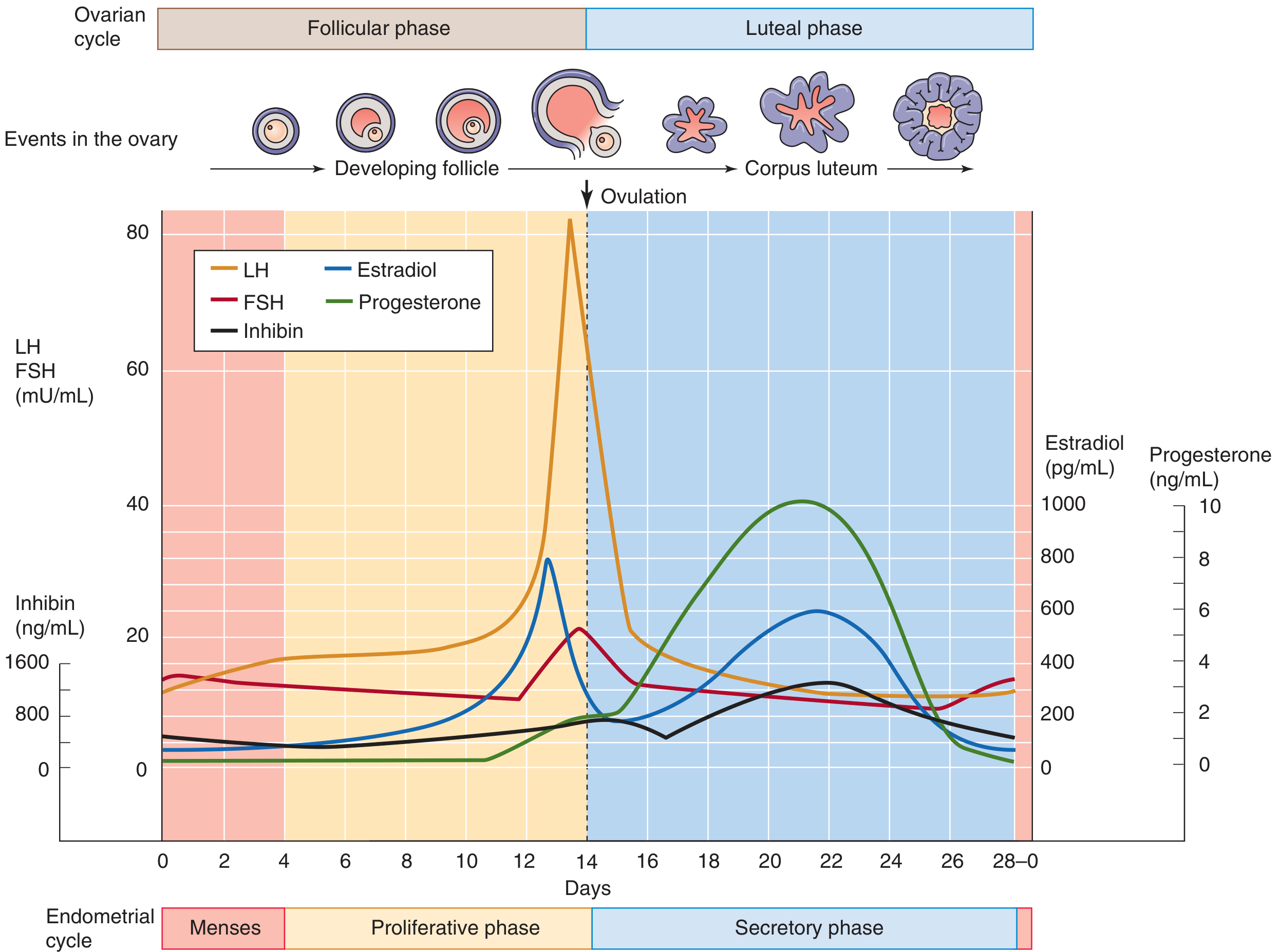
Figure 55-6: Hormonal changes during the menstrual cycle - LH surge at day 14 triggers ovulation; progesterone dominates the luteal phase. - Medical Physiology
Diagram 4: Integrated Menstrual Cycle Diagram
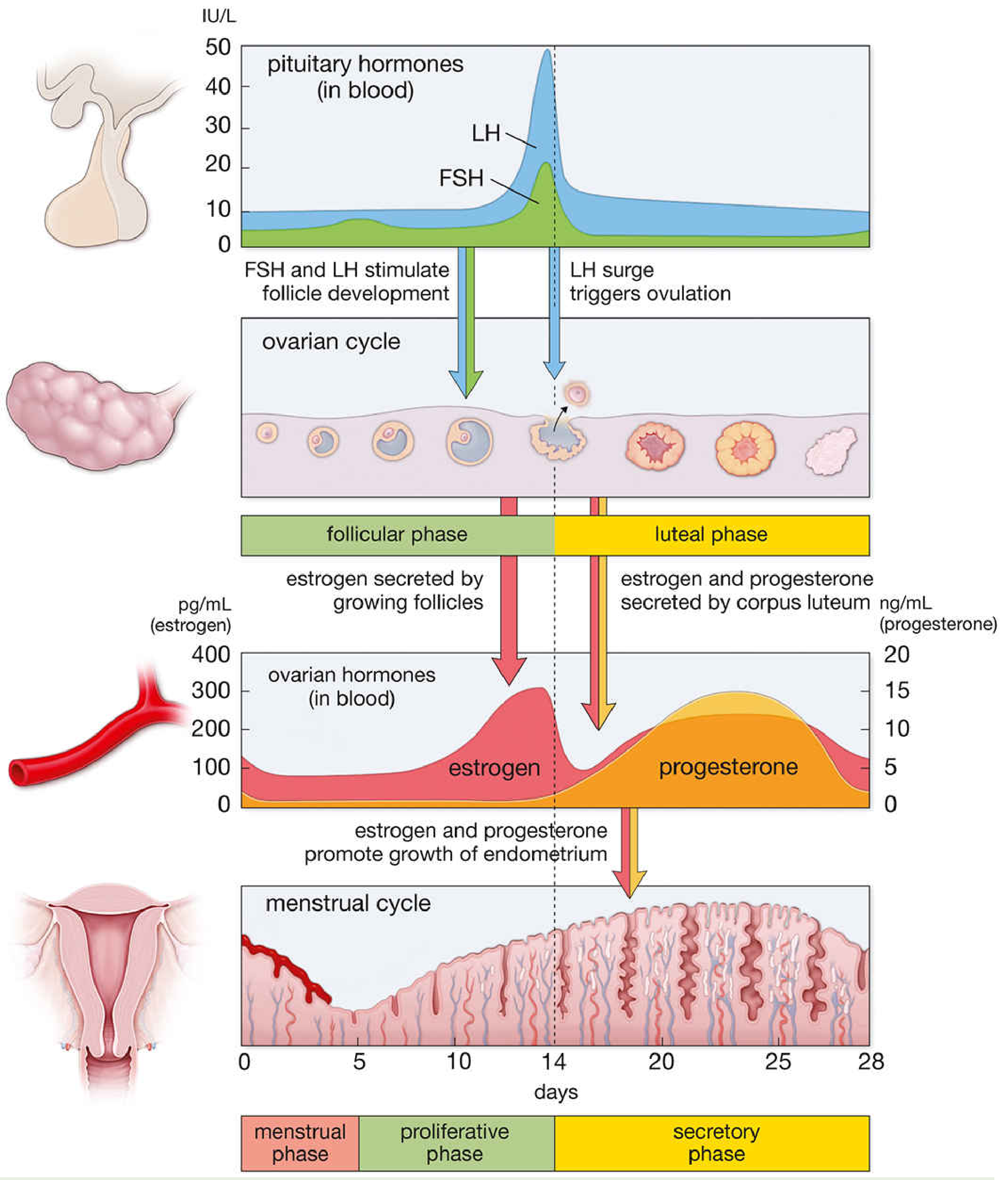
Histology: A Text and Atlas - Figure F23.3.1. Comprehensive correlation of morphological and physiological events of the menstrual cycle.
Phase 1: Follicular Phase (Days 1-14)
Sub-phases and Follicle Development
The follicular phase begins simultaneously with menstruation. A cohort of 10-20 primordial follicles is recruited under the rising influence of FSH.
Follicle Developmental Stages
| Stage | Characteristics | Day |
|---|---|---|
| Primordial follicle | Primary oocyte (arrested in meiosis I prophase) + single layer of squamous follicular cells | Before puberty / early cycle |
| Primary follicle | Follicular cells become cuboidal and stratify; zona pellucida begins forming | Days 1-5 |
| Secondary (antral) follicle | Antrum forms from fluid secreted by granulosa cells; theca interna and externa differentiate; granulosa cells aromatize androgens to estrogens | Days 5-12 |
| Dominant follicle selected | One follicle becomes FSH-independent (sustained by own estrogen); all others undergo atresia | Days 5-7 |
| Graafian (mature) follicle | Large antrum; prominent theca interna; oocyte surrounded by cumulus oophorus and corona radiata | Days 12-14 |
Hormonal Events in the Follicular Phase
Day 1:  FSH rises (corpus luteum has degenerated; estrogen + progesterone fall)
        ↓
Days 1-8: FSH stimulates granulosa & theca cells
          Granulosa: aromatase activity (androgens → estrogens)
          Theca: LH stimulates androgen synthesis
        ↓
Days 8-12: Rising estradiol → NEGATIVE FEEDBACK on FSH
           Inhibin B from granulosa cells also suppresses FSH
           LH initially falls (negative feedback)
        ↓
Days 12-13: Estradiol peaks (sustained high levels > 200 pg/mL for 48-50 hours)
            → POSITIVE FEEDBACK on LH → LH SURGE triggered
            → FSH also surges (smaller peak)
        ↓
Day 13-14: LH surge induces resumption of meiosis I in oocyte
           → Secondary oocyte formed (arrested in meiosis II metaphase)
Key Hormonal Feedback Mechanism:
- Negative feedback: Low-moderate estradiol + inhibin B suppress FSH and LH
- Positive feedback: High sustained estradiol (>200 pg/mL for 36-48h) triggers the LH surge - unique reversal of the usual inhibitory action
The LH Surge and Ovulation (Day 14)
Ovulation occurs:
- 34-36 hours after the START of the LH surge
- 10-12 hours after the PEAK of the LH surge
Events at Ovulation
- The LH surge activates protease enzymes (collagenase, plasminogen activator) in the follicle wall
- The follicle wall thins, and stigma (avascular spot) forms at the surface
- The Graafian follicle ruptures
- The secondary oocyte (with its corona radiata) is expelled into the peritoneal cavity and swept into the fallopian tube
- Prostaglandins and oxytocin assist in follicular rupture via smooth muscle contraction
Note: The released oocyte is arrested in metaphase II and only completes meiosis II upon fertilization.
Phase 2: Luteal Phase (Days 14-28)
Corpus Luteum Formation (Luteinization)
After ovulation, the ruptured Graafian follicle undergoes luteinization - a rapid morphologic transformation:
| Cell Origin | Transforms To | Hormone Produced |
|---|---|---|
| Granulosa cells | Granulosa-lutein cells (large, ~35µm) | Estrogen (aromatase activity) + some progesterone |
| Theca interna cells | Theca-lutein cells (small, ~15µm) | Progesterone + 17α-hydroxyprogesterone |
Key events:
- Blood vessels invade the previously avascular granulosa layer (vascularization is essential for LDL cholesterol delivery)
- LDL cholesterol is the main substrate for steroid synthesis in the corpus luteum
- The corpus luteum becomes the primary source of progesterone in the luteal phase
Hormonal Events in the Luteal Phase
Day 14 (Ovulation): LH surge ends; corpus luteum forms
        ↓
Days 14-21: Progesterone rises sharply (peak ~8-10 ng/mL at day 21)
            Estradiol rises again (second peak - from corpus luteum)
            Inhibin A secreted by corpus luteum
            → Together suppress FSH and LH (prevent new follicle recruitment)
        ↓
Days 21-26: If NO fertilization:
            Corpus luteum begins to degenerate (luteolysis)
            Progesterone and estradiol fall
        ↓
Day 26-28: Hormones reach nadir
           FSH begins to rise (negative feedback removed)
           Next cycle recruited
        ↓
Day 28/0: Menses begins
Corpus Luteum of Menstruation vs. Pregnancy
| Feature | Corpus Luteum of Menstruation | Corpus Luteum of Pregnancy |
|---|---|---|
| Duration | 10-12 days after ovulation | Maintained until ~8-10 weeks |
| Fate | Degenerates → Corpus albicans (fibrous scar) | Maintained by hCG from embryo |
| Outcome | Menstruation occurs | Supports early pregnancy |
| hCG role | Not present | Rescues corpus luteum by acting like LH |
Summary Flowchart: Ovarian Cycle
MENSTRUATION (Day 1)
       |
       ↓ [FSH rises as CL degenerates]
PRIMORDIAL → PRIMARY → SECONDARY FOLLICLE
       |
       ↓ [FSH + LH stimulate follicle growth, Days 1-12]
DOMINANT FOLLICLE SELECTED (Days 5-7)
       |
       ↓ [Estradiol rises; negative feedback suppresses FSH]
GRAAFIAN FOLLICLE forms (Days 12-14)
       |
       ↓ [Estradiol peaks → POSITIVE FEEDBACK → LH SURGE]
OVULATION (Day 14) - Secondary oocyte released
       |
       ↓ [Luteinization of ruptured follicle]
CORPUS LUTEUM forms
       |
    ___|___
   |       |
NO fertilization   Fertilization
   |                   |
Luteolysis         hCG maintains CL
(Day 24-26)        → Corpus luteum of pregnancy
   |
Corpus albicans
   |
Menses → Cycle repeats
Key Points Summary
-
Follicular phase (Days 1-14): Variable duration; FSH drives follicle recruitment and selection; rising estradiol eventually triggers LH surge via positive feedback.
-
Ovulation (Day ~14): LH surge causes follicle rupture 34-36 hours later; a secondary oocyte arrested in metaphase II is released.
-
Luteal phase (Days 14-28): Fixed 14-day duration; corpus luteum secretes progesterone + estrogen; if no fertilization, luteolysis occurs and the cycle restarts.
-
Corpus albicans: The remnant scar left by a degenerated corpus luteum; accumulates over a woman's reproductive life.
-
The two-cell, two-gonadotropin theory: LH stimulates theca cells (androgens) and FSH stimulates granulosa cells (aromatase: converts androgens to estrogens) - the basis of follicular estrogen production.
-
Inhibins and activins: Inhibin B (follicular phase) and inhibin A (luteal phase) selectively suppress FSH; activins stimulate FSH - fine-tuning gonadotropin secretion throughout the cycle.
Sources: Medical Physiology (Boron & Boulpaep), Histology: A Text and Atlas (Ross), Berek & Novak's Gynecology
This is a shared conversation. Sign in to Orris to start your own chat.