
Treatment for Small follicles between fingers in summer season
Reading File
Finding Sources
Finding Sources
Reading File
Reading File
Reading File
Reading File
Reading File
I now have comprehensive information from two major dermatology textbooks. Let me compile a thorough answer.
Loading Image
The small follicles/vesicles between fingers in summer are characteristic of Dyshidrotic Eczema (Pompholyx / Dyshidrosis). Here is a comprehensive clinical overview:
Dyshidrotic Eczema (Pompholyx) — Small Vesicles Between Fingers in Summer
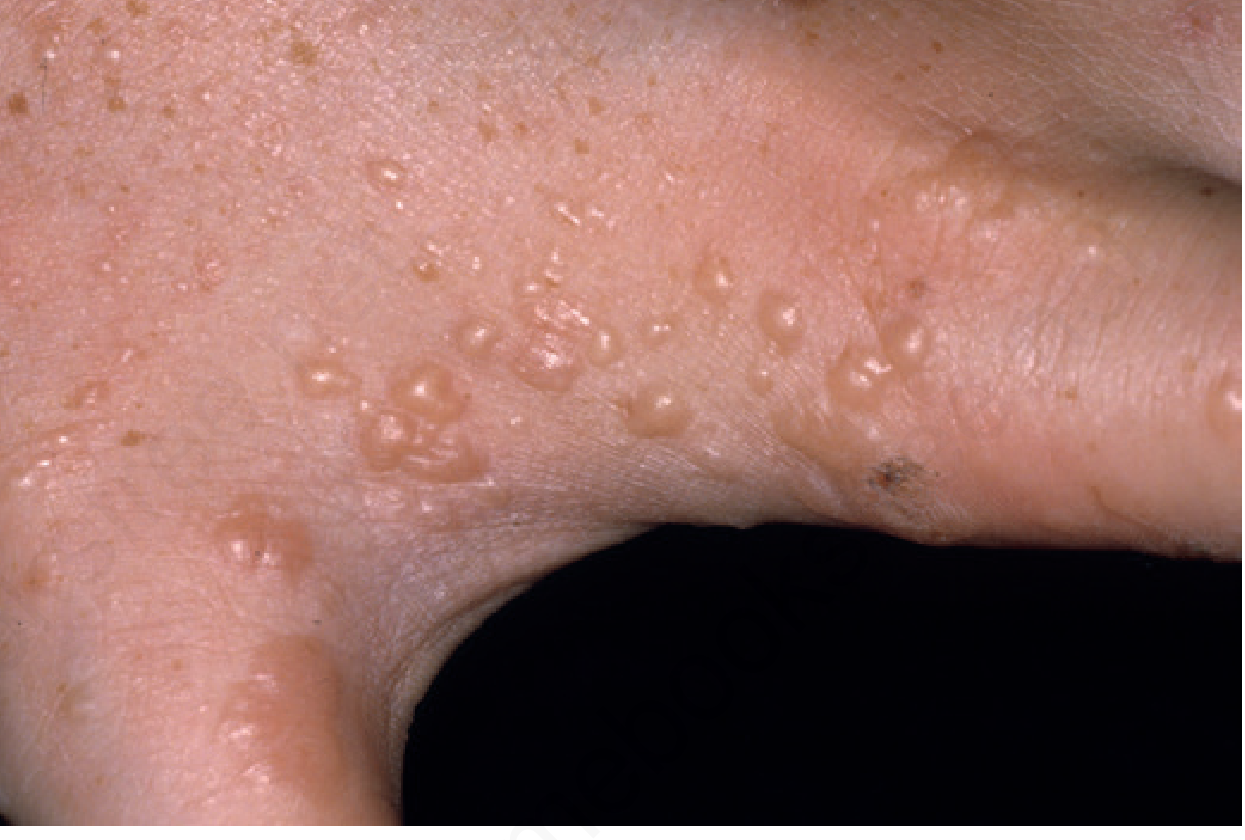
Why Summer?
Flares are strongly associated with hot climates, sweating (hyperhidrosis), and emotional stress. The condition is not caused by sweat duct blockage, but palmoplantar hyperhidrosis is a key aggravating factor — controlling it can improve the eczema. — Dermatology 2-Volume Set 5e
Presentation
- Symmetric, firm, deep-seated vesicles on the lateral and medial aspects of fingers, palms, and soles
- Vesicles resemble tapioca pudding — clustered, 1–2 mm, pruritic
- Intense pruritus often precedes the eruption
- Larger lesions ("pompholyx") can coalesce into bullae
- Resolves with thick scaling and desquamation
- Chronic cases may show hyperkeratosis, fissuring, and nail dystrophy
— Andrews' Diseases of the Skin; Dermatology 2-Volume Set 5e
Common Triggers to Identify & Address
| Trigger | Notes |
|---|---|
| Atopic dermatitis | Most common underlying association |
| Allergic contact dermatitis | Nickel, cobalt, balsam of Peru — patch testing indicated |
| Irritant contact dermatitis | Wet work, detergents, solvents |
| Hot/humid weather | Summer flares very common |
| Emotional stress | Well-recognized trigger |
| Dietary nickel/cobalt ingestion | Low-nickel diet may help in sensitized patients |
Treatment
1. Skin Protection (First Line)
- Wear vinyl gloves (with white cotton gloves underneath) during wet work
- Avoid rubber gloves if latex-sensitive
- Use protective cloth or leather gloves for rough outdoor work
2. Barrier Repair / Moisturizers
- Apply a heavy moisturizing ointment (e.g., white petrolatum) after every handwash/water exposure
- At night: apply moisturizer and occlude with a plastic bag or vinyl gloves
- White petrolatum is inexpensive, non-sensitizing, and highly effective
3. Topical Agents (Pharmacologic)
| Agent | Notes |
|---|---|
| Potent/ultrapotent topical corticosteroids | First-line; enhanced by pre-soaking ("soak and smear" technique) or overnight occlusion |
| Calcineurin inhibitors (tacrolimus, pimecrolimus) | Steroid-sparing option, useful for maintenance |
| Topical retinoids | Helpful in some cases |
| PUVA (bath PUVA preferred over systemic) | For resistant cases |
4. Managing Hyperhidrosis
- Controlling sweating directly reduces flares
- Onabotulinumtoxin A (Botox) injections into the palms may ameliorate dyshidrotic eczema by treating hyperhidrosis
5. Systemic Therapy (Chronic/Recalcitrant Cases)
| Agent | Use |
|---|---|
| Oral corticosteroids | Short courses for severe acute flares |
| Cyclosporine | For refractory chronic cases |
| Systemic retinoids (acitretin) | Chronic relapsing disease |
| Low-nickel/cobalt diet | If sensitization confirmed on patch testing |
— Dermatology 2-Volume Set 5e; Andrews' Diseases of the Skin
Differential Diagnosis to Rule Out
- Inflammatory tinea manuum (fungal) — KOH scraping; treat with antifungals
- Scabies — burrows in web spaces; treat with permethrin
- Palmoplantar pustular psoriasis
- Bullous tinea / id reaction from tinea pedis
- Dyshidrosis-form pemphigoid
Key Practical Points
- Always patch test to rule out allergic contact dermatitis — a treatable and curable cause
- If tinea pedis is present, treat it — an id (autoeczematization) reaction on the hands can mimic dyshidrosis and will clear with antifungal therapy
- Individual outbreaks resolve spontaneously over several weeks, but the condition is chronic and relapsing
- Career counseling is warranted for patients in high-risk occupations (hairdressers, health care workers, bakers, cooks)
This is a shared conversation. Sign in to Orris to start your own chat.