
Can you create on page image for vibrio cholera microbiology
A detailed one-page medical microbiology reference card for Vibrio cholerae. Dark navy blue background with clean white and yellow text. Organized into clearly labeled sections: TITLE at top: "Vibrio cholerae - Microbiology Overview" in large bold white text with a cholera bacteria illustration. Section 1 - MORPHOLOGY & CLASSIFICATION (light blue header): • Gram-negative, curved comma-shaped rod (vibrio) • Single polar flagellum (monotrichous) - highly motile • Facultative anaerobe • Family: Vibrionaceae Section 2 - KEY CHARACTERISTICS (green header): • Oxidase positive • Grows at pH 6.5-9.0 (prefers alkaline: TCBS agar - yellow colonies) • Tolerates wide temperature range (14°C-40°C) • Halophilic (requires NaCl); V. cholerae can grow without extra salt • O1 and O139 serogroups cause epidemic cholera • Serogroup O1: biotypes Classical & El Tor; serotypes Inaba, Ogawa, Hikojima Section 3 - VIRULENCE FACTORS (orange header): • Cholera Toxin (CT): A-B toxin — B subunit binds GM1 ganglioside; A subunit activates adenylate cyclase → cAMP↑ → massive fluid/electrolyte secretion • Toxin Coregulated Pilus (TCP): adhesin, receptor for bacteriophage CTXφ • Vibrio Pathogenicity Island (VPI-1) • Accessory Cholera Enterotoxin (ACE): increases fluid secretion • Zonula Occludens Toxin (ZOT): loosens tight junctions • Neuraminidase: increases GM1 binding sites Section 4 - PATHOGENESIS (red header): • Fecal-oral route (contaminated water/food) • Infective dose: large inoculum needed (acid-labile) • Colonizes small intestine → secretory diarrhea • "Rice-water stools" — up to 1L fluid loss/hour • No invasion; purely toxin-mediated Section 5 - CLINICAL FEATURES (purple header): • Incubation: 6 hours to 5 days • Profuse watery diarrhea, vomiting, severe dehydration • Metabolic acidosis, hypokalemia • Can progress to hypovolemic shock and death if untreated Section 6 - DIAGNOSIS (teal header): • Dark-field microscopy: "shooting stars" motility • Culture: TCBS agar (yellow colonies) • String test: positive (mucosal agglutination) • Stool PCR / serology Section 7 - TREATMENT & PREVENTION (gold header): • Oral Rehydration Therapy (ORT) — mainstay • Antibiotics: Doxycycline (adults), Azithromycin (children/pregnant) • Vaccines: Dukoral, Shanchol, Euvichol (oral killed vaccines) • WASH: clean water, sanitation, hygiene Small diagram in corner showing cholera toxin mechanism: B pentamer binding GM1 → A subunit → adenylate cyclase → ATP→cAMP → Cl- and water efflux into lumen.
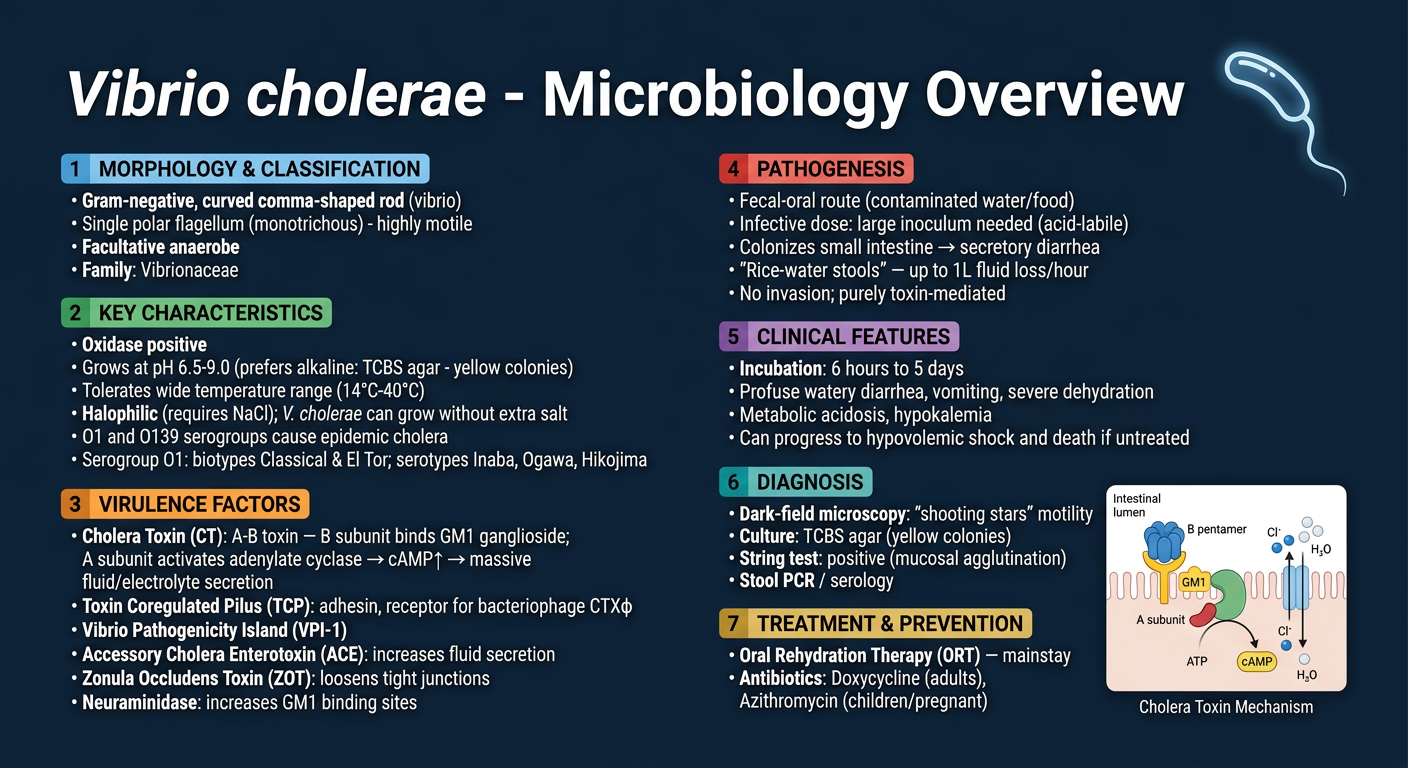
- Morphology - Gram-negative curved rod, single polar flagellum, facultative anaerobe
- Key characteristics - Oxidase positive, TCBS agar (yellow colonies), serogroups O1 & O139 cause epidemics; O1 biotypes (Classical/El Tor) and serotypes (Inaba/Ogawa/Hikojima)
- Virulence factors - Cholera toxin (A-B type), TCP pilus, VPI-1, ACE, ZOT, neuraminidase
- Pathogenesis - B subunit binds GM1 ganglioside → A subunit activates adenylate cyclase → cAMP surge → massive secretory diarrhea ("rice-water stools," up to 1L/hour)
- Diagnosis - Dark-field "shooting stars" motility, TCBS culture, string test
- Treatment - Oral rehydration therapy (mainstay) + doxycycline/azithromycin; oral killed vaccines for prevention