
How to design anterior hairline from textbook of unnger textbook
anterior hairline design hair transplant surgery
Anterior Hairline Design in Hair Transplantation
Core Principle
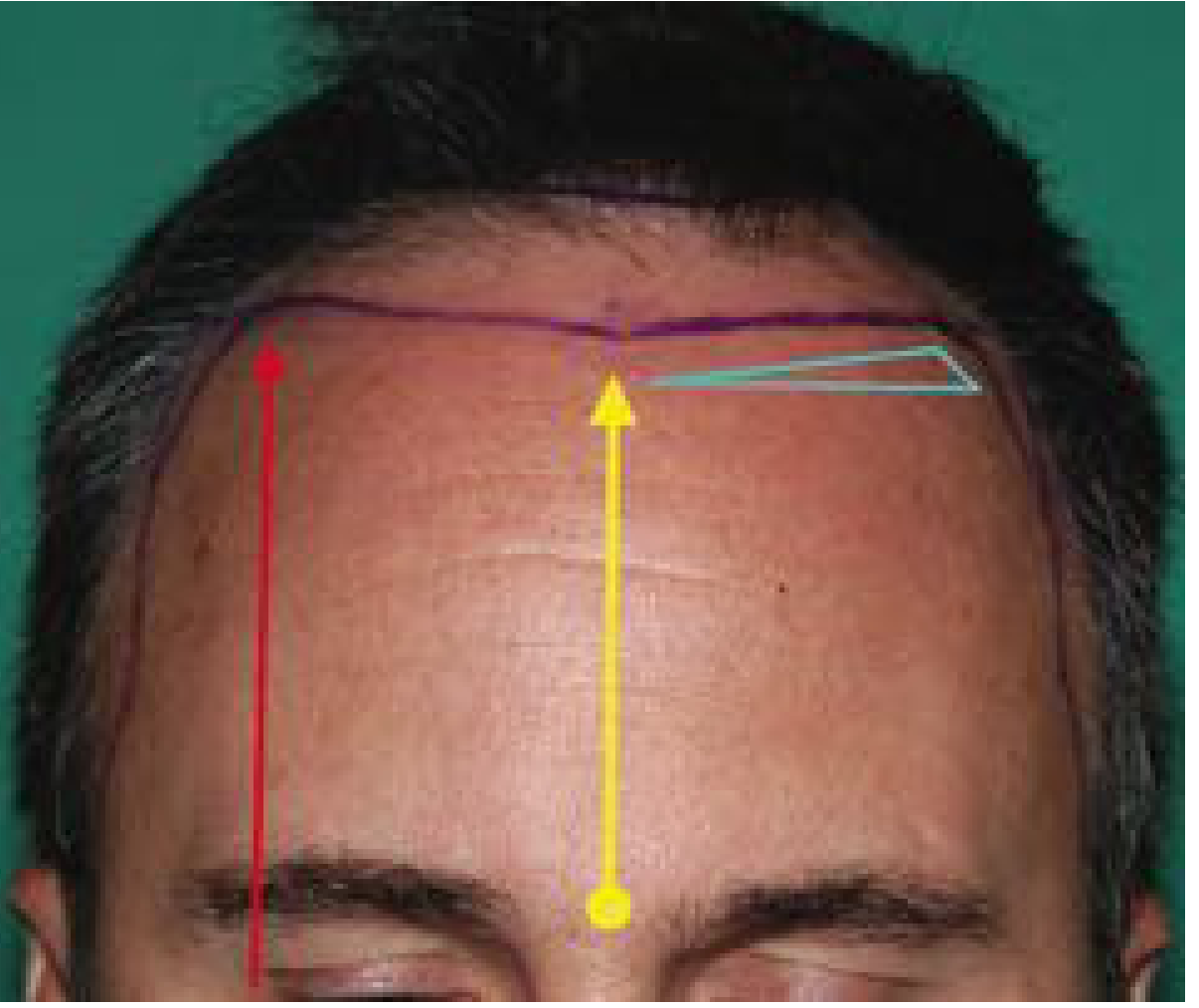
1. Shape of the Hairline
- The natural frontal hairline is convex, with the central portion (trichion) positioned slightly inferior to the frontotemporal regions.
- It should NOT be a straight line - a straight hairline looks artificial.
- The hairline is better conceptualized as a transition zone ("feathering zone"), not a fixed boundary - a zone of gradually increasing density from bare skin to fully terminal hair-bearing skin.
2. Vertical Placement (Height of the Hairline)
| Facial Third | Landmarks |
|---|---|
| Upper third | Trichion to glabella |
| Middle third | Glabella to subnasale |
| Lower third | Subnasale to mentum |
- In patients with advanced hair loss and limited donor reserves, the hairline is placed higher for a more age-appropriate result.
- The surgeon must assume every patient will eventually progress to the highest grade of hair loss (worst-case scenario) - this prevents a hairline that looks isolated and unnatural as hair loss continues behind it.
3. Lateral Extent - The Frontotemporal Triangle
- The mature male hairline naturally shows a bilateral triangular recession at the junction of the frontal and temporal hair - the frontotemporal triangles.
- These are formed by recession of the frontal hairline superiorly and the temporal hairline posteriorly.
- The apex of the frontotemporal triangle (the lateral-most point of the designed hairline) must fall on a vertical line drawn upward from the lateral canthus of the eye.
- Advanced temporal recession requires a more posterior frontal hairline - a low frontal hairline is impossible when temporal hairlines have receded significantly.
4. The Feathering Zone - Creating Naturalness
- Place follicular unit (FU) grafts (1-4 follicles per unit) in an irregular, random pattern along the leading edge.
- Single-hair FU grafts go at the very front; 2-4 hair FUs are placed progressively behind.
- This gradual increase in density mimics nature's own transition zone.
- Density at recipient sites: 10-30 sites/cm², varying with existing hair density.
5. The Vertex - Caution
- The crown/vertex should be approached with caution, especially in young patients.
- Progressive circumferential hair loss at the vertex creates exponentially increasing surface area, consuming grafts rapidly.
- Priority should always be given to frontal hairline density over crown coverage.
- Either avoid crown grafting or use lower density there to preserve the donor supply.
6. Special Considerations
| Factor | Implication for Design |
|---|---|
| Young patient | Place hairline higher; hair loss will progress |
| Advanced Norwood grade | Higher, more posterior hairline |
| Low donor density | Prioritize frontal hairline; avoid crown |
| High hair-skin contrast | Less tolerance for low density; careful feathering |
| Women | Usually stable hairlines; recreation often unnecessary |
7. Recipient Site Angles
- Sites should mimic the natural 30-45° angle of hair growth on the scalp.
- Needle gauges for recipient sites: 18G (4-hair FU), 19G (3-hair), 20G (2-hair), 21G (single hair).
- Use magnification to avoid transecting existing follicles.
- Cummings Otolaryngology Head and Neck Surgery, Section: Hairline Design (p. 448 context)
- Dermatology 2-Volume Set, 5e - Hairline Design and Recipient Site Creation (Section 157)
Make a diagrams for this with measurements
Medical diagram of anterior hairline design for hair transplant surgery, showing a front-facing male head outline with the following labeled measurements and anatomical landmarks: 1. A convex frontal hairline drawn across the top of the forehead 2. "Trichion" labeled at the central lowest point of the hairline 3. "Glabella" labeled between the eyebrows 4. "Subnasale" labeled at the base of the nose 5. "Mentum" labeled at the chin 6. Three equal vertical arrows on the right side showing facial thirds: "Upper 1/3", "Middle 1/3", "Lower 1/3" 7. A double-headed arrow on the left side measuring "7–10 cm" from glabella up to the trichion 8. A vertical red dashed line drawn upward from the lateral canthus of the eye to the lateral edge of the hairline, labeled "Lateral canthus vertical" 9. A small shaded triangle at each lateral end of the hairline labeled "Frontotemporal triangle" 10. The hairline apex labeled "Apex of frontotemporal triangle" at the point where the red vertical line meets the hairline 11. A gradient shading along the leading edge of the hairline labeled "Feathering zone (1-4 hair FU grafts, irregular pattern)" 12. Clean anatomical illustration style, white background, black line art with color-coded measurement lines (red, yellow, blue), all labels in clear sans-serif font
Medical diagram showing detailed anterior hairline feathering zone and recipient site design for hair transplant, showing: 1. A close-up top-down view of the frontal scalp showing the hairline zone 2. Three rows of dots representing follicular unit grafts: - Front row: single dots (1-hair FU grafts) labeled "1-hair FU - leading edge" - Middle row: pairs of dots (2-hair FU) labeled "2-hair FU" - Back row: clusters of 3-4 dots (3-4 hair FU) labeled "3-4 hair FU - full density zone" 3. The dots arranged in an irregular, random (not grid-like) pattern to show naturalness 4. Small angled arrows next to each dot showing 30-45 degree hair growth angle, labeled "30–45° growth angle" 5. A bracket showing "Feathering / Transition Zone" spanning the front two rows 6. A bracket showing "10–30 sites/cm²" indicating density 7. A label "Bare skin" on the left (anterior) side 8. A label "Hair-bearing scalp" on the right (posterior) side 9. Needle gauge table inset in corner: 21G = 1-hair FU, 20G = 2-hair FU, 19G = 3-hair FU, 18G = 4-hair FU 10. Clean anatomical diagram style, white background, color-coded dots (light to dark gradient from front to back), clear sans-serif labels
Diagram 1 - Anterior Hairline Placement & Facial Landmarks
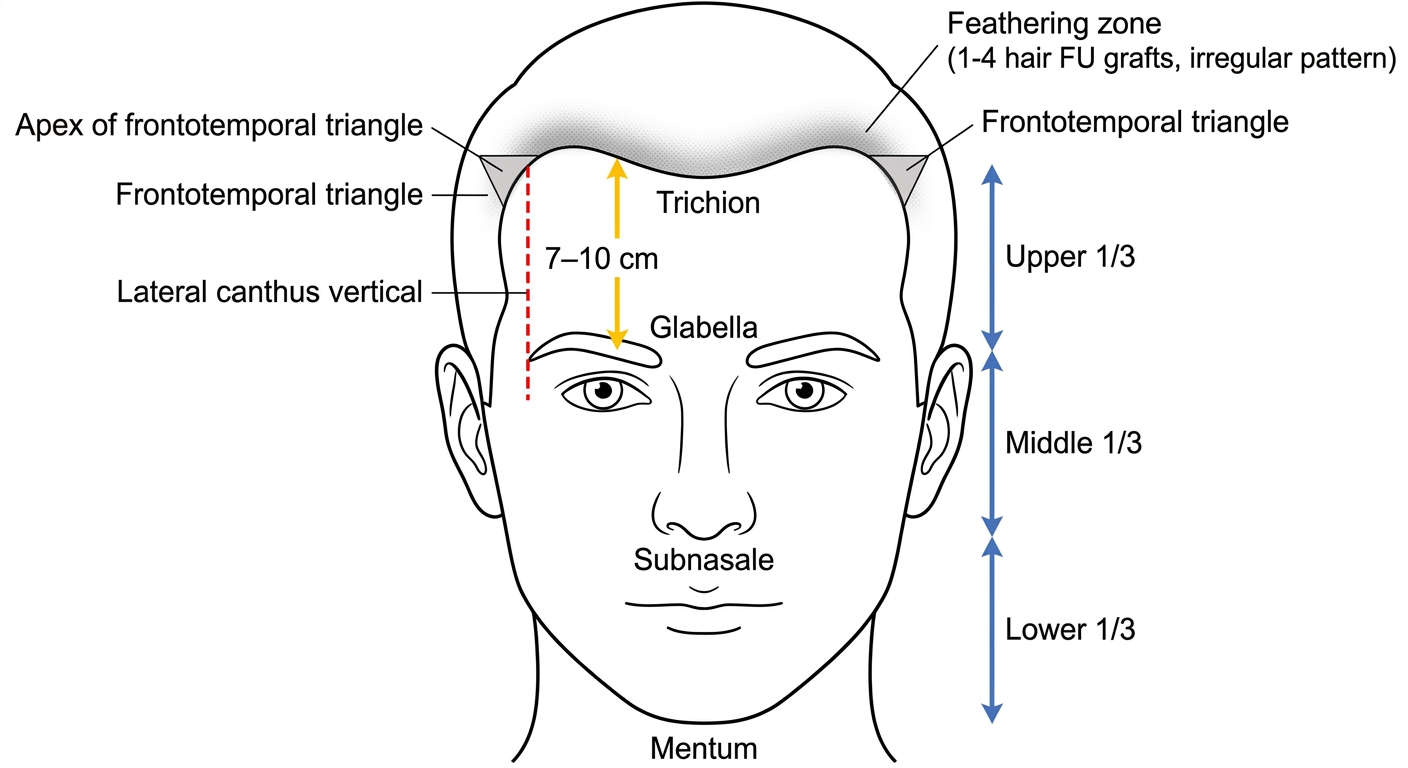
- 7-10 cm from glabella up to the trichion (hairline midpoint)
- Facial thirds - upper, middle, lower thirds should be approximately equal
- Lateral canthus vertical - the apex of the frontotemporal triangle must fall on this line
- Frontotemporal triangles - bilateral recessed triangles at the junction of frontal and temporal hair
Diagram 2 - Feathering Zone & Graft Placement Pattern
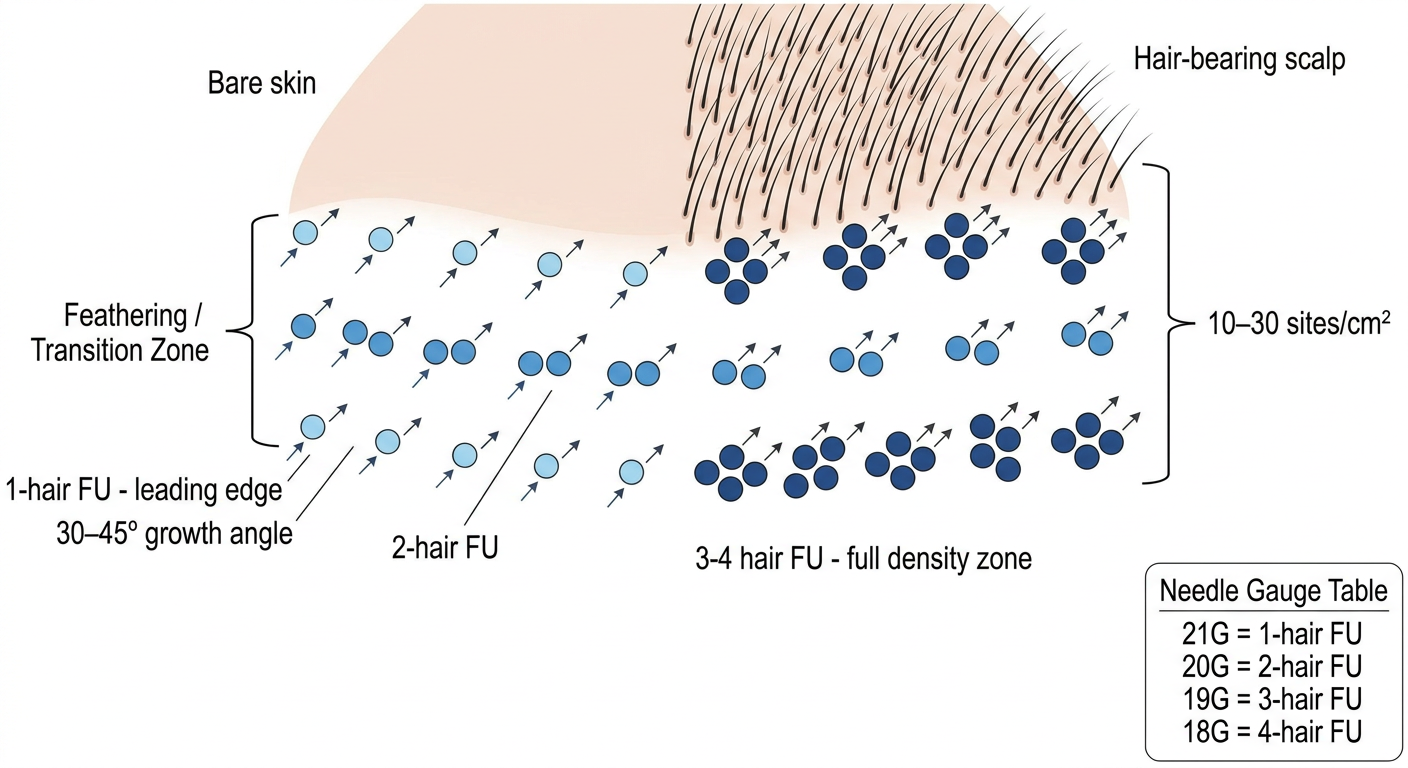
- Irregular, random placement of FU grafts (never a grid pattern)
- Gradient density from front to back: 1-hair → 2-hair → 3-4 hair FU grafts
- 30-45° hair growth angle for each recipient site
- 10-30 sites/cm² density
- Needle gauge guide: 21G (1-hair) → 20G (2-hair) → 19G (3-hair) → 18G (4-hair FU)