
Drugs acting on RAAS
Your credits are exhausted. You can purchase a top-up or subscribe to a plan to continue using Orris. If you're already subscribed, your daily credits will reset tomorrow.
Create a presentation on RAAS drugs classification
Your credits are exhausted. You can purchase a top-up or subscribe to a plan to continue using Orris. If you're already subscribed, your daily credits will reset tomorrow.
Drugs acting on RAAS
The renin-angiotensin-aldosterone system (RAAS) is a key regulator of blood pressure, fluid balance, and cardiovascular homeostasis. Drugs acting on this system are among the most widely used in clinical medicine.
Searching sources...
Reading File
Finding Sources
Finding Sources
Reading File
Reading File
Reading File
Finding Sources
Finding Sources
Reading File
Reading File
I now have enough information to provide a thorough answer. Let me fetch the RAAS drug pathway diagram as well.
Loading Image
Here is a complete, organized overview of drugs acting on the RAAS system.
Drugs Acting on the Renin-Angiotensin-Aldosterone System (RAAS)
The RAAS Pathway
The RAAS cascade: Angiotensinogen (hepatic α₂-globulin) → Renin → Angiotensin I → ACE → Angiotensin II → acts on AT₁ receptors → vasoconstriction + aldosterone release → sodium/water retention → ↑ BP
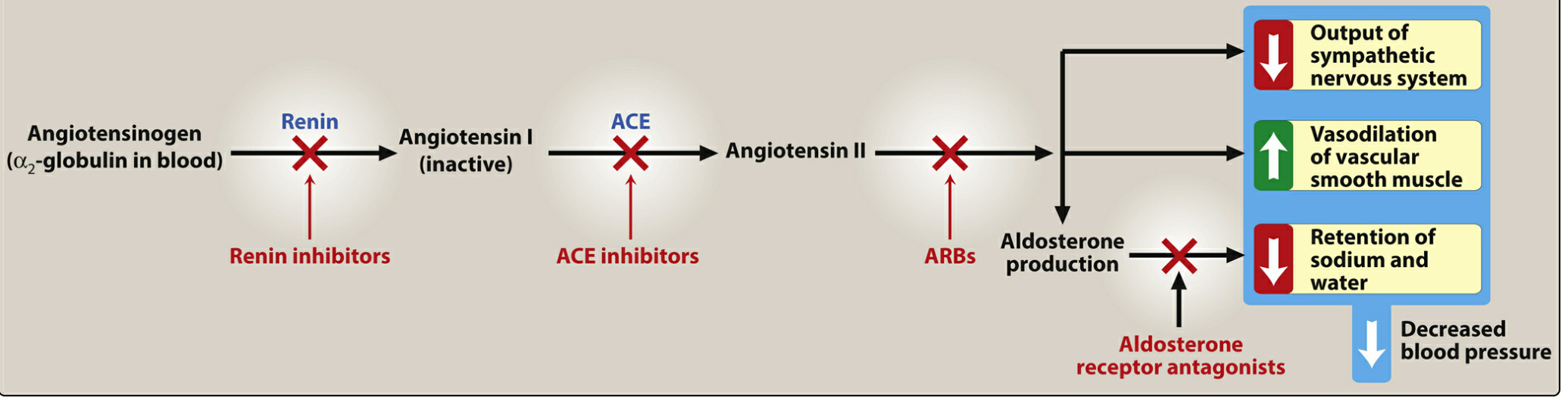
Classification of RAAS Drugs
1. Renin Inhibitors (Direct Renin Inhibitors - DRIs)
Mechanism: Block the earliest step - renin cannot convert angiotensinogen to Angiotensin I.
| Drug | Dose | Notes |
|---|---|---|
| Aliskiren | 150-300 mg/day orally | Only approved oral DRI |
- Binds the active site of renin with 10,000-fold higher affinity than other aspartic peptidases (IC50 ~0.6 nM)
- Reduces Ang I, Ang II, and plasma aldosterone; increases plasma renin concentration (loss of AngII negative feedback)
- Bioavailability ~2.5%; t½ = 20-45 h; minimal hepatic metabolism; excreted mainly in feces
- ADRs: Diarrhea (dose-related), cough, angioedema (less than ACEi)
- Contraindicated in pregnancy; avoid with ACEi or ARB (additive risk without extra benefit)
- Substrate for P-glycoprotein; fatty meals reduce absorption; metabolized by CYP3A4
2. ACE Inhibitors (ACEIs)
Mechanism: Block ACE, which prevents conversion of Ang I → Ang II AND inhibits bradykinin degradation (→ ↑ NO, ↑ prostacyclin → vasodilation).
Suffix: "-pril"
| Drug | Special Feature |
|---|---|
| Captopril | Shortest acting; active drug (no prodrug conversion needed) |
| Enalapril | Prodrug → enalaprilat; only ACEI available IV (enalaprilat) |
| Lisinopril | Active drug; no hepatic conversion needed |
| Ramipril | Prodrug; preferred in high CV risk patients (HOPE trial) |
| Fosinopril | Only ACEI with dual renal + hepatic elimination - no dose adjustment in renal impairment |
| Perindopril | Prodrug; long-acting |
| Quinapril, Benazepril, Trandolapril, Moexipril | Prodrugs; renally eliminated |
Therapeutic uses:
- Hypertension (first-line with diabetes, CKD, post-MI, HFrEF)
- Heart failure (reduces preload and afterload)
- Post-MI ventricular remodeling
- Diabetic nephropathy (reduces efferent arteriolar resistance → ↓ intraglomerular pressure → ↓ proteinuria)
- Chronic kidney disease
Adverse effects:
- Dry cough (up to 10%) - due to ↑ bradykinin and substance P in pulmonary tree
- Angioedema (rare but potentially life-threatening) - also bradykinin-mediated
- Hyperkalemia (↓ aldosterone → ↓ K⁺ excretion)
- First-dose hypotension
- Fetotoxicity / teratogenicity - contraindicated in pregnancy (causes fetal renal agenesis)
- Altered taste (captopril - contains sulfhydryl group)
- Captopril specifically: rash, taste disturbance due to sulfhydryl group
Pharmacokinetics key point: All except captopril and lisinopril are prodrugs requiring hepatic conversion - captopril/lisinopril preferred in severe hepatic impairment.
3. Angiotensin II Receptor Blockers (ARBs)
Mechanism: Selectively block AT₁ receptors - prevent all actions of Ang II (vasoconstriction, aldosterone release, sympathetic facilitation) regardless of how Ang II was formed (not only ACE-generated).
Advantage over ACEi: More complete Ang II blockade (chymase can also form Ang II); no bradykinin accumulation → no cough, much less angioedema.
Suffix: "-sartan"
| Drug | Notes |
|---|---|
| Losartan | First approved ARB; also lowers uric acid (uricosuric) |
| Valsartan | Used post-MI; component of sacubitril/valsartan (Entresto) |
| Irbesartan | Good evidence in diabetic nephropathy |
| Candesartan | Potent; used in heart failure |
| Olmesartan | Longest-acting |
| Telmisartan | Longest t½; also activates PPAR-γ (metabolic benefit) |
| Eprosartan, Azilsartan | Second-generation |
Uses: Same as ACEi; preferred when ACEi cough is intolerable; first-line in diabetic nephropathy, HFrEF, post-MI, hypertension.
Adverse effects: Similar to ACEi but no cough, very rare angioedema; hyperkalemia; teratogenic (contraindicated in pregnancy).
Do NOT combine ACEi + ARB - increased risk of hypotension, hyperkalemia, and renal failure without additional cardiovascular benefit.
4. Aldosterone Receptor Antagonists (Mineralocorticoid Receptor Antagonists - MRAs)
Mechanism: Competitively block mineralocorticoid receptors in the collecting duct → prevent Na⁺/water retention and K⁺ excretion; also block cardiac fibrosis mediated by aldosterone.
4a. Steroidal MRAs
| Drug | Selectivity | Key Uses | Notes |
|---|---|---|---|
| Spironolactone | Non-selective (also blocks androgen + progesterone receptors) | HFrEF, primary hyperaldosteronism, resistant HTN, ascites | ADRs: gynecomastia, impotence, menstrual irregularity |
| Eplerenone | Selective for mineralocorticoid receptor | Post-MI heart failure, HFrEF, hypertension | Fewer endocrine ADRs; more expensive |
4b. Non-steroidal MRA (New Generation)
| Drug | Notes |
|---|---|
| Finerenone | FDA approved 2021; indicated for CKD with type 2 diabetes; reduces cardiovascular events and CKD progression; fewer hyperkalemia than steroidal MRAs |
Class ADRs: Hyperkalemia (most important), hyponatremia. Spironolactone-specific: gynecomastia, menstrual irregularity, decreased libido (anti-androgenic).
5. Angiotensin Receptor-Neprilysin Inhibitor (ARNI)
Mechanism: Combined AT₁ receptor blockade + neprilysin inhibition (↑ natriuretic peptides ANP/BNP).
| Drug | Components | Indication |
|---|---|---|
| Sacubitril/Valsartan (Entresto) | Neprilysin inhibitor + ARB | HFrEF (NYHA II-IV); superior to enalapril in PARADIGM-HF trial |
- Neprilysin degrades natriuretic peptides; inhibiting it raises ANP/BNP levels → natriuresis, vasodilation, anti-fibrosis
- Must NOT be combined with ACEi (high risk of angioedema; 36-hour washout required when switching from ACEi)
- Also approved for hypertension in some guidelines
Summary Classification Table
| Class | Drug(s) | Site of Action | Key Indication |
|---|---|---|---|
| Direct Renin Inhibitor | Aliskiren | Renin (blocks Ang I formation) | Hypertension |
| ACE Inhibitors | Captopril, Enalapril, Lisinopril, Ramipril, etc. | ACE (blocks Ang II formation + bradykinin degradation) | HTN, HF, CKD, post-MI |
| ARBs | Losartan, Valsartan, Irbesartan, Candesartan, etc. | AT₁ receptor (blocks Ang II action) | HTN, HF, CKD, post-MI |
| Steroidal MRAs | Spironolactone, Eplerenone | Mineralocorticoid receptor | HF, hyperaldosteronism, resistant HTN |
| Non-steroidal MRA | Finerenone | Mineralocorticoid receptor | CKD + T2DM |
| ARNI | Sacubitril/Valsartan | AT₁ receptor + neprilysin | HFrEF |
Key Contraindications Across All RAAS Drugs
- Pregnancy - all RAAS drugs are teratogenic (fetal renal agenesis)
- Bilateral renal artery stenosis - ACEi/ARBs cause acute renal failure
- Hyperkalemia - all RAAS drugs increase serum K⁺
- History of angioedema with ACEi - use ARB instead (not ARNI)
Sources: Lippincott Illustrated Reviews Pharmacology, 7th Ed.; Goodman & Gilman's Pharmacological Basis of Therapeutics; Katzung's Basic & Clinical Pharmacology, 16th Ed.
This is a shared conversation. Sign in to Orris to start your own chat.