
Sjogren syndrome
I'll read the medical library skill first, then search for comprehensive information on Sjogren syndrome.
Reading File
Now I'll search the medical library and PubMed simultaneously for comprehensive coverage.
Finding Sources
Searching PubMed
"Sjogren syndrome"[MeSH Terms]
Good. Now let me read the key textbook sections in parallel - focusing on the most comprehensive sources.
Finding Sources
Reading File
Searching PubMed
"Sjogren syndrome"[MeSH Terms] AND diagnosis
Good content so far. Let me read more sections and search additional sources in parallel.
Reading File
Reading File
Reading File
Excellent. Let me now read the remaining portions from Cummings (treatment section) and also get the Grainger radiology section and Bradley neurology section for completeness.
Reading File
Reading File
Reading File
I now have comprehensive material. Let me fetch the key image and also check for neurology manifestations quickly.
Loading Image
Reading File
I now have very comprehensive information from multiple textbooks. Let me compile the full answer.
Sjögren Syndrome
Definition and Epidemiology
Sjögren syndrome (SjS) is a chronic autoimmune inflammatory disorder of the exocrine glands - primarily the salivary and lacrimal glands - characterized by lymphoplasmacytic infiltration and resulting glandular hypofunction. The hallmark presentation is the sicca complex: xerostomia (dry mouth) and keratoconjunctivitis sicca (dry eyes).
- Prevalence: 1-3% of the population
- Sex: >90% of patients are women (female-to-male ratio ~9:1)
- Age of onset: Most commonly in the 4th-5th decades of life
- Classification:
- Primary SjS: Sicca complex alone, not associated with another autoimmune disease
- Secondary SjS: Sicca complex occurring alongside another autoimmune disease (most commonly rheumatoid arthritis, SLE, scleroderma, polymyositis, or primary biliary cholangitis)
Pathogenesis
The etiology involves a three-way interaction of genetics, the immune system, and environment:
- Genetic predisposition: HLA alleles B8 and DR3 confer susceptibility
- Environmental trigger: Most likely a viral infection acts as the inciting event
- Aberrant autoimmune response:
- Dense lymphocytic infiltration of exocrine glands
- B-cell overstimulation producing excess immunoglobulins and autoantibodies
- Formation of germinal centers within salivary glands, allowing autoreactive B-cell clones to escape tolerance checkpoints
- Elevated follicular helper T-cell levels contribute to disease development
- Autoantibodies against M3-muscarinic acetylcholine receptors impair glandular secretion
Key autoantibodies:
- Anti-Ro/SS-A (60 kDa ribonucleoprotein, also associated with Ro52/TRIM21)
- Anti-La/SS-B (48 kDa protein, almost always accompanied by anti-SS-A)
- Also: ANA (homogeneous or speckled pattern), rheumatoid factor, cryoglobulins, hypergammaglobulinemia
Clinical Features
Glandular (Sicca Complex)
Oral (Xerostomia):
- Difficulty chewing, swallowing, and speaking
- Dental caries (often rampant)
- Adherence of food to buccal mucosa
- Intolerance to acidic/spicy foods
- Smooth, fissured tongue with papillary atrophy
- Oral candidiasis (Candida albicans overgrowth)
- Absence of pooled saliva in the floor of the mouth
- Scant or cloudy saliva from ducts
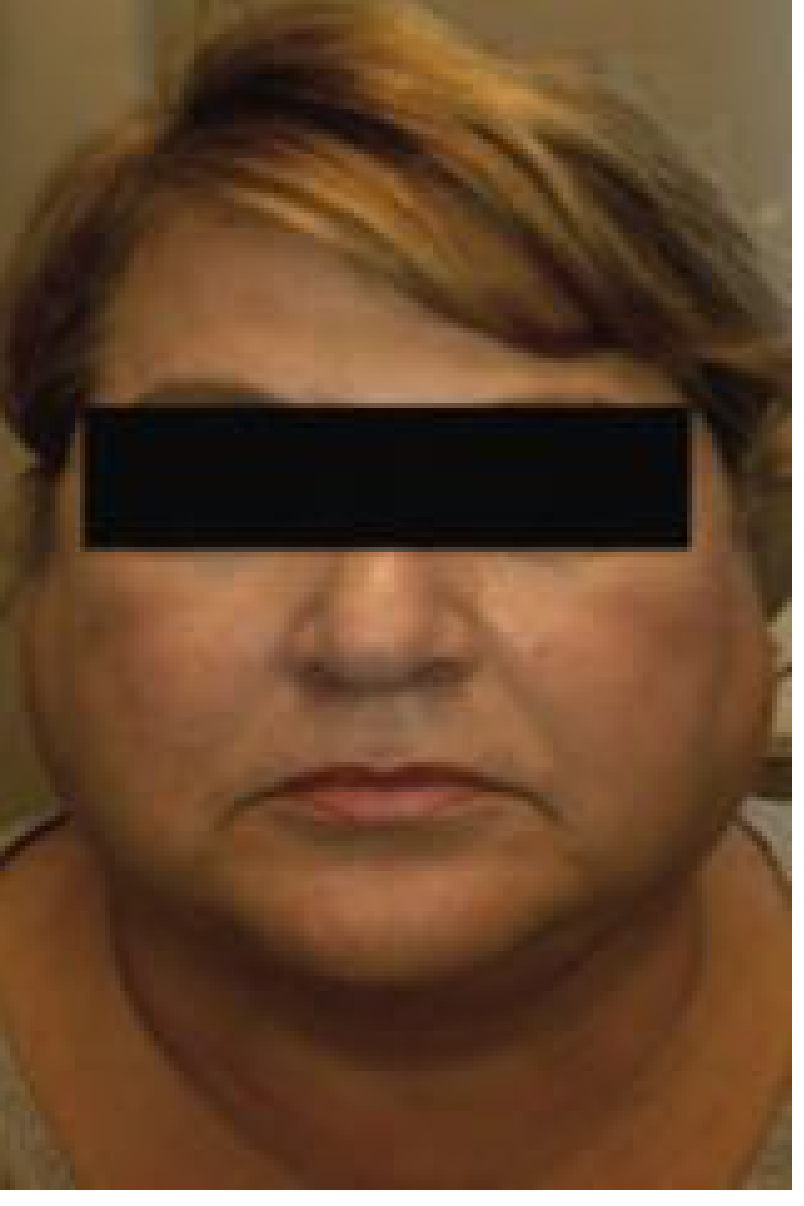
- Parotid gland enlargement in 25-66% of patients - may be unilateral initially, but typically bilateral; can be episodic or chronic
Ocular (Keratoconjunctivitis Sicca):
- "Gritty" or "sandy" foreign body sensation
- Dilated bulbar conjunctival vessels, periorneal injection
- Corneal epithelial irregularity
- Occasional lacrimal gland enlargement
Systemic (Extraglandular) Manifestations
Occur in approximately one-third of patients:
| System | Manifestations |
|---|---|
| Constitutional | Fatigue, generalized malaise, low-grade fever, myalgia, arthralgia |
| Pulmonary | Dryness of pharynx/trachea, bronchitis, pneumonia; NSIP (most common ILD pattern), lymphoid interstitial pneumonia (LIP), amyloidosis |
| Renal | Tubulointerstitial nephritis, distal renal tubular acidosis, impaired concentrating ability, hypercalciuria; rarely glomerulonephritis (mesangial, MPGN, membranous) |
| Vascular | Raynaud phenomenon, recurrent urticaria-like lesions; vasculitis in 20-30% |
| Neurologic | Peripheral sensory and motor polyneuropathies (10-30% of primary SjS); sensory ataxic neuronopathy; small-fiber neuropathy; trigeminal sensory neuropathy; autonomic neuropathy (cardiac parasympathetic dysfunction, anhidrosis, Adie pupil) |
| Skin | Cutaneous vasculitis, dry skin, vaginal dryness |
| GI/Endocrine | Dysphagia, esophageal dysmotility; associated with primary biliary cholangitis, chronic active hepatitis, Crohn disease, thyroid disease |
| Lymphoproliferative | Increased risk of B-cell lymphoma (esp. MALT type) - risk persists for >2 decades; also Waldenström macroglobulinemia |
Key risk: Persistent unilateral or bilateral parotid enlargement is a warning sign for lymphoma development.
Diagnosis
Objective Tests
Ocular evaluation:
- Schirmer test: <8 mm wetting per 5 minutes (or <5 mm in modified test) indicates reduced tear production
- Rose Bengal staining: Stains damaged corneal and conjunctival epithelia - positive in keratoconjunctivitis sicca
Salivary evaluation:
- Salivary flow rate (Lashley cups over Stensen duct)
- Sialography: Demonstrates sialectasis in 85-97% of SjS patients
Tissue biopsy:
- Minor salivary gland biopsy (labial) is the most consistent feature of primary SjS; should include several glandular lobes from areas with normal overlying mucosa
- Histopathology: Focal lymphocytic sialadenitis - multiple mononuclear aggregates adjacent to and replacing normal acini; focus score ≥1 (foci/4 mm²) is diagnostic
Serology:
- Anti-Ro/SS-A and anti-La/SS-B antibodies (ELISA)
- ANA (>1:320), RF (>1:320)
- Elevated ESR, hypergammaglobulinemia
Diagnostic Criteria
San Diego Criteria (Fox et al.) requires all three for definite SjS:
| Criterion | Details |
|---|---|
| A - Ocular | Schirmer test <8 mm/5 min AND positive Rose Bengal staining |
| B - Oral | Decreased parotid flow rate AND minor salivary gland biopsy (focus score ≥1) |
| C - Serologic | Elevated RF (>1:320), ANA (>1:320), or anti-SS-A/SS-B |
Probable SjS can be diagnosed without biopsy (criteria A, B-1 oral flow only, and C).
Exclusions: HIV infection, hepatitis B/C, sarcoidosis, preexisting lymphoma, primary fibromyalgia, keratitis sicca from other causes.
Note: Patients with HIV or hepatitis C virus can present with sicca complex that mimics SjS - these must be excluded before diagnosing SjS.
Pulmonary Radiology (HRCT Findings)
- NSIP is the most common ILD pattern
- LIP (lymphoid interstitial pneumonia): thin-walled cysts + ground-glass opacity
- Association of LIP with amyloidosis produces multiple irregular nodules with cysts
- Mild bronchiectasis is common
- Finding of LIP + nodules/consolidations should raise concern for pulmonary lymphoma
Neurology in Sjögren Syndrome
Peripheral nerve involvement occurs in 10-30% of primary SjS patients and may precede sicca symptoms:
- Most common: Distal symmetrical sensory neuropathy (mixed large/small fiber)
- Sensory ataxic neuronopathy (dorsal root ganglionopathy) - loss of kinesthesia/proprioception; may mimic spinocerebellar ataxia
- Small-fiber neuropathy, polyradiculoneuropathy, multiple mononeuropathies
- Trigeminal sensory neuropathy, autonomic neuropathy
- EMG/NCS: Reduced/absent SNAPs, normal or mildly abnormal motor conduction
- MRI cervical cord: T2 hyperintensity in posterior columns in sensory ganglionopathy
Treatment
Symptomatic Management
| Problem | Treatment |
|---|---|
| Xerostomia | Chew sugarless gum/candy (local stimulation); pilocarpine 5 mg TID-QID (muscarinic agonist sialagogue) - side effects: sweating, flushing, urinary frequency; saliva substitutes |
| Dental caries | Fluoride treatment, preventive dental care |
| Keratoconjunctivitis | Artificial tear lubricants; eye patching if corneal ulceration develops |
| Oral candidiasis | Antifungal agents |
Disease-Modifying / Systemic Treatment
| Indication | Treatment |
|---|---|
| Systemic disease / B-cell depletion | Rituximab (anti-CD20 monoclonal antibody) - reduces both peripheral and salivary gland B-cell subsets; improves xerostomia, fatigue, joint tenderness. Note: not beneficial for low disease activity |
| Severe extraglandular complications (glomerulonephritis, necrotizing vasculitis) | Systemic corticosteroids ± cytotoxic immunosuppressants |
| Emerging therapies | Belimumab (anti-BAFF), abatacept (CTLA4-Ig) - promising in preliminary trials |
Salivary Gland-Specific
- Sialendoscopy: Dilation and irrigation of affected ducts for recurrent sialadenitis - reduces intensity/frequency of episodes
- Gland excision: If all other treatments fail
- Unilateral enlargement despite known SjS should raise suspicion for tumor
Key Associations and Complications
- Lymphoma risk is elevated even after 2+ decades of benign disease - primary SjS is the autoimmune condition with the highest lymphoma risk (predominantly marginal zone / MALT lymphoma)
- Renal tubular acidosis can present with hypokalemic periodic paralysis
- Neonatal lupus/congenital heart block: anti-Ro/SS-A antibodies in pregnant women with SjS can cross the placenta
- Lab: Serum complement is generally normal in primary SjS (unlike SLE); low complement suggests associated cryoglobulinemia or secondary SjS-SLE overlap
Sources: Cummings Otolaryngology Head and Neck Surgery, p. 1497-1499 | Textbook of Family Medicine 9e, p. 698-700 | Brenner and Rector's The Kidney, p. 1487 | Bradley and Daroff's Neurology, p. 2699 | Grainger & Allison's Diagnostic Radiology, p. 238 | Henry's Clinical Diagnosis and Management by Laboratory Methods, p. 1521-1528
This is a shared conversation. Sign in to Orris to start your own chat.