
Rct from park textbook
Reading File
RCT in the context of Park's textbook refers to Randomized Controlled Trial - a key study design covered extensively in epidemiology/community medicine. Let me search the library now.
Searching sources...
Finding Sources
Finding Sources
Park's textbook is confirmed. Now let me search specifically within it for RCT content.
Finding Sources
Finding Sources
The main RCT section is at lines 393-418 in block2. Let me read that full section along with surrounding content.
Reading File
I have very rich content. Let me read the rest of this section to get all the steps fully covered.
Reading File
Loading Image
I have all the essential content. Let me also read the manipulation, follow-up, and outcome assessment sections from the truncated output.
Reading File
I now have comprehensive content from Park's textbook. Let me also get the manipulation/follow-up sections which were in between.
Reading File
I now have all the content needed for a comprehensive answer. Here is the full write-up from Park's Textbook of Preventive and Social Medicine.
Randomized Controlled Trial (RCT) - Park's Textbook
Definition and Overview
An RCT is essentially an epidemiological experiment. It is an important assessment method that uses scientific techniques to evaluate methods of treatment and prevention. Since its introduction, the RCT has questioned the validity of widely used treatments such as oral hypoglycaemic agents, varicose vein stripping, tonsillectomy, hospitalization of all patients with myocardial infarction, and multiphasic screening.
"For new programmes or new therapies, the RCT is the No.1 method of evaluation."
- Park's Textbook of Preventive and Social Medicine
Design of an RCT (Fig. 9)
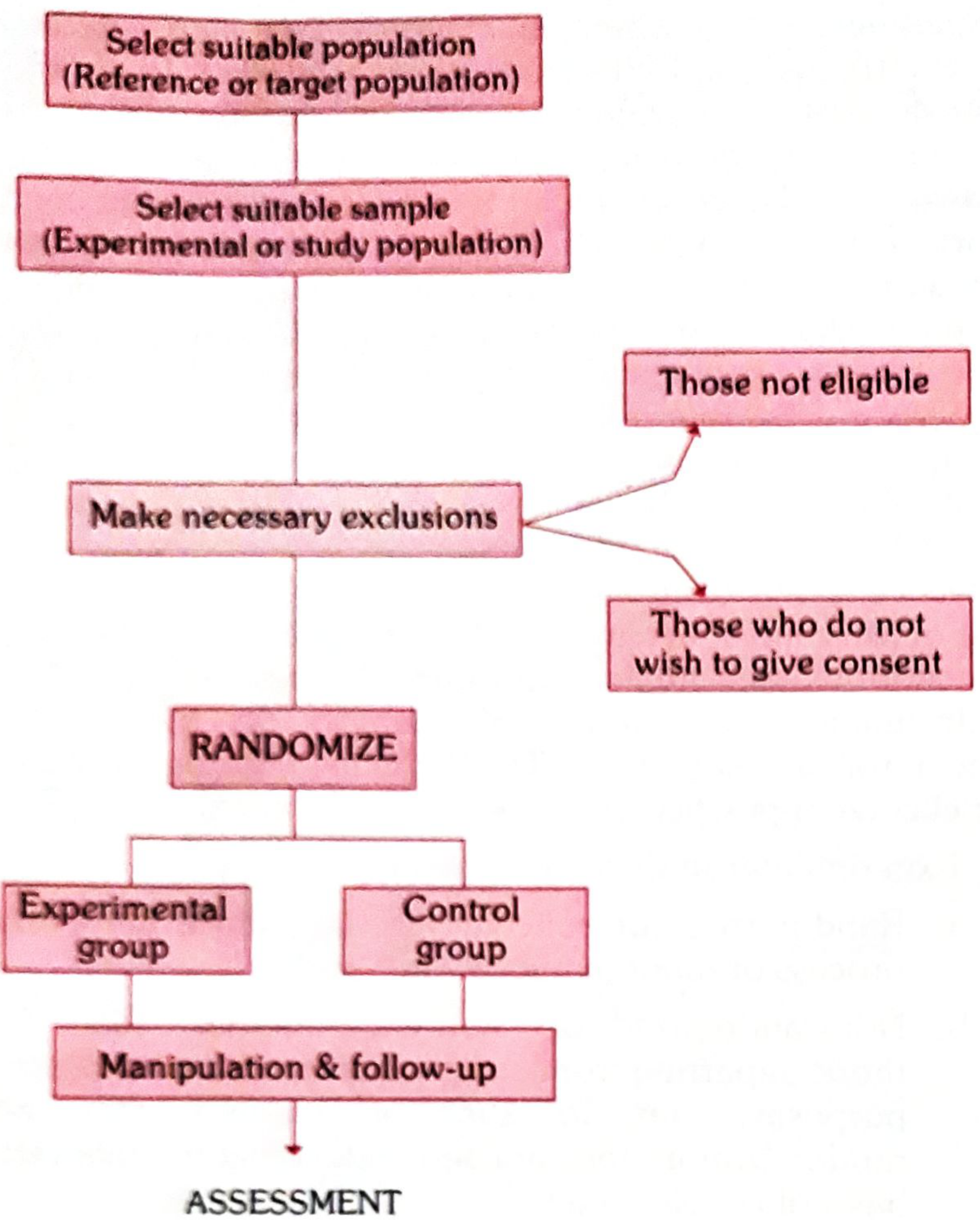
Basic Steps in Conducting an RCT
1. Drawing Up a Protocol
One of the essential features of an RCT is that it is conducted under a strict protocol. The protocol specifies:
- Aims and objectives of the study
- Questions to be answered
- Criteria for selection of study and control groups
- Sample size
- Procedures for allocation of subjects
- Treatments to be applied (when, where, how, and to which patients)
- Standardization of working procedures and schedules
- Responsibilities of all parties involved, up to the evaluation stage
Preliminary test runs (Pilot studies): Sometimes, before a protocol is completed, pilot studies are done to check feasibility, operational efficiency, or acceptability of certain policies. The final protocol must be agreed upon by all concerned before the trial begins.
2. Selecting Reference and Experimental Populations
(a) Reference (Target) Population: The population to which findings, if successful, are expected to be applicable. It may be as broad as mankind or limited geographically or by age, sex, occupation, or social group (e.g., school children, industrial workers, obstetric population).
(b) Experimental (Study) Population: Derived from the reference population. Ideally randomly chosen from it to share the same characteristics. If the study population differs from the reference population, generalization of findings may not be possible.
Participants/volunteers must fulfill three criteria:
- a. Informed consent - must agree after being fully informed about purpose, procedures, and possible dangers
- b. Representative - should be representative of the reference population
- c. Eligible/Qualified - must be susceptible to the disease under study (e.g., non-immune if testing a vaccine; anaemic if testing a drug for anaemia)
Note: Persons who agree to participate are likely to differ from those who do not, in ways that may affect the outcome.
3. Randomization
Randomization is a statistical procedure by which participants are allocated into groups (usually "study" and "control") to receive or not receive an experimental preventive or therapeutic procedure.
Purpose of randomization:
- Eliminates bias
- Allows for comparability
- Distributes known and unknown confounding factors equally between groups
- Eliminates selection bias - the investigator has no control over allocation
"Randomization is the 'heart' of a controlled trial." It gives the greatest confidence that groups are comparable so that "like can be compared with like." Every individual gets an equal chance of being allocated to either group.
The essential difference between an RCT and an analytical study is that in analytical studies there is no randomization, because differentiation into diseased/non-diseased or exposed/non-exposed groups has already taken place.
Methods of randomization:
- Simple randomization: Using random number tables or tossing a coin
- Stratified randomization: Participants are first stratified by important variables (e.g., age, sex, severity of disease), then randomized within strata to ensure balanced groups
4. Manipulation (Intervention)
Having formed the study and control groups, the next step is to intervene or manipulate the study (experimental) group by the deliberate application, withdrawal, or reduction of the suspected causal factor (e.g., drug, vaccine, dietary component, habit) as laid down in the protocol.
- Independent variable: The manipulation itself (e.g., drug, vaccine, new procedure)
- Dependent variable: The measured outcome (e.g., incidence of disease, survival time, recovery period)
5. Follow-up
Examination of the experimental and control group subjects at defined intervals of time, in a standard manner, with equal intensity, under the same circumstances, in the same time frame until final assessment of outcome. Duration depends on when a significant difference is expected to be demonstrable.
Attrition: Some losses to follow-up are inevitable due to death, migration, or loss of interest. If attrition is substantial, it may be difficult to generalize results to the reference population. Every effort should be made to minimize losses to follow-up.
6. Assessment of Outcome
The final step involves comparison of results in both groups:
- (a) Positive results: Benefits of the experimental measure - reduced incidence or severity of disease, cost to health service, etc.
- (b) Negative results: Severity and frequency of side-effects, complications, including death (adverse effects may be missed if not actively sought)
The incidence of positive/negative results is rigorously compared in both groups and differences are tested for statistical significance.
Blinding (to reduce bias in assessment)
Three sources of bias can arise during assessment:
- Subject variation - participants may feel better subjectively if they know they received a new treatment
- Observer bias - the investigator may be influenced by knowing which group the patient belongs to
- Evaluation bias - subconscious favourable reporting of the outcome
Randomization and sample size cannot guard against these biases. To reduce them, blinding is adopted:
| Type | Who is Blind |
|---|---|
| Single Blind | Participant is unaware of group allocation |
| Double Blind | Neither the doctor nor the participant knows group allocation and treatment received |
| Triple Blind | Participant + investigator + person analyzing data are all blind |
Double blinding is the most frequently used method. When an outcome such as death is being measured, blinding is not essential.
Study Designs in RCTs
1. Concurrent Parallel Study Design (Fig. 10a)
- Two randomly assigned groups
- One group exposed to specific treatment, the other not
- Patients remain in their assigned group for the entire duration
2. Cross-over Type Study Design (Fig. 10b)
- Each patient serves as his own control
- Patients randomly assigned to study and control groups initially
- After the first observation period, there is a washout period (to eliminate carry-over effects)
- Then the two groups are switched - those who received treatment cross over to control, and vice versa
- This design is particularly useful for chronic stable conditions
Source: Park's Textbook of Preventive and Social Medicine, pp. 93-96
Case control from park textbook
Searching sources...
Finding Sources
Finding Sources
Main section starts at line 6753. Let me read the full case-control section in parallel chunks.
Reading File
Reading File
Reading File
Loading Image
Now let me get the remaining content - the 2x2 table, selection of cases/controls, matching, odds ratio, and examples.
Reading File
Reading File
Now let me get the matching and odds ratio sections.
Reading File
I now have all the content needed. Here is the comprehensive write-up from Park's Textbook.
Case Control Study - Park's Textbook of Preventive and Social Medicine
Definition and Key Features
Case control studies, often called "retrospective studies", are a common first approach to test causal hypothesis. The case control method has three distinct features:
- a. Both exposure and outcome (disease) have already occurred before the start of the study
- b. The study proceeds backwards from effect to cause (retrospective direction)
- c. It uses a control or comparison group to support or refute an inference
By definition, a case control study involves two populations - cases and controls. The unit is the individual (not the group). The focus is on a disease or health problem that has already developed.
Case control studies have their major use in chronic disease problems where the causal pathway may span many decades.
Design of a Case Control Study (Fig. 8)
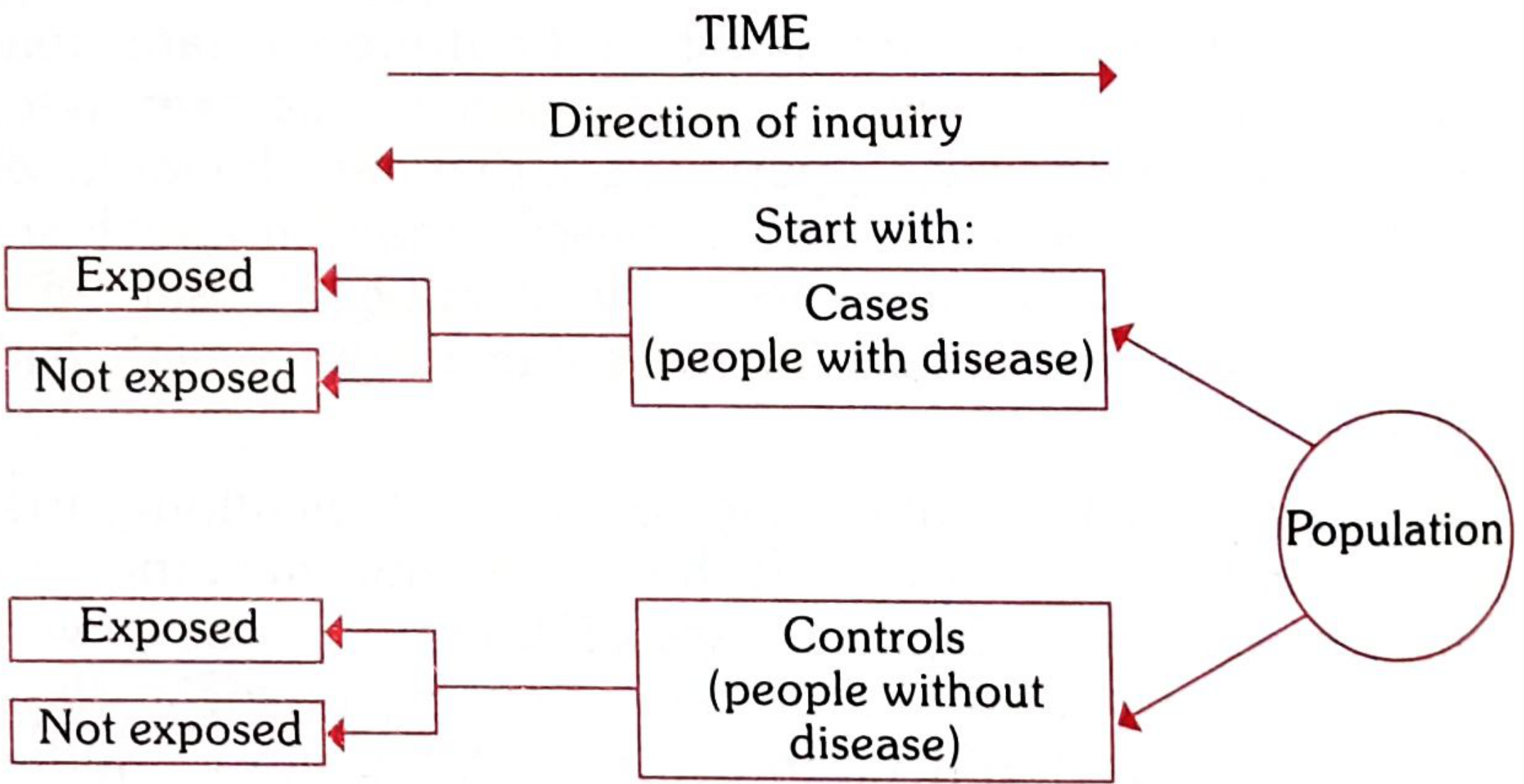
The direction of inquiry is backwards in time - from disease (effect) to exposure (cause).
The 2×2 Contingency Table (Table 11)
Framework of a case control study:
| Suspected Risk Factor | Cases (Disease present) | Controls (Disease absent) |
|---|---|---|
| Present | a | b |
| Absent | c | d |
| Total | a + c | b + d |
- If frequency of exposure in cases a/(a+c) is higher than in controls b/(b+d), an association is said to exist.
Basic Steps in Conducting a Case Control Study
There are four basic steps:
- Selection of cases and controls
- Matching
- Measurement of exposure
- Analysis and interpretation
Step 1 - Selection of Cases and Controls
(1) Selection of Cases
(a) Definition of a case involves two specifications:
- Diagnostic criteria: Must be specified before the study - e.g., histological criteria for cancer; once established, must not be altered
- Eligibility criteria: E.g., cases must be newly diagnosed (incident cases)
Sources of cases:
- (i) Hospitals: Cases drawn from a single hospital or network during a specified period. Entire case series or a random sample is selected.
- (ii) General population: In a population-based case control study, all cases occurring within a defined geographic area during a specified period are ascertained through a survey, disease registry, or hospital network. Cases should be representative of all cases in the community.
(2) Selection of Controls
Controls must be:
- Free from the disease under study
- As similar to cases as possible except for the absence of the disease
Sources of controls:
- (i) Hospital controls: From the same hospital with different illnesses. Risk: hospital controls are often a source of selection bias (many hospital patients may have diseases also influenced by the factor under study - e.g., bladder cancer as controls when studying smoking and MI would mask the association)
- (ii) Relatives: Spouses and siblings. Note: sibling controls are unsuitable where genetic conditions are under study
- (iii) Neighbours: Living in the same neighbourhood, matched for age, sex, etc.
- (iv) General population: Random sample from the general population
How many controls?
- If many cases are available and cost of collecting case and control is equal: one control per case (1:1)
- If cases are rare, increasing the ratio of controls to cases (up to 4:1) can improve statistical power; beyond this ratio there is little gain
Step 2 - Matching
Matching is the process by which controls are selected so that they are similar to the cases with regard to certain pertinent variables (confounding factors) such as age, sex, race, occupation, social status. Matching is used to control confounding.
Two types:
- Group (frequency) matching: Cases and controls are matched as groups (e.g., same proportion of males and females in both groups)
- Individual (pair) matching: Each case is individually matched with a specific control(s) of similar characteristics
Step 3 - Measurement of Exposure
Definitions and criteria about exposure (variables of aetiological importance) must be as carefully defined as those for cases and controls. Information about exposure should be obtained in precisely the same manner for both cases and controls, via:
- Interviews
- Questionnaires
- Past records (hospital records, employment records, etc.)
The most important factor when testing associations is the question of "bias" or systematic error, which must be ruled out - even more important than the P values obtained.
Step 4 - Analysis and Interpretation
Two key analyses:
(a) Exposure Rates
A case control study provides a direct estimation of exposure rates (frequency of exposure) to a suspected factor in disease and non-disease groups.
Example - Smoking and Lung Cancer (Table 12):
| Cases (lung cancer) | Controls (without lung cancer) | Total | |
|---|---|---|---|
| Smokers | 33 (a) | 55 (b) | 88 |
| Non-smokers | 2 (c) | 27 (d) | 29 |
| Total | 35 | 82 | 117 |
- Exposure rate in cases = a/(a+c) = 33/35 = 94.2%
- Exposure rate in controls = b/(b+d) = 55/82 = 67.0%
- P < 0.001 → statistically significant association
(b) Odds Ratio (OR) - Estimation of Disease Risk
A case control study cannot directly calculate incidence rates or relative risk. Instead, it estimates risk through the Odds Ratio (OR), also called the cross-product ratio or relative odds.
Formula:
$$OR = \frac{ad}{bc}$$
Using the smoking/lung cancer data:
OR = (33 × 27) / (55 × 2) = 891/110 = 8.1
This means smokers have approximately 8 times the odds of developing lung cancer compared to non-smokers.
When the disease is rare in the population (< 5-10%), the odds ratio is a good approximation of the relative risk.
Bias in Case Control Studies
Bias = any systematic error in determining the association between exposure and disease.
| Type of Bias | Description |
|---|---|
| Confounding bias | Due to confounding variables; controlled by matching |
| Memory (Recall) bias | Cases are more likely to recall past exposures than healthy controls (e.g., post-MI patients recall habits more vividly) |
| Selection bias | Cases and controls may not be representative of the general population; systematic differences in their characteristics |
| Berkesonian bias | Arises because of different rates of hospital admission for people with different diseases (named after Dr. Joseph Berkeson) |
| Interviewer's bias | Interviewer knowing the hypothesis may question cases more thoroughly than controls; controlled by double-blinding |
Advantages and Disadvantages
Advantages
- Relatively easy to carry out
- Rapid and inexpensive (compared to cohort studies)
- Require comparatively few subjects
- Particularly suitable for rare diseases or diseases about which little is known
- No risk to subjects
- Allows study of several different aetiological factors simultaneously (e.g., smoking, physical activity, personality in MI)
- Risk factors can be identified - rational prevention and control programmes can be established
- No attrition problems - no follow-up of individuals into the future is required
- Ethical problems minimal
Disadvantages
- Problems of bias - relies on memory or past records; validation may be difficult or impossible
- Selection of an appropriate control group may be difficult
- Cannot measure incidence; can only estimate relative risk (via OR)
- Does not distinguish between causes and associated factors
- Not suited to evaluation of therapy or prophylaxis of disease
- Concern about representativeness of cases and controls
Classic Examples of Case Control Studies
- Cigarette smoking and lung cancer (Doll & Hill)
- Maternal smoking and congenital malformations
- Radiation and leukaemia
- Oral contraceptive use and hepatocellular adenoma
- Physical activity and coronary death
- Artificial sweeteners and bladder cancer
Landmark Example - Vaginal Adenocarcinoma and DES:
7 young women (15-22 years) developed vaginal adenocarcinoma at one Boston hospital between 1966-1969 (a rare "time clustering"). A case control study in 1971 matched each case with 4 controls from birth records. Results showed that 7 of 8 cases had been exposed to DES (diethylstilbestrol) in foetal life - the drug had been given to their mothers in the first trimester to prevent miscarriage. None of the controls had DES exposure. The study confirmed DES in utero as the cause of vaginal adenocarcinoma 10-20 years later - a landmark demonstration of the power of the case control method.
Source: Park's Textbook of Preventive and Social Medicine, pp. 83-87
This is a shared conversation. Sign in to Orris to start your own chat.