
Childhood schizophrenia
Reading File
Childhood schizophrenia (also called early-onset schizophrenia) is a rare but severe psychiatric disorder. Let me pull authoritative textbook content alongside recent evidence.
Searching sources...
Finding Sources
Finding Sources
Searching PubMed
"childhood schizophrenia" OR "early-onset schizophrenia"
Good - found dedicated sections in both Kaplan & Sadock's Comprehensive Textbook and Synopsis. Let me read all of them in parallel.
Reading File
Reading File
Reading File
Excellent content. Now let me read the full dedicated COS section from the Comprehensive Textbook (block50) which has 5 paragraphs spanning a wide range, and also search for treatment-specific content.
Reading File
Finding Sources
Good content on neurobiology. Now let me search for the clinical features, epidemiology, diagnostic criteria, and treatment sections.
Finding Sources
Finding Sources
Let me read the pharmacotherapy and detailed clinical sections from the Synopsis.
Reading File
Reading File
Excellent - I now have comprehensive content. Let me also get the epidemiology and clinical features section, and the brain scan image.
Reading File
Loading Image
I now have comprehensive content to write a thorough response. Let me compile everything.
Childhood-Onset Schizophrenia (COS)
Definition and Epidemiology
Childhood-onset schizophrenia (COS) is defined as schizophrenia with onset before age 13 (some texts use before 17); onset before 5 is virtually nonexistent. It is a rare condition - incidence is less than 1 in 10,000 - making it far less common than adult schizophrenia. There is a slight male predominance (M:F ratio approximately 1.67:1). COS is considered a more severe form of the disease, with higher rates of premorbid abnormalities and a generally worse prognosis than adult-onset schizophrenia.
- Kaplan and Sadock's Synopsis of Psychiatry, p. 669
- Kaplan & Sadock's Comprehensive Textbook of Psychiatry, p. 10891
Etiology and Risk Factors
Genetic factors dominate. A family history of schizophrenia is markedly increased in COS. Healthy siblings of COS patients show gray matter deficits in left prefrontal and bilateral temporal cortices, suggesting familial/trait markers.
Neurodevelopmental factors:
- Premorbid delays in motor milestones and language acquisition (resembling autism spectrum disorder features) are common
- Prenatal and perinatal complications are not specifically increased (unlike ASD)
- Exaggerated neuronal pruning is implicated in pathogenesis
- COMT gene polymorphism may modulate frontal deficits
Environmental risk factors: Psychosocial/family stressors (high expressed emotion - "high EE" families) are known to influence relapse rate.
Pathophysiology and Neuroimaging
COS shows more severe neurobiological changes than adult schizophrenia, making it a valuable model for studying schizophrenia neurobiology:
Gray and white matter:
- Smaller total brain volume (even more dramatic than in adults)
- Progressive loss of gray and white matter in periventricular regions: posterior cingulate, caudate, thalamus
- Slower growth of parietal white matter
- Reduced fractional anisotropy in the cuneus (also seen in healthy siblings)
Prefrontal cortex / insula / temporal lobe:
- Lower NAA (neuronal marker) and reduced gray matter in frontal and anterior cingulate cortices
- Smaller right and left insula volumes; right insula inversely correlates with positive symptoms
- Smaller superior temporal gyrus volumes - correlate with symptom severity; normalize somewhat after pharmacotherapy
- Siblings show reduced activation of frontal and striatal regions (cortical-striatal dysfunction as a liability marker)
Hippocampus and amygdala:
- Significant bilateral hippocampal volume deficit (~9-10%), persisting from age 9-26
- Anterior hippocampal inward deformation correlates with positive symptoms
- Amygdala-hippocampal volume reduction found in patients AND unaffected relatives
Subcortical structures:
- Increased caudate volume (partly due to typical neuroleptic exposure - normalizes with clozapine)
- Decreased thalamic volume - one of the most consistent findings in psychotropic-naïve patients
The figure below from the NIMH longitudinal study demonstrates progressive gray matter loss in COS compared to healthy controls:
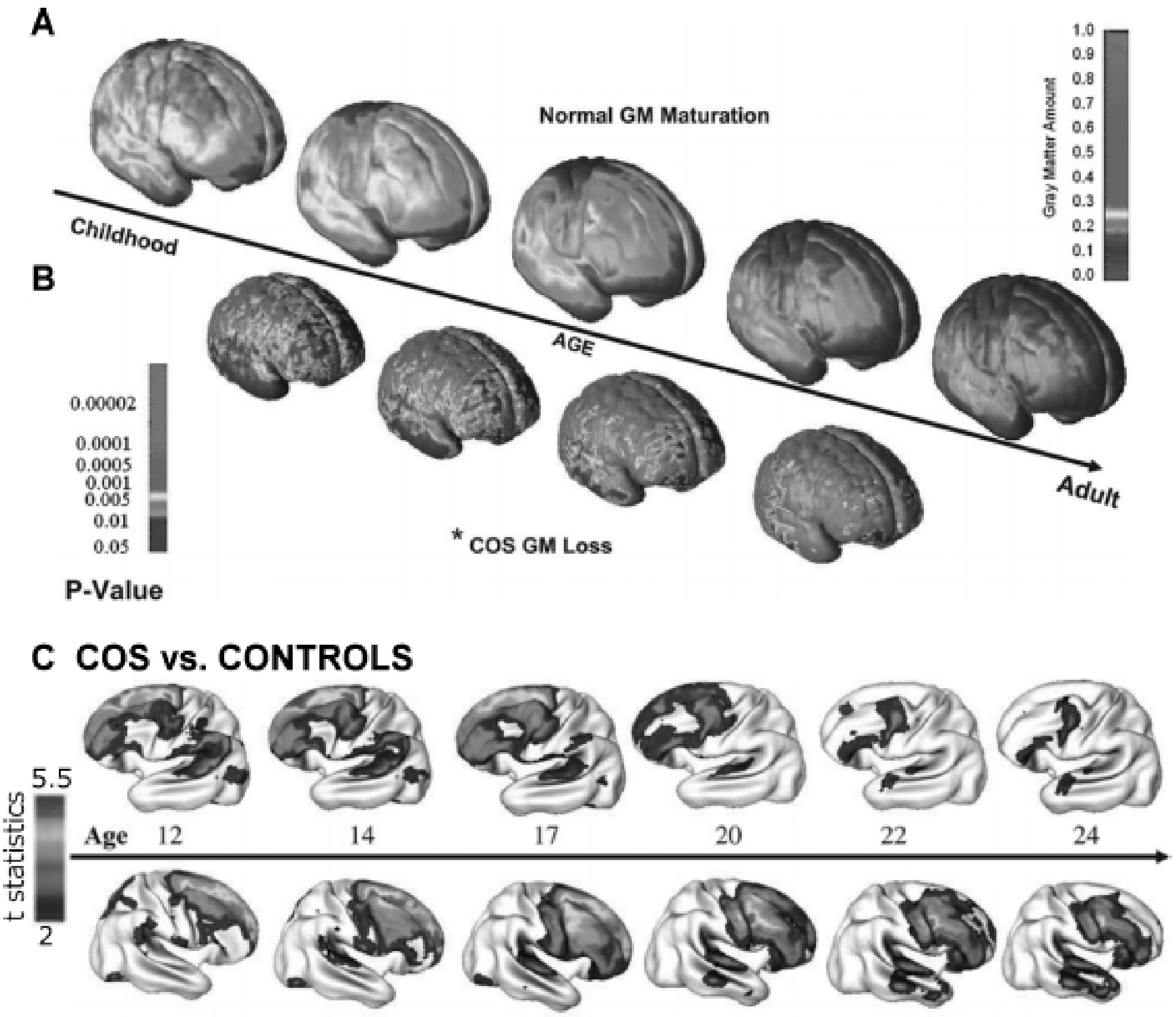
FIGURE: Right lateral views of (A) normal gray matter maturation in healthy youth ages 4-22, (B) global gray matter loss in COS vs. controls, and (C) progressive GM deficits in COS from ages 12 to 24 - showing that COS follows an exaggerated form of normal cortical maturation. - Kaplan & Sadock's Comprehensive Textbook, p. 10892
Clinical Features
All symptoms seen in adult schizophrenia can occur in children, but presentation differs based on developmental level:
Positive Symptoms
Hallucinations are the most common feature:
- Auditory hallucinations predominate - voices may offer running commentary, command the child to harm themselves or others, or sound like "a computer in my head," "Martians," or familiar relatives
- The NIMH COS project found unexpectedly high rates of tactile, olfactory, and visual hallucinations - visual ones (seeing devils, skeletons, scary faces) are associated with lower IQ and earlier onset
- Visual, tactile, and olfactory hallucinations are markers of more severe psychosis
Delusions occur in up to 50% of children and adolescents:
- Types: persecutory, grandiose, religious
- Content is developmentally influenced - young children have simpler delusions featuring age-appropriate fears (monsters, animals); older children develop more complex ones
- Frequency increases with age
Thought disorder:
- Loosening of associations, thought blocking, illogical thinking, poverty of thought
- Unlike adults, children do NOT show poverty of speech content but speak less and communicate more ambiguously
- Failure to self-correct (no self-initiated repair) is a distinctive communication deficit
Negative Symptoms
- Blunted or inappropriate affect (near universal) - giggling for no reason, crying inexplicably
- Avolition, apathy, social withdrawal
- Academic and social decline
Premorbid Features
- Social rejection, poor peer relationships, clingy/withdrawn behavior
- Academic difficulties
- Some children show delayed motor milestones and language acquisition similar to ASD
- Comorbid ADHD and conduct disorder are common
Differential Diagnosis
| Condition | Key Distinguishing Features |
|---|---|
| Autism Spectrum Disorder (ASD) | Early developmental onset; poor social relatedness; stereotypies; no hallucinations/delusions as core features; seizures in 4-32%; no family history of schizophrenia |
| Bipolar I Disorder | 1/3 of children initially diagnosed COS are later rediagnosed with bipolar disorder in adolescence; better long-term prognosis |
| Substance-induced psychosis | Amphetamines, LSD, PCP can cause paranoid psychosis; sudden flagrant onset is a clue |
| Medical causes | Thyroid disease, SLE, temporal lobe epilepsy |
| Anxiety/PTSD | Anxious children can have quasi-delusional thinking; PTSD flashbacks can mimic hallucinations |
| Depression/mania | Mood disorders can include nihilistic/grandiose delusions |
| Intellectual disability | Global impairments in verbal and nonverbal; relates socially per mental age |
- Kaplan and Sadock's Synopsis of Psychiatry, p. 404 (Table 2-13)
Course and Prognosis
COS generally carries a guarded prognosis - worse than adult-onset schizophrenia. Key predictors:
Poor prognostic factors:
- Early age of onset and insidious onset
- Family history of schizophrenia
- Premorbid developmental delays, lower IQ, lower functioning
- Comorbid ADHD or conduct disorder
- Long or chronic first psychotic episode
- High expressed emotion (high EE) in the family
Moderating factors: Response to pharmacological and psychosocial interventions, degree of remission after first episode, degree of family support.
The NIMH Treatment of Early-Onset Schizophrenia study (comparing molindone, olanzapine, and risperidone) found modest but significant improvement in neurocognitive functioning with antipsychotic treatment over 1 year, with no significant differences among the three agents.
Treatment
Treatment requires a multimodal approach.
Psychosocial Interventions
- Psychoeducation for families - ongoing family therapeutic interventions are critical; high EE predicts relapse
- CBT - effective component of integrated psychological intervention (IPI)
- Group skills training and cognitive remediation therapy
- Multifamily psychoeducation
- Appropriate educational placement - addressing frequent social skills deficits, attention deficits, and academic difficulties
- An RCT of integrated psychological interventions (IPI) in early prodromal youth was more effective than standard treatment in delaying psychosis onset over 2 years
Pharmacotherapy
Second-generation antipsychotics (SGAs) are the first-line treatment. Six RCTs support their efficacy in early-onset schizophrenia, with limited evidence favoring one agent over another.
| Agent | Notes |
|---|---|
| Risperidone | FDA-approved for schizophrenia in adolescents; increases frontal activation (unlike typicals) |
| Olanzapine | Compared to clozapine in a double-blind RCT; significant weight gain concern |
| Aripiprazole | FDA-approved for adolescents |
| Quetiapine | Used in practice; sedation profile can be limiting |
| Lurasidone | FDA-approved for adolescents (2017) |
| Paliperidone | FDA-approved for adolescents (2017) |
| Clozapine | Most effective for positive AND negative symptoms, but last resort due to side effects (agranulocytosis, seizures, metabolic effects); normalizes caudate volume after switching from typicals |
Important caveats in children:
- Children have less robust responses to antipsychotics than adolescents and adults
- Use the lowest effective dosage - children are more vulnerable to side effects
- Greater vulnerability to extrapyramidal symptoms (EPS) with D2 antagonists
- Greater risk of weight gain and metabolic abnormalities with SGAs
- Antipsychotic drugs may impair learning in this population
- Typical neuroleptics decrease frontal cortical activation; atypicals (e.g., risperidone) increase frontal activation
Key Comparison: COS vs. ASD
| Feature | ASD | COS (before puberty) |
|---|---|---|
| Age of onset | Early developmental | Rarely under age 5 |
| Incidence | ~1% | <1 in 10,000 |
| M:F ratio | 4:1 | 1.67:1 |
| Family Hx of schizophrenia | Not increased | Increased |
| Perinatal complications | Increased | Not increased |
| Core symptoms | Poor social relatedness, stereotypies, language abnormalities | Hallucinations, delusions, thought disorder |
| Adaptive functioning | Impaired | Deterioration from baseline |
| IQ | Wide range; 30% intellectually disabled | Usually normal/low average |
| Seizures | 4-32% | Low incidence |
- Kaplan and Sadock's Synopsis of Psychiatry, p. 404
Sources:
- Kaplan & Sadock's Comprehensive Textbook of Psychiatry (10th ed.), Chapter 37, pp. 10891-10894
- Kaplan and Sadock's Synopsis of Psychiatry, pp. 669-676
This is a shared conversation. Sign in to Orris to start your own chat.