

9c0593b2-2328-416d-9498-6d987c4d57fb.jpeg
Please explain in detail step 1, preparation
I can see the image shows a page from a pharmacology textbook covering Enzyme Kinetics (Michaelis-Menten kinetics and Lineweaver-Burk plots). However, the image does not contain a "Step 1: Preparation" - it appears you may be referring to a different image or document.
Could you clarify what procedure or protocol you're asking about?
Asking for Preferences
The image you shared shows a pharmacology page on enzyme kinetics (Michaelis-Menten, inhibitors, Lineweaver-Burk plots). There is no 'Step 1: Preparation' visible in it. What are you referring to?
The first concept on this page is Michaelis-Menten kinetics. Let me give you a thorough explanation.
Searching sources...
Reading File
Finding Sources
Finding Sources
Reading File
Reading File
Reading File
Loading Image
Here is a detailed explanation of Michaelis-Menten Kinetics - the first (and foundational) concept on the page you shared.
Michaelis-Menten Kinetics - Detailed Explanation
Background
In 1913, Leonor Michaelis and Maud Menten proposed a model to explain how most enzyme-catalyzed reactions behave. The model is based on a simple sequence of events:
E + S ⇌ ES → E + P
- E = free enzyme
- S = substrate
- ES = enzyme-substrate complex
- P = product
- k₁ = rate of ES formation
- k₋₁ = rate of ES dissociation back to E + S
- k₂ (kcat) = rate of ES breakdown to E + P
The Michaelis-Menten Equation
The central equation is:
v₀ = (Vmax × [S]) / (Km + [S])
Where:
- v₀ = initial reaction velocity (how fast the reaction is going right now)
- Vmax = maximum possible velocity (when all enzyme molecules are saturated with substrate)
- [S] = substrate concentration
- Km = Michaelis constant
Three Key Assumptions
The equation is derived using three critical assumptions, per Lippincott's Biochemistry:
-
[S] >> [E]: Substrate concentration is far greater than enzyme concentration, so the proportion of total substrate bound to enzyme at any moment is negligible.
-
Steady-state assumption: The concentration of the ES complex stays constant over time. This means the rate of ES formation equals the rate of ES breakdown (both back to E+S and forward to E+P). This is the "steady-state" - ES is neither accumulating nor being depleted.
-
Initial velocity (v₀): Only the very first moments of the reaction are measured. At t=0, product concentration is essentially zero, so the reverse reaction (P → S) can be ignored.
The Hyperbolic Curve
Plotting v₀ (y-axis) vs. [S] (x-axis) produces a rectangular hyperbola:
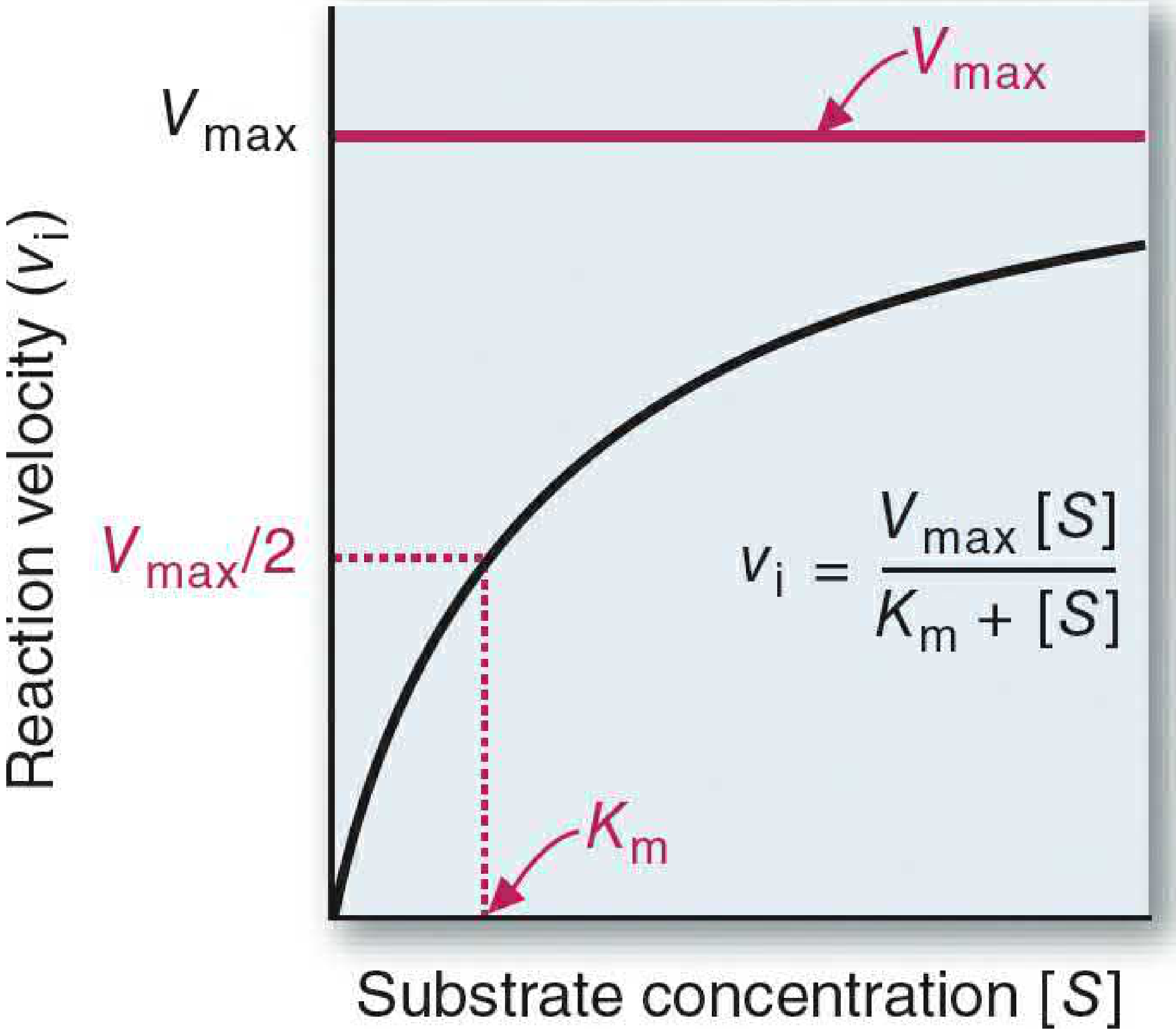
The curve has two distinct phases:
- At low [S]: velocity rises steeply and almost linearly with [S]
- At high [S]: velocity plateaus and asymptotically approaches Vmax (saturation kinetics)
This saturation behavior happens because at very high [S], all enzyme active sites are occupied - adding more substrate cannot speed things up further.
Contrast: If an enzyme shows a sigmoidal (S-shaped) curve instead of a hyperbola, it indicates cooperative kinetics (like hemoglobin binding oxygen). These enzymes do NOT follow Michaelis-Menten kinetics.
Understanding Vmax
- Vmax = kcat × [E]total
- Vmax is directly proportional to enzyme concentration - double the enzyme, double the Vmax
- It represents the reaction speed when every single enzyme molecule has a substrate bound
- It is a theoretical ceiling - never fully reached in practice (you would need infinite [S])
Understanding Km (the Michaelis Constant)
- Km = (k₋₁ + k₂) / k₁
- Numerically, Km = the [S] at which v₀ = ½ Vmax (read directly off the graph)
- Km is inversely related to enzyme-substrate affinity:
- Low Km → high affinity → enzyme reaches half-maximal velocity at a low substrate concentration
- High Km → low affinity → enzyme needs a lot of substrate to get going
- Km does not change with enzyme concentration
- It is characteristic of a specific enzyme-substrate pair (like a fingerprint of their interaction)
Practical Significance
| Situation | What happens |
|---|---|
| [S] << Km | Velocity increases nearly proportionally to [S] (first-order kinetics) |
| [S] = Km | v₀ = ½ Vmax |
| [S] >> Km | Velocity approaches Vmax (zero-order kinetics - independent of [S]) |
This is clinically relevant: most drugs act as enzyme substrates or inhibitors, and understanding Km tells you how much drug (substrate concentration) is needed to engage the enzyme meaningfully.
Summary of Key Points (from the textbook page)
| Parameter | What it tells you |
|---|---|
| Km | Inversely related to enzyme-substrate affinity |
| Vmax | Directly proportional to enzyme concentration |
| Hyperbolic curve | Typical Michaelis-Menten behavior |
| Sigmoidal curve | Cooperative kinetics (e.g., hemoglobin) |
- Biochemistry, 8th ed., Lippincott Illustrated Reviews, pp. 182-183
- Basic Medical Biochemistry, 6th ed., pp. 268-269
This is a shared conversation. Sign in to Orris to start your own chat.