
https://youtu.be/xk5E9ChRIOA?si=xQfZFFj8eyc90izH. explain me this video of sympathetic nervous system in detail
Reading File
Reading Web Page
https://youtu.be/xk5E9ChRIOA?si=xQfZFFj8eyc90izH
I can't directly access or play YouTube videos, but I can see this is a video about the sympathetic nervous system. I'll pull comprehensive content from the medical textbook library to give you a thorough explanation of everything a typical SNS video like this would cover.
Searching sources...
Finding Sources
Searching the Web
sympathetic nervous system anatomy physiology explained YouTube xk5E9ChRIOA
Reading File
Finding Sources
Reading File
Reading File
Reading File
Finding Sources
Loading Image
Finding Sources
I now have all the textbook material needed for a thorough explanation. Here is the complete breakdown of the Sympathetic Nervous System, covering exactly what such a video would teach:
The Sympathetic Nervous System - Complete Explanation
Note: I cannot directly play or access YouTube videos, but I can give you a full, detailed explanation of the sympathetic nervous system - the exact topic covered in that video - using authoritative medical textbooks.
1. What Is It? - Overview
The sympathetic nervous system (SNS) is one of the two main divisions of the autonomic nervous system (ANS). The ANS controls involuntary body functions - things your body does automatically without conscious thought. The other division is the parasympathetic nervous system (PSNS).
The SNS is the body's "fight or flight" system. When you face stress, danger, or physical demand, the SNS is activated to prepare you for action. Its effects include:
- Increased arterial blood pressure
- Increased blood flow to active (skeletal) muscles
- Elevated metabolic rate and blood glucose
- Heightened mental alertness
Even when you're not in crisis, the SNS is always working in the background, continuously modulating your heart, blood vessels, gut, airways, and sweat glands.
- Costanzo Physiology 7th Edition, p. 56
2. Anatomy - The Structural Organization
Here is the full anatomical diagram of the SNS:
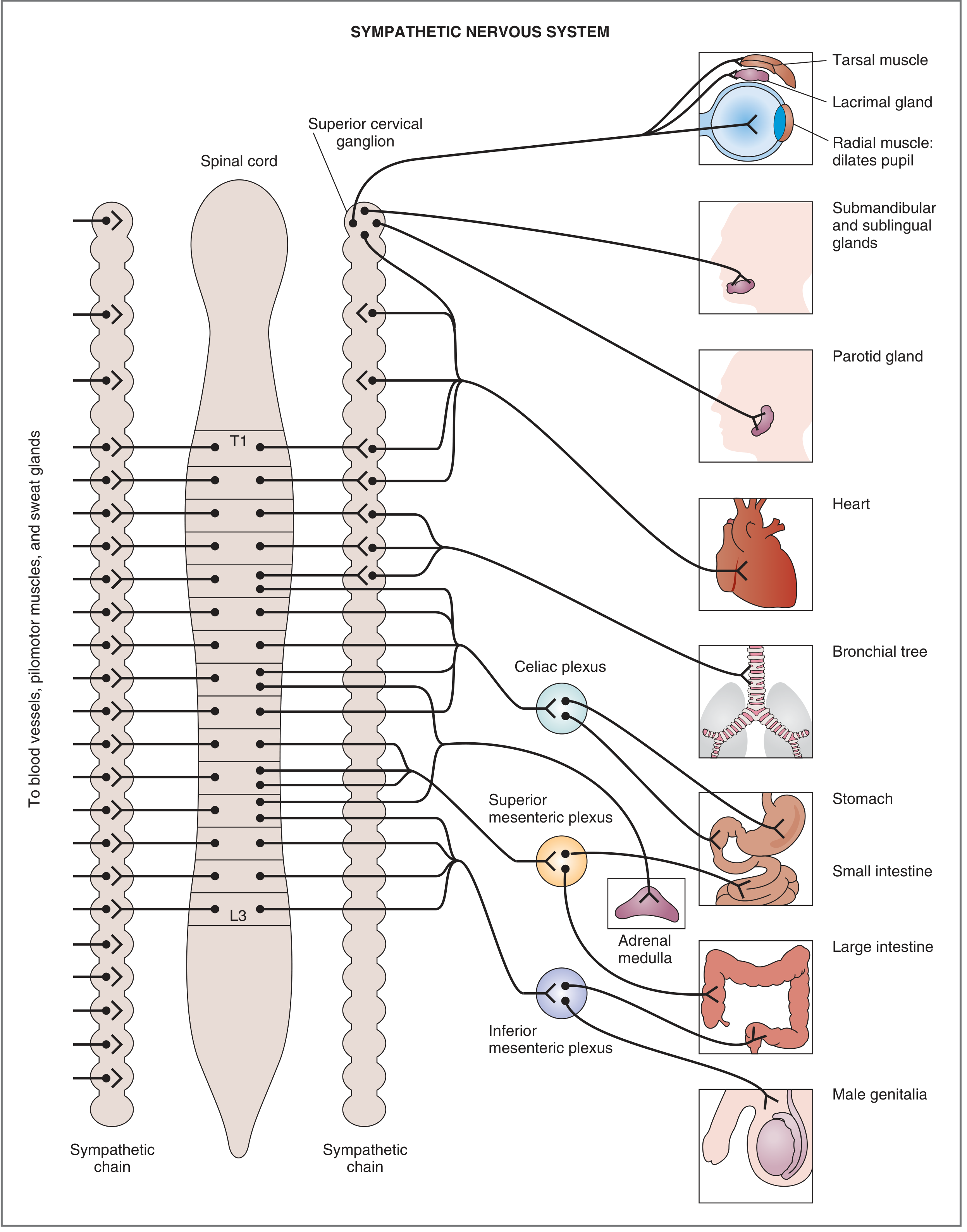
A. Where Do the Signals Come From? - Preganglionic Neurons
The SNS originates in the thoracic and lumbar spinal cord, specifically segments T1 through L3. This is why the SNS is called the "thoracolumbar" division.
The origin is anatomically logical:
- Upper thoracic (T1-T5) preganglionic neurons control the heart and upper body
- Lower thoracic and lumbar neurons control pelvic organs (colon, bladder, genitals)
- Blood vessels, sweat glands, and pilomotor muscles (hair-raising) have preganglionic neurons spread across multiple levels of the chain
B. The Sympathetic Chain (Paravertebral Ganglia)
After leaving the spinal cord via the ventral motor roots and white rami, the preganglionic axons enter the sympathetic chain - a long ladder-like structure of ganglia running on either side of the vertebral column from neck to pelvis.
A key feature: preganglionic fibers can travel up or down the chain to synapse at ganglia above or below their entry point. This produces the diffuse, widespread character of sympathetic responses (activating many organs at once).
C. Prevertebral Ganglia
Some preganglionic fibers pass straight through the sympathetic chain without synapsing, and travel out to prevertebral ganglia located closer to the target organs:
| Ganglion | Organs Supplied |
|---|---|
| Celiac ganglion | Stomach, small intestine |
| Superior mesenteric ganglion | Small and large intestine |
| Inferior mesenteric ganglion | Lower large intestine, bladder, genitalia |
| Superior cervical ganglion | Eyes, salivary glands, head and neck structures |
D. Axon Length Rule
Because sympathetic ganglia are located near the spinal cord, the pattern is:
- Short preganglionic axons (from cord to ganglion)
- Long postganglionic axons (from ganglion to effector organ)
This is the opposite of the parasympathetic system, where the ganglia are located near or within target organs.
- Costanzo Physiology 7th Edition, p. 57-58
3. The Adrenal Medulla - A Special Sympathetic Ganglion
The adrenal medulla (the inner portion of the adrenal gland sitting atop each kidney) is essentially a modified sympathetic ganglion. Its preganglionic neurons originate at T5-T9, travel through the sympathetic chain and celiac ganglion without synapsing, and reach the adrenal gland via the greater splanchnic nerve.
When stimulated, the adrenal medulla secretes epinephrine (adrenaline) and norepinephrine directly into the bloodstream. This is how the SNS produces rapid, body-wide effects - instead of just acting via local nerve endings, it floods the entire circulation with catecholamines.
- Costanzo Physiology 7th Edition, p. 58
4. Neurotransmitters and Receptors - The Chemical Signals
This is the core pharmacology of the SNS:
Preganglionic Neurons (always cholinergic)
- Release: Acetylcholine (ACh)
- Receptor on postganglionic neuron cell body: Nicotinic (N2) receptors
Postganglionic Neurons (almost always adrenergic)
- Release: Norepinephrine (NE)
- Exception: Thermoregulatory sweat glands receive sympathetic cholinergic fibers (they release ACh onto muscarinic receptors - this is why sweating is triggered by SNS activation despite using ACh)
Adrenergic Receptors on Target Organs
| Receptor | Location | Effect When Activated |
|---|---|---|
| Alpha-1 (α1) | Blood vessels, internal sphincters | Vasoconstriction, sphincter contraction |
| Alpha-2 (α2) | Presynaptic nerve terminals, some vessels | Feedback inhibition of NE release |
| Beta-1 (β1) | Heart, kidneys | Increased heart rate and contractility, renin release |
| Beta-2 (β2) | Bronchi, blood vessels in muscle, bladder wall | Bronchodilation, vasodilation, relaxation |
- Costanzo Physiology 7th Edition, p. 58-59
5. Sympathetic Varicosities - How NE Is Released
Sympathetic postganglionic adrenergic neurons don't form classic synapses - they have bead-like varicosities along the nerve fiber that release neurotransmitters en masse onto target tissues (like vascular smooth muscle).
Each varicosity contains:
- Small dense-core vesicles: contain norepinephrine + ATP (co-released together)
- Large dense-core vesicles: contain neuropeptide Y (released with intense stimulation)
The sequence of action on smooth muscle:
- ATP acts first - binds purinergic receptors, causing a quick initial contraction
- Norepinephrine acts second - binds α1 receptors, causing a stronger, more prolonged contraction
- Neuropeptide Y acts last - with high-frequency stimulation, causes a slow, sustained third wave of contraction
- Costanzo Physiology 7th Edition, p. 59-60
6. Effects on Major Organ Systems - "Fight or Flight" in Action
| Organ | Sympathetic Effect | Receptor |
|---|---|---|
| Heart (SA node) | Increased heart rate | β1 |
| Heart (myocardium) | Increased contractility | β1 |
| Blood vessels (skin, viscera) | Vasoconstriction | α1 |
| Blood vessels (skeletal muscle) | Vasodilation | β2 |
| Lungs (bronchi) | Bronchodilation | β2 |
| Pupils (radial muscle of iris) | Dilation (mydriasis) | α1 |
| GI tract (wall) | Decreased motility (relaxation) | β2 |
| GI tract (sphincters) | Contraction | α1 |
| Urinary bladder (detrusor) | Relaxation (filling) | β2 |
| Urinary bladder (sphincter) | Contraction | α1 |
| Sweat glands (thermoregulatory) | Sweating | Muscarinic (cholinergic) |
| Liver | Glycogenolysis (glucose release) | β2/α |
| Adrenal medulla | Epinephrine + NE secretion | N (nicotinic) |
| Male genitalia | Ejaculation | α1 |
- Costanzo Physiology 7th Edition, p. 62-65
7. Sympathetic vs. Parasympathetic - Reciprocal Control
Most organs receive both sympathetic and parasympathetic innervation, working in opposing or complementary ways. A few key examples:
Heart Rate (SA Node)
- SNS activation → increases heart rate
- PSNS activation → decreases heart rate
- If blood pressure drops, the brain simultaneously increases SNS and decreases PSNS to the SA node - both changes work together to raise heart rate. This is called reciprocal control.
Urinary Bladder
- During bladder filling: SNS dominates → detrusor muscle relaxes (β2), internal sphincter contracts (α1) → urine is retained
- During micturition (urination): PSNS dominates → detrusor contracts, sphincter relaxes → urine is expelled
Eye (Pupil Size)
- SNS → contracts the radial muscle of the iris → pupil dilates (mydriasis) - better vision in dim conditions
- PSNS → contracts the circular muscle → pupil constricts (miosis)
Male Sexual Response
-
SNS → controls ejaculation
-
PSNS → controls erection Together they coordinate the full male sexual response.
-
Costanzo Physiology 7th Edition, p. 62-67
8. Cardiovascular Control - SNS and Blood Pressure
The SNS plays a central role in circulatory regulation:
- Sympathetic fibers exit T1-L2 and enter the sympathetic chain, then go to all blood vessels (arteries, veins, arterioles) except capillaries
- Arterioles: SNS constriction increases peripheral resistance → raises blood pressure
- Veins: SNS constriction reduces venous volume → increases preload to the heart → raises cardiac output
- Heart: Direct SNS fibers increase heart rate and force of contraction
The SNS is the primary neural controller of the cardiovascular system. All major vessels (except capillaries) are innervated, and by adjusting the tone of vessels throughout the body, the SNS redistributes blood to where it is needed during stress (brain + muscles) and away from non-essential areas (gut, skin).
- Guyton and Hall Textbook of Medical Physiology, p. 223
9. Central Control - Where Does the Signal Come From?
The SNS is not activated randomly - it is controlled by higher brain centers:
- Vasomotor center in the brainstem (medulla oblongata) - regulates cardiovascular SNS tone
- Hypothalamus - integrates emotional, thermal, and metabolic inputs
- Limbic system and cortex - emotional states (fear, anger) can trigger SNS activation
This is why psychological stress, fear, or excitement activate the "fight or flight" response just as effectively as physical danger.
Summary - Key Points to Remember
| Feature | Sympathetic NS |
|---|---|
| Division | Autonomic NS (thoracolumbar) |
| Origin | T1-L3 spinal cord |
| Ganglia location | Near spinal cord (paravertebral + prevertebral) |
| Preganglionic fiber | Short |
| Postganglionic fiber | Long |
| Preganglionic NT | Acetylcholine (→ Nicotinic receptor) |
| Postganglionic NT | Norepinephrine (→ α/β adrenoceptors); ACh in sweat glands |
| Overall function | "Fight or Flight" - mobilize body for action |
| Special component | Adrenal medulla (secretes Epi + NE into blood) |
The sympathetic nervous system is essentially your body's rapid-response activation system - it speeds up the heart, opens the airways, redirects blood to muscles, dilates pupils, releases stored glucose, and suppresses non-essential functions like digestion, all within seconds of a stressful trigger.
Sources: Costanzo Physiology 7th Edition; Guyton and Hall Textbook of Medical Physiology
This is a shared conversation. Sign in to Orris to start your own chat.