
homeostasis and its types
Homeostasis is the process by which living organisms maintain a stable internal environment despite changes in external conditions. It involves constant monitoring and adjustment of variables like temperature, pH, blood glucose, and fluid balance. The key mechanism involves sensors (receptors), a control center (usually the brain or endocrine glands), and effectors (muscles or glands) working via feedback loops.
Searching sources...
Reading File
Finding Sources
Searching the Web
homeostasis types negative positive feedback physiology
Reading File
Finding Sources
Reading File
Reading File
Loading Image
Loading Image
Finding Sources
Here is a thorough breakdown of homeostasis and its types, drawn from Medical Physiology (Boron & Boulpaep) and Ganong's Review of Medical Physiology (26th ed.).
Homeostasis
Definition
Homeostasis is the control and maintenance of a vital physiological parameter within a stable, narrow range, despite continuous changes in the external or internal environment. The term was coined by Walter Cannon, building on Claude Bernard's concept of the milieu intérieur (internal environment).
The body regulates a seemingly endless list of parameters, including:
- Arterial blood pressure and blood volume
- Core body temperature
- Blood glucose (euglycemia ~70-100 mg/dL)
- Plasma electrolytes: K+, Ca2+, Na+, H+ (pH)
- Blood osmolality (275-299 mOsm)
- Oxygen and CO2 levels
"Homeostasis also occurs at the level of the single cell. Thus, cells regulate many of the same parameters that the body as a whole regulates: volume, the concentrations of many small inorganic ions, and energy levels (e.g., ATP)."
- Medical Physiology, p. 15
Components of a Homeostatic System
Every homeostatic loop requires four elements:
| Component | Role | Example |
|---|---|---|
| Sensor (Receptor) | Detects the value of the variable | Osmoreceptors in the hypothalamus |
| Control Center | Compares input to the set-point; generates error signal | Hypothalamus, brainstem |
| Effector | Executes the corrective response | Kidney collecting duct, sweat glands |
| Set-point | The target/optimal value | Blood osmolality = 275-299 mOsm |
Types of Homeostasis
1. Negative Feedback (Most Common)
This is the dominant mechanism for homeostasis in the body. The output of a process opposes and reverses the original stimulus, returning the parameter back toward the set-point.
How it works:
- Deviation detected → control center activated → effector produces a response opposite to the initial change → parameter returns to normal → feedback signal turns off the response.
Key examples:
- Blood osmolality regulation (diagram below): Dehydration raises blood osmolality → osmoreceptors in the hypothalamus activate → vasopressin (ADH) released → renal collecting duct reabsorbs water + thirst center stimulated → osmolality falls back to normal → vasopressin release inhibited.
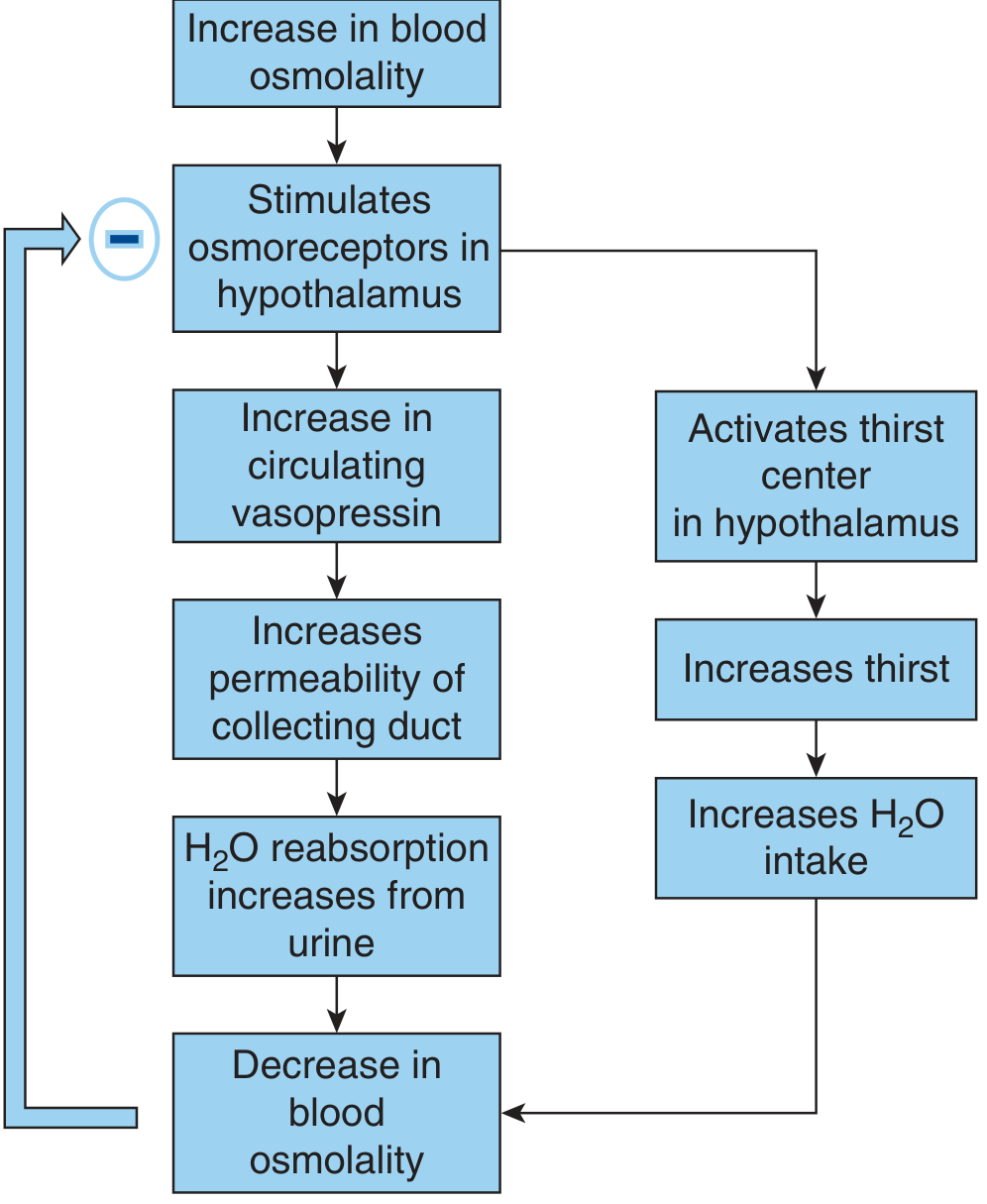
- Blood glucose: Rising glucose → pancreas secretes insulin → cells take up glucose → glucose falls → insulin secretion stops.
- Body temperature: Rise in temperature → sweating, vasodilation → heat loss → temperature falls back to 37°C.
- Endocrine axes: The hypothalamus-pituitary-target organ axis (shown below) uses nested negative feedback loops. High cortisol from the adrenal gland feeds back to inhibit both the hypothalamus (CRH) and pituitary (ACTH).
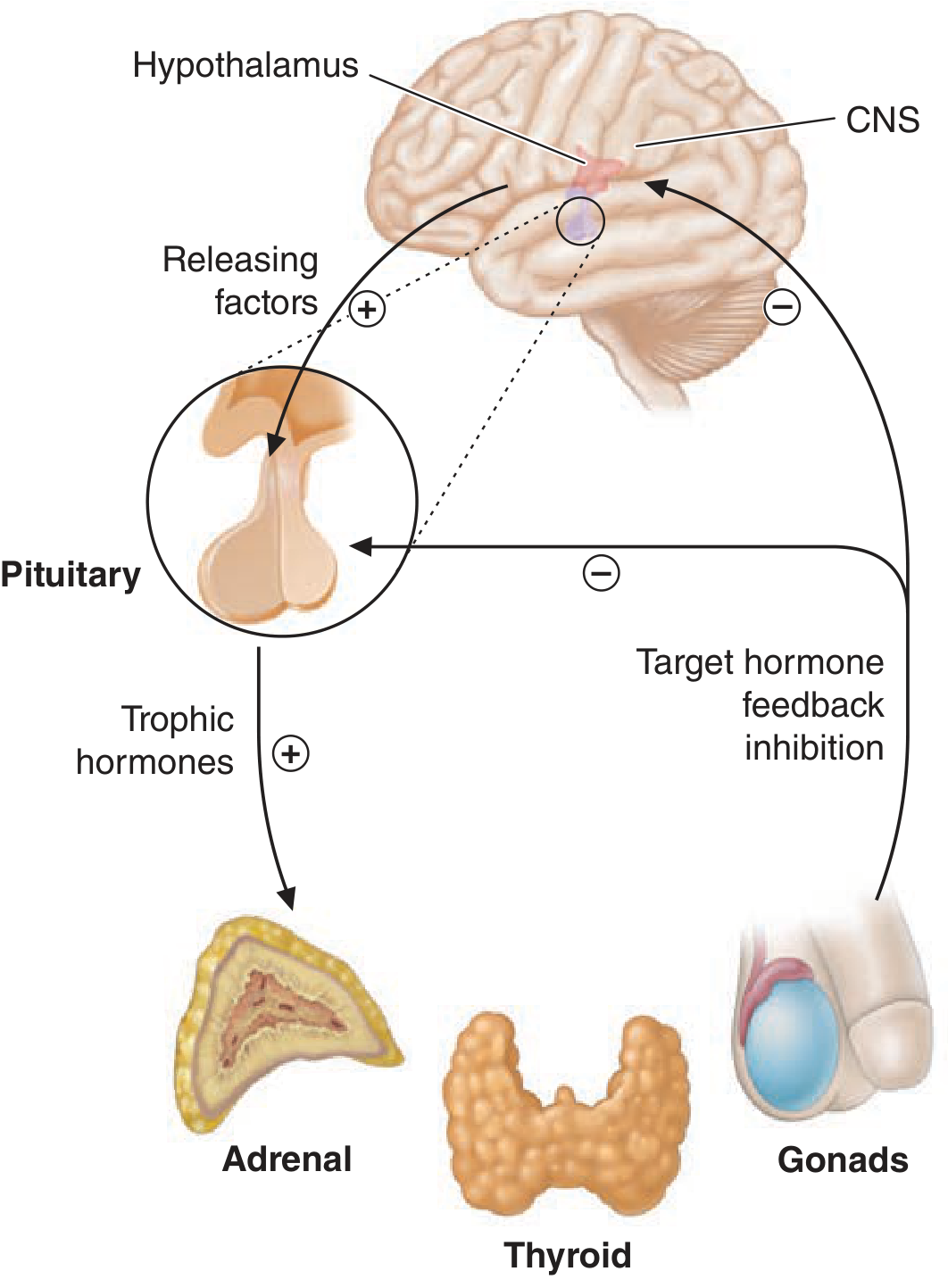
2. Positive Feedback (Less Common)
The output amplifies and reinforces the original stimulus, pushing the variable further away from the starting point. This is not "homeostatic" in the traditional sense - it is used in situations that need to build momentum toward an all-or-nothing outcome, and always ends with a terminating event.
Key examples:
- Parturition (childbirth): Uterine contractions push the baby against the cervix → cervical stretch detected → oxytocin released → stronger contractions → more oxytocin → birth occurs → loop terminates.
- Blood clotting (coagulation cascade): Platelet activation recruits more platelets → clot formation amplified until the vessel is sealed.
- Luteinizing Hormone (LH) surge at ovulation: Rising estrogen (from a dominant follicle) triggers a massive LH surge from the pituitary, which triggers ovulation - the opposite of the usual negative feedback by estrogen.
- Action potential depolarization: Opening of Na+ channels causes Na+ influx, which depolarizes the membrane further, opening more Na+ channels (self-amplifying) - until the channel inactivates.
3. Feed-Forward (Anticipatory) Control
The system responds to a predicted disturbance before it happens, rather than waiting for the error to develop. This allows faster compensation.
Examples:
- Seeing/smelling food increases gastric acid secretion and insulin release before the meal is consumed.
- During exercise, the brain (central command) increases heart rate and ventilation even before blood CO2 rises.
- The autonomic nervous system (ANS) uses feed-forward to anticipate needs: "The ANS maintains physiological parameters within an optimal range by means of feedback loops... [and] orchestrates a feed-forward response to meet anticipated needs." - Medical Physiology
4. Hierarchical / Nested Feedback Control
Single feedback loops rarely operate alone. The body uses networks of interacting loops arranged in hierarchies:
- The hypothalamus controls the pituitary → pituitary controls the adrenal cortex → cortisol regulates blood glucose.
- Two loops can act synergistically (e.g., glucagon and cortisol both raise blood glucose) or antagonistically (e.g., insulin lowers blood glucose while epinephrine raises it).
5. Redundancy in Homeostasis
The more vital a parameter, the more control systems the body deploys. If one system fails, others compensate. This explains why some gene knockouts do not produce the expected severe phenotype.
Homeostasis vs. Equilibrium
A common misconception: a regulated parameter is not in equilibrium. Equilibrium requires no energy expenditure. Homeostasis is a steady state - the value is constant only because the body continuously expends energy to balance opposing processes (e.g., ongoing insulin secretion vs. glucagon secretion to keep glucose stable).
Summary Table
| Type | Direction of Response | Energy Used | Purpose | Example |
|---|---|---|---|---|
| Negative Feedback | Opposes the change | Yes | Maintain set-point | Temperature, blood glucose |
| Positive Feedback | Amplifies the change | Yes | Drive to completion | Childbirth, clotting, LH surge |
| Feed-Forward | Anticipates change | Yes | Prevent deviation | Cephalic phase of digestion |
| Hierarchical | Multi-loop network | Yes | Fine-tune control | HPT, HPA, HPG axes |
Sources:
- Medical Physiology (Boron & Boulpaep), p. 15
- Ganong's Review of Medical Physiology, 26th ed., pp. 1509-1522
what is feedback mechanism defination types with eample and how it is related to homeostasis
A feedback mechanism is a regulatory process where the output (result) of a system loops back to influence the input (cause), either dampening or amplifying the original change. It is the core tool the body uses to achieve homeostasis - without feedback, there is no way to correct deviations from the set-point.
Searching sources...
Finding Sources
Searching the Web
feedback mechanism definition types negative positive examples physiology homeostasis
Reading File
Finding Sources
Finding Sources
Finding Sources
Reading File
Finding Sources
Loading Image
Finding Sources
Now I have everything needed for a thorough, well-illustrated answer.
Feedback Mechanism - Definition, Types, Examples, and Relation to Homeostasis
1. Definition
A feedback mechanism is a regulatory loop in which the output (result) of a biological process is "fed back" to modify or control the input (cause) - either to oppose the change (negative feedback) or to amplify it (positive feedback).
"Feedback can regulate the further release of a hormone in either a negative feedback or (more rarely) a positive feedback loop."
- Ganong's Review of Medical Physiology, 26th ed.
In simple terms:
- Stimulus (deviation from normal) → Detected by a sensor → Processed by a control center → Response by an effector → Feeds back to modify the original stimulus.
2. Components of Every Feedback Loop
| Component | Function | Example |
|---|---|---|
| Stimulus | A change that disturbs the variable | Rise in blood glucose after a meal |
| Receptor/Sensor | Detects the change | Beta cells of pancreatic islets |
| Afferent pathway | Carries signal to control center | Neural / hormonal signals |
| Control center | Compares with set-point; decides response | Hypothalamus, brain, endocrine glands |
| Efferent pathway | Carries response signal to effector | Nerve fibers, blood-borne hormones |
| Effector | Executes the response | Muscle, gland, kidney |
| Feedback | Result returns to modify the stimulus | Falling glucose inhibits further insulin |
3. Types of Feedback Mechanisms
Type 1 - Negative Feedback
Definition: The output of the system opposes and reverses the original stimulus, pushing the variable back toward the set-point. This is the most common type in the body and is directly responsible for homeostasis.
Analogy: A thermostat. When room temperature exceeds the set-point, the AC turns on. When the temperature drops back to normal, the AC turns off.
Key Features:
- Stabilizing - resists deviation
- Self-correcting
- Operates continuously
- Result: steady state (the variable is held constant)
Example 1 - Blood Glucose Regulation
| Step | What Happens |
|---|---|
| 1. Stimulus | Blood glucose rises after eating (above ~100 mg/dL) |
| 2. Sensor | Beta (β) cells of the pancreatic islets of Langerhans detect high glucose |
| 3. Response | Beta cells secrete insulin |
| 4. Effect | Cells take up glucose; liver converts glucose to glycogen |
| 5. Feedback | Falling glucose inhibits further insulin release |
| 6. Result | Blood glucose returns to 70-100 mg/dL (set-point) |
Conversely, if glucose falls too low:
- Alpha (α) cells secrete glucagon → liver breaks down glycogen → glucose rises back to normal.
"Increased glucose levels stimulate β cells to release insulin and inhibit α cells from releasing glucagon; decreased glucose levels stimulate α cells to release glucagon. Opposing actions of these hormones help to precisely control blood glucose concentration."
- Junqueira's Basic Histology, 17th ed.
Example 2 - Blood Osmolality Regulation
| Step | What Happens |
|---|---|
| 1. Stimulus | Dehydration raises blood osmolality above 299 mOsm |
| 2. Sensor | Osmoreceptors in the hypothalamus activated |
| 3. Response | Vasopressin (ADH) released from posterior pituitary; thirst center activated |
| 4. Effect | Kidney collecting duct reabsorbs water (via aquaporins); water intake increases |
| 5. Feedback | Falling osmolality inhibits vasopressin release |
| 6. Result | Osmolality restored to 275-299 mOsm |
Example 3 - Endocrine Axes (Nested Negative Feedback)
The HPT (hypothalamic-pituitary-thyroid) axis is a classic hierarchical negative feedback system:
- Hypothalamus releases TRH → stimulates anterior pituitary
- Pituitary releases TSH → stimulates thyroid
- Thyroid releases T3/T4 → feeds back (-) to inhibit both hypothalamus and pituitary
- Result: thyroid hormones are kept within a tight normal range
Example 4 - Body Temperature
| Step | What Happens |
|---|---|
| Stimulus | Body temperature rises above 37°C |
| Sensor | Thermoreceptors in skin and hypothalamus |
| Control center | Hypothalamic thermoregulatory center |
| Response | Sweating, cutaneous vasodilation, behavioral changes |
| Feedback | As temperature falls back to 37°C, sweating stops |
| Result | Core temperature maintained at ~37°C |
Type 2 - Positive Feedback
Definition: The output amplifies and reinforces the original stimulus, driving the variable further away from the starting point in the same direction. This continues until an all-or-nothing endpoint is reached, after which a terminating event stops the loop.
Key Features:
- Destabilizing (by design - it amplifies)
- Drives a process to completion
- Self-limiting (must terminate)
- Used for explosive, decisive physiological events
- Does NOT maintain a set-point - so by itself it is not homeostatic, but it serves specific physiological purposes
Example 1 - Parturition (Childbirth) - The Classic Positive Feedback
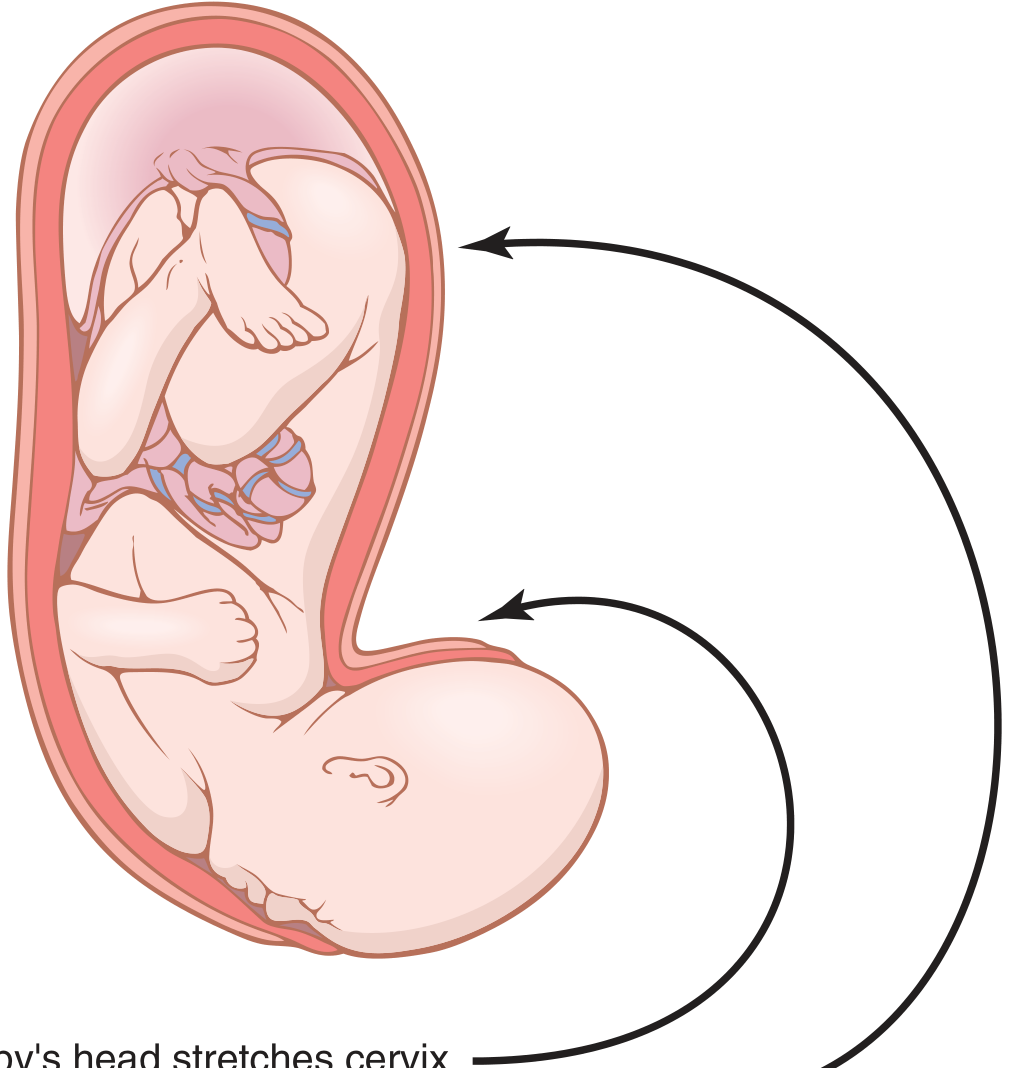
"Once the strength of uterine contraction becomes greater than a critical value, each contraction leads to subsequent contractions that become stronger and stronger until maximum effect is achieved."
- Guyton and Hall Textbook of Medical Physiology
Step-by-step:
- Baby's head presses and stretches the cervix
- Cervical stretch triggers uterine body contraction
- Stronger contraction pushes baby further down
- More cervical stretch → more oxytocin released → stronger contractions
- Cycle repeats and amplifies until baby is delivered
- Terminating event: delivery of baby removes the stretch stimulus → loop ends
Example 2 - Blood Clotting (Coagulation Cascade)
- Vessel injury → platelet activation → platelets release ADP and thromboxane A2 → recruit more platelets → clot grows
- Simultaneously, clotting factors activate each other in a cascade (each step activates the next in larger quantities - amplification)
- Terminates when the vessel is sealed and fibrinolysis begins
Example 3 - LH Surge and Ovulation
- As the dominant follicle matures, rising estrogen normally exerts negative feedback on the pituitary
- However, at a critical estrogen level near mid-cycle, this flips to positive feedback - estrogen now stimulates a massive LH surge from the anterior pituitary
- The LH surge triggers ovulation
- Once the follicle ruptures, estrogen drops and the loop terminates
Example 4 - Nerve Action Potential
- Membrane depolarization opens voltage-gated Na+ channels
- Na+ influx depolarizes the membrane further
- Further depolarization opens more Na+ channels → more Na+ flows in
- This runaway positive feedback drives the action potential to +30 mV peak
- Terminates via Na+ channel inactivation and K+ channel opening (repolarization)
4. How Feedback Mechanisms Relate to Homeostasis
Feedback mechanisms are the machinery by which homeostasis is achieved. The relationship is direct and inseparable:
| Aspect | Explanation |
|---|---|
| Homeostasis is the goal | Maintaining a stable internal environment |
| Feedback loops are the tool | They detect deviation and generate a corrective response |
| Negative feedback = homeostatic stabilizer | Every deviation triggers a corrective response that returns the variable to the set-point |
| Positive feedback = completes vital processes | Used for events that require explosive completion (birth, clotting, ovulation); does not maintain a steady state itself but contributes to overall body homeostasis |
| Multiple loops cooperate | The body uses networks of overlapping feedback loops for redundancy |
| Without feedback, no homeostasis | Without the ability to detect and correct deviations, the milieu intérieur would be unregulated |
"One of the most common themes in physiology is the negative-feedback mechanism responsible for homeostasis."
- Medical Physiology (Boron & Boulpaep), p. 15
"The more vital a parameter is, the more systems the body mobilizes to regulate it. If one system should fail, others are there to help maintain homeostasis."
- Medical Physiology (Boron & Boulpaep)
5. Quick Comparison Table
| Feature | Negative Feedback | Positive Feedback |
|---|---|---|
| Direction of response | Opposes the stimulus | Amplifies the stimulus |
| Effect on variable | Returns to set-point | Drives away from starting point |
| Frequency | Very common | Rare |
| Purpose | Maintain homeostasis | Complete an all-or-nothing event |
| Self-limiting? | Yes - loop stops when set-point is restored | Yes - terminates when endpoint reached |
| Stability | Stabilizing | Destabilizing (temporarily) |
| Examples | Blood glucose, temperature, BP, thyroid axis | Childbirth, clotting, LH surge, action potential |
Sources:
- Medical Physiology (Boron & Boulpaep), p. 15
- Ganong's Review of Medical Physiology, 26th ed., pp. 1506-1524
- Guyton and Hall Textbook of Medical Physiology
- Junqueira's Basic Histology, 17th ed.
how can positive feedback be fatal
Positive feedback becomes fatal when the self-amplifying loop has no natural terminating event - so instead of completing a useful process and stopping, it spirals out of control. Examples include septic shock (inflammation amplifies itself until organs fail), malignant hyperthermia (rising temperature accelerates metabolism which generates more heat), and disseminated intravascular coagulation (clotting cascades consume all clotting factors).
Searching sources...
Finding Sources
Searching the Web
positive feedback loop fatal pathophysiology vicious cycle examples shock fever
Finding Sources
Finding Sources
Reading File
Finding Sources
Reading File
Finding Sources
Loading Image
Finding Sources
Finding Sources
Finding Sources
Finding Sources
Finding Sources
I have rich textbook material from Guyton & Hall on the shock vicious cycle. Now I can compose a complete, well-referenced answer.
How Positive Feedback Can Be Fatal
The Core Principle
Positive feedback is normally designed to drive a process to completion and then stop (e.g., childbirth ends when the baby is delivered; clotting stops when the vessel is sealed). It becomes fatal when:
- The terminating event never arrives - the loop has nothing to stop it
- The amplification overwhelms the body's negative feedback systems - the corrective mechanisms can no longer compensate
- Each cycle causes irreversible tissue damage - even if the trigger is removed, organs have already failed
"In severe shock, the deteriorative feedback mechanisms become more and more powerful, leading to such rapid deterioration of the circulation that all the normal negative feedback systems of circulatory control acting together cannot return the cardiac output to normal."
- Guyton and Hall Textbook of Medical Physiology
The Key Concept - The "Vicious Cycle"
A vicious cycle is a pathological positive feedback loop with no natural terminator. Each step in the loop worsens the initial problem, which in turn worsens the next step. There is a critical threshold: below it, the body's negative feedback systems can still rescue the situation; above it, the spiral is irreversible.
Fatal Examples of Runaway Positive Feedback
1. Circulatory Shock - The Clearest Textbook Example
This is the most well-documented fatal positive feedback mechanism in physiology.
The vicious cycle of progressive shock:
Low cardiac output
       ↓
Reduced tissue perfusion
       ↓
Cell damage → lactic acid → acidosis
       ↓
Lysosomal rupture → hydrolase release → more cell death
       ↓
Liver failure → toxin accumulation
       ↓
Heart muscle damage → LOWER cardiac output
       ↓
(cycle repeats, getting worse each time)
Why it becomes fatal:
- In mild shock: negative feedback systems (sympathetic reflexes, fluid shifts from interstitium into blood, stress-relaxation of venous reservoirs) can still overcome the positive feedback and rescue the patient.
- In severe shock: the deteriorative loops overpower every compensatory mechanism. Even if a blood transfusion temporarily restores cardiac output to near-normal, the underlying tissue damage - depleted ATP stores, enzymatic destruction, acidosis - continues to kill the patient.
"After shock has progressed to a certain stage, transfusion or any other type of therapy becomes incapable of saving the person's life. The person is then said to be in the irreversible stage of shock."
- Guyton and Hall Textbook of Medical Physiology
The graph below shows this perfectly:
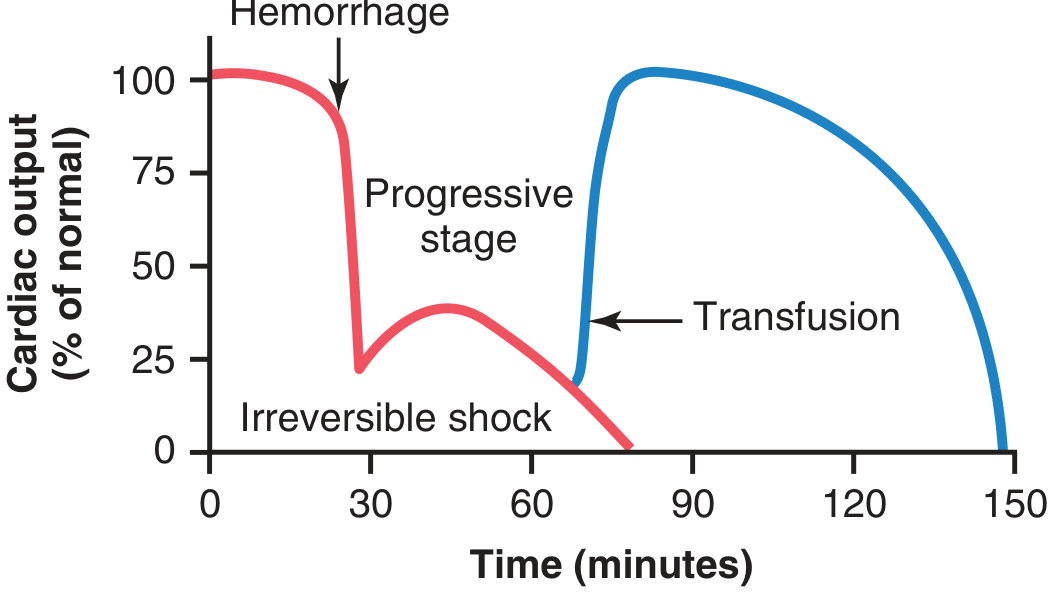
Notice: After a transfusion, cardiac output returns to ~100% of normal - but then collapses again and death follows. The positive feedback damage is already done at the cellular level and cannot be reversed.
Specific deteriorative factors in shock (all positive feedback loops):
| Factor | How it amplifies shock |
|---|---|
| Acidosis (lactic acid from anaerobic glycolysis) | Depresses myocardial contractility → lower output → more ischemia → more acidosis |
| Lysosomal rupture | Releases digestive hydrolases → destroys cells → more organ dysfunction |
| Liver failure | Fails to detoxify blood → toxins damage heart and brain |
| Pulmonary edema (ARDS) | Poor oxygenation → more tissue hypoxia → more organ failure |
| ATP depletion | Cells lose energy → irreversible cell death; new ATP synthesis takes hours at only 2%/hr |
| Insulin resistance | Glucose cannot enter cells → cells starve despite normal blood glucose |
2. Heat Stroke / Malignant Hyperthermia
The vicious cycle:
High body temperature
       ↓
Metabolic rate rises (Q10 effect: every 1°C rise ~13% increase in metabolism)
       ↓
More heat produced by accelerated metabolism
       ↓
Body temperature rises further
       ↓
(loop continues until proteins denature and cells die)
- At temperatures above ~41-42°C, the hypothalamic thermoregulatory center (which normally drives negative feedback) begins to fail.
- Sweating stops (sweat glands become exhausted or damaged).
- Now there is no negative feedback left to counter the rising heat.
- The positive feedback loop accelerates - temperatures can reach 43-45°C.
- At these temperatures: enzyme denaturation, neuronal death, rhabdomyolysis (muscle breakdown releasing more heat), and multi-organ failure occur.
- Death results from cardiac arrhythmias, cerebral edema, and cardiovascular collapse.
Malignant hyperthermia (triggered by certain anesthetic agents like succinylcholine in genetically susceptible patients) is a particularly explosive version: uncontrolled Ca²+ release from sarcoplasmic reticulum → sustained muscle contraction → massive heat generation → runaway hyperthermia → death within minutes if untreated.
3. Sepsis and Cytokine Storm
The vicious cycle:
Bacterial infection → immune activation
       ↓
Cytokines (TNF-α, IL-1, IL-6) released
       ↓
Cytokines trigger MORE cytokine release (amplification)
       ↓
Widespread inflammation → capillary leak → hypotension
       ↓
Reduced perfusion → more tissue damage → more immune activation
       ↓
(Septic shock → multi-organ failure → death)
- Normally the immune response has built-in negative feedback (anti-inflammatory cytokines like IL-10, cortisol, regulatory T cells) to terminate inflammation.
- In sepsis and cytokine storms (also seen in severe COVID-19, CAR-T therapy reactions), this negative regulation is overwhelmed.
- The positive feedback of cytokine-stimulating-more-cytokines becomes uncontrolled.
- Endothelial damage, disseminated intravascular coagulation (DIC), and multi-organ failure follow.
4. Disseminated Intravascular Coagulation (DIC)
Blood clotting is normally a useful positive feedback (small trigger → large clot, which seals the wound then stops). In DIC:
Massive trigger (sepsis, trauma, obstetric emergency)
       ↓
Coagulation cascade activated everywhere in the body simultaneously
       ↓
Microthrombi block small vessels throughout all organs
       ↓
Clotting factors and platelets consumed faster than they are made
       ↓
Paradoxical bleeding (no clotting factors left)
       ↓
Hemorrhage + organ ischemia → death
The positive feedback of clotting has no local terminator here - it runs body-wide simultaneously, consuming everything.
5. Ventricular Fibrillation
The action potential itself runs on positive feedback (Na⁺ influx → more depolarization → more Na⁺ channels open). Normally this terminates with repolarization. In ventricular fibrillation:
- A premature electrical impulse hits during the vulnerable period of the cardiac cycle
- Re-entrant circuits form: each electrical wave re-excites previously fired tissue
- Positive feedback of re-excitation → chaotic, self-sustaining electrical activity
- The heart quivers uselessly → no cardiac output → death within minutes without defibrillation
Why Positive Feedback Crosses Into Being Fatal - Summary
| Condition | Normal Terminator | What Goes Wrong |
|---|---|---|
| Childbirth | Baby delivered | - (safe) |
| Blood clotting | Vessel sealed | In DIC: no localization, consumes all factors |
| Fever/inflammation | Anti-inflammatory signals | In sepsis: overwhelmed, cytokine storm |
| Action potential | K⁺ repolarization | In VF: re-entry circuits, no reset |
| Shock | Sympathetic reflexes | Overwhelmed; ATP depleted; irreversible |
| Heat production | Sweating, vasodilation | Thermostat fails at 41°C+; runaway |
The unifying principle: Positive feedback is fatal when the gain of the loop exceeds the body's ability to terminate or counteract it, and when each cycle causes damage that is irreversible - so even if the trigger is removed, the process cannot be undone.
Sources:
- Guyton and Hall Textbook of Medical Physiology - Chapter 24 (Shock)
- Medical Physiology (Boron & Boulpaep) - Homeostasis & Feedback
- Ganong's Review of Medical Physiology, 26th ed.
This is a shared conversation. Sign in to Orris to start your own chat.