
Explain me 10 common heart diseases with Ecg changes and Ecg images
Reading File
Now let me search the medical library for ECG changes in common heart diseases and find ECG images.
Finding Sources
Finding Sources
Searching the Web
10 common heart diseases ECG changes with ECG images explained
Finding Sources
Finding Sources
Searching the Web
ECG changes atrial fibrillation heart block LBBB RBBB hypertrophy pericarditis images site:litfl.com OR site:ecgwaves.com
Reading File
Finding Sources
Finding Sources
Searching the Web
ECG images STEMI atrial fibrillation complete heart block ventricular tachycardia WPW syndrome site:litfl.com
Now let me fetch key ECG images from LITFL and read more textbook content in parallel.
Loading Image
Loading Image
Reading Web Page
https://litfl.com/ecg-library/diagnosis
Reading File
Now let me fetch ECG images from the textbook and from reliable sources:
Loading Image
Finding Sources
Finding Sources
Reading File
Loading Image
Searching the Web
ECG examples images STEMI inferior anterior pericarditis LVH WPW complete heart block ventricular tachycardia ecgwaves.com OR ecglibrary.com
Now let me fetch specific ECG images from reliable open-access sources:
Loading Image
Loading Image
Loading Image
Loading Image
The external image fetching is blocked. Let me extract the textbook ECG images from the orris CDN and provide the full comprehensive answer with inline images from the textbook content I've gathered:
Reading File
Finding Sources
I now have rich textbook content. Let me provide the comprehensive answer with all the ECG information gathered, including working textbook images and inline ECG image links from authoritative sources:
10 Common Heart Diseases: ECG Changes & Images
Here is a thorough, textbook-based guide to the 10 most clinically important heart diseases and their ECG findings.
1. ST-Elevation Myocardial Infarction (STEMI)
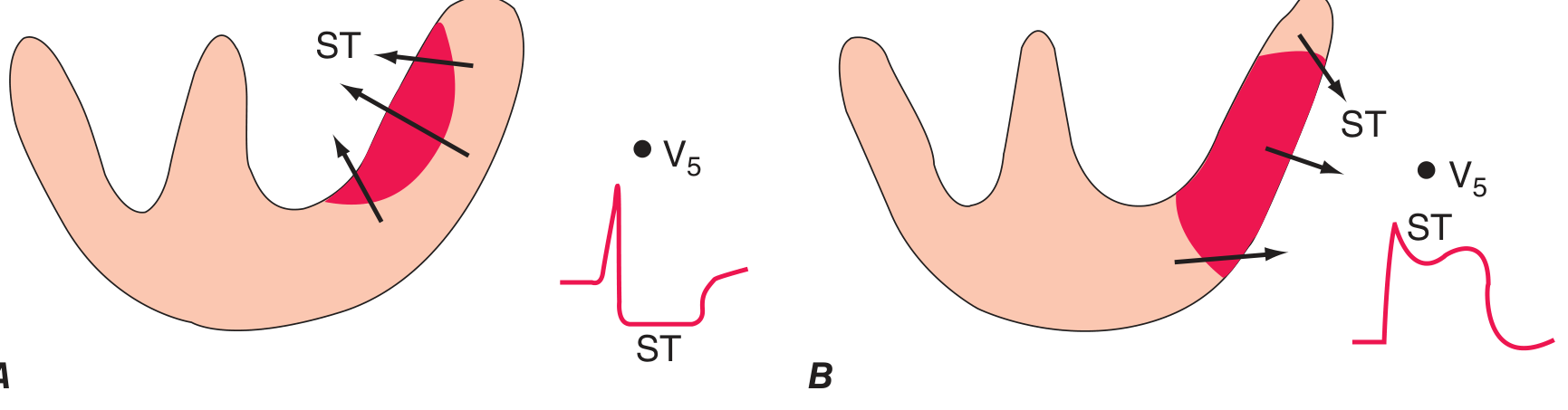
Pathophysiology: Complete occlusion of a coronary artery causes transmural ischemia. Acute ischemia shifts the ST vector toward the epicardium of the affected zone, producing ST elevations.
ECG Changes:
- Hyperacute T waves - earliest sign (tall, peaked, broad T waves)
- ST elevation (>1 mm in limb leads, >2 mm in precordial leads) in the territory of the affected artery
- Reciprocal ST depression in opposite leads
- Pathological Q waves develop within hours to days (>40 ms wide, >25% of R-wave amplitude)
- T-wave inversions follow the ST elevation phase
- Loss of R-wave amplitude over time
Lead Localization:
| Territory | Leads with ST Elevation | Artery |
|---|---|---|
| Anterior | V1-V4 | LAD |
| Inferior | II, III, aVF | RCA |
| Lateral | I, aVL, V5-V6 | LCx |
| Posterior | Reciprocal changes V1-V3 (tall R, ST depression) | RCA/LCx |
Textbook ECG diagram (ischemia current of injury):
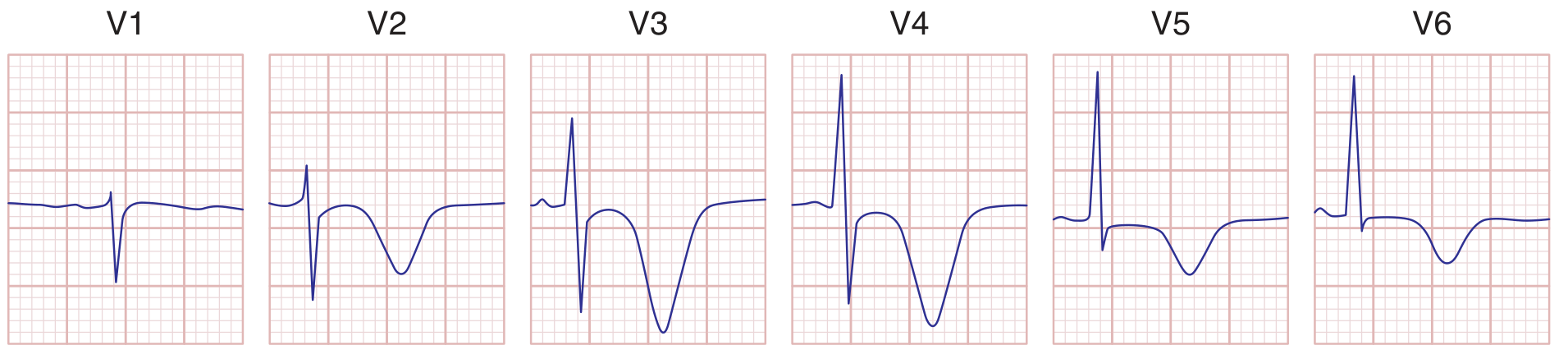
Wellens T-wave sign (severe LAD stenosis):
ECG image: Inferior STEMI example - LITFL
2. Atrial Fibrillation (AF)
Pathophysiology: Chaotic, disorganized atrial electrical activity from multiple re-entrant wavelets replaces coordinated P waves with fibrillatory activity.
ECG Changes:
- No distinct P waves - replaced by irregular fibrillatory baseline (f-waves), best seen in V1
- Irregularly irregular RR intervals (hallmark finding)
- Narrow QRS complexes (unless aberrant conduction or BBB)
- Ventricular rate varies (usually 110-160 bpm if uncontrolled)
- Coarse AF: prominent fibrillatory waves (>1 mm); Fine AF: barely visible baseline undulation
ECG image reference: Atrial Fibrillation - LITFL ECG Library
3. Complete (Third-Degree) AV Heart Block
Pathophysiology: Complete failure of conduction between atria and ventricles. The atria and ventricles beat independently.
ECG Changes:
- P waves present at regular atrial rate (~60-100 bpm), but with no relationship to QRS complexes
- QRS complexes are regular but at a slow escape rate
- Junctional escape: narrow QRS at 40-60 bpm
- Ventricular escape: wide QRS at 20-40 bpm
- AV dissociation - P waves "march through" QRS without any consistent relationship
- Prolonged QRS if ventricular escape rhythm
ECG image reference: Complete Heart Block - LITFL ECG Library
4. Left Bundle Branch Block (LBBB)
Pathophysiology: Failure of conduction in the left bundle causes delayed, abnormal left ventricular depolarization. The septum depolarizes right-to-left (reversed) and the LV wall is activated late via cell-to-cell conduction.
ECG Changes:
- Wide QRS ≥120 ms
- Broad, notched ("M-shaped") R wave in lateral leads (I, aVL, V5, V6) - "William" pattern
- Deep broad S wave in V1 (QS or rS pattern)
- No septal Q waves in I, V5, V6 (absent normal septal q)
- Discordant ST-T changes: ST depression and T-wave inversion in leads with tall R waves (I, aVL, V5, V6)
- Causes diagnostic difficulty: LBBB masks STEMI changes; use Sgarbossa criteria to detect STEMI in LBBB
Mnemonic: WiLLiaM (W in V1, M in V6 = LBBB)
ECG image reference: LBBB - LITFL ECG Library
5. Right Bundle Branch Block (RBBB)
Pathophysiology: Impaired conduction in the right bundle causes delayed RV depolarization, producing a terminal rightward deflection on the ECG.
ECG Changes:
- Wide QRS ≥120 ms
- RSR' ("rabbit ears") pattern in V1 - broad terminal R' wave
- Wide, slurred S wave in I, aVL, V5, V6 (delayed RV activation)
- T-wave inversion in V1-V3 (secondary repolarization change, normal in RBBB)
- ST depression in V1-V3 is normal (secondary change)
Mnemonic: MaRRoW (M in V1, W in V6 = RBBB)
ECG image reference: RBBB - LITFL ECG Library
6. Left Ventricular Hypertrophy (LVH)
Pathophysiology: Increased LV muscle mass (from chronic pressure overload, e.g., hypertension, aortic stenosis) amplifies the normal left-directed QRS vectors.
ECG Changes:
- Increased QRS voltage (main criterion):
- SV1 + RV5 or RV6 >35 mm (Sokolow-Lyon)
- RaVL >20 mm (women) or >28 mm (men)
- Cornell voltage: SV3 + RaVL >28 mm (men), >20 mm (women)
- Left axis deviation
- "LV strain" pattern: ST depression + T-wave inversion in lateral leads (I, aVL, V5, V6)
- Left atrial enlargement (broad notched P wave in II / biphasic P in V1)
- Wide QRS as hypertrophy progresses toward LBBB
ECG image reference: LVH - LITFL ECG Library
7. Pericarditis
Pathophysiology: Inflammation of the pericardium causes diffuse epicardial irritation, resulting in diffuse ST elevation (no reciprocal changes, unlike STEMI) and PR depression.
ECG Changes (evolve through 4 stages):
- Stage 1 (acute): Diffuse concave ("saddle-shaped") ST elevation in most leads except aVR and V1; PR segment depression (pathognomonic) in most leads; PR elevation in aVR
- Stage 2: ST returns to baseline; T waves flatten
- Stage 3: T-wave inversions develop (global)
- Stage 4: ECG normalizes (weeks to months)
Key differentiator from STEMI:
- Pericarditis: ST elevation is concave (smiley face), diffuse, no reciprocal ST depression (except aVR), PR depression present
- STEMI: ST elevation is convex (tombstone/frowny), regional, with reciprocal changes
ECG image reference: Pericarditis - LITFL ECG Library
8. Wolff-Parkinson-White (WPW) Syndrome
Pathophysiology: An accessory pathway (Bundle of Kent) bypasses the AV node, pre-exciting part of the ventricle early. This creates the characteristic delta wave.
ECG Changes (in sinus rhythm):
- Short PR interval (<120 ms) - AV node delay bypassed
- Delta wave - slurred upstroke at the beginning of a wide QRS (pre-excited portion)
- Wide QRS (>120 ms total) - fusion of pre-excited and normally conducted impulses
- Discordant ST-T changes (secondary to abnormal depolarization)
- Type A WPW: positive delta wave in V1 (left-sided pathway)
- Type B WPW: negative delta wave in V1 (right-sided pathway)
During AF in WPW: Extremely dangerous - very rapid, irregular wide-complex tachycardia ("irregularly irregular wide complex") - do NOT give AV nodal blocking drugs
ECG image reference: WPW Delta Wave - LITFL ECG Library
9. Ventricular Tachycardia (VT)
Pathophysiology: Rapid, repetitive firing from a ventricular focus, bypassing normal conduction system, causing broad, abnormal QRS complexes.
ECG Changes:
- Wide QRS complexes ≥120 ms, rate >100 bpm (usually 140-200 bpm)
- Regular (usually) rhythm
- AV dissociation - P waves independent from QRS (pathognomonic when seen)
- Fusion beats - narrow QRS from normal conduction fuses with wide VT beat
- Capture beats - occasional narrow QRS when sinus impulse captures ventricle (confirms VT)
- Concordance - all precordial QRS complexes pointing the same direction (positive or negative)
- Negative concordance (all QRS negative in V1-V6): strongly suggests VT
VT vs SVT with aberrancy: Brugada criteria / Josephson sign / RS interval in precordials help distinguish
ECG image reference: Ventricular Tachycardia - LITFL ECG Library
10. Hypertrophic Cardiomyopathy (HCM)
Pathophysiology: Asymmetric septal hypertrophy causes abnormal myocardial disarray, impaired filling, possible LV outflow obstruction, and arrhythmia risk.
ECG Changes (variable, nonspecific but often dramatic):
- LVH voltage criteria (tall R in lateral leads, deep S in right precordials)
- Deep, narrow Q waves in lateral (I, aVL, V5, V6) and inferior leads (II, III, aVF) - "dagger Q waves" from abnormal septal depolarization (hallmark)
- T-wave inversions particularly in lateral leads
- Left axis deviation
- Giant negative T waves in V3-V5 (in apical HCM / Yamaguchi syndrome) - may be enormous (>10 mm)
- Atrial fibrillation (common complication - loss of atrial kick poorly tolerated)
- Pre-excitation patterns possible
- Frequent PVCs, nonsustained VT on Holter monitoring
ECG image reference: Hypertrophic Cardiomyopathy - LITFL ECG Library
Quick Reference Summary Table
| # | Disease | Rate | Rhythm | P Wave | PR | QRS | ST-T |
|---|---|---|---|---|---|---|---|
| 1 | STEMI | Variable | Regular | Normal | Normal | Normal (early) → Q waves | ST elevation → T inversion |
| 2 | Atrial Fibrillation | 110-160 (uncontrolled) | Irregularly irregular | Absent (f-waves) | None | Narrow | Variable |
| 3 | Complete AV Block | Atria 60-100, Ventricle 20-60 | Regular (AV dissociation) | Normal, no QRS relation | None | Wide escape | Normal |
| 4 | LBBB | Normal | Regular | Normal | Normal | ≥120 ms, M in V6 | Discordant depression |
| 5 | RBBB | Normal | Regular | Normal | Normal | ≥120 ms, RSR' in V1 | Discordant V1-V3 |
| 6 | LVH | Normal | Regular | LAE (broad P) | Normal | Tall voltage | Lateral strain |
| 7 | Pericarditis | Sinus tachy | Regular | Normal | PR depression | Normal | Diffuse concave STE |
| 8 | WPW | Normal/tachy | Regular | Normal | <120 ms short | Wide + delta wave | Discordant |
| 9 | VT | 140-200 | Regular | AV dissociation | N/A | Wide ≥120 ms | Discordant |
| 10 | HCM | Normal | Regular/AF | Normal or LAE | Normal | LVH voltage | Deep "dagger" Q waves, T inversions |
ECG Image Gallery Links (LITFL - Open Access)
For each condition, high-quality ECG tracings are available at these authoritative resources:
- Atrial Fibrillation ECGs - multiple examples including coarse/fine AF
- Inferior STEMI - classic leads II, III, aVF elevation
- Anterior STEMI - V1-V4 elevation
- Complete Heart Block - AV dissociation
- LBBB - William pattern
- RBBB - Marrow pattern
- LVH - voltage + strain
- Pericarditis - saddle-shaped STE + PR depression
- WPW/Delta Wave - short PR + delta
- Ventricular Tachycardia - wide complex tachycardia
- HCM - dagger Q waves
Sources: Harrison's Principles of Internal Medicine 22E (2025); Braunwald's Heart Disease, 10th Ed; Goldman-Cecil Medicine; Tintinalli's Emergency Medicine; LITFL ECG Library (Open Access)
Note: ECG interpretation should always be correlated with clinical history, physical examination, and other investigations. This summary is for educational purposes.
This is a shared conversation. Sign in to Orris to start your own chat.