
Give me easy notes of DMD for pediatrics exams Pathophysiology in chart form Easy language
Reading File
Now let me search the medical library for DMD content in parallel:
Finding Sources
Finding Sources
Good findings. Let me now read the most relevant sections in parallel - Campbell's Orthopaedics (most detailed) and Goldman-Cecil Medicine for clinical content:
Reading File
Reading File
Reading File
Excellent content gathered. Let me also fetch the dystrophin diagram and read the Campbell's section on clinical features/management more fully:
Loading Image
Reading File
I now have excellent content from authoritative textbooks. Let me compose comprehensive, exam-ready notes for DMD.
🧬 Duchenne Muscular Dystrophy (DMD) — Pediatrics Exam Notes
1. QUICK FACTS (Memory Pegs)
| Feature | Detail |
|---|---|
| Full name | Duchenne Muscular Dystrophy |
| Type | X-linked recessive |
| Who gets it | Boys (females are carriers; also females with Turner syndrome) |
| Incidence | 1 in 3,500–5,000 male births |
| Gene | DMD gene on chromosome Xp21 |
| Protein missing | Dystrophin (400 kDa) |
| Family history | Present in ~70%; ~30% are spontaneous mutations |
Mnemonic: "Dystrophin Deficiency = Duchenne" — All three Ds!
2. PATHOPHYSIOLOGY CHART
MUTATION in DMD gene (Xp21)
          ↓
   Frameshift mutation
          ↓
  ABSENT Dystrophin protein
          ↓
┌──────────────────────────────────────────────────────┐
│  Normally: Dystrophin anchors ACTIN (inside cell)    │
│            to DYSTROGLYCAN COMPLEX (cell membrane)   │
│            to MEROSIN/LAMININ-2 (outside cell)       │
│  → This creates a mechanical "shock absorber" link   │
│    between the sarcomere and the sarcolemma          │
└──────────────────────────────────────────────────────┘
          ↓ Without dystrophin:
  Sarcolemma (cell membrane) becomes UNSTABLE
          ↓
  Ca²⁺ leaks INTO the muscle cell
          ↓
  Calcium activates proteases (calpains)
          ↓
  NECROSIS of muscle fibers
          ↓
  Repeated cycles of necrosis → fibrosis
          ↓
  Muscle replaced by FAT + FIBROUS tissue
          ↓
  Progressive MUSCLE WEAKNESS + WASTING
          ↓
  ┌────────────────┬─────────────────┬──────────────┐
  ↓                ↓                 ↓              ↓
Skeletal      Cardiac           Respiratory   CNS
Muscle Weak   Cardiomyopathy    Failure       Cognitive Sx
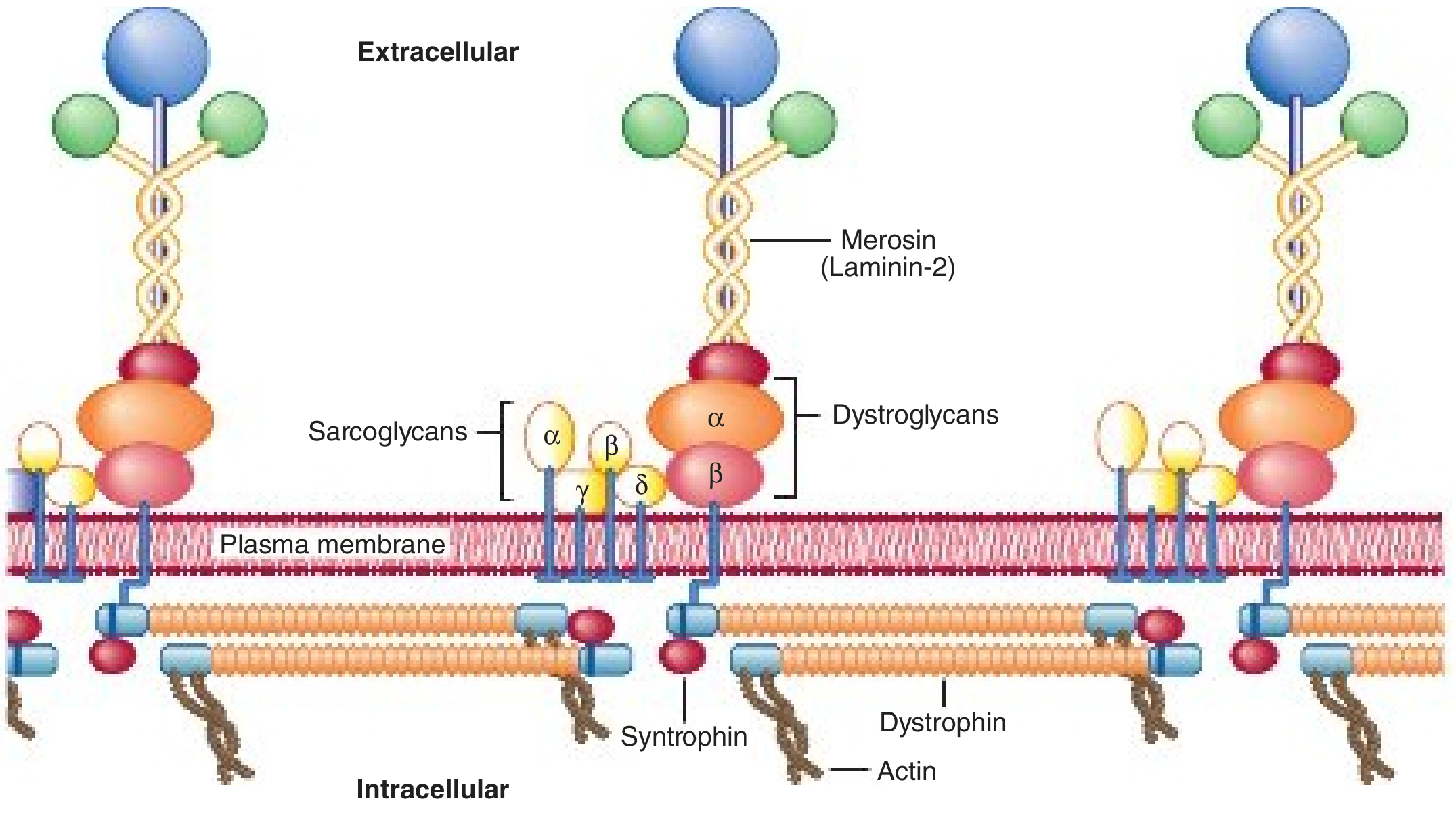
3. CLINICAL FEATURES — AGE-WISE TIMELINE
BIRTH → 2 yrs       : Normal early milestones (appears normal)
                       ↓ subtle toe walking may be noted

2–5 yrs              : PRESENTATION
                       • Delayed walking / waddling gait
                       • Frequent falls
                       • Difficulty climbing stairs
                       • PSEUDOHYPERTROPHY of calves
                         (fat + fibrous tissue replaces muscle)
                       • Gowers' sign positive ←★ EXAM FAVOURITE

5–10 yrs             : PROGRESSION
                       • Proximal muscle weakness (hip > shoulder)
                       • Lordosis, waddling gait
                       • Joint contractures begin

By ~12 yrs           : WHEELCHAIR BOUND
                       (loss of ambulation)

By ~20 yrs           : COMPLICATIONS
                       • Kyphoscoliosis
                       • Respiratory failure (main cause of death)
                       • Dilated cardiomyopathy → heart failure
                       • Fatal arrhythmias
4. KEY SIGNS — MUST KNOW
| Sign | Description | What it means |
|---|---|---|
| Gowers' Sign | Child uses hands to "walk up" own thighs to stand from floor | Proximal lower limb weakness |
| Pseudohypertrophy | Calves look big but feel rubbery/firm | Fat + fibrous tissue replacing muscle |
| Waddling Gait | Hip girdle weakness | Trendelenburg pattern |
| Toe Walking | Early sign in toddlers | Tight Achilles tendon |
| Trendelenburg Sign | Pelvis dips to opposite side when standing on one leg | Gluteus medius weakness |
5. INVESTIGATIONS CHART
Suspected DMD (young boy, proximal weakness, calf enlargement)
                ↓
SERUM CK (FIRST TEST)
• Elevated 20–100× normal ← KEY EXAM FACT
• May be elevated even before symptoms appear
                ↓
GENETIC TESTING (DNA analysis of DMD gene)
• Detects ~90–95% of cases
• If POSITIVE → Confirmed DMD
                ↓
If genetic testing NEGATIVE
                ↓
MUSCLE BIOPSY
• Histology: necrosis, regeneration, fibrosis
• Immunostaining: ABSENT dystrophin (except in revertant fibers)
                ↓
Additional:
• ECG + ECHO → cardiomyopathy
• Pulmonary function tests → respiratory reserve
• Cognitive/neuropsychological testing
6. ASSOCIATED FEATURES (Non-muscle)
| System | Feature |
|---|---|
| Heart | Dilated cardiomyopathy, arrhythmias, heart failure |
| Lungs | Respiratory failure (main cause of death) |
| Brain/CNS | Intellectual disability (~30%), ADHD, autism spectrum |
| Bone | Osteoporosis (steroid use + immobility), fractures |
| Spine | Kyphoscoliosis (worsens respiratory compromise) |
| GI | Constipation, delayed gastric emptying |
| Endocrine | Short stature, delayed puberty (steroid effects) |
7. MANAGEMENT CHART
                    ┌──────────────────────────┐
                    │  MULTIDISCIPLINARY TEAM  │
                    └──────────────────────────┘
                         ↓         ↓       ↓
                    Neurology  Cardiology  Pulm
                    Ortho      Physio      Nutrition

PHARMACOLOGICAL:

1. CORTICOSTEROIDS ← Most important drug in exams
   • Prednisone: 0.75 mg/kg/day
   • Deflazacort: 0.9 mg/kg/day (less weight gain)
   • Benefits: delays loss of ambulation, improves strength,
     slows scoliosis, helps respiratory function

2. CARDIAC MANAGEMENT (once cardiomyopathy develops)
   • ACE inhibitors → slow myocardial fibrosis
   • Beta-blockers → for heart failure

3. EXON SKIPPING THERAPIES (newer, FDA-approved)
   • Eteplirsen — skips exon 51 (IV, 30 mg/kg/week)
   • Golodirsen / Viltolarsen — skip exon 53
   • Casimersen — skips exon 45
   Goal: restore partial dystrophin production

NON-PHARMACOLOGICAL:
   • Physiotherapy → prevent contractures
   • Splints / orthotics → maintain joint angles
   • Wheelchair when ambulation lost
   • Scoliosis monitoring → spinal fusion if needed
   • Non-invasive ventilation (NIV/BiPAP) for respiratory failure
   • Nutritional support
8. DMD vs BECKER — COMPARISON TABLE
| Feature | DMD | Becker MD |
|---|---|---|
| Dystrophin | Completely absent | Reduced / abnormal |
| Mutation | Frameshift → no protein | In-frame → partial protein |
| Onset | 2–5 years | Later (teens/young adult) |
| Progression | Rapid | Slower |
| Wheelchair | By age 12 | Often not until 20s–30s |
| Cardiac | Common, severe | Present |
| CK | Very high | High |
Key concept: Same gene, different mutation type. DMD = frameshift (no protein). Becker = in-frame (partial protein).
9. EXAM-FAVOURITE HIGH-YIELD POINTS
| Point | Answer |
|---|---|
| Gene location | Xp21 |
| Protein absent | Dystrophin |
| First investigation | Serum CK (20–100× elevated) |
| Confirmatory test | Genetic testing / muscle biopsy |
| Most important drug | Corticosteroids (prednisone/deflazacort) |
| Classic sign | Gowers' sign |
| Calves appearance | Pseudohypertrophy |
| Most common cause of death | Respiratory failure |
| Pattern of inheritance | X-linked recessive |
| Muscle biopsy finding | Absent dystrophin on immunostaining |
10. ONE-LINE PATHOPHYSIOLOGY (For Short Answer)
DMD gene mutation (Xp21) → frameshifted mRNA → no dystrophin → unstable sarcolemma → Ca²⁺ leak → muscle fiber necrosis → fibrosis → progressive weakness.
Sources: Goldman-Cecil Medicine (International Ed), Campbell's Operative Orthopaedics 15th Ed 2026, Harper's Illustrated Biochemistry 32nd Ed
This is a shared conversation. Sign in to Orris to start your own chat.