
Describe About Neuroglia, Its Types And Functions Of Each. 5 marks
Reading File
Finding Sources
Finding Sources
Reading File
Reading File
Reading File
Searching Images
neuroglia types astrocyte oligodendrocyte microglia
Reading File
I now have comprehensive information. Let me also grab the microglia and oligodendrocyte sections for completeness.
Reading File
Loading Image
I have all the information needed. Here is a comprehensive 5-mark answer on Neuroglia:
Neuroglia — Types and Functions
Definition
Neuroglia (Greek: nerve glue) are the non-neuronal supporting cells of the nervous system. They outnumber neurons by approximately 10:1 and, unlike neurons, retain the ability to divide throughout life. They do not generate or conduct action potentials but are functionally interdependent with neurons, providing structural, metabolic, and immunological support.
Neuroglia are classified into two broad groups based on location:
- Central Neuroglia (CNS)
- Peripheral Neuroglia (PNS)
A. Central Neuroglia (CNS)
There are four types of central neuroglia:
1. Astrocytes
The largest of the neuroglial cells, forming an interconnected network throughout the CNS.
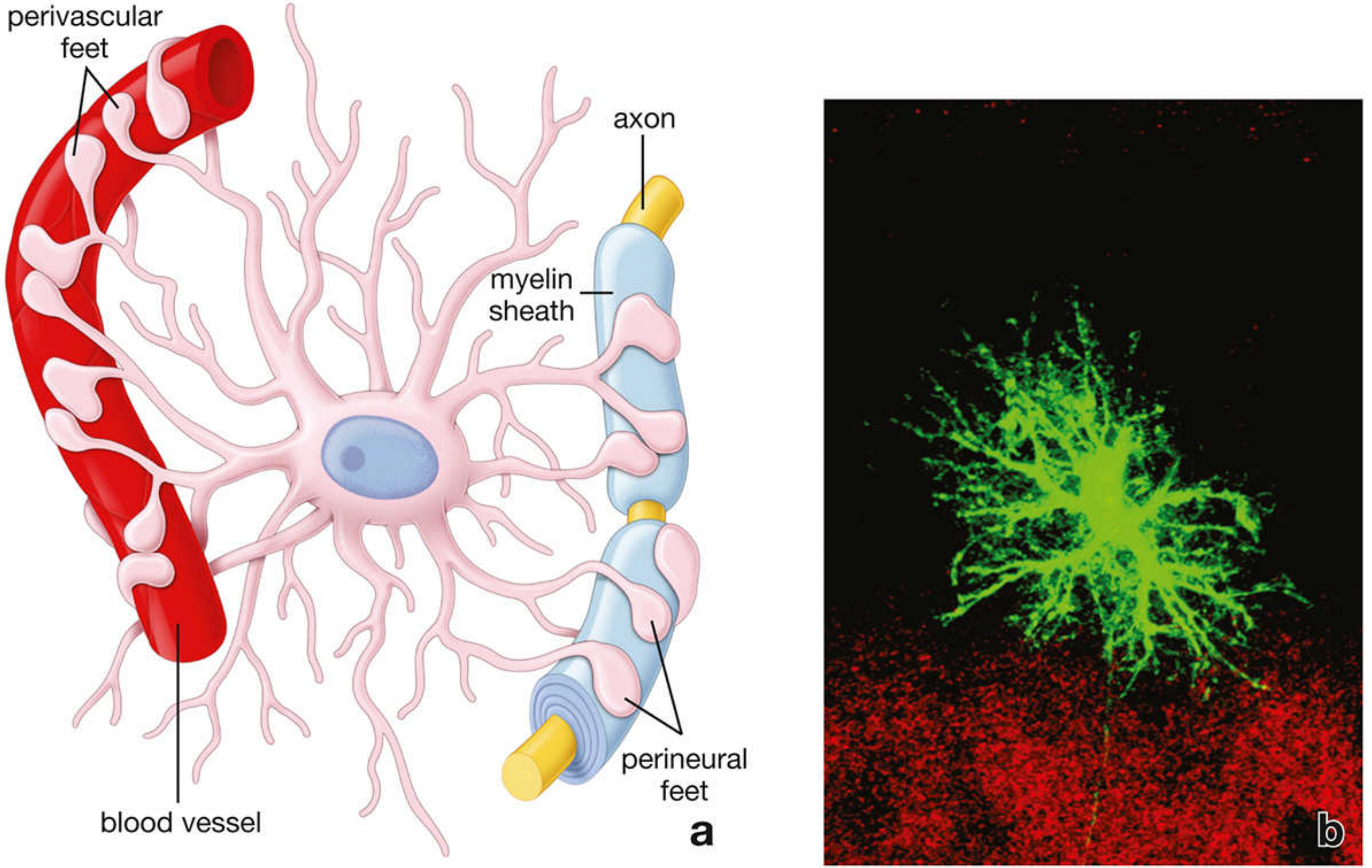
Two subtypes:
- Protoplasmic astrocytes — found in gray matter; have short, branching processes; a single cell can interact with up to 2 million synapses in humans
- Fibrous astrocytes — found in white matter; have long, slender, less-branched processes
Functions:
| Function | Detail |
|---|---|
| Structural support | Form a scaffold for neuron migration during brain development (radial glial cells) |
| Blood-brain barrier | Perivascular foot processes cover capillaries and contribute to the BBB |
| Potassium spatial buffering | K⁺ pumps/channels regulate extracellular K⁺ concentration, maintaining neuronal microenvironment |
| Neurotransmitter homeostasis | Recycle glutamate and GABA; regulate neurotransmitter levels at synapses |
| Phagocytosis | Reactive astrocytes eliminate excess synapses during development and clear myelin debris after injury |
| Scar formation | Form glial scars (reactive gliosis) at CNS injury sites |
| CSF-blood transport | Tanycytes (specialized ependymal-like astrocytes) transport substances between CSF and portal circulation |
2. Oligodendrocytes
Small cells with relatively few processes, often aligned in rows between axons.
Functions:
- Produce and maintain myelin in the CNS — each oligodendrocyte sends out multiple tongue-like processes that wrap concentrically around nearby axons, forming the internodal myelin sheath
- A single oligodendrocyte can myelinate several axons simultaneously (contrast with Schwann cells in PNS, which myelinate only one axon segment)
- CNS myelin uses specific proteins: proteolipid protein (PLP), myelin oligodendrocyte glycoprotein (MOG), and OMgp — deficiencies in these are implicated in autoimmune demyelinating diseases (e.g., multiple sclerosis)
3. Microglia
Small cells with dark, elongated, irregular nuclei and thin processes.
Functions:
- Resident immune cells of the CNS — derived from monocytes (mesodermal origin, unlike other glia)
- Phagocytosis — engulf cellular debris, dead neurons, pathogens, and damaged myelin
- Surveillance — continuously survey the CNS microenvironment
- Activated in response to CNS injury, infection, or disease (become enlarged, amoeboid "reactive microglia")
4. Ependymal Cells
Columnar cells forming a single-layer epithelium lining the brain ventricles and the central canal of the spinal cord. They have cilia on their apical surface.
Functions:
- Line and protect the ventricular system and central canal
- Cilia circulate cerebrospinal fluid (CSF)
- Choroid plexus — specialized ependymal cells produce and secrete CSF by transport and secretion from adjacent capillary loops
- Tanycytes (specialized ependymal cells in the floor of the 3rd ventricle) transport substances from CSF to the hypothalamic portal circulation and are involved in glucose/energy sensing
B. Peripheral Neuroglia (PNS)
5. Schwann Cells
The major glial cell of the PNS. Three phenotypes:
| Phenotype | Role |
|---|---|
| Myelinating Schwann cells | Wrap around large-diameter axons forming the myelin sheath; ensure rapid saltatory conduction |
| Nonmyelinating (Remak) Schwann cells | Envelop multiple small-diameter axons in grooves (Remak bundles); support unmyelinated fibers |
| Repair Schwann cells | Dedifferentiate after nerve injury; form bands of Büngner that guide axonal regrowth; secrete trophic factors and cytokines for repair |
Key distinction: Unlike oligodendrocytes, one Schwann cell myelinates only one internode of one axon.
6. Satellite Cells
Found surrounding neuron cell bodies in peripheral ganglia (dorsal root ganglia, autonomic ganglia).
Functions:
- Regulate the chemical microenvironment around ganglionic neurons
- Provide structural and metabolic support analogous to astrocytes in the CNS
7. Other Peripheral Neuroglia
- Terminal (perisynaptic) Schwann cells (teloglia) — cover axon terminals at neuromuscular junctions; modulate synaptic transmission
- Enteric glial cells — support neurons of the enteric nervous system in the gut wall
- Müller cells — specialized glia of the retina
Summary Table
| Cell Type | Location | Key Function |
|---|---|---|
| Astrocytes | CNS | Structural support, BBB, K⁺ buffering, synapse modulation |
| Oligodendrocytes | CNS | Myelin formation (multiple axons) |
| Microglia | CNS | Phagocytosis, immune surveillance |
| Ependymal cells | CNS | Line ventricles, CSF production/circulation |
| Schwann cells | PNS | Myelin formation (one axon), nerve repair |
| Satellite cells | PNS | Ganglionic neuron support |
— Histology: A Text and Atlas with Correlated Cell and Molecular Biology (Pawlina), 8th Ed.
This is a shared conversation. Sign in to Orris to start your own chat.