
Describe the Amphibolic role of TCA cycle
The TCA cycle (Krebs cycle) is called amphibolic because it serves both catabolic (energy-yielding, degradative) and anabolic (biosynthetic) purposes. Intermediates like oxaloacetate, alpha-ketoglutarate, and succinyl-CoA are siphoned off for biosynthesis of amino acids, heme, glucose, and fatty acids - while anaplerotic reactions replenish those intermediates to keep the cycle running.
Searching sources...
Reading File
Now let me search the library for the TCA cycle amphibolic role content:
Finding Sources
Finding Sources
Finding Sources
Finding Sources
Finding Sources
Finding Sources
Excellent - I found the key sections in Harper's and Lippincott. Let me read them in full:
Reading File
Reading File
Now let me read the key Harper's section on the amphibolic/anaplerotic role:
Reading File
Loading Image
Reading File
Loading Image
I also have the fatty acid synthesis diagram URL. Let me fetch it too:
Loading Image
I now have all the content needed from Harper's and Lippincott for a thorough, well-illustrated answer.
Amphibolic Role of the TCA Cycle
What Does "Amphibolic" Mean?
The term amphibolic (from Greek: amphi = both sides) describes a pathway that functions in both catabolic (degradative) and anabolic (synthetic) processes. The TCA cycle occupies a unique central position in metabolism - it simultaneously breaks down fuels AND provides the carbon skeletons for biosynthesis of many key molecules.
"Because it functions in both oxidative and synthetic processes, it is amphibolic."
- Harper's Illustrated Biochemistry, 32nd Ed.
1. The CATABOLIC Role (Energy Generation)
The cycle accepts acetyl-CoA derived from the catabolism of all three major fuel classes:
| Fuel | Entry point |
|---|---|
| Carbohydrates | Pyruvate → Acetyl-CoA (via PDH) |
| Fatty acids | Beta-oxidation → Acetyl-CoA |
| Amino acids | Multiple intermediates (see below) |
Per turn of the cycle, oxidation of one acetyl-CoA yields:
- 3 NADH (for ~7.5 ATP via ETC)
- 1 FADH2 (for ~1.5 ATP via ETC)
- 1 GTP (by substrate-level phosphorylation, via succinate thiokinase)
- 2 CO2 released
2. The ANABOLIC Role (Biosynthesis) - "Cataplerosis"
TCA intermediates are continuously drained out (cataplerosis) to serve as precursors for biosynthetic pathways:
A. Gluconeogenesis
- All TCA intermediates are potentially glucogenic - each can give rise to oxaloacetate (OAA), which then exits the cycle for glucose synthesis.
- The key enzyme is phosphoenolpyruvate carboxykinase (PEPCK), which decarboxylates OAA → phosphoenolpyruvate (PEP), using GTP as the phosphate donor.
- This GTP is supplied by the GDP-dependent isoenzyme of succinate thiokinase - this ensures OAA is only withdrawn when there is sufficient energy (GTP) available.
B. Amino Acid Synthesis (via Transamination)
- alpha-Ketoglutarate is transaminated to form glutamate (and glutamine, proline, arginine)
- Oxaloacetate is transaminated to form aspartate (and asparagine, pyrimidines, purines)
- Pyruvate (formed from cycle intermediates) is transaminated to alanine
- The reactions are reversible, so the cycle also accepts carbon from amino acid catabolism
C. Fatty Acid Synthesis (Lipogenesis)
- Acetyl-CoA is the substrate for fatty acid synthesis, but it is produced in the mitochondrial matrix and cannot cross the inner mitochondrial membrane directly.
- The TCA cycle solves this: acetyl-CoA condenses with OAA → citrate, which is transported out of the mitochondrion by the tricarboxylate carrier.
- In the cytosol, citrate lyase cleaves citrate back to acetyl-CoA + OAA - making acetyl-CoA available for fatty acid and cholesterol synthesis.
- The OAA is then reduced to malate (by malate dehydrogenase), and the malic enzyme oxidatively decarboxylates malate → pyruvate + NADPH, which provides half the reducing power needed for fatty acid synthesis.
D. Heme Synthesis
- Succinyl-CoA (a TCA intermediate) is a direct precursor for porphyrin ring synthesis - the first committed step is the condensation of succinyl-CoA with glycine to form delta-aminolevulinic acid (ALA), catalyzed by ALA synthase.
E. Purine & Pyrimidine Synthesis
- alpha-Ketoglutarate and oxaloacetate contribute to purine synthesis (via glutamate and aspartate).
- IMP (inosine monophosphate) is synthesized from amphibolic intermediates.
3. The ANAPLEROTIC Reactions - Replenishing the Cycle
Because intermediates are constantly removed for biosynthesis, they must be continuously replenished. These "filling-up" reactions are called anaplerotic reactions:
| Reaction | Intermediate Formed | Enzyme |
|---|---|---|
| Pyruvate + CO2 → Oxaloacetate | OAA | Pyruvate carboxylase (most important; requires biotin & ATP) |
| Amino acid catabolism: Glutamate → alpha-KG | alpha-Ketoglutarate | Glutamate dehydrogenase |
| Ile, Met, Val → Succinyl-CoA | Succinyl-CoA | Via methylmalonyl-CoA |
| Phe, Tyr → Fumarate | Fumarate | Phenylalanine hydroxylase pathway |
| Propionate → Succinyl-CoA | Succinyl-CoA | Propionyl-CoA pathway |
The most important anaplerotic reaction is pyruvate carboxylase - when acetyl-CoA levels are high, it allosterically activates this enzyme to make more OAA, ensuring acetyl-CoA has sufficient OAA to condense with so the cycle keeps running.
4. Amphibolic Diagram
This figure from Harper's shows the TCA cycle's involvement in transamination, gluconeogenesis, and amino acid interconversion:
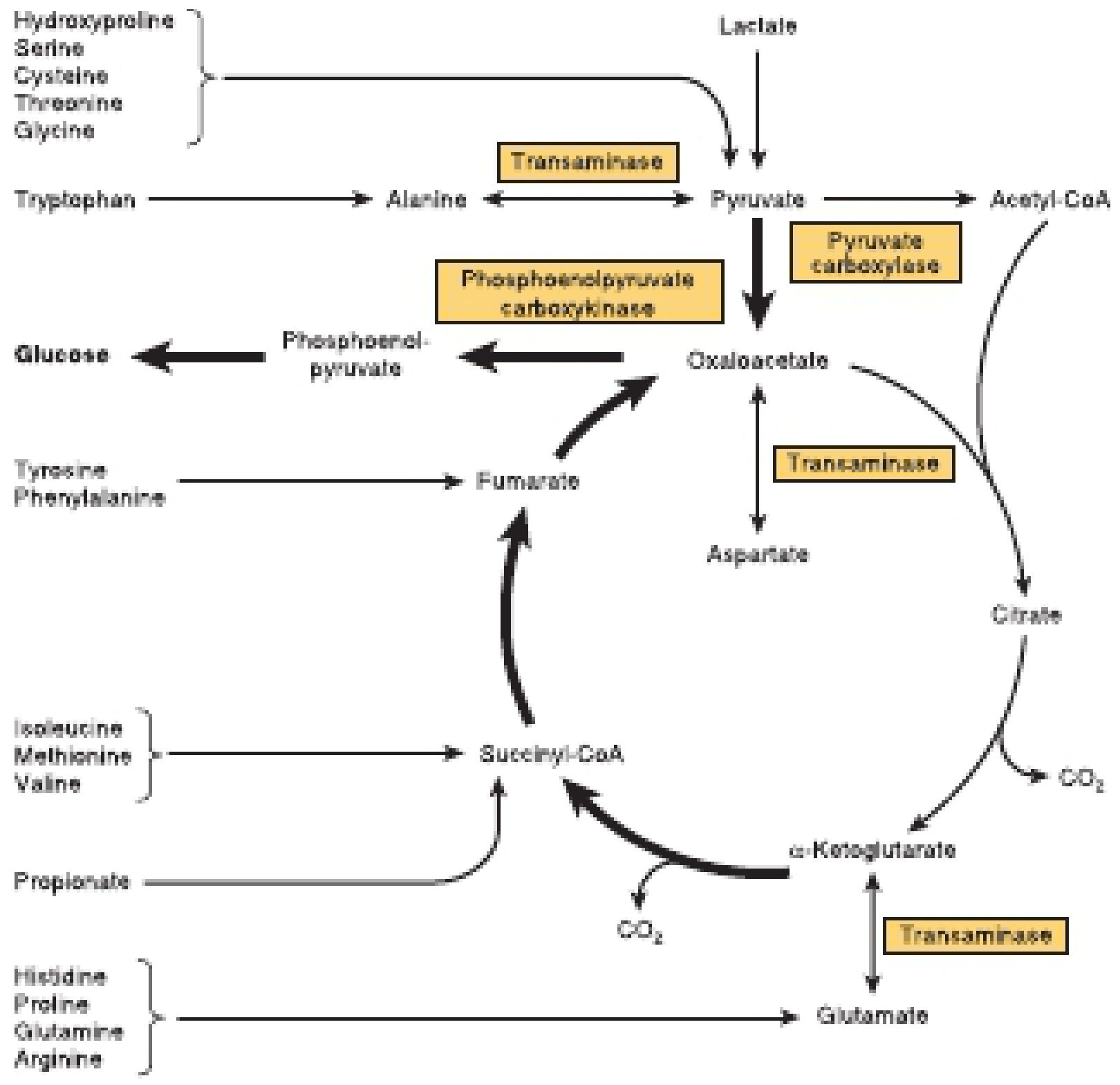
FIGURE 16-4 (Harper's): Involvement of the citric acid cycle in transamination and gluconeogenesis. Bold arrows = main gluconeogenic pathway.
And the role in fatty acid synthesis:
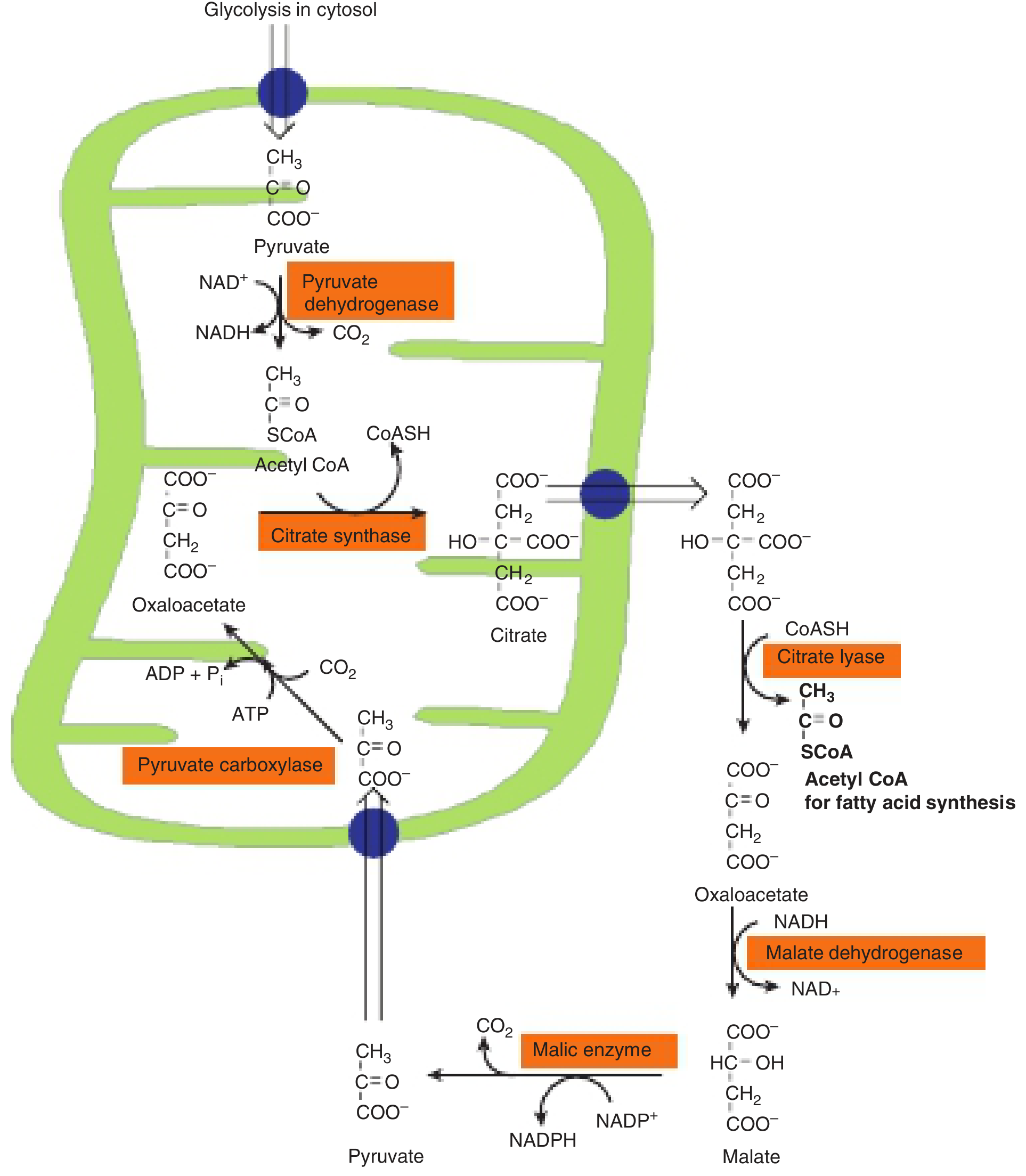
FIGURE 16-5 (Harper's): Participation of the citric acid cycle in providing cytosolic acetyl-CoA for fatty acid synthesis from glucose.
Summary Table
| Function | Category | TCA Intermediate Involved |
|---|---|---|
| ATP production via ETC | Catabolic | All (via NADH, FADH2) |
| Gluconeogenesis | Anabolic | OAA → PEP |
| Amino acid synthesis | Anabolic | alpha-KG → Glu; OAA → Asp |
| Fatty acid synthesis | Anabolic | Citrate (shuttle) |
| Heme synthesis | Anabolic | Succinyl-CoA |
| Purine/pyrimidine synthesis | Anabolic | alpha-KG, OAA (via Glu, Asp) |
| Pyruvate carboxylation | Anaplerotic | OAA replenishment |
| Amino acid catabolism → cycle entry | Anaplerotic | Multiple intermediates |
Clinical Relevance
- Hyperammonemia (advanced liver disease): Excess NH3 withdraws alpha-ketoglutarate to form glutamate/glutamine, depleting TCA intermediates and reducing ATP production - causing impaired consciousness, coma, and convulsions.
- Pyruvate carboxylase deficiency: Impairs anaplerosis → OAA deficiency → cycle slows → lactic acidosis and neurologic impairment.
- Liver disease (hepatitis, cirrhosis): The liver is the only organ where all amphibolic functions occur significantly; hepatocellular damage therefore has profound metabolic consequences.
Sources: Harper's Illustrated Biochemistry, 32nd Ed., pp. 168-173; Lippincott's Illustrated Reviews: Biochemistry, 8th Ed., pp. 332-335.
This is a shared conversation. Sign in to Orris to start your own chat.