
Open partial laryngectomy in detail for 20 marker long question answer according to standard ENT textbook
Reading File
Finding Sources
Finding Sources
Finding Sources
Finding Sources
Reading File
Reading File
Finding Sources
Reading File
Reading File
Reading File
Reading File
Reading File
Reading File
Reading File
Reading File
Reading File
Searching PubMed
"open partial laryngectomy" AND larynx cancer
Open Partial Laryngectomy
Introduction
Partial laryngectomy is a conservation (organ-preserving) laryngeal surgery in which only the tumour-bearing part of the larynx is removed, while the remaining laryngeal framework is reconstructed to preserve a functional airway, voice, and a competent sphincter for swallowing (separation of the airway from the food passage). "Open" partial laryngectomy refers to procedures done through an external neck approach (as opposed to transoral laser microsurgery, TLM, which removes tumour endoscopically). The first partial laryngectomy is credited to Theodor Billroth (1874), and multiple modifications have since evolved (Scott-Brown's Otolaryngology, p. 495).
Goal of open partial laryngectomy (OPL):
- Complete tumour removal with microscopically clear margins (oncological safety) – this is the single most important determinant of local control and survival.
- Preservation of a safe, patent airway with a functional (neo)glottic valve.
- Preservation of a competent sphincter to prevent aspiration during swallowing.
- Preservation of useful voice.
(Scott-Brown's Otorhinolaryngology Head & Neck Surgery, "Surgical Goals of Open Partial Laryngectomy", p. 495)
Classification of Partial Laryngectomy
A. By approach
- Endoscopic/Transoral laser microsurgery (TLM)
- Open partial laryngectomy (external approach)
B. Open Partial Laryngectomy - by orientation of resection
| Category | Procedures |
|---|---|
| Vertical procedures (glottic tumours) | Anterolateral hemilaryngectomy, Frontolateral hemilaryngectomy, Anterior vertical (commissure) laryngectomy |
| Horizontal procedures (supraglottic/transglottic tumours) | Horizontal Supraglottic Partial Laryngectomy (HSPL), Supracricoid Partial Laryngectomy (SCPL) with Cricohyoidoepiglottopexy (CHEP) or Cricohyoidopexy (CHP), Supratracheal laryngectomy |
| Near-total/extended procedures | Extended vertical hemilaryngectomy with tracheal autograft reconstruction, Near-total laryngectomy |
Indications
Since most early and many moderately advanced laryngeal cancers are amenable to several equally effective treatment options, choice depends on tumour, patient and physician factors (Table below).
| Tumour factors | Patient factors | Physician factors |
|---|---|---|
| Site, extent, volume, N-stage, M-stage | Age, comorbidity, pulmonary reserve, tobacco/alcohol use, occupation (voice needs), motivation, social support, compliance | Availability of resources/expertise, experience, preference |
(Scott-Brown's, Table 27.3, p. 498)
Specific indications:
- T1-T2 glottic carcinoma with mobile cord, in patients unfit for or preferring not to have TLM/radiotherapy, or where TLM is not feasible (poor transoral exposure).
- T1b/T2 glottic carcinoma with anterior commissure involvement (not more than one-third of the contralateral cord) – frontolateral/anterior vertical laryngectomy.
- Transglottic tumours crossing the anterior commissure, tumours with limited pre-epiglottic space invasion, limited thyroid cartilage invasion, or reduced cord mobility, not suitable for hemilaryngectomy or HSPL – supracricoid laryngectomy.
- Supraglottic carcinoma confined above the ventricle, without extension to the true cord, without cricoarytenoid fixation, without more than minimal pre-epiglottic invasion – HSPL.
- Selected advanced (T3-T4a) laryngeal cancers with limited cartilage invasion in expert centres, as an alternative to total laryngectomy, provided oncological safety is not compromised.
- Selected radio-recurrent laryngeal cancers (approximately 30-50% of cases can be safely salvaged with OPL rather than total laryngectomy) in well-selected patients.
Contraindications
- Fixed vocal cord due to recurrent laryngeal nerve invasion (as opposed to fixation from bulk/paraglottic extension, which may still permit surgery in selected cases).
- Gross thyroid/cricoid cartilage invasion (microscopic erosion alone is not an absolute contraindication).
- Involvement of both arytenoids, or bilateral arytenoid fixation.
- Extension through the cricoid cartilage, subglottic extension beyond 10 mm anteriorly/5 mm posteriorly (for hemilaryngectomy).
- Poor pulmonary reserve/inability to tolerate aspiration risk (COPD, poor cough reflex) — because all partial laryngectomies carry a risk of post-operative aspiration.
- Patient non-compliance or inability to participate in prolonged swallowing/speech rehabilitation, or inability to consent to possible intra-operative conversion to total laryngectomy.
- Skull-base-to-clavicle type prior irradiation fields or salvage setting with poor tissue quality (relative contraindication).
(Scott-Brown's, "Indications for Open Partial Laryngectomy" and "Tumour factors", pp. 498-499)
Types of Open Partial Laryngectomy — Technique
1. Vertical Partial Laryngectomy
a) Anterolateral (Vertical) Hemilaryngectomy
- Indicated for glottic tumours not involving the anterior commissure.
- Thyroid cartilage exposed below strap muscles; ipsilateral perichondrium elevated and preserved.
- Vertical cuts through the thyroid cartilage in laryngofissure fashion; the ipsilateral thyroid ala, true vocal cord, false cord and part of subglottic mucosa are removed en bloc with the tumour.
- Strap muscles are sutured over the residual perichondrium to reconstruct a "pseudocord", which vibrates against the intact contralateral cord to produce voice.
- Temporary tracheostomy and feeding tube required (3-7 days).
b) Frontolateral Hemilaryngectomy
- Used when tumour involves the anterior commissure and up to one-third of the contralateral cord.
- The contralateral thyroid cartilage cut is placed 1 cm paramedian to the midline, so that resection includes the anterior commissure and adjoining contralateral cord.
c) Anterior Vertical (Commissure) Laryngectomy
- Two paramedian thyroid cartilage incisions are made about 1 cm either side of the midline.
- Used for tumours confined to the anterior third of one or both cords at the commissure.
- After resection, the residual posterior cords are reattached to the anterior thyroid ala remnants; a silastic keel is placed at the neo-commissure to prevent web formation and removed endoscopically after about 4 weeks.
2. Horizontal Supraglottic Partial Laryngectomy (HSPL)
- Removes epiglottis, part of hyoid bone, pre-epiglottic space, thyrohyoid membrane, upper half of thyroid cartilage, aryepiglottic folds and part of false cords, while the true vocal cords, arytenoids and cricoid are preserved.
- Superior cut through the vallecula, inferior cut at the ventricles, lateral cuts through the aryepiglottic folds.
- Closure: base of tongue is approximated to the residual (lower half) thyroid cartilage; posterior false cord mucosa closed to medial pyriform sinus mucosa.
- Because of high rates of (contralateral) occult neck node metastasis from supraglottic cancer, bilateral selective neck dissection is performed simultaneously.
- Internal and external branches of the superior laryngeal nerve must be identified and preserved bilaterally.
- Temporary tracheostomy required; swallowing rehabilitation is essential as true cords now must compensate for loss of the epiglottic "lid".
3. Supracricoid Partial Laryngectomy (SCPL)
Two variants, depending on whether the pre-epiglottic tissue and suprahyoid epiglottis can be preserved:
- SCPL with Cricohyoidoepiglottopexy (CHEP) – for glottic tumours crossing the anterior commissure not amenable to hemilaryngectomy.
- SCPL with Cricohyoidopexy (CHP) – for supraglottic tumours with glottic extension, pre-epiglottic invasion, reduced cord mobility, or limited thyroid cartilage invasion (the epiglottis cannot be preserved so there is no epiglottic remnant for reconstruction, delaying swallowing recovery).
Extent of resection: both true cords, both false cords, the entire thyroid cartilage, bilateral paraglottic spaces, and up to one arytenoid can be sacrificed.
Key surgical principles:
- Preserve both superior laryngeal nerves (sensation for swallowing safety).
- Preserve at least one functioning recurrent laryngeal nerve (for airway closure during speech/swallow).
- Preserve at least one arytenoid — functional results are best with both arytenoids intact.
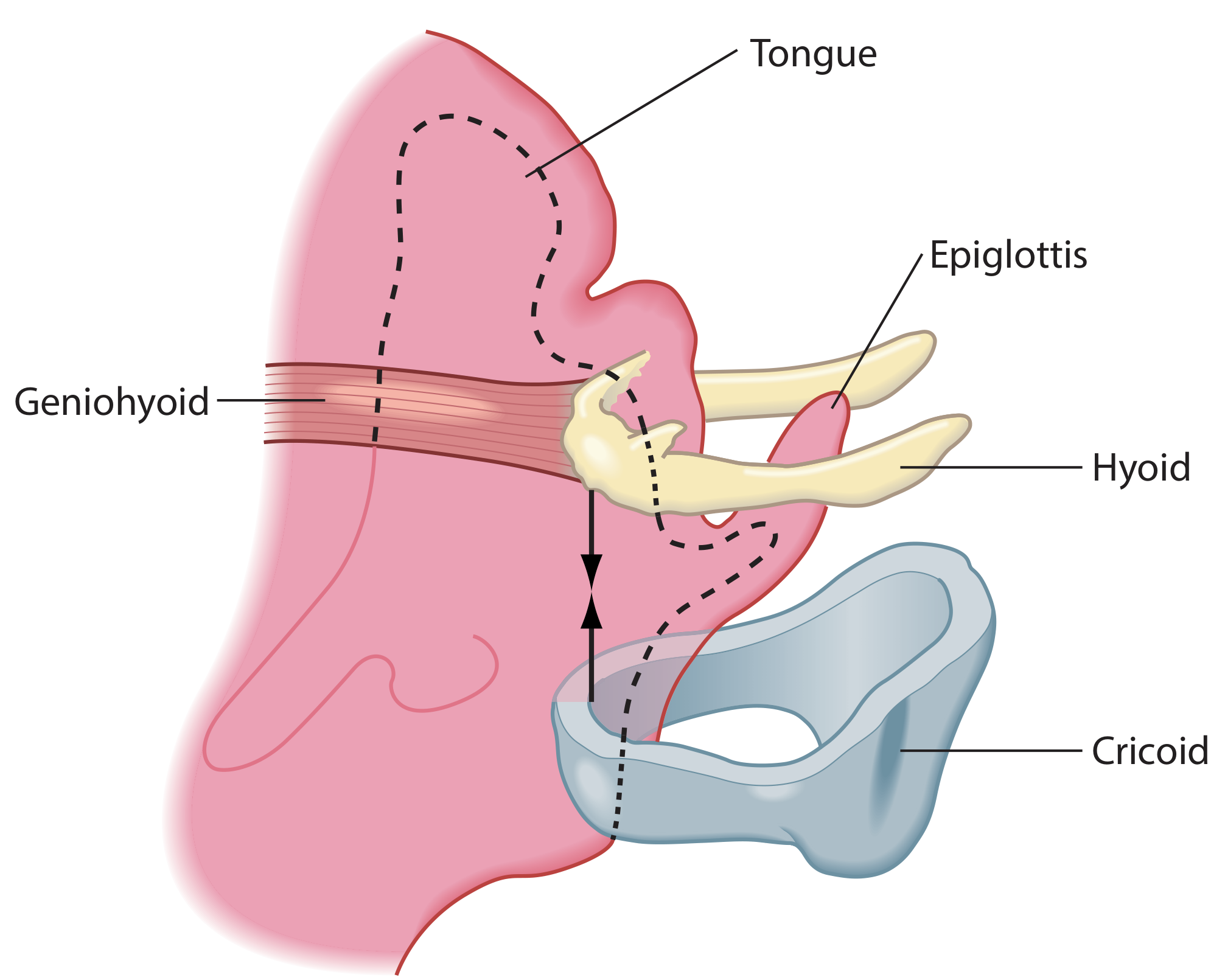
- Reconstruction: the hyoid bone is approximated to the cricoid cartilage with three absorbable sutures (one midline, two paramedian, avoiding the lingual arteries, hypoglossal and superior laryngeal nerves) — cricohyoidopexy; if the suprahyoid epiglottis is preserved it is incorporated into the pexy (CHEP).
- The airway axis rotates roughly 90° from its normal anteroposterior slit orientation to a transverse/T-shaped neoglottic opening, closed by the mobile arytenoid(s).
- Temporary tracheostomy is mandatory; most patients can be decannulated early. A nasogastric tube is used for feeding (removed at 4-6 weeks with swallowing therapy); a PEG tube is preferred in older patients, those with only one arytenoid preserved, prior irradiation, or nerve dysfunction. Quiet (silent) aspiration is expected in nearly all patients and meticulous oral hygiene is essential.
4. Other Extended Procedures
- Supratracheal laryngectomy – an extension of SCPL for subglottic extension, resecting one or more tracheal rings along with the cricoid arch.
- Extended vertical hemilaryngectomy with neovascularized tracheal autograft reconstruction – used for more extensive vertical resections requiring cartilage replacement.
- Near-total laryngectomy – for one-sided extensive disease, creating a permanent tracheostome with a shunt/pseudo-glottis for voicing, functionally intermediate between partial and total laryngectomy.
Peri-operative and Post-operative Management
- Tracheostomy – temporary in almost all OPL procedures, to protect the airway during the immediate post-operative oedema phase.
- Feeding – nasogastric tube (or PEG in high-risk patients) until safe swallowing is confirmed; swallowing rehabilitation with a speech-language pathologist is started early.
- Voice/swallow rehabilitation is intensive and prolonged; patient motivation and compliance are essential prerequisites for success.
- Patients need close oncologic follow-up given the altered anatomy, which can mask recurrence.
Complications
Categorised as:
- Local: wound infection, wound dehiscence, pharyngocutaneous fistula (2.5-4%, higher after salvage surgery — ~14%), chyle leak.
- Swallowing: dysphagia, aspiration pneumonia, pharyngeal/laryngeal stricture.
- Airway: laryngeal oedema, laryngeal stenosis, granuloma formation, surgical emphysema, perichondritis, CHEP/CHP breakdown.
- Systemic: cardiac, pulmonary, renal, infectious, and metabolic complications.
Overall complication rate after OPL is around 20%, with local complications the commonest (8-11%). Prior radiotherapy is the strongest predictor of local complications and fistula formation (up to a 13-fold increase). More extensive procedures (e.g., SCPL) carry a higher complication rate than simple hemilaryngectomy on univariate analysis.
(Scott-Brown's, "Complications and Functional Outcomes of Open Partial Laryngectomy", p. 500)
Oncological and Functional Outcomes
- Pooled data (systematic review, 5061 patients): 24-month local control ~89.8%, larynx preservation rate ~90.9%, comparing favourably with (chemo)radiotherapy.
- T1 glottic SCC: local control/laryngeal preservation 92-100%.
- T2 glottic SCC: local control 69-93%; laryngeal preservation after salvage still reaches ~93%.
- Disease-specific mortality from early glottic cancer is low (~1-3%) regardless of modality chosen, so local control and organ preservation, not survival, are the key comparative endpoints between surgery, TLM and radiotherapy.
- Functional voice quality is generally rated superior after radiotherapy, but laryngeal preservation rates favour surgery.
Recent Evidence (Supplementary)
Recent systematic reviews and meta-analyses support and extend the textbook indications:
- A 2025 systematic review/meta-analysis on open partial horizontal laryngectomies in naïve T3-T4a laryngeal cancer confirms these procedures remain oncologically viable alternatives to total laryngectomy in carefully selected advanced disease in expert centres (PMID: 40356754).
- A 2025 meta-analysis on surgical margins in open horizontal laryngectomy reaffirms that margin status is the strongest prognostic factor for local control, consistent with the textbook emphasis on complete tumour resection (PMID: 40400379).
- A 2024 systematic review on supracricoid partial laryngectomy outcomes in the US found favourable local control and functional preservation, supporting continued use of SCPL as a laryngeal-preservation option (PMID: 38251796).
These do not contradict the standard textbook teaching but reinforce that patient selection and margin control remain central to success.
Summary
Open partial laryngectomy is a family of larynx-conserving procedures (vertical hemilaryngectomy variants, horizontal supraglottic laryngectomy, and supracricoid laryngectomy with CHEP/CHP) used for carefully selected glottic, supraglottic and transglottic cancers. Success depends on rigorous tumour staging, patient selection (pulmonary reserve, compliance, motivation), meticulous nerve-sparing technique, and structured post-operative swallowing/voice rehabilitation. Compared with total laryngectomy, OPL preserves natural voice and avoids a permanent stoma, at the cost of a more demanding recovery and a real risk of aspiration; compared with TLM and radiotherapy, it remains most relevant for tumours not accessible transorally, more advanced (T3-T4a) disease, and selected radio-recurrent cancers.
Primary source: Scott-Brown's Otorhinolaryngology Head & Neck Surgery, Chapter 27 "Laryngectomy", pp. 495-500.
This is a shared conversation. Sign in to Orris to start your own chat.