
Explain wide radical neck dissection?
Reading File
Finding Sources
Finding Sources
Reading File
Reading File
Reading File
Reading File
Finding Sources
Reading File
Reading File
Reading File
Loading Image
Now I have comprehensive information to give a thorough answer. Let me also quickly check the Sabiston reference and the "wide" vs "extended" terminology.
Reading File
I now have all the information needed. Here is a comprehensive explanation:
Wide (Extended) Radical Neck Dissection
Terminology Clarification
"Wide radical neck dissection" is a colloquial term for what is formally classified as an extended radical neck dissection (ERND). In the American Head and Neck Society (AHNS) classification, when a modification of the radical neck dissection (RND) involves the removal of additional lymph node groups or nonlymphatic structures beyond those routinely removed in a standard RND, the procedure is called an extended radical neck dissection. — Cummings Otolaryngology Head and Neck Surgery
Foundation: The Standard Radical Neck Dissection (Crile Operation)
To understand the "extended" version, one must first understand the standard:
Radical Neck Dissection (RND) removes, en bloc:
- All ipsilateral cervical lymph nodes, Levels I–V
- Spinal accessory nerve (SAN / CN XI)
- Internal jugular vein (IJV)
- Sternocleidomastoid muscle (SCM)
Boundaries:
- Superior: Inferior border of the mandible
- Inferior: Clavicle
- Medial: Contralateral anterior belly of digastric + lateral border of strap muscles
- Lateral: Anterior border of trapezius
Structures not removed in standard RND: postauricular, suboccipital, periparotid, perifacial/buccinator, retropharyngeal, and paratracheal nodes.
Extended Radical Neck Dissection — Definition
The ERND goes beyond the standard RND by additionally resecting one or more of the following:
| Additional Structure Resected | Clinical Scenario |
|---|---|
| Common carotid artery (CCA) / Internal carotid artery (ICA) | Tumor directly invading or encasing carotid wall |
| Hypoglossal nerve (CN XII) | Advanced nodal disease involving the nerve |
| Vagus nerve (CN X) | Direct tumor infiltration |
| External carotid artery | Tumor involvement |
| Skin overlying the neck | Skin invasion (e.g., nasopharyngeal carcinoma) |
| Parotid gland | Nodal disease in parotid region |
| Deep cervical (paraspinal) muscles | Posterior infiltration |
| Additional lymph node levels (e.g., Level VI, retropharyngeal nodes) | Pattern of spread demands wider clearance |
Surgical Anatomy Illustration
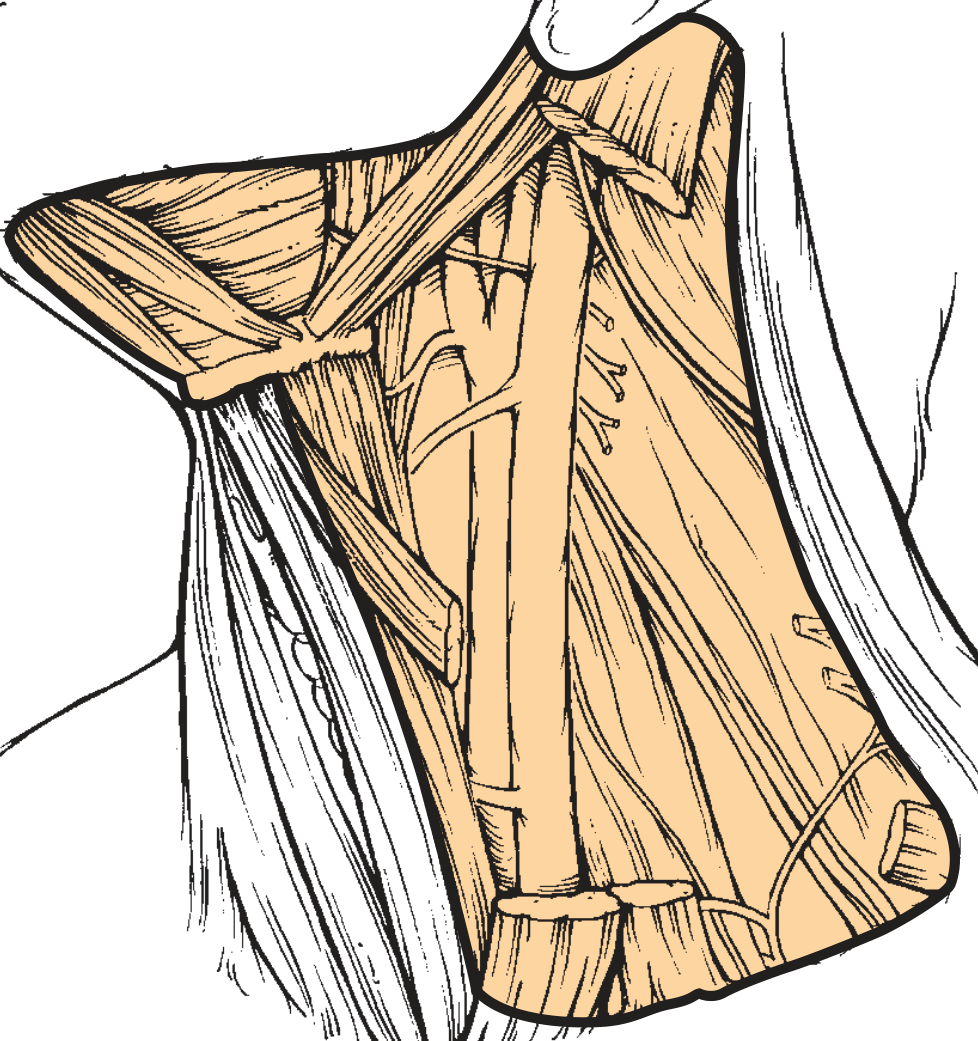
Radical neck dissection with boundaries of dissection (Fig. 118.3, Cummings Otolaryngology). Extended RND goes further by removing additional non-lymphatic structures.
Indications
ERND is indicated when:
- Extensive nodal metastases directly infiltrate or fix to non-lymphatic structures beyond those already sacrificed in standard RND
- Disease is adherent to or encasing the carotid artery, requiring its resection for complete clearance
- Nasopharyngeal carcinoma with skin involvement (skin over the neck is resected)
- Salvage surgery after failed chemoradiation with fibrotic, adherent nodal disease
Key Surgical Considerations
Carotid Artery Resection
This is the most consequential extension. Before planned carotid resection:
- Endovascular balloon occlusion test of the ICA is performed with physiologic monitoring
- Crossover flow through the circle of Willis is assessed angiographically
- A 30-minute occlusion test with induced hypotension and clinical neurological observation is performed
- Functional cerebral blood flow studies (xenon CT, SPECT) confirm tolerance
- If the patient cannot tolerate ICA sacrifice, an ICA revascularization procedure (saphenous vein interposition graft preferred over prosthetic) is planned
- If skin is irradiated, a myocutaneous flap covers the graft
Evidence shows that only ~18% of patients with tumor adherent to the carotid artery develop recurrence in the neck without distant metastasis, raising the question of which patients truly benefit from carotid resection. — Cummings Otolaryngology
AHNS Classification Notation (Contemporary)
The current AHNS/international system encodes the procedure precisely:
- Prefix: L (left) or R (right) side
- Levels removed: Roman numerals (e.g., I–V)
- Non-lymphatic structures removed: Acronyms (SCM, IJV, CN XI, CN XII, CCA, ICA, ECA, SKN, PG, DCM, etc.)
Example:
R ND (I–V, SCM, IJV, CN XI, CN XII) = Right extended radical neck dissection removing levels I–V plus SCM, IJV, spinal accessory nerve, and hypoglossal nerve.Comparison of Neck Dissection Types
| Type | Levels Removed | Structures Sacrificed |
|---|---|---|
| Selective ND | Subset (e.g., I–III, II–IV) | None (SCM, IJV, SAN preserved) |
| Modified Radical ND | I–V | IJV and/or SCM; SAN preserved |
| Radical ND (RND) | I–V | SCM + IJV + SAN |
| Extended Radical ND | I–V (+ additional levels) | SCM + IJV + SAN + additional structures (carotid, CN XII, skin, etc.) |
Morbidity
- Shoulder drop/weakness (trapezius paralysis) from SAN sacrifice — the primary functional deficit of RND, carried forward into ERND
- Carotid resection carries stroke risk (~12% postoperative cerebrovascular complications in series)
- Facial edema / raised intracranial pressure if bilateral IJV sacrifice is required
- Wound breakdown in previously irradiated fields — mitigated with flap coverage
- Voice/swallowing dysfunction if vagus or hypoglossal nerves are sacrificed
Outcomes
Recurrence rates after RND/ERND are influenced by:
- Extracapsular spread (ECS): Macroscopic ECS → 44% recurrence vs. 25% for microscopic
- Number of involved nodes: ≥4 nodes dramatically worsen 4-year survival
- Multi-level nodal involvement: Recurrence 36.5% (one level) vs. 71% (multiple levels)
- Adjuvant radiotherapy significantly improves neck control after all types of neck dissection
Sources: Cummings Otolaryngology Head and Neck Surgery (pp. 2293–2306); Bailey and Love's Short Practice of Surgery, 28th ed.; Sabiston Textbook of Surgery
This is a shared conversation. Sign in to Orris to start your own chat.