
Difference between nephrogenic and central Diabetes insipidus
Reading File
Now let me search the medical library for content on diabetes insipidus in parallel:
Finding Sources
Finding Sources
Now let me read the most relevant sections in parallel:
Reading File
Reading File
Reading File
Now let me get the Goldman-Cecil detailed section and the Tietz lab section for diagnostic workup:
Reading File
Reading File
Let me get the nephrogenic DI details and treatment from Goldman-Cecil, and also fetch the diagnostic flowchart image:
Reading File
Loading Image
Let me read the treatment and water deprivation test section from Goldman-Cecil:
Reading File
I now have comprehensive information to provide a detailed, well-structured answer. Let me also get the water deprivation / desmopressin test details:
Reading File
I now have enough comprehensive information to give a thorough answer. Let me compile it:
Central vs. Nephrogenic Diabetes Insipidus
Both forms share the same hallmark presentation - polyuria (>50 mL/kg/day of hypotonic urine), polydipsia, and dilute urine - but the underlying defect, causes, diagnostic response, and treatment differ fundamentally.
Core Pathophysiology
| Feature | Central DI | Nephrogenic DI |
|---|---|---|
| Defect location | Hypothalamus / posterior pituitary | Kidney (collecting duct) |
| Mechanism | Failure to synthesize or secrete ADH (vasopressin) | Renal resistance/unresponsiveness to ADH |
| ADH levels | Low or absent (unmeasurable) | Normal or elevated |
| Aquaporin-2 (AQP2) | AQP2 present but not stimulated | AQP2 absent, mutated, or signaling is blocked |
In central DI, as few as 10-15% of normal vasopressinergic neurons in the hypothalamus are sufficient to maintain asymptomatic urine volumes - loss of just a few more neurons produces rapid symptomatic polyuria. In nephrogenic DI, vasopressin is secreted normally from the posterior pituitary, but the principal cells of the collecting duct cannot respond to it. - Goldman-Cecil Medicine, p. 2190-2194
Causes
Central DI (acquired > congenital)
- Tumors: craniopharyngioma, germinoma, pinealoma, metastases (lung, breast)
- Trauma: head injury, basal skull fracture, post-neurosurgical (especially after pituitary adenoma resection)
- Infiltrative/inflammatory: neurosarcoidosis, histiocytosis (Langerhans cell), tuberculous meningitis, multiple sclerosis
- Vascular: hypothalamic hemorrhage
- Idiopathic: up to 30-50% of cases (not considered truly idiopathic until 4 years of follow-up with negative annual imaging)
- Genetic (autosomal dominant): mutations in the signal peptide or neurophysin portion of the pre-prohormone; onset is typically delayed to childhood - Goldman-Cecil Medicine, p. 2192-2194
Nephrogenic DI (renal resistance)
- Genetic (congenital):
- X-linked (>90% of congenital cases): mutations in the AVPR2 gene (vasopressin V2 receptor); affects males, frequency 4-8 per million male births; presents in the first week of life with vomiting, failure to thrive, hypernatremia
- Autosomal recessive/dominant (<10%): mutations in the AQP2 gene (aquaporin-2 water channel)
- Acquired (more common than congenital):
- Drugs: lithium (most common - blocks adenylyl cyclase in collecting duct cells), demeclocycline, amphotericin B
- Electrolyte disorders: hypokalemia, hypercalcemia
- Renal diseases: sickle cell disease, sarcoidosis, pyelonephritis, multiple myeloma, analgesic nephropathy, ureteric obstruction, CKD
- Diuretics (furosemide): impair loop of Henle concentrating mechanism - Guyton & Hall Physiology, p. 380; Goldman-Cecil Medicine, p. 2321
Clinical Features
| Feature | Central DI | Nephrogenic DI |
|---|---|---|
| Urine volume | Up to 18-24 L/day (complete) | Large, but may be less extreme in partial/acquired forms |
| Onset | Often relatively abrupt (days to weeks) | Congenital: neonatal period; Acquired: gradual |
| Thirst | Present and strong (preference for cold liquids) | Present; thirst mechanism intact |
| Nocturia/noctural polydipsia | Yes - disrupts sleep | Yes |
| Serum sodium | High-normal (mild hypernatremia if thirst insufficient) | Can be significantly elevated in congenital neonatal form |
| Uric acid | Elevated (>5 mg/dL) - helps distinguish from primary polydipsia | Similar |
| Bright spot on T1 MRI | Absent (normally present in posterior pituitary) | Present (normal posterior pituitary) |
Diagnostic Workup
The diagnostic flowchart below (from Goldman-Cecil Medicine) outlines the approach to polyuria:
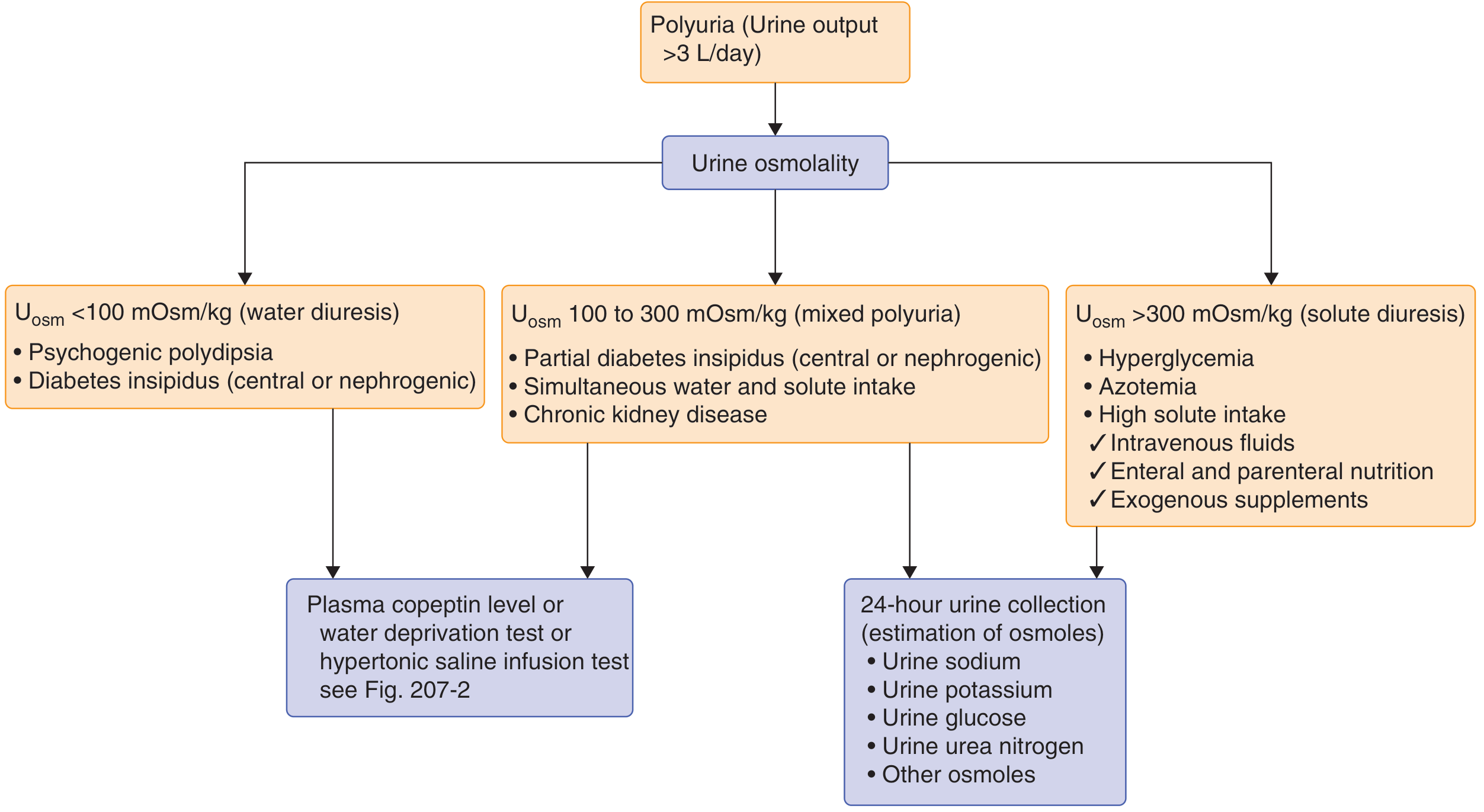
Both types produce urine osmolality <100 mOsm/kg (water diuresis). The key distinguishing test is the desmopressin (DDAVP) test:
Water Deprivation + Desmopressin Test
| Response after Desmopressin | Diagnosis |
|---|---|
| Urine osmolality increases >50% | Complete central DI |
| Urine osmolality increases 10-50% | Partial central DI |
| No significant increase (<10%) in urine osmolality | Nephrogenic DI |
| No increase (already maximally concentrated during deprivation) | Primary polydipsia |
Lack of a prompt decrease in urine volume and increase in urine osmolarity within 2 hours after desmopressin injection is strongly suggestive of nephrogenic DI. - Guyton & Hall Physiology, p. 380
Plasma Copeptin
A newer test (replacing water deprivation in many centers): copeptin (C-terminal fragment of the vasopressin precursor) is low in central DI and high or normal in nephrogenic DI and primary polydipsia.
Treatment
Central DI
- Desmopressin (DDAVP) - synthetic ADH analogue; drug of choice
- Intranasal: 5-20 µg per dose (spray or rhinal catheter)
- Oral: start with 0.05 mg (half a 0.1 mg tablet) at bedtime; titrate to 8-12 hour dosing
- Parenteral (hospitalized patients): 1-2 µg IV/SC every 8-12 hours
- Monitor serum sodium to avoid hyponatremia from over-treatment
- Treat the underlying cause (surgery, radiation for tumors)
- Post-surgical DI often recovers within 1 year; weekly dose holds can assess ongoing need - Goldman-Cecil Medicine, p. 2337-2341
Nephrogenic DI
- Address underlying cause: stop offending drugs (lithium, demeclocycline), correct hypokalemia/hypercalcemia
- Thiazide diuretics (paradoxically reduce polyuria): cause mild sodium depletion, reduce GFR, increase proximal tubule reabsorption - less fluid reaches the collecting duct
- Low-sodium, low-protein diet: reduces osmotic load
- NSAIDs (indomethacin): inhibit prostaglandins that antagonize ADH action - used adjunctively
- Amiloride: used specifically for lithium-induced nephrogenic DI - blocks lithium entry into collecting duct cells
- Desmopressin is ineffective in complete nephrogenic DI (the receptor/signaling pathway is the problem)
Summary Table
| Parameter | Central DI | Nephrogenic DI |
|---|---|---|
| Site of defect | Hypothalamus/pituitary | Kidney (collecting duct) |
| ADH secretion | Absent or low | Normal or high |
| ADH action | Cannot be tested (none released) | Defective despite normal/high ADH |
| Serum ADH/copeptin | Low | Normal or elevated |
| Response to desmopressin | Responds (urine concentrates) | Does not respond |
| MRI posterior pituitary | Bright spot absent | Bright spot present |
| Genetics | Autosomal dominant (AVPR gene mutations) | X-linked (AVPR2) or AR/AD (AQP2) |
| Treatment | Desmopressin | Thiazides, NSAIDs, amiloride, low-Na diet |
Sources: Goldman-Cecil Medicine (International Edition), Guyton & Hall Textbook of Medical Physiology, Tietz Textbook of Laboratory Medicine 7th Ed, Costanzo Physiology 7th Ed.
This is a shared conversation. Sign in to Orris to start your own chat.