
Perineal body
Reading File
Finding Sources
Finding Sources
Searching Images
perineal body anatomy
Reading File
Reading File
Reading File
Reading File
Loading Image
Perineal Body
Definition & Location
The perineal body (also called the central perineal tendon) is an ill-defined but critically important fibromuscular node located at the center of the perineum, midway between the two ischial tuberosities. It lies just anterior to the anus, along the posterior border of the perineal membrane, at the junction of the urogenital and anal triangles.
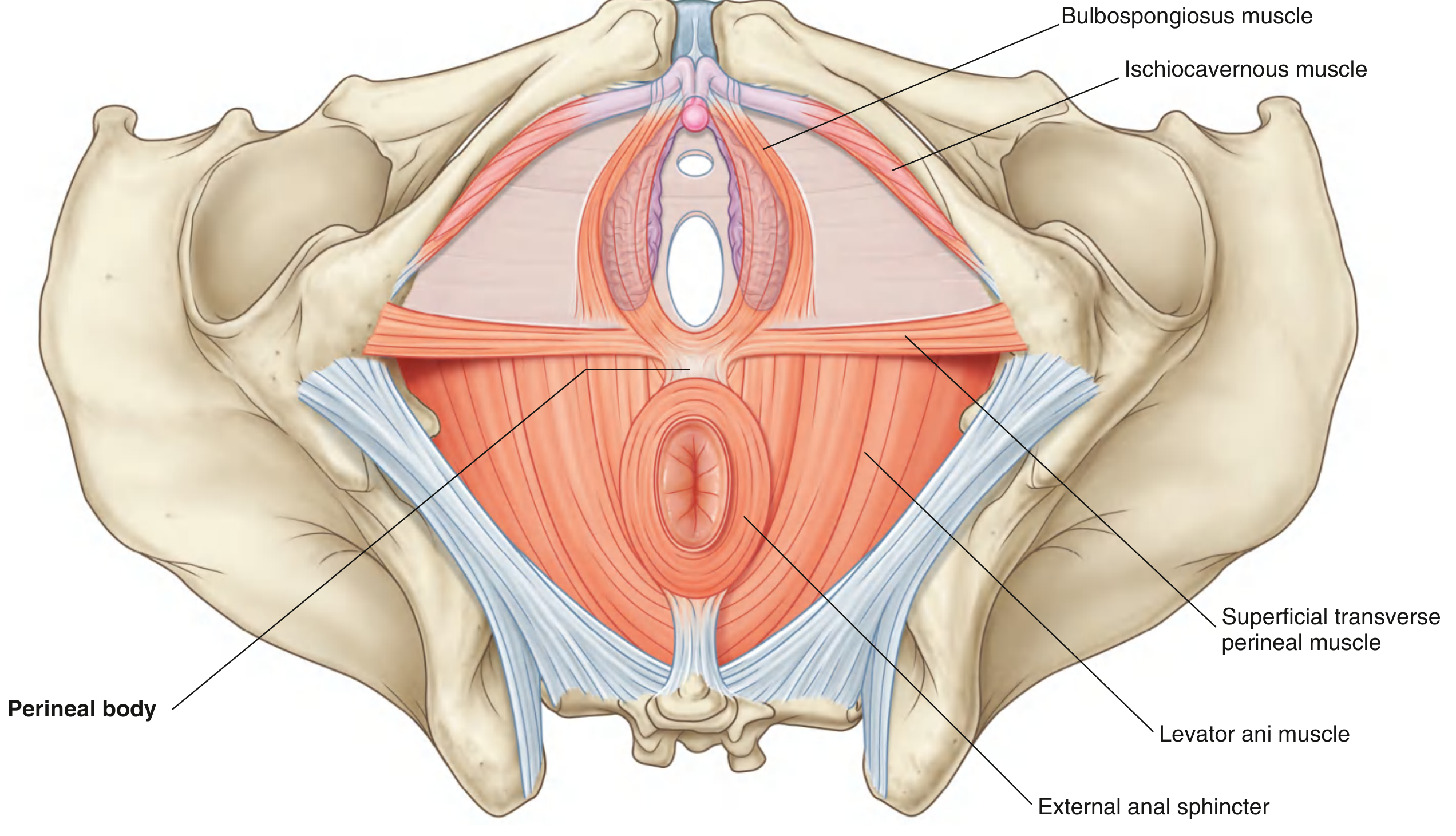
Muscular Attachments
Eight muscles converge and insert into the perineal body, making it an essential structural hub:
| Muscle | Layer |
|---|---|
| External anal sphincter (anterior fibers) | Superficial |
| Superficial transverse perineal muscles (from ischial tuberosities) | Superficial |
| Bulbospongiosus (most posterior fibers) | Superficial |
| Deep transverse perineal muscles | Deep |
| Sphincter urethrovaginalis (in women) | Deep |
| Levator ani (anterior fibers) | Pelvic floor |
The levator ani muscles of the pelvic diaphragm and the skeletal muscle sphincters associated with the urethra, vagina, and anus all converge here — connecting the pelvic floor above to the perineum below.
Relations
- Anterior: Posterior wall of the vagina (in women); bulb of the penis / membranous urethra (in men)
- Posterior: Anal canal and external anal sphincter
- Superior: Posterior end of the urogenital hiatus of the levator ani; attaches to the perineal membrane
Sex Differences
- Women: The perineal body is particularly robust. The sphincter urethrovaginalis fuses with it, and it serves as the primary anchoring point for pelvic organ support. Damage leads to pelvic organ prolapse (vaginal, uterine, or bladder descent).
- Men: The external urethral sphincter does not fuse with the perineal body; a fascial plane exists between the perineal body and external anal sphincter. The ischiocavernosus and bulbospongiosus muscles attach posteriorly to it at the midline of the perineum.
Clinical Significance
| Scenario | Relevance |
|---|---|
| Childbirth / episiotomy | Perineal body is at risk of tearing during vaginal delivery; episiotomy is performed to limit uncontrolled tears |
| Obstetric anal sphincter injury (OASIS) | 3rd/4th-degree tears disrupt the perineal body and anal sphincter |
| Pelvic organ prolapse | Disruption of perineal body attachments leads to cystocele, rectocele, or uterine prolapse |
| Perineal descent | Surgical repair (sacral colpoperineopexy) anchors a graft from the sacral promontory to the perineal body |
| Perineal body repair (perineorrhaphy) | Reconstructs support after obstetric or traumatic injury |
Imaging
On transperineal ultrasound, the perineal body appears as a well-defined triangular, homogeneous echogenic structure between the urethra/bladder anteriorly and the anal canal posteriorly. In pelvic organ prolapse, it becomes smaller, less defined, and more heterogeneous.
Sources: Gray's Anatomy for Students, pp. 514, 534; Campbell-Walsh-Wein Urology, Superficial Perineal Space section; Berek & Novak's Gynecology
This is a shared conversation. Sign in to Orris to start your own chat.