
give difference between mechanism of sonic and passive ultrasonic irrigation method of sealer penetration and difference between Diode laser and Ee:YAG LASER irrigation method of sealer penetration in picture format
sonic passive ultrasonic irrigation sealer penetration root canal
diode laser Er:YAG laser root canal irrigation sealer penetration
A clean, professional dental/endodontics educational comparison diagram with a white background. Title at top: "Irrigation Activation Methods for Sealer Penetration - Sonic vs Passive Ultrasonic". Split into two clear columns with distinct color coding. LEFT COLUMN (blue theme) labeled "SONIC IRRIGATION (SI)": Shows a root canal cross-section with a sonic device (EndoActivator-style tip) vibrating at 1-6 kHz. Below the diagram, show bullet points: "• Frequency: 1-6 kHz (subsonic)", "• Mechanism: Acoustic streaming + fluid agitation", "• Tip movement: Large amplitude back-and-forth oscillation", "• Non-cutting polymer tip placed in canal", "• Creates fluid vortexing and streaming currents", "• Pushes irrigant/sealer into dentinal tubules", "• Sealer penetration: Moderate depth", "• Reaches lateral canals and isthmuses", "• Less risk of extrusion than PUI". RIGHT COLUMN (orange/red theme) labeled "PASSIVE ULTRASONIC IRRIGATION (PUI)": Shows a root canal cross-section with a thin ultrasonic file/wire vibrating at 25-30 kHz. Below: "• Frequency: 25-30 kHz (ultrasonic)", "• Mechanism: Acoustic microstreaming + cavitation", "• Tip movement: Small amplitude, high-frequency oscillation", "• Smooth non-cutting wire/file (K-file size 15/20)", "• Creates intense micro-vortices near tip", "• Cavitation bubbles collapse and drive sealer deep", "• Sealer penetration: Greater depth into tubules", "• Superior smear layer removal", "• Risk of irrigant extrusion if near apex". At the bottom, a comparison table with rows: Feature | Sonic | PUI, Frequency | 1-6 kHz | 25-30 kHz, Main Effect | Streaming | Streaming + Cavitation, Tubule Penetration | Moderate | Superior, Tip Type | Polymer (non-cutting) | Metal wire/file, Energy Transfer | Lower | Higher. Professional medical illustration style with labeled arrows and anatomical accuracy.
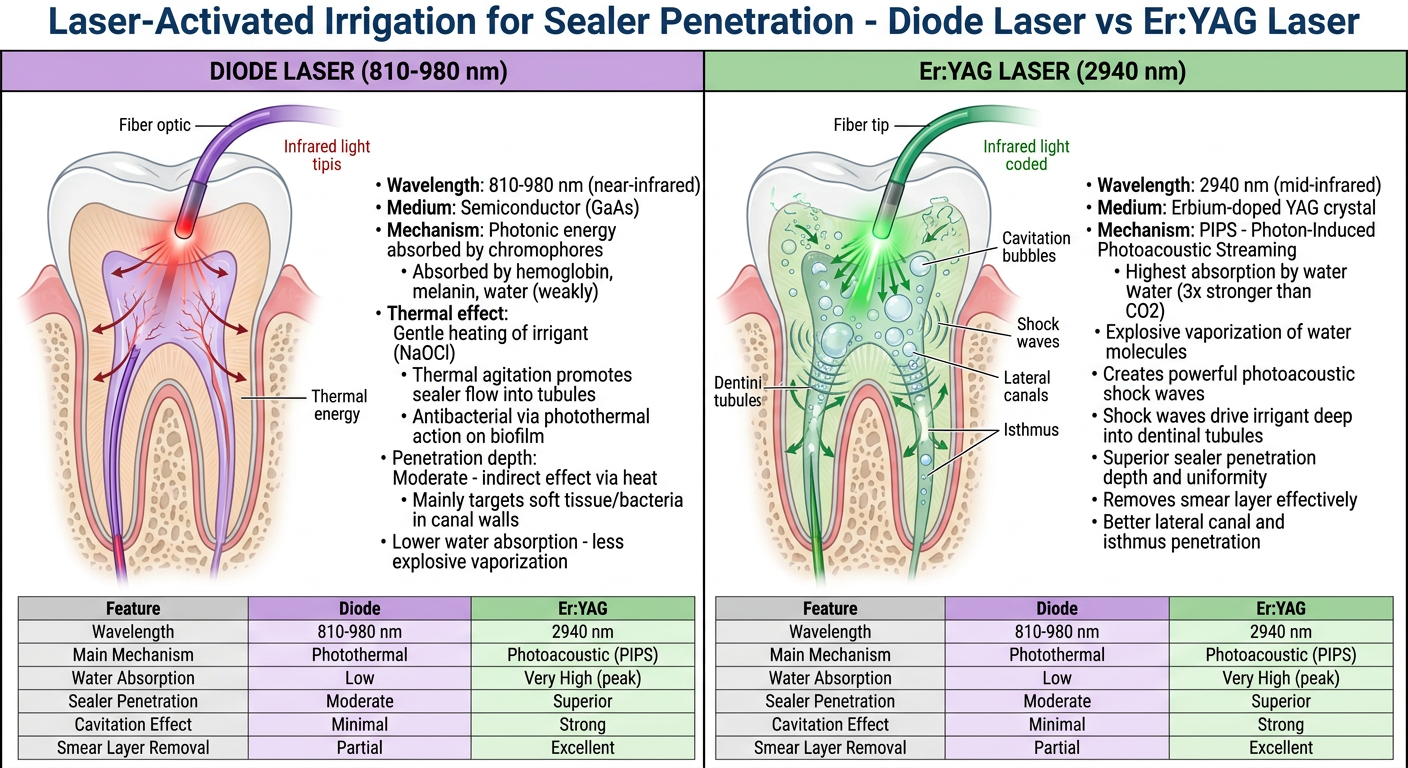
A clean, professional dental/endodontics educational comparison diagram with a white background. Title at top: "Laser-Activated Irrigation for Sealer Penetration - Diode Laser vs Er:YAG Laser". Split into two clear columns. LEFT COLUMN (purple/violet theme) labeled "DIODE LASER (810-980 nm)": Show a root canal cross-section with a thin fiber optic tip inside the canal emitting red/infrared light. Bullet points: "• Wavelength: 810-980 nm (near-infrared)", "• Medium: Semiconductor (GaAs)", "• Mechanism: Photonic energy absorbed by chromophores", "• Absorbed by hemoglobin, melanin, water (weakly)", "• Thermal effect: Gentle heating of irrigant (NaOCl)", "• Thermal agitation promotes sealer flow into tubules", "• Antibacterial via photothermal action on biofilm", "• Penetration depth: Moderate - indirect effect via heat", "• Mainly targets soft tissue/bacteria in canal walls", "• Lower water absorption - less explosive vaporization". RIGHT COLUMN (green theme) labeled "Er:YAG LASER (2940 nm)": Show a root canal cross-section with a fiber tip emitting green-coded infrared light with visible micro-bubbles/cavitation effect. Bullet points: "• Wavelength: 2940 nm (mid-infrared)", "• Medium: Erbium-doped YAG crystal", "• Mechanism: PIPS - Photon-Induced Photoacoustic Streaming", "• Highest absorption by water (3x stronger than CO2)", "• Explosive vaporization of water molecules", "• Creates powerful photoacoustic shock waves", "• Shock waves drive irrigant deep into dentinal tubules", "• Superior sealer penetration depth and uniformity", "• Removes smear layer effectively", "• Better lateral canal and isthmus penetration". Bottom comparison table: Feature | Diode | Er:YAG, Wavelength | 810-980 nm | 2940 nm, Main Mechanism | Photothermal | Photoacoustic (PIPS), Water Absorption | Low | Very High (peak), Sealer Penetration | Moderate | Superior, Cavitation Effect | Minimal | Strong, Smear Layer Removal | Partial | Excellent. Professional medical illustration style with clear labeled diagrams, color-coded sections, arrows showing mechanism of action.
Diagram 1 - Sonic vs Passive Ultrasonic Irrigation
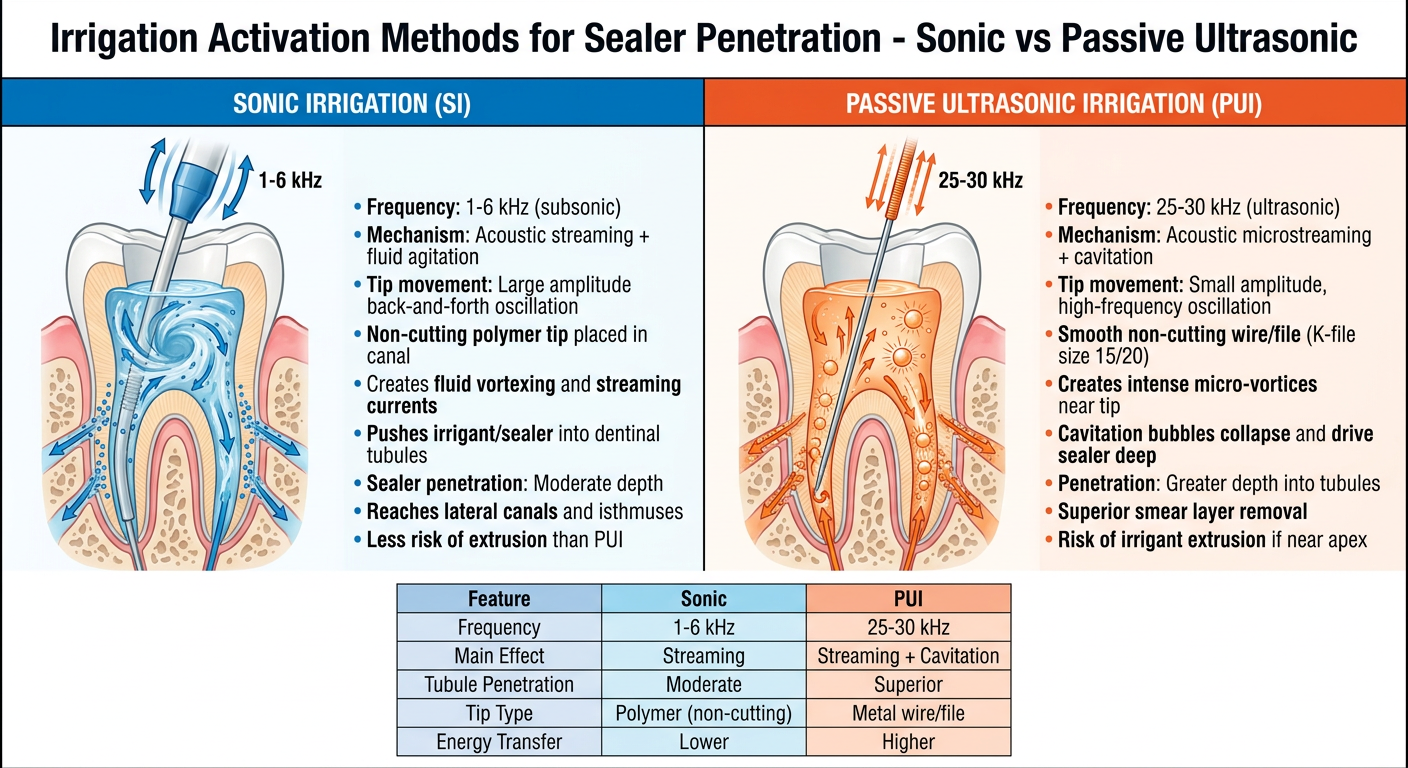
Diagram 2 - Diode Laser vs Er:YAG Laser Irrigation
Quick Summary
- Sonic (1-6 kHz) works mainly through acoustic streaming - the tip oscillates with large amplitude, creating fluid vortices that carry sealer into tubules. Moderate penetration depth.
- PUI (25-30 kHz) adds cavitation on top of streaming - the high-frequency vibration collapses micro-bubbles near the tip, generating intense pressure pulses that drive sealer deeper. Superior penetration and smear layer removal.
- Diode (810-980 nm) has poor water absorption, so it acts mainly via photothermal heating of the irrigant. The heat loosens smear layer and improves sealer flow. Moderate, indirect effect.
- Er:YAG (2940 nm) is absorbed at peak efficiency by water molecules, causing explosive vaporization that generates photoacoustic shock waves (PIPS technique). These waves drive irrigant and sealer deep into dentinal tubules and lateral canals - far superior penetration and smear layer elimination.
explain mechanism pictures in detail
DIAGRAM 1 - Sonic vs Passive Ultrasonic Irrigation
LEFT SIDE - Sonic Irrigation (SI) - Blue
What the diagram shows:
- Large curved arrows at the tip - these represent the wide back-and-forth oscillation of the sonic tip at 1-6 kHz. The tip swings in a big arc, which is the key difference from PUI.
- Spiral/vortex pattern of blue arrows inside the canal - this is the acoustic streaming effect. The large-amplitude swinging of the tip creates swirling fluid currents throughout the entire canal space. The sealer and irrigant are continuously churned and pushed around.
- Small blue bubbles along the canal walls - these represent the irrigant/sealer being driven toward the dentinal tubule openings. The streaming currents push fluid sideways into the tubules at a moderate depth.
- Downward arrows at the apex - show fluid movement toward the apex, explaining the lower risk of periapical extrusion compared to PUI (the energy is more dispersed).
Mechanism step-by-step:
- The polymer tip is placed inside the canal (non-cutting, so it doesn't widen the canal).
- It oscillates at sonic frequency (1-6 kHz) with large amplitude movements.
- This creates acoustic streaming - organized fluid flow patterns (vortices) throughout the canal.
- The vortices push sealer into lateral canals, isthmus areas, and superficially into dentinal tubules.
- The result is moderate sealer penetration - better than needle irrigation, but not as deep as PUI.
RIGHT SIDE - Passive Ultrasonic Irrigation (PUI) - Orange/Red
What the diagram shows:
- Tight, rapid oscillation lines at the tip (shown in orange) - representing the small amplitude, high-frequency vibration at 25-30 kHz. Unlike sonic, the tip barely moves spatially, but vibrates extremely fast.
- Bright starburst/sunburst pattern at the tip - this represents cavitation. The ultra-high frequency creates microscopic bubbles (cavitation bubbles) in the irrigant that rapidly collapse. This is the KEY feature that sonic irrigation does NOT have.
- Intense arrows radiating outward and downward - these show the microstreaming currents that are far more powerful than sonic streaming, concentrated near the tip.
- Arrows penetrating deeply into canal walls - showing sealer being driven far into dentinal tubules and lateral canals due to the combined cavitation + microstreaming energy.
- Bidirectional arrows along canal length - showing how the energy transmits up and down the full canal, not just near the tip.
Mechanism step-by-step:
- A smooth, non-cutting metal wire is placed passively in the already-shaped canal.
- It vibrates at ultrasonic frequency (25-30 kHz) with small amplitude.
- This generates acoustic microstreaming - more intense and concentrated than sonic streaming.
- Simultaneously, inertial cavitation occurs: microscopic bubbles form in the irrigant, grow, then violently implode.
- Each bubble implosion releases a tiny shockwave and jet of fluid.
- These jets and shockwaves blast sealer and irrigant deep into dentinal tubules, remove smear layer, and reach accessory canals.
- Result: Superior sealer penetration vs sonic.
DIAGRAM 2 - Diode Laser vs Er:YAG Laser
LEFT SIDE - Diode Laser (810-980 nm) - Purple
What the diagram shows:
- Thick purple fiber optic cable entering the canal from above - this is the delivery system for the diode laser energy. Diode lasers use a flexible optical fiber.
- Red/infrared glow at the tip labeled "Infrared light" - shows the 810-980 nm near-infrared photons being emitted from the fiber tip into the canal fluid.
- "Thermal energy" label with an arrow pointing to the canal wall - this is the central message: the diode laser's primary action is HEAT generation, not acoustic force.
- Red arrows pointing outward from the walls - these represent thermal agitation of the irrigant and sealer. The heat gently warms the NaOCl irrigant, increasing its fluidity and surface tension reduction, allowing it to flow more easily into tubule openings.
- Small red arrows into dentinal tubules - showing the indirect, heat-driven, moderate penetration of sealer into tubules. The arrows are shorter and less forceful than the Er:YAG side.
- No bubbles or shock waves - confirming there is no significant cavitation or acoustic effect.
Mechanism step-by-step:
- The diode laser fiber tip is placed in the canal containing irrigant (NaOCl or EDTA).
- Photons at 810-980 nm are poorly absorbed by water but absorbed by chromophores - hemoglobin (in pulp remnants), melanin (in bacteria), and organic tissue.
- This absorption converts light to heat - a photothermal effect.
- The heat warms the irrigant, reducing its viscosity and surface tension.
- Warmed sealer flows more easily into tubule openings.
- The heat also kills bacteria in the canal walls directly (photothermal antibacterial effect).
- Result: Moderate, indirect sealer penetration - better than cold needle irrigation, but no forceful driving mechanism.
RIGHT SIDE - Er:YAG Laser (2940 nm) - Green
What the diagram shows:
- Green fiber tip entering the canal - Er:YAG is delivered via a specially designed radial-firing tip (PIPS tip) or a plain fiber tip.
- Green-coded infrared light at the tip - 2940 nm mid-infrared photons being emitted into the water-based irrigant.
- Large cavitation bubbles labeled in the diagram - these are enormous compared to PUI cavitation. The Er:YAG laser causes explosive vaporization of water molecules, creating macroscopic vapor bubbles.
- "Shock waves" label with radiating arrows - when these vapor bubbles rapidly collapse, they release powerful photoacoustic shock waves. These are far more energetic than ultrasonic cavitation.
- Green arrows penetrating deep into "Dentinal tubules" (labeled) - showing sealer being driven forcefully and deeply into the tubules by the shockwaves.
- Green arrows reaching "Lateral canals" (labeled) - showing the shockwaves can push irrigant into complex anatomy unreachable by other methods.
- "Isthmus" (labeled at the apex area) - showing penetration even into isthmus connections between canals.
Mechanism step-by-step:
- A radial-firing Er:YAG fiber tip is placed near the orifice (NOT at the apex - unlike other methods).
- Short laser pulses (pulsed mode) are fired into the irrigant.
- Water molecules in the irrigant absorb 2940 nm photons at peak efficiency (2940 nm is the exact absorption peak of water).
- Water molecules explosively vaporize - converting liquid to vapor almost instantaneously.
- This is called PIPS - Photon-Induced Photoacoustic Streaming.
- Rapid vapor bubble formation followed by collapse generates powerful photoacoustic shock waves propagating in all directions.
- These shock waves drive irrigant and sealer simultaneously into dentinal tubules, lateral canals, and isthmuses at great depth.
- Smear layer is mechanically blasted away by the shockwaves.
- The tip near the orifice means energy propagates DOWN the full canal length without apical extrusion risk.
- Result: Superior sealer penetration, smear layer removal, and anatomical coverage - the most effective laser method.
Bottom Comparison Table Summary:
| Feature | Sonic | PUI | Diode | Er:YAG |
|---|---|---|---|---|
| Primary force | Acoustic streaming | Streaming + Cavitation | Thermal heating | Photoacoustic shockwaves |
| Water interaction | Mechanical agitation | Mechanical + bubble collapse | Poor absorption | Peak absorption (explosive) |
| Sealer penetration | Moderate | Superior | Moderate | Superior |
| Smear layer removal | Partial | Good | Partial | Excellent |
| Clinical safety | Safest | Watch apex | Safe (low power) | Tip position critical |