
Thrichinococcus infection
Reading File
The query is about "Thrichinococcus infection" — this appears to be a misspelling/blend of Trichinosis (Trichinella infection) and possibly Echinococcus (hydatid disease). Let me search both to be sure, while also searching for the exact term.
Finding Sources
Finding Sources
The term "Thrichinococcus" appears to be a misspelling of Trichinella (trichinosis/trichinellosis). Let me read the most comprehensive sections now.
Reading File
Reading File
Reading File
Reading File
Reading File
Loading Image
I now have comprehensive information. Let me compile a thorough response on Trichinella infection (trichinosis/trichinellosis).
Note on terminology: "Thrichinococcus" does not correspond to a recognized organism. Based on the spelling, this most likely refers to Trichinella infection (trichinosis/trichinellosis). If you meant Echinococcus (hydatid disease), please let me know.
Trichinella Infection (Trichinosis / Trichinellosis)
Trichinosis is a systemic zoonotic illness caused by nematodes of the genus Trichinella — primarily T. spiralis in most of the world, though 8 closely related species can infect humans.
Life Cycle
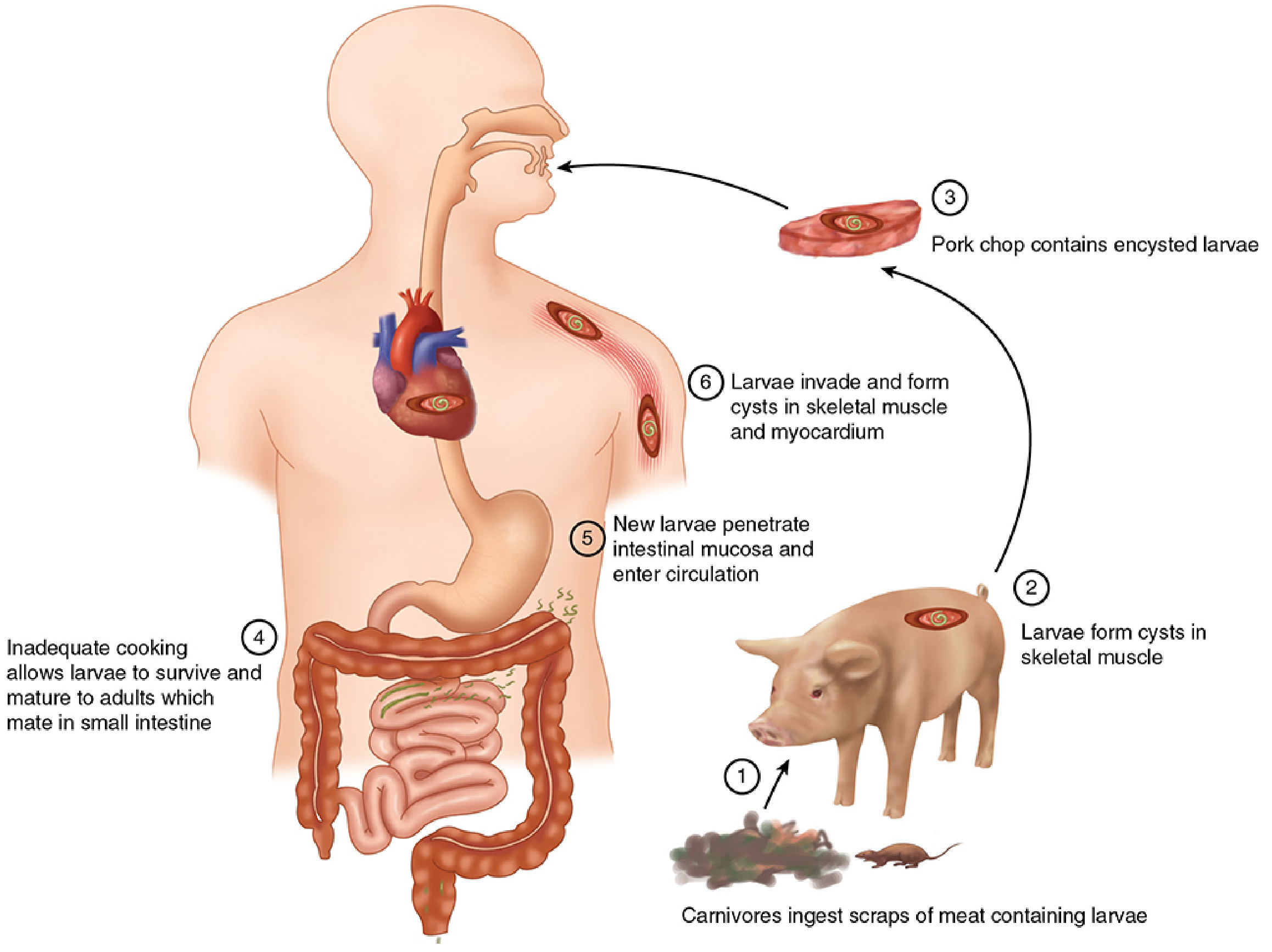
The same host harbors both the adult and larval forms:
- Ingestion of raw/undercooked meat containing encysted larvae
- Cysts dissolve in the GI tract; larvae invade the small intestinal mucosa, living within a syncytium of ~45 villus cells
- Adults mature rapidly; males (60 µm × 1.2 mm) and females (90 µm × 2.2 mm) mate within 30 hours
- Viviparous females begin releasing larvae ~1 week post-ingestion; adults are expelled within 4 weeks
- Larvae (6 × 100 µm) enter intestinal blood and lymphatics → distributed systemically
- Larvae develop only within striated muscle → enter a myocyte → induce transformation into a "nurse cell" → coiled larva remains viable for years
— Sleisenger and Fordtran's Gastrointestinal and Liver Disease, p. 2274
Epidemiology
| Species | Distribution |
|---|---|
| T. spiralis | Americas, Europe, Russia (most common globally) |
| T. nativa | Arctic/subarctic (infects walrus, bear; freeze-resistant) |
| T. britovi | Europe, North Africa, Middle East, Asia |
| T. nelsoni | Equatorial Africa |
| T. pseudospiralis | Americas, Europe, Russia (no encapsulated cysts; infects birds) |
| T. papuae | Papua New Guinea (infects reptiles) |
| T. zimbabwensis | Zimbabwe, Ethiopia, Mozambique (only species not yet implicated in human disease) |
Sources of human infection: undercooked pork, wild boar, bear meat, walrus, horse meat, cougar. Outbreaks are often cluster events — butcher shops, hunting feasts, subsistence feeding.
The incidence has declined markedly in industrialized countries due to: thorough cooking of pork, commercial freezing, and grain-only pig feeding. Trichinosis is a re-emerging illness in Eastern Europe due to relaxed enforcement.
— Sleisenger and Fordtran's GI and Liver Disease, p. 2272–2274; Sherris & Ryan's Medical Microbiology, p. 1870
Pathogenesis
- Enteral phase: Adult worms embed in intestinal epithelium → enteritis (eosinophils, lymphocytes, neutrophils)
- Parenteral phase: Migratory larvae invade striated muscle, heart, CNS → inflammatory responses
- Invaded muscle cells enlarge, lose cross-striations, undergo basophilic degeneration
- Specific IgG and IgM antibodies trigger eosinophil-mediated destruction of circulating larvae
- A vasculitis from circulating immune complex deposition may occur
- Th2 cytokines (IL-4, IL-5), T lymphocytes, eosinophils, and mast cells mediate worm expulsion
Clinical Features
Clinical trichinosis has two sequential phases:
Phase 1 — Intestinal (Enteral, Days 2–14)
- Nausea, abdominal pain, diarrhea, vomiting, low-grade fever
- Often mistaken for viral gastroenteritis or food poisoning
- Diarrhea can persist for weeks (T. nativa from walrus meat in Inuit populations)
Phase 2 — Systemic/Parenteral (Week 1–6+)
- Fever, myalgia, muscle weakness, muscle tenderness (cardinal features)
- Periorbital/eyelid edema (characteristic)
- Maculopapular skin rash
- Subconjunctival and subungual (splinter) hemorrhages
- Dysphagia, headache, paresthesias
Severe Disease
- Myocarditis → ECG abnormalities, tachycardia, congestive heart failure
- CNS involvement → encephalitis, meningitis, polyneuritis, delirium, psychosis, paresis, coma
- Pulmonary → hemoptysis, consolidation
- Vasculitis / venous thrombosis
- Death (larvae burden >1,000–5,000/g of tissue)
Larval burden determines severity: <10 larvae/g → asymptomatic; 100/g → significant disease; 1,000–5,000/g → potentially fatal.
— Sherris & Ryan's Medical Microbiology, p. 1871; Sleisenger and Fordtran, p. 2275
Diagnosis
| Test | Finding |
|---|---|
| Eosinophilia | 15–50% eosinophils; begins week 2, persists throughout illness; may disappear in fatal cases |
| Serum IgE | Elevated in most clinically ill patients |
| CPK (creatine phosphokinase) | Elevated (myositis) |
| Serology (IFA, ELISA) | Significant titers appear after week 3; may persist indefinitely |
| Muscle biopsy (deltoid or gastrocnemius) | Reveals encysted larvae during week 3 onward |
Serologic tests are usually negative before week 3, so early diagnosis relies on clinical picture + epidemiologic exposure history.
Treatment
| Indication | Treatment |
|---|---|
| Mild/moderate | Albendazole 400 mg twice daily × 10–15 days OR Mebendazole 5 mg/kg/day × 10–15 days |
| Severe (edema, pulmonary, cardiac, CNS) | Add glucocorticoids (corticosteroids first, then anthelmintics — to prevent hypersensitivity reaction from mass larval destruction) |
- Anthelmintics kill adult worms in the gut and halt larval production; they are less effective against already-encysted larvae
- Glucocorticoids given without anthelmintics may prolong the intestinal phase, increasing larval release — so combination is preferred in severe cases
- Mortality: ~1% in symptomatic cases; rises to ~10% with CNS involvement
— Sleisenger and Fordtran, p. 2276; Sherris & Ryan's, p. 1872
Prevention
- Thoroughly cook all meat (especially pork, wild game, bear) to ≥71°C (160°F) internally
- Freezing pork at −15°C for ≥3 weeks kills most strains (but not T. nativa, the arctic strain)
- Federal/agricultural regulations: grain-only feed for commercial pigs; meat inspection
- Control rodent contact with domestic pigs
Sources: Sleisenger and Fordtran's Gastrointestinal and Liver Disease | Sherris & Ryan's Medical Microbiology, 8th ed. | Bradley and Daroff's Neurology in Clinical Practice | Fuster and Hurst's The Heart, 15th ed.
This is a shared conversation. Sign in to Orris to start your own chat.