
How glucose forms from carbohydrates inside body
Reading File
Now let me search the medical library for carbohydrate digestion and glucose formation:
Finding Sources
Finding Sources
Excellent sources found. Let me read the most relevant sections in parallel:
Reading File
Reading File
Reading File
I have rich content. Let me also fetch the digestion diagram image and get the Guyton physiology section on monosaccharide absorption:
Loading Image
Reading File
I now have comprehensive information from multiple authoritative textbooks. Let me compile the full answer.
How Glucose is Formed from Carbohydrates in the Body
The process spans four stages: ingestion → luminal digestion → brush border hydrolysis → absorption and portal transport.
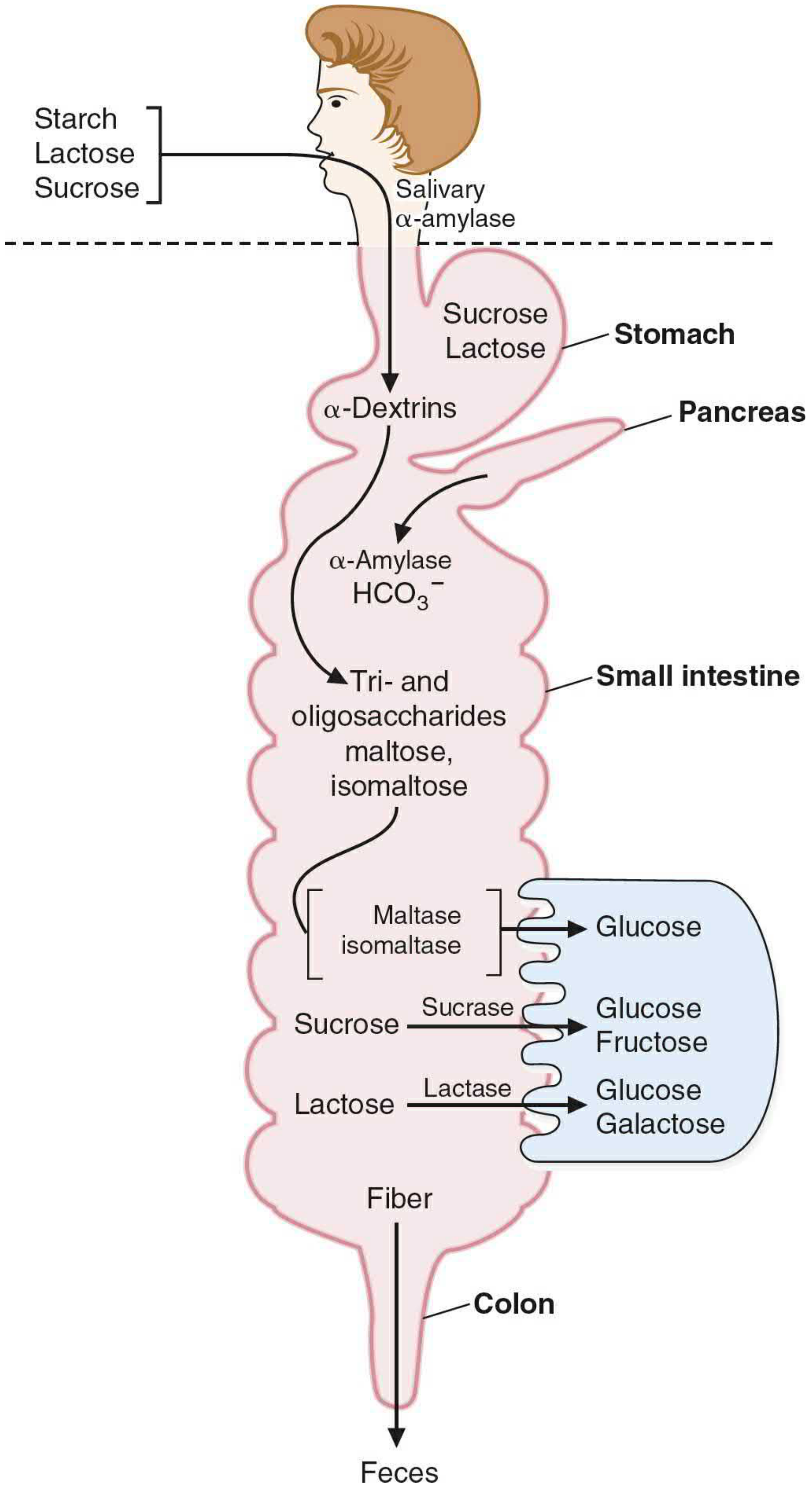
Stage 1: Dietary Carbohydrate Sources
About 45% of energy in a typical Western diet comes from carbohydrates, roughly half as starch (from cereals and plants). Other major sources include:
- Lactose (milk disaccharide → glucose + galactose)
- Sucrose (table sugar → glucose + fructose)
- Free fructose/glucose (fruits, vegetables)
Starch itself exists as:
- Amylose — linear polymer of glucose linked by α-1,4-glycosidic bonds
- Amylopectin — amylose with α-1,6-glycosidic branch points
— Basic Medical Biochemistry, 6e, p. 758
Stage 2: Luminal Digestion (Mouth → Small Intestine)
In the mouth:
- Salivary α-amylase begins hydrolysis of starch, cleaving α-1,4-glycosidic bonds to produce smaller polysaccharides called α-dextrins.
In the stomach:
- The acidic pH (HCl) inactivates salivary amylase — digestion pauses here.
- Sucrose and lactose pass through unchanged.
In the small intestine:
- The exocrine pancreas secretes pancreatic α-amylase and bicarbonate (HCO₃⁻) into the lumen. Bicarbonate neutralizes gastric acid, reactivating amylolytic digestion.
- Pancreatic α-amylase converts α-dextrins into:
- Maltose (disaccharide)
- Maltotriose (trisaccharide)
- Limit dextrins (oligosaccharides of 4–9 glucose units with α-1,6 branch points)
— Basic Medical Biochemistry, 6e, p. 759; Tietz Textbook of Laboratory Medicine, 7e
Stage 3: Brush Border Hydrolysis (Final Glucose Liberation)
Disaccharides and oligosaccharides cannot be absorbed as-is. They are cleaved by disaccharidases embedded in the brush border (microvilli) of intestinal epithelial cells in the duodenum and jejunum:
| Enzyme | Substrate | Products |
|---|---|---|
| Glucoamylase | α-1,4-bonds of dextrins | Glucose |
| Sucrase-isomaltase complex | Sucrose, maltose, isomaltose | Glucose + Fructose |
| Lactase (β-glycosidase) | Lactose | Glucose + Galactose |
| Trehalase | Trehalose (α-1,1-bond) | Glucose + Glucose |
The three terminal monosaccharides are: glucose, galactose, and fructose.
Glucose accounts for >80% of all absorbed monosaccharides, because it is the final breakdown product of starch.
— Basic Medical Biochemistry, 6e, p. 760; Guyton & Hall Medical Physiology; Schwartz's Principles of Surgery, 11e
Stage 4: Absorption into the Bloodstream
Monosaccharides cross the intestinal epithelium in two steps:
Step 1 — Apical (brush border) membrane entry:
- Glucose & Galactose → transported by SGLT1 (sodium-glucose co-transporter 1) via secondary active transport. Na⁺ is pumped out of the epithelial cell basolaterally by Na⁺/K⁺-ATPase, creating a Na⁺ gradient that drives glucose inward coupled to Na⁺. Essentially, glucose "rides" the sodium gradient into the cell.
- Fructose → enters via GLUT5 by facilitated diffusion (no energy cost, no Na⁺ needed).
Step 2 — Basolateral membrane exit into blood:
- All three monosaccharides exit the epithelial cell via GLUT2 into the paracellular space, then diffuse into intestinal venules.
- Some fructose is converted to glucose during absorption via an enediol intermediate.
Portal transport:
- Monosaccharides travel via the portal vein to the liver, where galactose and fructose are largely converted to glucose (or glucose-6-phosphate) for entry into mainstream carbohydrate metabolism.
— Guyton & Hall Medical Physiology, p. 821; Schwartz's Principles of Surgery, 11e; Tietz Textbook of Laboratory Medicine, 7e
After Absorption: What Happens to Blood Glucose?
Once glucose enters the bloodstream, its fate is governed by hormonal control:
- Energy production — glycolysis → CO₂ + H₂O + ATP
- Storage as glycogen — in liver and muscle (glycogenesis)
- Conversion to triglycerides — stored in adipose tissue
- Gluconeogenesis — when dietary supply is low, the liver synthesizes new glucose from amino acids, lactate, or glycerol
The initial phosphorylation of glucose by glucokinase (liver) or hexokinase (other tissues) to glucose-6-phosphate traps glucose inside cells and commits it to one of these fates.
— Tietz Textbook of Laboratory Medicine, 7e
Key Summary
Starch / Sucrose / Lactose (diet)
          ↓ Salivary α-amylase (mouth)
       α-Dextrins
          ↓ Pancreatic α-amylase (small intestine lumen)
  Maltose + Maltotriose + Limit Dextrins
          ↓ Brush border disaccharidases (SGLT1, sucrase, lactase)
   GLUCOSE + Galactose + Fructose (free monosaccharides)
          ↓ SGLT1 / GLUT5 (apical membrane)
       Epithelial cell
          ↓ GLUT2 (basolateral membrane)
       Portal blood → Liver
          ↓ Glucokinase
      Glucose-6-phosphate → Energy / Glycogen / Fat
Dietary fiber (cellulose, pectin) cannot be hydrolyzed by human enzymes because humans lack cellulase. In the colon, gut bacteria ferment fiber into short-chain fatty acids and gases — no glucose is released from fiber. — Basic Medical Biochemistry, 6e
This is a shared conversation. Sign in to Orris to start your own chat.