
alcohol mechanism of action on cns
Reading File
Now let me search the medical library for alcohol mechanism of action on CNS.
Finding Sources
Finding Sources
Finding Sources
Finding Sources
Good hits. Let me read the most relevant sections from Bradley & Daroff's Neurology and Goodman & Gilman's.
Reading File
Finding Sources
Excellent - Adams and Victor's has a dedicated section. Let me read both that and the Tietz section.
Reading File
Reading File
Excellent detail. Now let me read more of the Adams & Victor pharmacology section and also search for the reward/dopamine effects.
Reading File
Finding Sources
Let me read the Stahl's section on alcohol and the Katzung section on alcohol's pharmacology for the reward/dopamine details.
Reading File
Reading File
I now have comprehensive information. Let me also fetch the Stahl's diagram image which shows the VTA alcohol mechanism.
Loading Image
I now have all the information needed for a comprehensive answer. Here is the full response:
Mechanism of Action of Alcohol (Ethanol) on the CNS
Alcohol is a CNS depressant with no single receptor target - it acts on multiple membrane receptor systems simultaneously. Its effects are dose-dependent and complexity increases with chronic use.
1. GABAergic Enhancement (Primary Inhibitory Mechanism)
The principal inhibitory neurotransmitter in the CNS is GABA. Alcohol potentiates GABA-A receptor activity - the GABA-A receptor is a ligand-gated Cl⁻ ion channel. When GABA binds:
- The channel opens, allowing inward Cl⁻ flux
- This hyperpolarizes the membrane and decreases neuronal excitability
Alcohol enhances this GABA-induced Cl⁻ flux, producing sedation, anxiolysis, and ataxia - effects shared with barbiturates, benzodiazepines, and volatile anesthetics. Alcohol also acts at GABA-B receptors within the VTA (see reward section below).
- Tietz Textbook of Laboratory Medicine, 7th Edition
- Adams and Victor's Principles of Neurology, 12th Edition
2. NMDA Receptor Inhibition (Antagonism of Excitation)
Alcohol inhibits the NMDA receptor, which is the major ionotropic glutamate receptor and the primary mediator of excitatory neurotransmission. NMDA receptors are sensitive to very low concentrations of alcohol. Alcohol also inhibits kainate receptor subtypes. Notably, AMPA receptors are largely resistant to alcohol.
-
This inhibition contributes to the amnestic effects, sedation, and anesthetic-like properties of alcohol.
-
Alcohol also acts at postsynaptic metabotropic glutamate receptors (mGluR5, mGluR2) to reduce excitatory drive.
-
Tietz Textbook of Laboratory Medicine, 7th Edition
-
Bradley and Daroff's Neurology in Clinical Practice
3. Membrane Lipid Theory (Historical - now considered secondary)
Older theory proposed that alcohol, being lipid-soluble, dissolves into neuronal membranes and increases membrane fluidity (similar to general anesthetics). With chronic use, membranes were thought to "rigidify" as a compensatory response, leading to tolerance. This membrane fluidization hypothesis is no longer considered sufficient by itself to explain functional changes, but membrane effects on ion channels remain relevant.
- Adams and Victor's Principles of Neurology, 12th Edition
4. Other Ion Channel and Receptor Targets
Alcohol has a genuinely broad receptor profile (Katzung):
| Target | Effect |
|---|---|
| GABA-A receptor | Enhanced Cl⁻ influx (inhibitory) |
| NMDA receptor | Inhibited (less excitation) |
| Kir3/GIRK channels | Directly gated (inhibitory K⁺ current) |
| Glycine receptor | Enhanced activity |
| 5-HT₃ receptor | Enhanced (contributes to nausea, emesis) |
| Neuronal nicotinic ACh receptors | Both enhancement and inhibition reported |
| Equilibrative nucleoside transporter (ENT1) | Inhibited → adenosine accumulates → A₂ receptor stimulation → CREB signaling → contributes to dependence |
| Voltage-sensitive Ca²⁺ channels (VSCCs) | Inhibited |
- Katzung's Basic and Clinical Pharmacology, 16th Edition
5. Mesolimbic Dopamine Reward Pathway
The reinforcing and euphoric effects of alcohol are mediated via the mesolimbic dopamine system (VTA → nucleus accumbens). Alcohol increases dopamine release in the nucleus accumbens through multiple mechanisms:
- GABA/glutamate modulation in the VTA: Alcohol enhances GABA at interneurons that tonically inhibit VTA dopamine neurons. Net result is dopamine neuron disinhibition and increased DA release downstream.
- Opioid system: Opioid neurons from the arcuate nucleus project to the VTA. Alcohol either directly activates μ-opioid receptors or triggers release of endogenous opioids (e.g., β-endorphin), ultimately increasing nucleus accumbens dopamine release. This is the rationale for using naltrexone (μ-opioid antagonist) in alcohol use disorder.
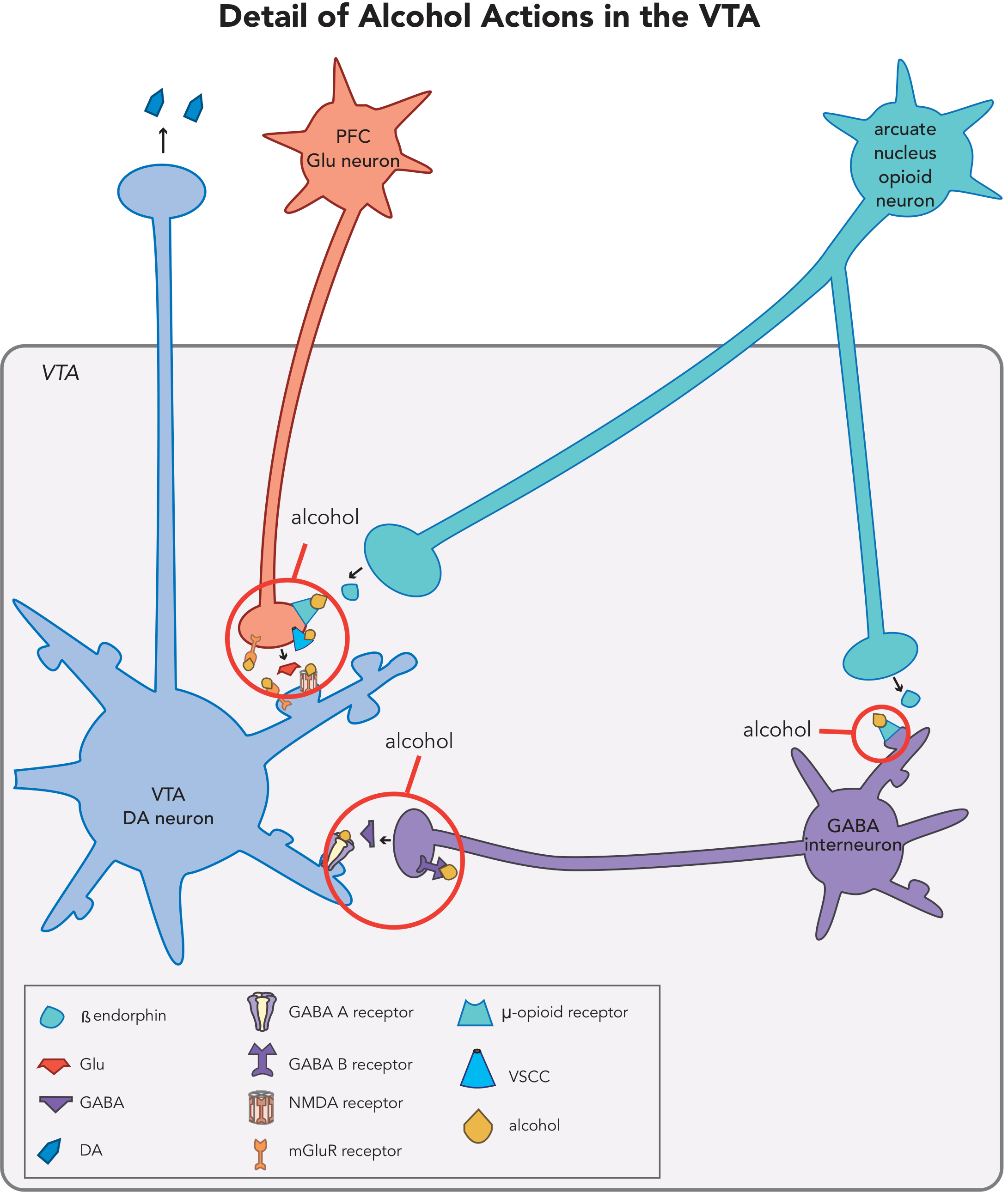
Figure: Alcohol's actions in the VTA - enhancing GABA at interneurons, inhibiting glutamate/NMDA inputs, and activating μ-opioid receptors, all leading to dopamine release in the nucleus accumbens (Stahl's Essential Psychopharmacology)
- Stahl's Essential Psychopharmacology
- Katzung's Basic and Clinical Pharmacology, 16th Edition
6. Dose-Dependent CNS Effects
Blood Alcohol Level (mg/dL) correlates with progressive CNS depression in non-tolerant individuals:
| BAC (mg/dL) | Clinical Effect |
|---|---|
| 30 | Mild euphoria |
| 50 | Mild incoordination |
| 100 | Obvious ataxia |
| 200 | Confusion, reduced mental activity |
| 300 | Stupor |
| ≥400 | Deep anesthesia, potentially fatal |
- Adams and Victor's Principles of Neurology, 12th Edition
7. Chronic Exposure: Tolerance and Dependence
With sustained heavy use, the CNS undergoes adaptive changes opposite to acute effects:
- GABA-A receptors: Downregulated and desensitized (via phosphorylation) → reduced sensitivity to GABA
- NMDA receptors: Upregulated and increased in number → increased sensitivity to glutamate
- Neuronal Ca²⁺ channels: Increased in number (calcium channel upregulation contributes to withdrawal seizures)
These adaptations mean that when alcohol is abruptly withdrawn, the CNS is suddenly in a state of relative glutamate overexcitation and GABA deficiency - manifesting as the alcohol withdrawal syndrome.
8. Alcohol Withdrawal Syndrome
Timeline and features:
- 4-12 hours: Insomnia, anxiety, tremor, tachycardia, diaphoresis
- 12-24 hours: Hallucinations (visual, auditory, tactile)
- 24-48 hours: Generalized tonic-clonic seizures
- 48-72 hours: Delirium tremens (disorientation, hallucinations, autonomic instability) - 5-15% mortality if untreated
This is a direct consequence of the unmasked NMDA hyperactivity and GABA deficiency that developed during chronic alcohol exposure.
Treatment: Benzodiazepines (chlordiazepoxide for outpatients with adequate liver function; oxazepam/lorazepam for hepatic impairment), calcium channel blockers can prevent withdrawal convulsions.
- Katzung's Basic and Clinical Pharmacology, 16th Edition
- Bradley and Daroff's Neurology in Clinical Practice
Summary
| Mechanism | Receptor/Target | Net Effect |
|---|---|---|
| GABA-A potentiation | Cl⁻ channel | Inhibition, sedation |
| NMDA inhibition | Glutamate receptor | Reduced excitation, amnesia |
| Opioid activation | μ-opioid receptor | Dopamine release, euphoria/reward |
| Mesolimbic DA disinhibition | VTA → NAcc | Reinforcement/addiction |
| Ca²⁺ channel inhibition | VSCCs | Reduced excitation |
| 5-HT₃ enhancement | Serotonin receptor | Drug-seeking behavior |
| ENT1 inhibition | Adenosine transport | Dependence via CREB signaling |
This is a shared conversation. Sign in to Orris to start your own chat.