
I need a review on lastest sepsis managment
"sepsis" AND "management" AND "guidelines"
Surviving Sepsis Campaign guidelines 2024 2025 latest updates
PMID: 41869844
https://link.springer.com/article/10.1007/s00134-026-08361-1
sepsis management algorithm flowchart septic shock resuscitation bundle
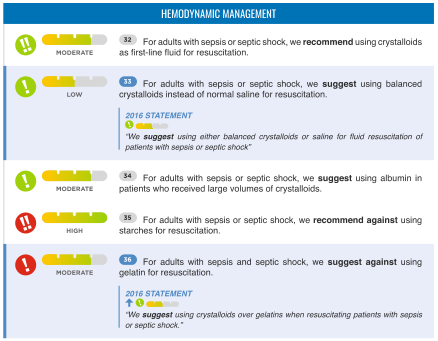
Summary : This figure presents recommendations for hemodynamic management in adults with sepsis or septic shock, focusing on the use of various fluids for resuscitation. It includes five guideline statements, each with a strength of recommendation, quality of evidence, and relevant 2016 statements for comparison. flowchart/table hybrid: # Recommendations Overview : • Five numbered recommendations (32–36) for fluid resuscitation in sepsis/septic shock. • Each recommendation includes: strength (recommend/suggest/suggest against/recommend against), evidence quality (moderate, low, high), and a traffic light icon (green/yellow/red). • 2016 statements are provided for two recommendations for historical comparison. # Individual Recommendations : • 32 (Moderate, green): "For adults with sepsis or septic shock, we recommend using crystalloids as first-line fluid for resuscitation." • 33 (Low, yellow): "For adults with sepsis or septic shock, we suggest using balanced crystalloids instead of normal saline for resuscitation." – 2016 Statement: "We suggest using either balanced crystalloids or saline for fluid resuscitation of patients with sepsis or septic shock." • 34 (Moderate, yellow): "For adults with sepsis or septic shock, we suggest using albumin in patients who received large volumes of crystalloids." • 35 (High, red): "For adults with sepsis or septic shock, we recommend against using starches for resuscitation." • 36 (Moderate, red): "For adults with sepsis and septic shock, we suggest against using gelatin for resuscitation." – 2016 Statement: "We suggest using crystalloids over gelatins when resuscitating patients with sepsis or septic shock." # Design Encodings : • Traffic light icons (green, yellow, red) indicate recommendation strength. • Horizontal bar visual for evidence quality (moderate, low, high). • Blue highlight for 2016 statements. • Bold text for "recommend" and "suggest" actions. # Analysis : • Crystalloids are strongly recommended as first-line fluids (moderate evidence). • Balanced crystalloids are suggested over saline, but evidence is low. • Albumin is suggested only for patients needing large volumes of crystalloids. • Starches and gelatins are discouraged, with strong (high) evidence against starches and moderate evidence against gelatins. • Recommendations have evolved slightly since 2016, with more explicit discouragement of gelatins and starches.
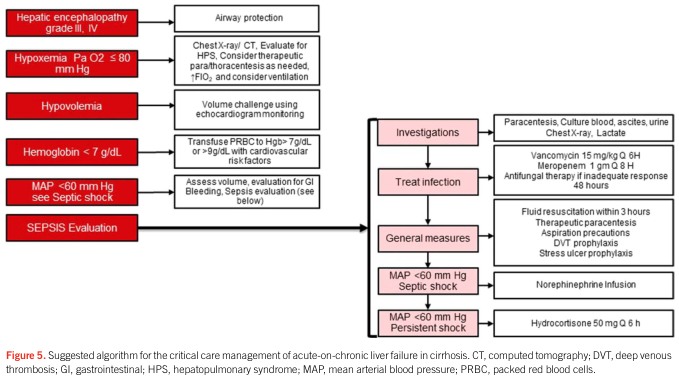
Summary : This figure presents a suggested algorithm for the critical care management of acute-on-chronic liver failure in cirrhosis, outlining stepwise assessment and interventions for various clinical scenarios including hepatic encephalopathy, hypoxemia, hypovolemia, anemia, and septic shock, with specific recommendations for investigations, infection treatment, and general supportive measures. flowchart: # Nodes : • Hepatic encephalopathy grade III, IV (rectangle, red) • Hypoxemia Pa O2 ≤ 80 mm Hg (rectangle, red) • Hypovolemia (rectangle, red) • Hemoglobin < 7 g/dL (rectangle, red) • MAP < 60 mm Hg see Septic shock (rectangle, red) • SEPSIS Evaluation (rectangle, red) • Airway protection (rectangle, white) • Chest X-ray/CT. Evaluate for HPS, Consider therapeutic para/thoracentesis as needed, ↑FiO2, and consider ventilation (rectangle, white) • Volume challenge using echocardiogram monitoring (rectangle, white) • Transfuse PRBC to Hgb > 7g/dL or > 9g/dL with cardiovascular risk factors (rectangle, white) • Assess volume, evaluation for GI Bleeding, Sepsis evaluation (rectangle, white) • Investigations (rectangle, pink) • Paracentesis, Culture blood, ascites, urine, Chest X-ray, Lactate (rectangle, white) • Treat infection (rectangle, pink) • Vancomycin 15 mg/kg Q 6H, Meropenem 1 gm Q 8H, Antifungal therapy if inadequate response 48 hours (rectangle, white) • General measures (rectangle, pink) • Fluid resuscitation within 3 hours, Therapeutic paracentesis, Aspiration precautions, DVT prophylaxis, Stress ulcer prophylaxis (rectangle, white) • MAP < 60 mm Hg Septic shock (rectangle, pink) • Norepinephrine Infusion (rectangle, white) • MAP < 60 mm Hg Persistent shock (rectangle, pink) • Hydrocortisone 50 mg Q 6 h (rectangle, white) # Connectors : • Each red rectangle (clinical scenario) connects rightward to a specific white rectangle (intervention or assessment). • SEPSIS Evaluation leads to a vertical sequence of pink rectangles: Investigations → Treat infection → General measures → MAP < 60 mm Hg Septic shock → MAP < 60 mm Hg Persistent shock. • Each pink rectangle is followed by a white rectangle detailing specific actions. • The flow is primarily left-to-right for initial assessment, then top-to-bottom for sepsis management. # Layout : • The diagram is organized in three main vertical columns: – Left: Red rectangles for initial clinical findings. – Middle: White rectangles for immediate interventions. – Right: Pink rectangles for sepsis evaluation and management, with white rectangles for detailed steps. • The sepsis management column is a vertical sequence, with each step leading to the next. # Analysis : • The algorithm provides a structured, stepwise approach for managing acute-on-chronic liver failure in cirrhosis, prioritizing airway protection, oxygenation, volume status, anemia correction, and sepsis evaluation. • Sepsis management is detailed, with specific recommendations for investigations, antimicrobial therapy, supportive measures, and escalation to vasopressors and steroids for persistent shock. • The flowchart emphasizes early identification and targeted intervention for each critical issue, integrating both general and specific measures for optimal patient care.
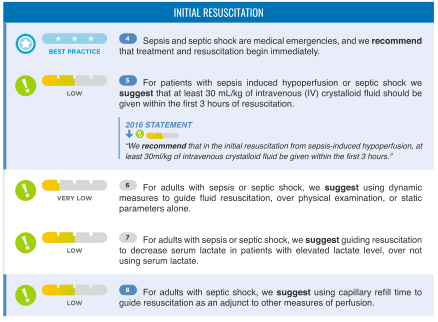
Summary : This figure presents recommendations and suggestions for initial resuscitation in adults with sepsis or septic shock, including fluid administration, resuscitation guidance, and perfusion assessment, with evidence levels and best practice indicators. flowchart/table hybrid: # Section Titles & Structure : • Main heading: "INITIAL RESUSCITATION" • Subsections for each numbered recommendation (4–8), each with evidence level (BEST PRACTICE, LOW, VERY LOW), and a summary statement. # Recommendations & Evidence Levels : • 4 (BEST PRACTICE): "Sepsis and septic shock are medical emergencies, and we recommend that treatment and resuscitation begin immediately." • 5 (LOW): "For patients with sepsis induced hypoperfusion or septic shock we suggest that at least 30 mL/kg of intravenous (IV) crystalloid fluid should be given within the first 3 hours of resuscitation." – Includes a 2016 statement: "We recommend that in the initial resuscitation from sepsis-induced hypoperfusion, at least 30ml/kg of intravenous crystalloid fluid be given within the first 3 hours." • 6 (VERY LOW): "For adults with sepsis or septic shock, we suggest using dynamic measures to guide fluid resuscitation, over physical examination, or static parameters alone." • 7 (LOW): "For adults with sepsis or septic shock, we suggest guiding resuscitation to decrease serum lactate in patients with elevated lactate level, over not using serum lactate." • 8 (LOW): "For adults with septic shock, we suggest using capillary refill time to guide resuscitation as an adjunct to other measures of perfusion." # Design Encodings : • Each recommendation is accompanied by a colored evidence bar (blue for BEST PRACTICE, yellow/orange for LOW/VERY LOW). • Numbered circles (4–8) for each recommendation. • Icons: exclamation mark in a circle for suggestions, blue badge for best practice. • 2016 statement highlighted in blue box. # Layout : • Vertical arrangement, each recommendation in a separate row. • Evidence level bar and icon on the left, recommendation text on the right. • Occasional blue highlight for prior statements. # Analysis : • The figure organizes initial resuscitation guidance by evidence strength, prioritizing immediate treatment and fluid administration. • Most recommendations are "suggestions" with low or very low evidence, except for the immediate treatment recommendation, which is "best practice." • The guidance emphasizes early and adequate fluid resuscitation, dynamic assessment over static measures, and adjunctive use of capillary refill time. • The 2016 statement is consistent with current fluid volume recommendations. • Visual cues (color bars, icons) help quickly identify evidence strength and recommendation type.
"septic shock" AND "vasopressors" AND "norepinephrine"
Latest Sepsis Management: A Comprehensive Review (2024-2026)
1. Definition and Diagnosis
- Sepsis: Suspected/confirmed infection + acute SOFA score increase of ≥2 points
- Septic shock: Sepsis + vasopressor requirement to maintain MAP ≥65 mmHg + serum lactate >2 mmol/L despite adequate fluid resuscitation
- qSOFA (quick SOFA): Altered mentation, RR ≥22/min, SBP ≤100 mmHg - useful bedside screening tool (≥2 points warrants concern)
2. The 1-Hour Bundle (Core Time-Sensitive Actions)
| Action | Details |
|---|---|
| Measure lactate | Re-measure if initial lactate >2 mmol/L |
| Blood cultures | 2 sets before antibiotics (do not delay abx >45 min for this) |
| Broad-spectrum antibiotics | Within 1 hour of shock recognition |
| IV crystalloid | 30 mL/kg within 3 hours if hypotension or lactate ≥4 mmol/L |
| Vasopressors | If hypotension persists during/after fluids; target MAP ≥65 mmHg |
3. Fluid Resuscitation - What's New
- Balanced crystalloids preferred over normal saline (low-certainty evidence, but consistent signal) - e.g., Lactated Ringer's or Plasma-Lyte. Normal saline carries risk of hyperchloremic acidosis.
- 30 mL/kg initial bolus remains the standard, but individualized reassessment using dynamic measures is mandatory.
- Dynamic measures over static: Use passive leg raise (PLR), stroke volume variation (SVV), or pulse pressure variation (PPV) rather than CVP or static filling pressures to guide further fluid therapy.
- Albumin: Suggested (conditional recommendation) for patients who receive large volumes of crystalloids. The ESICM 2025 fluid therapy guidelines support this approach.
- Starches are contraindicated (strong recommendation, high evidence) - associated with AKI and increased mortality.
- Gelatins: suggest against (moderate evidence).
- Lactate-guided resuscitation: Target normalization of serum lactate in patients with elevated levels. Capillary refill time (CRT) is a useful adjunct in septic shock.
4. Vasopressors and Hemodynamic Support
- Norepinephrine (NE) remains the first-line vasopressor for septic shock (strong recommendation). Target MAP ≥65 mmHg.
- Early NE initiation: A 2024 meta-analysis (Ahn et al., Chest 2024, PMID 38972348) found early NE administration (vs. delayed) was associated with reduced mortality - supporting initiation even before full fluid resuscitation completion.
- Vasopressin can be added as a second agent to either raise MAP or spare NE dose; typically initiated at 0.03 units/min.
- Adjunctive vasopressors: A 2025 meta-analysis (Bauer et al., Shock 2025, PMID 39965613) found that adjunctive vasopressors (angiotensin II, vasopressin, terlipressin) reduce short-term mortality in refractory septic shock.
- Angiotensin II: Approved for vasodilatory shock, particularly useful in patients with renal failure.
- Epinephrine: Third-line option; add if MAP target not achieved with NE + vasopressin.
- Dopamine: Reserve only for select patients (low risk of tachyarrhythmia, absolute or relative bradycardia).
- Dobutamine: For septic cardiomyopathy with evidence of cardiac dysfunction and hypoperfusion despite adequate MAP and volume.
5. Antimicrobial Therapy
Timing
- Septic shock: Antibiotics within 1 hour of recognition - every 1-hour delay increases mortality by ~7-8%, per Harrison's 2025.
- Sepsis without shock: Administration within 3 hours if no alternative diagnosis identified on clinical evaluation.
Empiric Selection (by site)
| Site | First-Line Empiric Therapy |
|---|---|
| CAP | Beta-lactam (ceftriaxone/ampicillin-sulbactam) + macrolide; OR respiratory fluoroquinolone monotherapy |
| HAP/VAP | Vancomycin or linezolid + anti-pseudomonal beta-lactam (pip-tazo, cefepime, meropenem) |
| Undifferentiated/unknown source | Ceftriaxone or cefotaxime (if Pseudomonas unlikely); cefepime/pip-tazo/carbapenem if Pseudomonas likely |
| MRSA risk | Add vancomycin or linezolid |
| Necrotizing fasciitis | Vancomycin/linezolid + pip-tazo or carbapenem + clindamycin (toxin suppression) |
| Abdominal source | Pip-tazo or ertapenem (community); carbapenem (healthcare-associated) |
| CNS/meningitis | Ceftriaxone + vancomycin ± ampicillin (Listeria risk); add dexamethasone |
| Carbapenem-resistant organisms | Ceftazidime-avibactam or meropenem-vaborbactam |
Antifungal Therapy
- Not recommended routinely in undifferentiated sepsis.
- Empiric echinocandin: Indicated in patients with multiple risk factors (recent abdominal surgery, parenteral nutrition, liver failure, diabetes, multi-site Candida colonization).
De-escalation
- Reassess antibiotic necessity at 48-72 hours using culture results, procalcitonin trends, and clinical response.
- Aim for the shortest effective course. Procalcitonin-guided de-escalation reduces antibiotic duration without increasing mortality.
6. Source Control
- Identify and control source as rapidly as possible - this is a best practice statement.
- Drain abscesses, debride necrotic tissue (e.g., necrotizing fasciitis), remove infected devices/catheters.
- Infected intravascular catheters should be removed once alternative access is secured.
- Surgical source control for perforated viscus, cholangitis, pyelonephritis with obstruction.
7. Corticosteroids
- Hydrocortisone 200 mg/day (continuous infusion or 50 mg every 6 hours) is recommended in adults with refractory septic shock - defined as needing escalating vasopressor doses to maintain MAP targets.
- A 2024 systematic review and meta-analysis (Pitre et al., Crit Care Explor 2024) confirmed corticosteroids reduce time on vasopressors and accelerate shock reversal.
- Do NOT use corticosteroids when vasopressors are not required.
- Fludrocortisone (50 mcg/day oral) may be added in some protocols.
- Taper steroids when vasopressors are no longer needed.
8. Respiratory Support
- Target SpO2 94-98% with supplemental oxygen; avoid both hypoxia and hyperoxia.
- High-flow nasal cannula (HFNC) preferred over non-invasive ventilation (NIV) for hypoxemic respiratory failure in sepsis.
- Intubation indications: Worsening respiratory failure, inability to protect airway, refractory hypoxemia.
- Lung-protective ventilation: Tidal volume 6 mL/kg ideal body weight (IBW), plateau pressure <30 cmH2O.
- Prone positioning: For moderate-severe ARDS (PaO2/FiO2 <150); ≥12-16 hours/day.
- Conservative oxygen strategy post-stabilization.
9. Glycemic and Metabolic Management
- Target blood glucose 140-180 mg/dL (7.8-10 mmol/L) - avoid hypoglycemia.
- Continuous insulin infusions require strict 1-2 hourly glucose monitoring.
- Stress ulcer prophylaxis: Indicated in patients with coagulopathy, mechanical ventilation ≥48 hours, or high-risk features.
- DVT prophylaxis: Pharmacological (LMWH preferred) unless contraindicated; mechanical if anticoagulation contraindicated.
10. Renal Replacement Therapy (RRT)
- RRT indicated for life-threatening metabolic derangements (hyperkalemia, severe acidosis, fluid overload unresponsive to diuretics, uremia).
- Continuous RRT (CRRT) preferred over intermittent hemodialysis in hemodynamically unstable patients.
- Early initiation: Not clearly superior to standard initiation - individualize based on clinical trajectory.
11. Sepsis Alert Systems
12. Post-ICU and Long-Term Care (Key 2024 Addition)
- Physical rehabilitation: Early mobilization in ICU, continued physiotherapy post-discharge.
- Cognitive and psychological support: Screening for ICU-acquired weakness, PTSD, depression, cognitive impairment.
- Goals-of-care discussions: Involve patients and families in discharge planning.
- Structured follow-up clinic within 2-4 weeks of hospital discharge.
- Assess and manage new organ dysfunction (CKD, respiratory impairment, endocrine dysfunction).
13. Pediatric Sepsis - SSC 2026 Update
- Fluid resuscitation strategy differs (no routine 30 mL/kg bolus; titrated smaller aliquots of 10-20 mL/kg).
- Dopamine is NOT recommended even as second-line (epinephrine or NE preferred).
- Corticosteroid thresholds and definitions of refractory shock are pediatric-specific.
14. Emerging and Investigational Therapies
- Vitamin C + thiamine + hydrocortisone (HAT protocol): Earlier enthusiasm not confirmed in large RCTs (ORANGES, ATESS trials). Not currently recommended by SSC.
- Immunomodulation (e.g., IL-6 inhibitors, anti-TNF): Active research area; no current guideline recommendation.
- Angiotensin II: Approved for use; useful in vasodilatory/renal failure scenarios.
- Cytosorb hemoadsorption: Investigational; insufficient evidence for routine use.
Key Takeaways
- Time is tissue - antibiotics within 1 hour of septic shock, blood cultures before antibiotics, fluids and vasopressors in parallel.
- Balanced crystalloids preferred; dynamic fluid assessment over static parameters.
- Norepinephrine first for vasopressors; consider early initiation rather than waiting.
- Antibiotic stewardship - empiric broad-spectrum, then de-escalate at 48-72 hours.
- Source control remains paramount and should not be delayed.
- Hydrocortisone for refractory shock requiring escalating vasopressors.
- Post-sepsis care is now a formal component of guidelines.
Create a clinical presentation & sepsis management decision tree
A detailed clinical decision tree for sepsis management. The tree starts at the top with "Suspected Infection" and branches down through: SOFA score assessment, then splits into Sepsis (SOFA ≥2) and No Sepsis. The Sepsis branch further splits based on lactate and vasopressor need into Septic Shock vs Sepsis without Shock. Each terminal node shows a management box: 1-hour bundle actions (measure lactate, blood cultures x2, broad-spectrum antibiotics, 30 mL/kg IV crystalloid, vasopressors if MAP <65). Below that, branches for fluid-responsive vs fluid-unresponsive, leading to: norepinephrine first-line, add vasopressin if needed, add hydrocortisone 200mg/day for refractory shock. Include a color-coded scheme: green for stable sepsis, orange for shock, red for refractory shock. Clean medical infographic style with clear arrows, boxes and labels. White background, professional clinical reference card.
ls -la /tmp/workspace/ 2>/dev/null || mkdir -p /tmp/workspace && echo "workspace ready"
mkdir -p /tmp/workspace/sepsis-deck && python /tmp/skills/shared/scripts/fetch_images.py "https://cdn.orris.care/image-gen/03e358bfc02b4269930107fc10381918.png" > /tmp/workspace/sepsis-deck/img_data.json && echo "Image fetched OK"
~/sepsis-deck/build_sepsis_deck.py
import json, base64, subprocess
from io import BytesIO
from pptx import Presentation
from pptx.util import Inches, Pt, Emu
from pptx.dml.color import RGBColor
from pptx.enum.text import PP_ALIGN, MSO_ANCHOR
from pptx.util import Inches, Pt
import pptx.oxml.ns as nsmap
from lxml import etree

# ── Colours ──────────────────────────────────────────────────────────────────
C_DARK_BLUE   = RGBColor(0x0A, 0x3D, 0x62)   # slide headers
C_MID_BLUE    = RGBColor(0x1E, 0x6F, 0xB4)   # section accent
C_GREEN       = RGBColor(0x1E, 0x8B, 0x4C)   # stable/safe
C_ORANGE      = RGBColor(0xE0, 0x7B, 0x00)   # warning/caution
C_RED         = RGBColor(0xB5, 0x1C, 0x1C)   # danger/refractory
C_LIGHT_BLUE  = RGBColor(0xD6, 0xEA, 0xF8)   # box fill light
C_PALE_GREEN  = RGBColor(0xD5, 0xF5, 0xE3)
C_PALE_ORANGE = RGBColor(0xFD, 0xEF, 0xD0)
C_PALE_RED    = RGBColor(0xFAD7, 0xD7, 0xD7)
C_PALE_RED    = RGBColor(0xFA, 0xD7, 0xD7)
C_WHITE       = RGBColor(0xFF, 0xFF, 0xFF)
C_GREY_BG     = RGBColor(0xF4, 0xF6, 0xF9)
C_TEXT        = RGBColor(0x17, 0x20, 0x2A)

W = Inches(13.333)
H = Inches(7.5)

prs = Presentation()
prs.slide_width  = W
prs.slide_height = H
blank = prs.slide_layouts[6]

# ── Helper functions ──────────────────────────────────────────────────────────

def add_rect(slide, x, y, w, h, fill_rgb, border_rgb=None, border_pt=1.0):
    shape = slide.shapes.add_shape(
        pptx.enum.shapes.MSO_SHAPE_TYPE.AUTO_SHAPE if False else 1,   # 1=rectangle
        Inches(x), Inches(y), Inches(w), Inches(h))
    shape.fill.solid()
    shape.fill.fore_color.rgb = fill_rgb
    if border_rgb:
        shape.line.color.rgb = border_rgb
        shape.line.width = Pt(border_pt)
    else:
        shape.line.fill.background()
    return shape

def add_text(slide, text, x, y, w, h, font_size=11, bold=False,
             color=C_TEXT, align=PP_ALIGN.LEFT, italic=False,
             v_anchor=MSO_ANCHOR.MIDDLE, wrap=True):
    tb = slide.shapes.add_textbox(Inches(x), Inches(y), Inches(w), Inches(h))
    tf = tb.text_frame
    tf.word_wrap = wrap
    tf.vertical_anchor = v_anchor
    tf.margin_left  = Inches(0.05)
    tf.margin_right = Inches(0.05)
    tf.margin_top   = Inches(0.02)
    tf.margin_bottom= Inches(0.02)
    p = tf.paragraphs[0]
    p.alignment = align
    run = p.add_run()
    run.text = text
    run.font.size  = Pt(font_size)
    run.font.bold  = bold
    run.font.italic= italic
    run.font.color.rgb = color
    run.font.name  = "Calibri"
    return tb

def add_titled_box(slide, title, bullets, x, y, w, h,
                   title_fill, title_text_color, body_fill, body_text_color,
                   border_rgb, font_title=11, font_body=9.5):
    # title bar
    add_rect(slide, x, y, w, 0.32, title_fill, border_rgb, 1.2)
    add_text(slide, title, x, y, w, 0.32,
             font_size=font_title, bold=True, color=title_text_color,
             align=PP_ALIGN.CENTER)
    # body
    body_h = h - 0.32
    add_rect(slide, x, y+0.32, w, body_h, body_fill, border_rgb, 1.2)
    tb = slide.shapes.add_textbox(
        Inches(x+0.08), Inches(y+0.34), Inches(w-0.16), Inches(body_h-0.06))
    tf = tb.text_frame
    tf.word_wrap = True
    tf.margin_left   = Inches(0.04)
    tf.margin_right  = Inches(0.04)
    tf.margin_top    = Inches(0.04)
    tf.margin_bottom = Inches(0.04)
    first = True
    for b in bullets:
        if first:
            p = tf.paragraphs[0]
            first = False
        else:
            p = tf.add_paragraph()
        p.space_before = Pt(1)
        run = p.add_run()
        run.text = b
        run.font.size  = Pt(font_body)
        run.font.color.rgb = body_text_color
        run.font.name  = "Calibri"

def slide_header(slide, title, subtitle=""):
    add_rect(slide, 0, 0, 13.333, 0.70, C_DARK_BLUE)
    add_text(slide, title, 0.2, 0.02, 10, 0.66,
             font_size=22, bold=True, color=C_WHITE, align=PP_ALIGN.LEFT)
    if subtitle:
        add_text(slide, subtitle, 10.3, 0.10, 2.9, 0.50,
                 font_size=10, color=RGBColor(0xAD, 0xD8, 0xE6),
                 align=PP_ALIGN.RIGHT, italic=True)

def add_arrow_down(slide, x_center, y_top, length=0.22):
    """Draw a simple downward arrow using a line + triangle approximation via shape."""
    from pptx.util import Inches, Pt
    line = slide.shapes.add_connector(
        pptx.enum.shapes.MSO_CONNECTOR_TYPE.STRAIGHT if False else 1,
        Inches(x_center), Inches(y_top),
        Inches(x_center), Inches(y_top + length)
    )
    line.line.color.rgb = C_TEXT
    line.line.width = Pt(1.5)

# ─────────────────────────────────────────────────────────────────────────────
# SLIDE 1 — TITLE SLIDE
# ─────────────────────────────────────────────────────────────────────────────
s1 = prs.slides.add_slide(blank)
add_rect(s1, 0, 0, 13.333, 7.5, C_DARK_BLUE)
add_rect(s1, 0, 2.8, 13.333, 0.06, C_MID_BLUE)
add_rect(s1, 0, 4.7, 13.333, 0.06, C_MID_BLUE)
add_text(s1, "SEPSIS", 0.5, 0.8, 12.3, 1.4,
         font_size=72, bold=True, color=C_WHITE, align=PP_ALIGN.CENTER)
add_text(s1, "Clinical Presentation & Management Decision Tree",
         0.5, 2.1, 12.3, 0.9,
         font_size=24, bold=False, color=RGBColor(0xAD, 0xD8, 0xE6),
         align=PP_ALIGN.CENTER)
add_text(s1, "Based on Surviving Sepsis Campaign Guidelines (SSC 2021/2024) & Harrison's 2025",
         0.5, 2.95, 12.3, 0.5,
         font_size=12, italic=True, color=RGBColor(0x85, 0xC1, 0xE9),
         align=PP_ALIGN.CENTER)
add_text(s1, "Sepsis-3 Definitions  |  1-Hour Bundle  |  Resuscitation  |  Antibiotics  |  Vasopressors  |  Adjuncts",
         0.5, 4.85, 12.3, 0.5,
         font_size=11, color=RGBColor(0x85, 0xC1, 0xE9),
         align=PP_ALIGN.CENTER)
add_text(s1, "Critical Care Reference  •  2024-2026",
         0.5, 6.8, 12.3, 0.45,
         font_size=10, italic=True, color=RGBColor(0x5D, 0x8A, 0xA8),
         align=PP_ALIGN.CENTER)

# ─────────────────────────────────────────────────────────────────────────────
# SLIDE 2 — DEFINITIONS & CLINICAL PRESENTATION
# ─────────────────────────────────────────────────────────────────────────────
s2 = prs.slides.add_slide(blank)
add_rect(s2, 0, 0, 13.333, 7.5, C_GREY_BG)
slide_header(s2, "Definitions & Clinical Presentation", "Sepsis-3 Criteria (JAMA 2016)")

# Sepsis-3 definition box
add_titled_box(s2, "SEPSIS (Sepsis-3 Definition)", [
    "Life-threatening organ dysfunction caused by a dysregulated host response to infection",
    "",
    "Criteria: Suspected/confirmed infection + acute SOFA score increase ≥ 2 points",
    "Mortality risk: ~10-15% in-hospital",
], 0.2, 0.80, 4.1, 1.45,
    C_MID_BLUE, C_WHITE, C_WHITE, C_TEXT, C_MID_BLUE, font_title=11, font_body=9.5)

# Septic shock box
add_titled_box(s2, "SEPTIC SHOCK", [
    "Sepsis + vasopressor requirement to maintain MAP ≥ 65 mmHg",
    "AND serum lactate > 2 mmol/L despite adequate fluid resuscitation",
    "Mortality risk: ~40-50% in-hospital",
], 4.5, 0.80, 4.1, 1.45,
    C_RED, C_WHITE, RGBColor(0xFF, 0xEB, 0xEB), C_TEXT, C_RED, font_title=11, font_body=9.5)

# qSOFA box
add_titled_box(s2, "qSOFA (Bedside Screening — ≥2 of 3)", [
    "• Altered mental status (GCS < 15)",
    "• Respiratory rate ≥ 22 breaths/min",
    "• Systolic BP ≤ 100 mmHg",
    "",
    "Score ≥ 2: Higher risk for poor outcome — escalate assessment",
], 8.8, 0.80, 4.3, 1.45,
    C_ORANGE, C_WHITE, RGBColor(0xFF, 0xF8, 0xEE), C_TEXT, C_ORANGE, font_title=11, font_body=9.5)

# Clinical presentation columns
add_rect(s2, 0.2, 2.45, 13.0, 0.32, C_MID_BLUE)
add_text(s2, "CLINICAL PRESENTATION — Signs & Symptoms by System",
         0.2, 2.45, 13.0, 0.32,
         font_size=12, bold=True, color=C_WHITE, align=PP_ALIGN.CENTER)

systems = [
    ("CARDIOVASCULAR", [
        "• Hypotension (SBP <90 or MAP <65)",
        "• Tachycardia (HR >90)",
        "• Cool clammy OR warm flushed skin",
        "• Prolonged capillary refill (>2 sec)",
        "• Mottled extremities (shock)",
    ], C_RED, RGBColor(0xFF, 0xEB, 0xEB)),
    ("RESPIRATORY", [
        "• Tachypnoea (RR >22)",
        "• Hypoxia / SpO2 <94%",
        "• Dyspnoea, accessory muscle use",
        "• Crackles (pneumonia source)",
        "• ARDS in severe cases",
    ], C_MID_BLUE, C_LIGHT_BLUE),
    ("NEUROLOGICAL", [
        "• Altered mental status / confusion",
        "• Agitation or obtundation",
        "• Reduced GCS",
        "• Septic encephalopathy",
    ], C_ORANGE, C_PALE_ORANGE),
    ("RENAL", [
        "• Oliguria (<0.5 mL/kg/hr)",
        "• Rising creatinine (AKI)",
        "• Electrolyte imbalances",
    ], C_GREEN, C_PALE_GREEN),
    ("METABOLIC", [
        "• Lactic acidosis (lactate >2)",
        "• Hyperglycaemia or hypoglycaemia",
        "• Hyperbilirubinaemia",
        "• Coagulopathy (DIC in severe)",
    ], RGBColor(0x6C, 0x35, 0x83), RGBColor(0xF3, 0xE8, 0xFF)),
]

box_w = 2.55
for i, (sys_name, items, title_col, body_col) in enumerate(systems):
    bx = 0.2 + i * (box_w + 0.05)
    add_titled_box(s2, sys_name, items, bx, 2.85, box_w, 2.0,
                   title_col, C_WHITE, body_col, C_TEXT, title_col,
                   font_title=10, font_body=9)

# Lab findings
add_rect(s2, 0.2, 5.0, 13.0, 0.30, RGBColor(0x21, 0x61, 0x8A))
add_text(s2, "KEY LABORATORY FINDINGS",
         0.2, 5.0, 13.0, 0.30, font_size=11, bold=True, color=C_WHITE, align=PP_ALIGN.CENTER)

labs = [
    ("Blood Cultures", "2 sets before abx\n(do not delay >45 min)"),
    ("Serum Lactate", ">2 mmol/L: hypoperfusion\n>4 mmol/L: high mortality risk"),
    ("CBC", "Leukocytosis (>12K) or\nLeukopenia (<4K) or Bands >10%"),
    ("Procalcitonin", "Elevated in bacterial sepsis\nGuides de-escalation"),
    ("CRP", "Elevated; less specific\nthan PCT"),
    ("CMP/LFTs", "AKI: Cr rise; ALP/bili\nelevated in hepatic dysfunction"),
    ("Coagulation", "PT/aPTT prolonged; D-dimer\nelevated; DIC in severe sepsis"),
    ("Blood Gas", "Metabolic acidosis\n(pH <7.35, low bicarb)"),
]
lab_w = 1.58
for i, (name, val) in enumerate(labs):
    lx = 0.22 + i * (lab_w + 0.04)
    add_rect(s2, lx, 5.38, lab_w, 1.85, C_WHITE, RGBColor(0x21, 0x61, 0x8A), 1)
    add_text(s2, name, lx, 5.38, lab_w, 0.30,
             font_size=8.5, bold=True, color=RGBColor(0x21, 0x61, 0x8A),
             align=PP_ALIGN.CENTER)
    add_text(s2, val, lx+0.04, 5.70, lab_w-0.08, 1.4,
             font_size=8.5, color=C_TEXT, align=PP_ALIGN.CENTER, wrap=True,
             v_anchor=MSO_ANCHOR.TOP)

add_text(s2, "SSC 2021 | Harrison's 22E 2025 | Sepsis-3 (Singer et al., JAMA 2016)",
         0.2, 7.22, 13.0, 0.25, font_size=7.5, italic=True,
         color=RGBColor(0x80, 0x80, 0x80), align=PP_ALIGN.RIGHT)

# ─────────────────────────────────────────────────────────────────────────────
# SLIDE 3 — DECISION TREE (image)
# ─────────────────────────────────────────────────────────────────────────────
s3 = prs.slides.add_slide(blank)
add_rect(s3, 0, 0, 13.333, 7.5, C_GREY_BG)
slide_header(s3, "Sepsis Management Decision Tree", "SSC 2021 | 1-Hour Bundle")

# Load decision tree image
with open("/tmp/workspace/sepsis-deck/img_data.json") as f:
    img_list = json.load(f)
img_b64 = img_list[0]["base64"].split(",", 1)[1]
img_bytes = base64.b64decode(img_b64)
img_stream = BytesIO(img_bytes)
s3.shapes.add_picture(img_stream, Inches(0.2), Inches(0.80), Inches(12.9), Inches(6.55))

add_text(s3, "SSC 2021 Guidelines | Harrison's Principles of Internal Medicine 22E (2025)",
         0.2, 7.22, 13.0, 0.25, font_size=7.5, italic=True,
         color=RGBColor(0x80, 0x80, 0x80), align=PP_ALIGN.RIGHT)

# ─────────────────────────────────────────────────────────────────────────────
# SLIDE 4 — 1-HOUR BUNDLE & INITIAL RESUSCITATION
# ─────────────────────────────────────────────────────────────────────────────
s4 = prs.slides.add_slide(blank)
add_rect(s4, 0, 0, 13.333, 7.5, C_GREY_BG)
slide_header(s4, "1-Hour Bundle & Initial Resuscitation", "Septic Shock or Lactate ≥ 4 mmol/L")

# 1-hour bundle steps (horizontal numbered boxes)
bundle_items = [
    ("1", "MEASURE\nLACTATE", "Serum lactate\nRe-measure if\n>2 mmol/L", C_MID_BLUE),
    ("2", "BLOOD\nCULTURES", "2 sets prior to\nantibiotics\n(≤45 min delay max)", C_MID_BLUE),
    ("3", "ANTIBIOTICS", "Broad-spectrum\nwithin 1 hour of\nshock recognition", C_RED),
    ("4", "IV FLUIDS", "30 mL/kg balanced\ncrystalloid within\nfirst 3 hours", C_GREEN),
    ("5", "VASOPRESSORS", "If MAP <65 mmHg\nduring or after\nfluid resuscitation", C_ORANGE),
]

bw = 2.4
for i, (num, title, detail, col) in enumerate(bundle_items):
    bx = 0.22 + i * (bw + 0.11)
    # number circle (simulated with small colored box)
    add_rect(s4, bx, 0.82, 0.40, 0.40, col)
    add_text(s4, num, bx, 0.82, 0.40, 0.40,
             font_size=18, bold=True, color=C_WHITE, align=PP_ALIGN.CENTER)
    # title bar
    add_rect(s4, bx+0.42, 0.82, bw-0.42, 0.40, col)
    add_text(s4, title, bx+0.42, 0.82, bw-0.42, 0.40,
             font_size=10, bold=True, color=C_WHITE, align=PP_ALIGN.CENTER)
    # detail
    add_rect(s4, bx, 1.22, bw, 0.90, C_WHITE, col, 1.2)
    add_text(s4, detail, bx+0.05, 1.23, bw-0.10, 0.88,
             font_size=9.5, color=C_TEXT, align=PP_ALIGN.CENTER,
             v_anchor=MSO_ANCHOR.MIDDLE)

# Fluid resuscitation section
add_rect(s4, 0.2, 2.28, 13.0, 0.30, RGBColor(0x21, 0x61, 0x8A))
add_text(s4, "FLUID RESUSCITATION — Guidance & Choice",
         0.2, 2.28, 13.0, 0.30, font_size=12, bold=True, color=C_WHITE, align=PP_ALIGN.CENTER)

fluid_data = [
    ("FIRST-LINE FLUID", C_GREEN, C_PALE_GREEN, [
        "Balanced crystalloids (Lactated Ringer's or Plasma-Lyte)",
        "Preferred over normal saline (avoid hyperchloremic acidosis)",
        "30 mL/kg initial bolus in first 3 hours",
    ]),
    ("DYNAMIC MONITORING", C_MID_BLUE, C_LIGHT_BLUE, [
        "Use dynamic over static parameters:",
        "• Passive leg raise (PLR) + cardiac output response",
        "• Stroke volume variation (SVV) / Pulse pressure variation (PPV)",
        "• Capillary refill time as adjunct in septic shock",
    ]),
    ("ALBUMIN", C_ORANGE, C_PALE_ORANGE, [
        "Conditional recommendation:",
        "Consider if large volumes of crystalloids given",
        "4% or 20% albumin — not as first-line",
    ]),
    ("AVOID", C_RED, RGBColor(0xFF, 0xEB, 0xEB), [
        "• Hydroxyethyl starches (HES) — STRONG recommendation against",
        "• Gelatins — suggest against (moderate evidence)",
        "• Excess normal saline (hyperchloraemia/AKI risk)",
    ]),
]
fw = 3.15
for i, (title, t_col, b_col, items) in enumerate(fluid_data):
    fx = 0.22 + i * (fw + 0.12)
    add_titled_box(s4, title, items, fx, 2.65, fw, 1.90,
                   t_col, C_WHITE, b_col, C_TEXT, t_col, font_title=10, font_body=9)

# Lactate interpretation
add_rect(s4, 0.2, 4.68, 13.0, 0.30, RGBColor(0x6C, 0x35, 0x83))
add_text(s4, "LACTATE INTERPRETATION & RESUSCITATION TARGETS",
         0.2, 4.68, 13.0, 0.30, font_size=12, bold=True, color=C_WHITE, align=PP_ALIGN.CENTER)

lactate_data = [
    ("<2 mmol/L", "Normal", "Unlikely tissue hypoperfusion.\nMonitor and reassess.", C_GREEN, C_PALE_GREEN),
    ("2-4 mmol/L", "Elevated - Concern", "Possible hypoperfusion.\nRe-measure within 2 hours.\nInitiate resuscitation.", C_ORANGE, C_PALE_ORANGE),
    (">4 mmol/L", "High - Urgent", "Significant hypoperfusion.\n1-hour bundle activation.\nICU admission.", C_RED, RGBColor(0xFF, 0xEB, 0xEB)),
    ("Target", "Clearance ≥10% per 2h", "Guide resuscitation to\ndecrease lactate toward\nnormal. Dynamic reassessment.", C_MID_BLUE, C_LIGHT_BLUE),
    ("MAP Target", "≥65 mmHg", "Higher targets (80 mmHg)\nmay benefit patients with\nprior hypertension (SEPSISPAM).", RGBColor(0x21, 0x61, 0x8A), C_LIGHT_BLUE),
]
lw = 2.52
for i, (level, label, detail, t_col, b_col) in enumerate(lactate_data):
    lx = 0.22 + i * (lw + 0.08)
    add_rect(s4, lx, 5.05, lw, 0.35, t_col)
    add_text(s4, f"{level}  —  {label}", lx+0.05, 5.05, lw-0.1, 0.35,
             font_size=9, bold=True, color=C_WHITE, align=PP_ALIGN.CENTER)
    add_rect(s4, lx, 5.40, lw, 1.80, b_col, t_col, 1)
    add_text(s4, detail, lx+0.05, 5.42, lw-0.10, 1.75,
             font_size=9, color=C_TEXT, align=PP_ALIGN.CENTER,
             v_anchor=MSO_ANCHOR.MIDDLE)

add_text(s4, "SSC 2021 | ESICM Fluid Therapy Guidelines 2025 | Harrison's 22E 2025",
         0.2, 7.22, 13.0, 0.25, font_size=7.5, italic=True,
         color=RGBColor(0x80, 0x80, 0x80), align=PP_ALIGN.RIGHT)

# ─────────────────────────────────────────────────────────────────────────────
# SLIDE 5 — VASOPRESSORS & ADJUNCT THERAPIES
# ─────────────────────────────────────────────────────────────────────────────
s5 = prs.slides.add_slide(blank)
add_rect(s5, 0, 0, 13.333, 7.5, C_GREY_BG)
slide_header(s5, "Vasopressors & Adjunct Therapies", "Septic Shock Management")

# Vasopressor stepwise ladder
add_rect(s5, 0.2, 0.82, 13.0, 0.30, C_MID_BLUE)
add_text(s5, "VASOPRESSOR LADDER — Stepwise Approach (MAP Target ≥ 65 mmHg)",
         0.2, 0.82, 13.0, 0.30, font_size=12, bold=True, color=C_WHITE, align=PP_ALIGN.CENTER)

vp_steps = [
    ("STEP 1\n(First-Line)", "NOREPINEPHRINE", "0.01 - 3.3 mcg/kg/min IV\nStart early (consider before completing fluid resuscitation)\nStrong Recommendation — High Evidence", C_GREEN, C_PALE_GREEN),
    ("STEP 2\n(Add-On)", "VASOPRESSIN", "Fixed 0.03 units/min IV\nAdd to spare NE dose or raise MAP\nConditional recommendation", C_MID_BLUE, C_LIGHT_BLUE),
    ("STEP 3\n(Refractory)", "EPINEPHRINE", "0.01 - 0.3 mcg/kg/min IV\nAdd if MAP not achieved\nConditional — consider over dopamine", C_ORANGE, C_PALE_ORANGE),
    ("STEP 4\n(Refractory)", "ANGIOTENSIN II", "20-80 ng/kg/min IV\nApproved for vasodilatory shock\nParticularly useful with renal failure", RGBColor(0x6C, 0x35, 0x83), RGBColor(0xF3, 0xE8, 0xFF)),
    ("AVOID AS\nFIRST-LINE", "DOPAMINE", "Only in select patients:\n• Low tachyarrhythmia risk\n• Absolute/relative bradycardia", C_RED, RGBColor(0xFF, 0xEB, 0xEB)),
]
vw = 2.52
for i, (step, drug, detail, t_col, b_col) in enumerate(vp_steps):
    vx = 0.22 + i * (vw + 0.08)
    add_rect(s5, vx, 1.18, vw, 0.38, t_col)
    add_text(s5, step, vx, 1.18, vw, 0.38,
             font_size=9, bold=True, color=C_WHITE, align=PP_ALIGN.CENTER)
    add_rect(s5, vx, 1.56, vw, 0.35, RGBColor(int(t_col.rgb>>16), int((t_col.rgb>>8)&0xFF), int(t_col.rgb&0xFF)))
    add_text(s5, drug, vx, 1.56, vw, 0.35,
             font_size=10.5, bold=True, color=C_WHITE, align=PP_ALIGN.CENTER)
    add_rect(s5, vx, 1.91, vw, 1.30, b_col, t_col, 1)
    add_text(s5, detail, vx+0.05, 1.93, vw-0.1, 1.26,
             font_size=9, color=C_TEXT, align=PP_ALIGN.CENTER, v_anchor=MSO_ANCHOR.MIDDLE)

# Adjunct therapies row
add_rect(s5, 0.2, 3.35, 13.0, 0.30, RGBColor(0x21, 0x61, 0x8A))
add_text(s5, "ADJUNCT THERAPIES",
         0.2, 3.35, 13.0, 0.30, font_size=12, bold=True, color=C_WHITE, align=PP_ALIGN.CENTER)

adjuncts = [
    ("CORTICOSTEROIDS", [
        "Hydrocortisone 200 mg/day (CI or 50 mg q6h)",
        "Indication: Refractory septic shock requiring",
        "escalating vasopressors",
        "Duration: Until vasopressors no longer needed",
        "Add fludrocortisone 50 mcg/day (oral) — optional",
        "DO NOT use if vasopressors not required",
    ], C_ORANGE, C_PALE_ORANGE),
    ("DOBUTAMINE", [
        "Indication: Septic cardiomyopathy",
        "Evidence of cardiac dysfunction with",
        "persistent hypoperfusion despite adequate",
        "MAP and volume",
        "Dose: 2.5-20 mcg/kg/min IV",
        "Reassess frequently — tachycardia risk",
    ], C_MID_BLUE, C_LIGHT_BLUE),
    ("BLOOD PRODUCTS", [
        "RBC: Transfuse if Hb <7 g/dL",
        "(Target 7-9 g/dL; higher if active ischaemia)",
        "Platelets: <10K (prophylactic); <20K if bleeding risk;",
        "<50K if active bleeding/procedure",
        "FFP: Only for active bleeding or invasive procedures",
        "Avoid routine transfusion without indication",
    ], C_GREEN, C_PALE_GREEN),
    ("GLYCAEMIC CONTROL", [
        "Target blood glucose 140-180 mg/dL",
        "(7.8-10 mmol/L)",
        "Use insulin infusion protocol",
        "Monitor glucose every 1-2 hours",
        "Avoid hypoglycaemia (<70 mg/dL)",
        "Hypoglycaemia associated with increased mortality",
    ], RGBColor(0x6C, 0x35, 0x83), RGBColor(0xF3, 0xE8, 0xFF)),
]
aw = 3.15
for i, (title, items, t_col, b_col) in enumerate(adjuncts):
    ax = 0.22 + i * (aw + 0.13)
    add_titled_box(s5, title, items, ax, 3.72, aw, 2.70,
                   t_col, C_WHITE, b_col, C_TEXT, t_col, font_title=10, font_body=9)

# Monitoring targets footer
add_rect(s5, 0.2, 6.52, 13.0, 0.28, C_DARK_BLUE)
targets = "MAP ≥65 mmHg  |  Urine output ≥0.5 mL/kg/hr  |  Lactate clearance ≥10%/2h  |  ScvO2 ≥70%  |  Capillary refill <2 sec  |  SpO2 94-98%"
add_text(s5, f"MONITORING TARGETS:  {targets}",
         0.3, 6.52, 12.8, 0.28, font_size=9, bold=False,
         color=RGBColor(0xAD, 0xD8, 0xE6), align=PP_ALIGN.CENTER)

add_text(s5, "SSC 2021 | Ahn et al. Chest 2024 | Bauer et al. Shock 2025 | Harrison's 22E",
         0.2, 6.88, 13.0, 0.25, font_size=7.5, italic=True,
         color=RGBColor(0x80, 0x80, 0x80), align=PP_ALIGN.RIGHT)

# ─────────────────────────────────────────────────────────────────────────────
# SLIDE 6 — ANTIMICROBIAL THERAPY
# ─────────────────────────────────────────────────────────────────────────────
s6 = prs.slides.add_slide(blank)
add_rect(s6, 0, 0, 13.333, 7.5, C_GREY_BG)
slide_header(s6, "Antimicrobial Therapy", "Empiric Selection & Stewardship")

add_rect(s6, 0.2, 0.82, 13.0, 0.28, C_RED)
add_text(s6, "TIMING:  Septic Shock → Antibiotics within 1 HOUR  |  Sepsis without Shock → within 3 hours if no alternative diagnosis",
         0.2, 0.82, 13.0, 0.28, font_size=11, bold=True, color=C_WHITE, align=PP_ALIGN.CENTER)

abx_table = [
    ("PULMONARY — CAP",          C_MID_BLUE, C_LIGHT_BLUE,
     "Beta-lactam + Macrolide:\nCeftriaxone/Amp-sulbactam + Azithromycin OR\nRespiratory fluoroquinolone monotherapy (Levofloxacin)"),
    ("PULMONARY — HAP/VAP",      C_MID_BLUE, C_LIGHT_BLUE,
     "Vancomycin OR Linezolid\n+ Anti-pseudomonal beta-lactam:\nPip-tazo, Cefepime, Ceftazidime,\nMeropenem, or Aztreonam"),
    ("UNKNOWN SOURCE",           C_ORANGE, C_PALE_ORANGE,
     "Pseudomonas unlikely:\nCeftriaxone or Cefotaxime\n\nPseudomonas likely:\nCefepime, Pip-tazo, or Carbapenem"),
    ("MRSA RISK FACTORS",        C_RED, RGBColor(0xFF, 0xEB, 0xEB),
     "Add: Vancomycin OR Linezolid\n(healthcare exposure, prior MRSA,\nhospital-onset sepsis)"),
    ("ABDOMINAL SOURCE",         C_GREEN, C_PALE_GREEN,
     "Community:\nErtapenem OR Pip-tazo\n\nHealthcare/Severe:\nMeropenem OR Imipenem"),
    ("NECROTIZING FASCIITIS",    C_RED, RGBColor(0xFF, 0xEB, 0xEB),
     "Vancomycin/Linezolid\n+ Pip-tazo or Carbapenem\n+ Clindamycin (toxin suppression)\nURGENT surgical consultation"),
    ("CNS — MENINGITIS",         RGBColor(0x6C, 0x35, 0x83), RGBColor(0xF3, 0xE8, 0xFF),
     "Ceftriaxone + Vancomycin\n+ Ampicillin (if Listeria risk)\n+ Dexamethasone 0.15 mg/kg q6h"),
    ("URINARY SOURCE",           C_GREEN, C_PALE_GREEN,
     "Community uncomplicated:\nCeftriaxone\n\nComplicated/Healthcare:\nPip-tazo or Carbapenem"),
]

tw = 3.12
for i, (site, t_col, b_col, regimen) in enumerate(abx_table):
    row = i // 4
    col = i % 4
    tx = 0.22 + col * (tw + 0.11)
    ty = 1.18 + row * 2.55
    add_titled_box(s6, site, [regimen], tx, ty, tw, 2.40,
                   t_col, C_WHITE, b_col, C_TEXT, t_col, font_title=9.5, font_body=9)

# Stewardship footer
add_rect(s6, 0.2, 6.38, 13.0, 0.30, RGBColor(0x21, 0x61, 0x8A))
add_text(s6, "STEWARDSHIP: Reassess at 48-72h | Use cultures + PCT to de-escalate | Shortest effective course | Empiric antifungal ONLY if high-risk Candida",
         0.2, 6.38, 13.0, 0.30, font_size=10, color=C_WHITE, bold=False, align=PP_ALIGN.CENTER)

add_text(s6, "Harrison's 22E 2025 | SSC 2021 | IDSA Guidelines",
         0.2, 7.22, 13.0, 0.25, font_size=7.5, italic=True,
         color=RGBColor(0x80, 0x80, 0x80), align=PP_ALIGN.RIGHT)

# ─────────────────────────────────────────────────────────────────────────────
# SLIDE 7 — RESPIRATORY, RENAL & POST-SEPSIS
# ─────────────────────────────────────────────────────────────────────────────
s7 = prs.slides.add_slide(blank)
add_rect(s7, 0, 0, 13.333, 7.5, C_GREY_BG)
slide_header(s7, "Respiratory Support | Renal | Post-Sepsis Syndrome", "Organ Support & Recovery")

# Respiratory
add_rect(s7, 0.2, 0.82, 4.15, 0.30, C_MID_BLUE)
add_text(s7, "RESPIRATORY SUPPORT", 0.2, 0.82, 4.15, 0.30,
         font_size=11, bold=True, color=C_WHITE, align=PP_ALIGN.CENTER)
add_titled_box(s7, "Oxygen & Non-Invasive", [
    "• Target SpO2 94-98% (avoid hyperoxia)",
    "• HFNC preferred over standard O2 for hypoxaemic RF",
    "• HFNC preferred over NIV in sepsis-related ARF",
    "• NIV trial acceptable if hypoxaemia + fluid overload",
], 0.2, 1.18, 4.15, 1.60, C_MID_BLUE, C_WHITE, C_LIGHT_BLUE, C_TEXT, C_MID_BLUE, font_title=9.5, font_body=9)

add_titled_box(s7, "Mechanical Ventilation (Intubation Indicated)", [
    "• Lung-protective: TV 6 mL/kg IBW",
    "• Plateau pressure <30 cmH2O",
    "• PEEP titration (FiO2-PEEP table or ARDSnet)",
    "• Prone positioning if P/F ratio <150 (≥16h/day)",
    "• Conservative fluid strategy post-stabilisation",
    "• Weaning: Daily SAT + SBT protocol",
], 0.2, 2.88, 4.15, 2.20, C_MID_BLUE, C_WHITE, C_LIGHT_BLUE, C_TEXT, C_MID_BLUE, font_title=9.5, font_body=9)

# Renal
add_rect(s7, 4.55, 0.82, 4.15, 0.30, C_GREEN)
add_text(s7, "RENAL SUPPORT (AKI)", 4.55, 0.82, 4.15, 0.30,
         font_size=11, bold=True, color=C_WHITE, align=PP_ALIGN.CENTER)
add_titled_box(s7, "AKI — Monitoring & Prevention", [
    "• Hourly urine output monitoring (target ≥0.5 mL/kg/hr)",
    "• Avoid nephrotoxins (aminoglycosides, NSAIDs, contrast)",
    "• Careful fluid resuscitation (avoid overload)",
    "• Treat septic shock source to restore renal perfusion",
    "• Stage AKI per KDIGO criteria (Cr, UO, baseline)",
], 4.55, 1.18, 4.15, 1.80, C_GREEN, C_WHITE, C_PALE_GREEN, C_TEXT, C_GREEN, font_title=9.5, font_body=9)

add_titled_box(s7, "Renal Replacement Therapy (RRT)", [
    "Indications:",
    "• Refractory hyperkalemia",
    "• Severe metabolic acidosis (pH <7.1 refractory)",
    "• Fluid overload unresponsive to diuretics",
    "• Uraemic complications (encephalopathy, pericarditis)",
    "",
    "CRRT preferred over IHD in haemodynamic instability",
    "No clear benefit to early RRT initiation — individualise",
], 4.55, 3.05, 4.15, 2.03, C_GREEN, C_WHITE, C_PALE_GREEN, C_TEXT, C_GREEN, font_title=9.5, font_body=9)

# Post-sepsis syndrome
add_rect(s7, 8.98, 0.82, 4.15, 0.30, C_ORANGE)
add_text(s7, "POST-SEPSIS SYNDROME", 8.98, 0.82, 4.15, 0.30,
         font_size=11, bold=True, color=C_WHITE, align=PP_ALIGN.CENTER)
add_titled_box(s7, "Physical Sequelae", [
    "• ICU-acquired weakness (ICUAW): 40-60% of ICU survivors",
    "• Early physiotherapy and mobilisation in ICU",
    "• Ongoing rehabilitation post-discharge",
    "• New organ dysfunction (CKD, respiratory impairment)",
    "• Endocrine: new-onset diabetes, adrenal insufficiency",
], 8.98, 1.18, 4.15, 1.60, C_ORANGE, C_WHITE, C_PALE_ORANGE, C_TEXT, C_ORANGE, font_title=9.5, font_body=9)

add_titled_box(s7, "Cognitive & Psychological", [
    "• Post-Intensive Care Syndrome (PICS): cognitive, psych, physical",
    "• PTSD in up to 25% of ICU survivors",
    "• Depression and anxiety — screen routinely",
    "• Cognitive impairment — neuropsychological testing",
    "• Family members at risk for PICS-F",
], 8.98, 2.85, 4.15, 1.55, C_ORANGE, C_WHITE, C_PALE_ORANGE, C_TEXT, C_ORANGE, font_title=9.5, font_body=9)

add_titled_box(s7, "Post-Discharge Care (SSC 2021 Focus)", [
    "• Involve patient & family in goals-of-care",
    "• Structured follow-up clinic 2-4 weeks post-discharge",
    "• Review new medications, referrals, and organ support",
    "• Nutritional assessment and support",
    "• Vaccination (pneumococcal, influenza) if indicated",
    "• Re-evaluate for occult infection source",
], 8.98, 4.47, 4.15, 2.15, C_ORANGE, C_WHITE, C_PALE_ORANGE, C_TEXT, C_ORANGE, font_title=9.5, font_body=9)

# DVT/stress ulcer prophylaxis strip
add_rect(s7, 0.2, 5.15, 8.55, 1.40, C_WHITE, RGBColor(0x6C, 0x35, 0x83), 1.2)
add_text(s7, "DVT & STRESS ULCER PROPHYLAXIS", 0.28, 5.15, 8.4, 0.30,
         font_size=10, bold=True, color=RGBColor(0x6C, 0x35, 0x83), align=PP_ALIGN.LEFT)
add_text(s7,
         "DVT Prophylaxis:\n"
         "• Pharmacological (LMWH preferred) — start early unless contraindicated\n"
         "• Mechanical (IPC devices) if anticoagulation contraindicated\n\n"
         "Stress Ulcer Prophylaxis (PPIs or H2 blockers):\n"
         "• Indicated: MV ≥48h, coagulopathy, prior GI bleed/ulcer, high-dose steroids",
         0.28, 5.47, 8.40, 1.05,
         font_size=9, color=C_TEXT, align=PP_ALIGN.LEFT, v_anchor=MSO_ANCHOR.TOP)

add_text(s7, "SSC 2021 | Harrison's 22E 2025 | PICS: Needham et al. Crit Care Med 2012",
         0.2, 7.22, 13.0, 0.25, font_size=7.5, italic=True,
         color=RGBColor(0x80, 0x80, 0x80), align=PP_ALIGN.RIGHT)

# ─────────────────────────────────────────────────────────────────────────────
# SAVE
# ─────────────────────────────────────────────────────────────────────────────
output_path = "/tmp/workspace/sepsis-deck/Sepsis_Management_Decision_Tree.pptx"
buf = BytesIO()
prs.save(buf)
with open(output_path, "wb") as f:
    f.write(buf.getvalue())
print(f"Saved: {output_path}")
cd /tmp/workspace/sepsis-deck && python build_sepsis_deck.py 2>&1
~/sepsis-deck/build_sepsis_deck.py
Successfully replaced 1 instance(s) of the string in '/tmp/workspace/sepsis-deck/build_sepsis_deck.py'
cd /tmp/workspace/sepsis-deck && python build_sepsis_deck.py 2>&1
~/sepsis-deck/build_sepsis_deck.py
Successfully replaced 1 instance(s) of the string in '/tmp/workspace/sepsis-deck/build_sepsis_deck.py'
cd /tmp/workspace/sepsis-deck && python build_sepsis_deck.py 2>&1
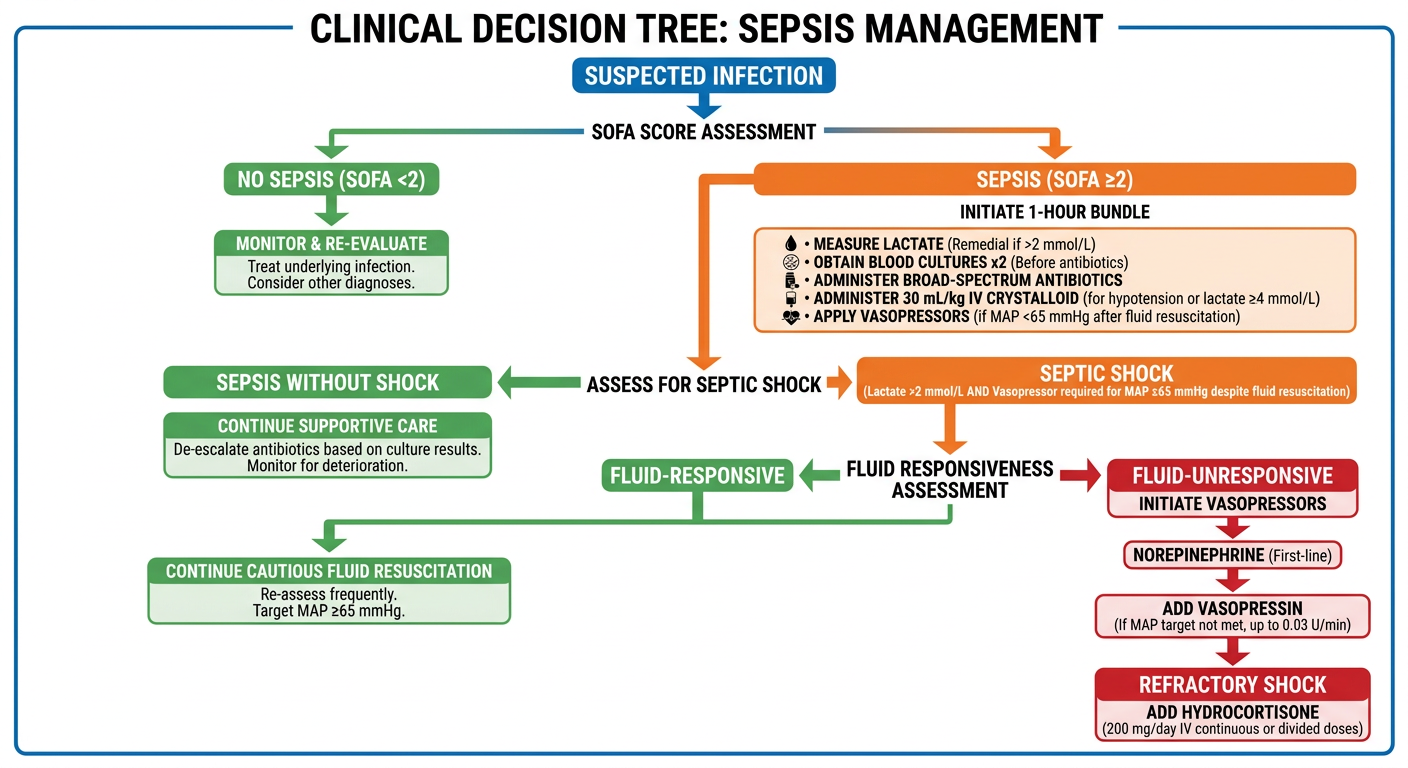
Sepsis Management Decision Tree
Presentation · PPTX
What's inside (7 slides, 16:9 widescreen):
| Slide | Content |
|---|---|
| 1 - Title | Sepsis management cover with SSC/Harrison's attribution |
| 2 - Clinical Presentation | Sepsis-3 definitions, qSOFA, signs by organ system (CVS, Respiratory, Neuro, Renal, Metabolic), key lab findings table |
| 3 - Decision Tree | Full visual algorithm from suspected infection → Sepsis → Septic Shock → Refractory Shock with management at each node |
| 4 - 1-Hour Bundle & Fluids | 5-step numbered bundle, fluid choice (balanced crystalloids vs. saline vs. albumin vs. avoid starches), lactate interpretation table |
| 5 - Vasopressors & Adjuncts | Stepwise ladder (NE → Vasopressin → Epi → Ang II), corticosteroids, dobutamine, blood products, glycaemic control, monitoring targets |
| 6 - Antimicrobial Therapy | Empiric regimens by source (CAP, HAP/VAP, unknown, MRSA, abdominal, necrotizing fasciitis, CNS, UTI), stewardship banner |
| 7 - Respiratory / Renal / Post-Sepsis | HFNC vs. MV, lung-protective ventilation, AKI management, RRT indications, Post-Intensive Care Syndrome (PICS), discharge planning |
Sofa or news2? Fot screening and what news score is sugestive of sepsis
"NEWS2" AND "SOFA" AND "sepsis" AND "screening"
NEWS2 score sepsis screening threshold SOFA comparison 2024 2025
"NEWS2" AND "sepsis" AND "sensitivity"
NEWS2 score table parameters respiratory rate heart rate sepsis
![Table 7: Definition and criteria of sepsis and septic shock [304-306]
<table><thead><tr><th>Disorder</th><th>Definition</th></tr></thead><tbody><tr><td>Sepsis</td><td>Life-threatening organ dysfunction caused by a dysregulated host response to infection. For clinical application, organ dysfunction can be represented by an increase in the Sequential [Sepsis-related] Organ Failure Assessment (SOFA) score of 2 points or more. For rapid identification a quickSOFA (qSOFA) score was developed: respiratory rate of 22/min or greater, altered mentation, or systolic blood pressure of 100 mmHg or less.</td></tr><tr><td>Septic shock</td><td>Septic shock should be defined as a subset of sepsis in which particularly profound circulatory, cellular, and metabolic abnormalities are associated with a greater risk of mortality than with sepsis alone. Patients with septic shock can be clinically identified by a vasopressor requirement to maintain a mean arterial pressure of 65 mmHg or greater and serum lactate level greater than 2 mmol/L (>18 mg/dL) in the absence of hypovolemia.</td></tr></tbody></table>](https://cdn.orris.care/cdss_images/GLGCA_4543237_1766502857832_ae2bf8f4-ab30-4c48-8d62-c48dca104e78_10f240ff-6d7e-443a-9ad3-ae9263402c7f.png)
Table 7: Definition and criteria of sepsis and septic shock [304-306] <table><thead><tr><th>Disorder</th><th>Definition</th></tr></thead><tbody><tr><td>Sepsis</td><td>Life-threatening organ dysfunction caused by a dysregulated host response to infection. For clinical application, organ dysfunction can be represented by an increase in the Sequential [Sepsis-related] Organ Failure Assessment (SOFA) score of 2 points or more. For rapid identification a quickSOFA (qSOFA) score was developed: respiratory rate of 22/min or greater, altered mentation, or systolic blood pressure of 100 mmHg or less.</td></tr><tr><td>Septic shock</td><td>Septic shock should be defined as a subset of sepsis in which particularly profound circulatory, cellular, and metabolic abnormalities are associated with a greater risk of mortality than with sepsis alone. Patients with septic shock can be clinically identified by a vasopressor requirement to maintain a mean arterial pressure of 65 mmHg or greater and serum lactate level greater than 2 mmol/L (>18 mg/dL) in the absence of hypovolemia.</td></tr></tbody></table>
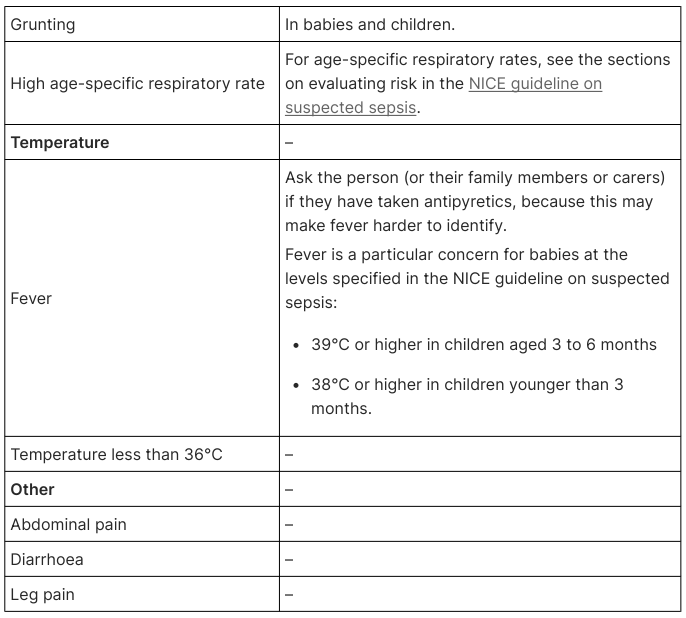
<table><tr><td>Grunting</td><td>In babies and children.</td></tr><tr><td>High age-specific respiratory rate</td><td>For age-specific respiratory rates, see the sections on evaluating risk in the NICE guideline on suspected sepsis.</td></tr><tr><td>Temperature</td><td>–</td></tr><tr><td>Fever</td><td>Ask the person (or their family members or carers) if they have taken antipyretics, because this may make fever harder to identify. Fever is a particular concern for babies at the levels specified in the NICE guideline on suspected sepsis: <ul><li>39°C or higher in children aged 3 to 6 months</li><li>38°C or higher in children younger than 3 months.</li></ul></td></tr><tr><td>Temperature less than 36°C</td><td>–</td></tr><tr><td>Other</td><td>–</td></tr><tr><td>Abdominal pain</td><td>–</td></tr><tr><td>Diarrhoea</td><td>–</td></tr><tr><td>Leg pain</td><td>–</td></tr></table>
SOFA vs NEWS2 for Sepsis Screening
The Short Answer
| Purpose | Best Tool |
|---|---|
| Screening (early detection, ward/ED/prehospital) | NEWS2 |
| Diagnosis (confirming organ dysfunction) | SOFA |
| Rapid bedside prognostication | qSOFA |
Understanding Each Tool
SOFA (Sequential Organ Failure Assessment)
| SOFA Component | What It Measures |
|---|---|
| Respiratory | PaO2/FiO2 ratio |
| Coagulation | Platelets |
| Liver | Bilirubin |
| Cardiovascular | MAP / vasopressor dose |
| CNS | Glasgow Coma Scale |
| Renal | Creatinine / urine output |
qSOFA (Quick SOFA)
NEWS2 (National Early Warning Score 2)
| Parameter | Scoring Range |
|---|---|
| Respiratory rate | 0-3 |
| SpO2 (Scale 1 or 2 for hypercapnic risk) | 0-3 |
| Systolic blood pressure | 0-3 |
| Heart rate | 0-3 |
| Level of consciousness (ACVPU) | 0-3 |
| Temperature | 0-2 |
| Supplemental oxygen use | 0-2 |
| Maximum total score | 20 |
NEWS2 Thresholds Suggestive of Sepsis
| NEWS2 Score | Risk Level | Action |
|---|---|---|
| 0 | Low | Routine monitoring |
| 1-4 | Low-medium | Increased monitoring frequency |
| ≥5 | Medium - HIGH CONCERN FOR SEPSIS | Urgent clinical review; consider sepsis |
| 5-6 with any single parameter scoring 3 | High | Urgent/emergency review |
| ≥7 | HIGH - Possible sepsis/critical illness | Immediate emergency response |
NEWS2 ≥5 is the threshold used in UK NHS and NICE guidelines as a trigger to consider sepsis and initiate the Sepsis 6 pathway.
- Sensitivity of 86.6% for detecting SOFA ≥2 (sepsis) in patients with bacteraemia
- Specificity of 51.5%
- AUC of 0.77 against SOFA ≥2 as the reference standard
- Best cut-off was confirmed at 5 points
Head-to-Head Performance
| Metric | NEWS2 | qSOFA |
|---|---|---|
| AUC for mortality | Higher (ROC curve above qSOFA) | Lower |
| AUC for predicting ICU stay | 0.72 | 0.70 |
| Sensitivity (overall) | Higher | Lower |
| Complexity | Moderate (7 parameters) | Very simple (3 items) |
- NEWS2 AUC for outcome prediction: 0.879
- qSOFA AUC: 0.767
- Modified Shock Index: 0.682
Practical Guidance: Which to Use When?
| Clinical Setting | Recommended Tool | Why |
|---|---|---|
| General ward - routine monitoring | NEWS2 | Triggered automatically from obs; high sensitivity |
| ED triage | NEWS2 | Better early detection than qSOFA |
| Prehospital / ambulance | NEWS2 | Pre-calculated from vitals; no labs needed |
| ICU / confirming sepsis diagnosis | SOFA | Gold standard; quantifies organ dysfunction |
| Very rapid 30-second bedside check | qSOFA | 3 items, no equipment - but use only as a quick flag, not to rule out |
| Antibiotic de-escalation / prognosis | SOFA | Tracks organ dysfunction trajectory |
Key Bottom Line
- NEWS2 ≥5 = suspect sepsis, trigger urgent review and Sepsis 6 pathway.
- NEWS2 ≥7 = high risk, immediate emergency response.
- SOFA is for confirming sepsis (organ dysfunction ≥2 from baseline) and severity tracking - it requires labs.
- qSOFA should NOT be used alone for screening - it misses too many cases.
- Neither NEWS2 nor qSOFA replaces clinical judgment. Harrison's 2025 and SSC 2021 both note that no single tool is universally endorsed - use them together with clinical assessment.