
Pineal gland anatomy
Reading File
Finding Sources
Finding Sources
Searching Images
pineal gland anatomy location brain
Reading File
Reading File
Reading File
Reading File
Loading Image
Loading Image
Loading Image
Here is a comprehensive overview of pineal gland anatomy drawn from multiple textbooks:
Pineal Gland Anatomy
Gross Anatomy
The pineal gland (also called the epiphysis cerebri or pineal body) is a small, pine cone-shaped structure — hence the name, from Latin pinea (pine cone). Key dimensions:
- Size: 5–10 mm long × 3–5 mm in diameter
- Weight: ~100–200 mg
Location
It lies at the posterior wall of the third ventricle, between the:
- Habenular commissure (anterosuperior)
- Posterior commissure (inferior)
The bulk of the gland projects caudally beyond the roof of the ventricle, resting in a depression between the two superior colliculi of the tectal plate (quadrigeminal plate). The pineal recess — an extension of the third ventricular cavity — projects into the stalk and is lined by ependyma. The remaining surface is covered by pia mater.
It is classified as a circumventricular organ and a neurohemal organ — it sits outside the blood-brain barrier, enabling direct hormonal release into the bloodstream.
Blood Supply & Venous Drainage
- Arterial supply: Medial and lateral posterior choroidal arteries (branches of the posterior cerebral arteries)
- Venous drainage: Great cerebral vein (vein of Galen)
Embryology & Phylogeny
The pineal gland develops from the neuroectoderm of the diencephalon (posterior roof of the third ventricle) and remains connected to the rest of the brain via the habenulae. Phylogenetically, it originated as a photosensory "parietal eye" — present as a true third eye in some reptiles — and evolved into a neuroendocrine gland in mammals. In comparative anatomy, it is considered a vestigial remnant of that dorsal photoreceptor organ.
Microscopic Anatomy
The gland is divided into lobules by connective tissue septa derived from the pia mater. These septa carry small blood vessels.
Cell Types
| Cell Type | Features |
|---|---|
| Pinealocytes (~95%) | Large cells; slightly basophilic cytoplasm; irregular euchromatic (pale) nuclei; long cytoplasmic processes ending in dilations near capillaries → endocrine secretion |
| Interstitial glial cells (~5%) | Modified astrocytes; GFAP-positive; elongated, darkly stained nuclei; located in perivascular areas and between pinealocyte clusters |
Ultrastructure of pinealocytes: Secretory vesicles, abundant mitochondria, and long processes with knob-like endings containing synaptic ribbons (associated with synaptic vesicles) that terminate in the pericapillary compartment — the characteristic secretory interface.
Unmyelinated sympathetic nerve fibers (noradrenergic, from the superior cervical ganglion) enter the gland and synapse on pinealocytes, linking retinal light detection to melatonin synthesis.
Histology Images
H&E micrographs of pineal gland (from Junqueira's Basic Histology):
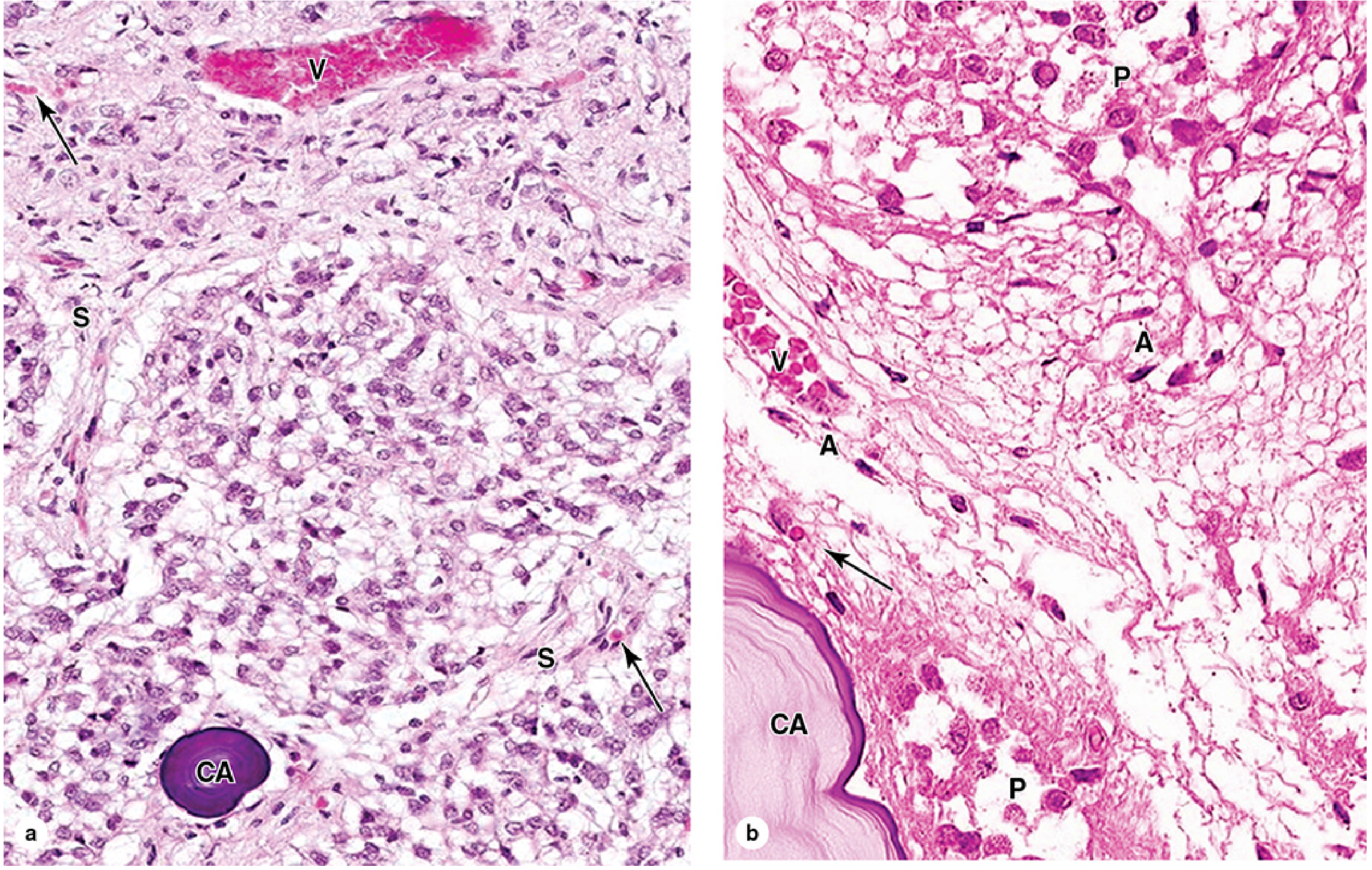
(a) Pinealocytes surrounded by septa (S) containing venules (V) and capillaries (arrows), with a corpus arenaeum (CA) — ×200 H&E. (b) Large pinealocytes (P) with euchromatic nuclei, fewer astrocytes (A) with elongated dark nuclei near vessels (V), and a large corpus arenaeum (CA) — ×400 H&E.
Corpora Arenacea ("Brain Sand")
A hallmark feature of the adult pineal gland: calcium and magnesium salt concretions formed by mineralization of extracellular protein deposits around the pinealocyte processes. They:
- Increase in number with age (rare in childhood, almost universal in adults)
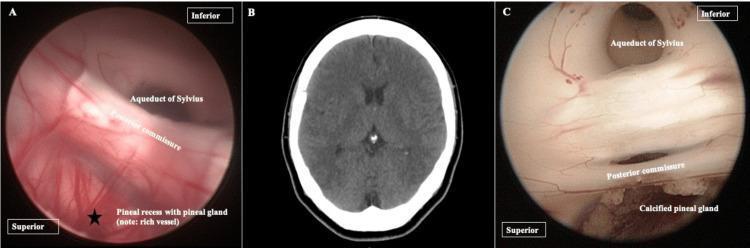
- Are radiologically visible on plain skull X-ray and CT, serving as a midline marker
- Appear as laminated, granular deposits on histology
- Have no known physiologic function, but are diagnostically useful
The image below shows the pineal gland's position on CT and during neuroendoscopy, with the calcified gland, posterior commissure, and aqueduct of Sylvius visible:
Innervation & Neurocircuitry
The pineal gland lacks direct neural input from the brain proper (no axons from the hypothalamus or cortex enter it directly). Instead, it receives postganglionic sympathetic fibers from the superior cervical ganglion. The circuit:
Retina → retinohypothalamic tract → suprachiasmatic nucleus (SCN) of hypothalamus → descending projections → superior cervical ganglion → internal carotid nerve plexus → pineal gland
Norepinephrine (NE) released from sympathetic terminals stimulates pinealocyte enzymes (notably AANAT — arylalkylamine N-acetyltransferase) that drive melatonin synthesis.
Functional Anatomy Summary
| Feature | Detail |
|---|---|
| Location | Posterior wall of 3rd ventricle, between superior colliculi |
| Stalk | Short; attached to habenulae; contains pineal recess |
| Covering | Pia mater (external); ependyma (recess) |
| Circumventricular | Yes — outside the BBB |
| Primary secretion | Melatonin (darkness-stimulated; tryptophan → serotonin → melatonin) |
| Other secretions | α-MSH, various peptides |
| Key landmark | Corpora arenacea — visible on CT/X-ray as calcified midline structure |
| Age-related change | Progressive gliosis and cyst formation; parenchyma pushed to periphery |
Sources: Junqueira's Basic Histology 17e; Histology: A Text and Atlas (Pawlina) 8e; Color Atlas of Human Anatomy Vol. 2; Guyton & Hall Medical Physiology
This is a shared conversation. Sign in to Orris to start your own chat.