
treatment of heart failure with preserved ejection fraction detail
I'll start by reading the medical library skill, then search for HFpEF treatment content in parallel.
Searching sources...
Reading File
Now I'll run parallel searches across the medical library, PubMed, and web simultaneously.
Finding Sources
Searching PubMed
"heart failure preserved ejection fraction" AND treatment
Searching the Web
HFpEF treatment guidelines 2025 2026 SGLT2 inhibitors aldosterone
Now let me read the key textbook sections in parallel - Braunwald's, Harrison's, Goodman & Gilman's, and Fuster's Heart.
Reading File
Reading File
Reading File
Reading File
Now let me read the Harrison's treatment section more fully, plus the Fuster's Heart chapter, and extract the treatment section from Goldman-Cecil:
Reading File
Reading File
Reading File
Let me read the Fuster's treatment section in detail and fetch the Goldman-Cecil treatment flowchart image:
Reading File
Loading Image
Reading Web Page
https://pmc.ncbi.nlm.nih.gov/articles/PMC12979370
I now have comprehensive data from multiple authoritative sources. Let me compile the full response.
Heart Failure with Preserved Ejection Fraction (HFpEF): Treatment
Definition: HFpEF is defined as symptomatic heart failure with LVEF ≥50%, accounting for >50% of all HF cases. It is a multifactorial systemic illness driven by aging, hypertension, obesity, diabetes, inflammation, and fibrosis - not simply a "diastolic dysfunction" syndrome.
Treatment Flowchart (Goldman-Cecil Medicine)
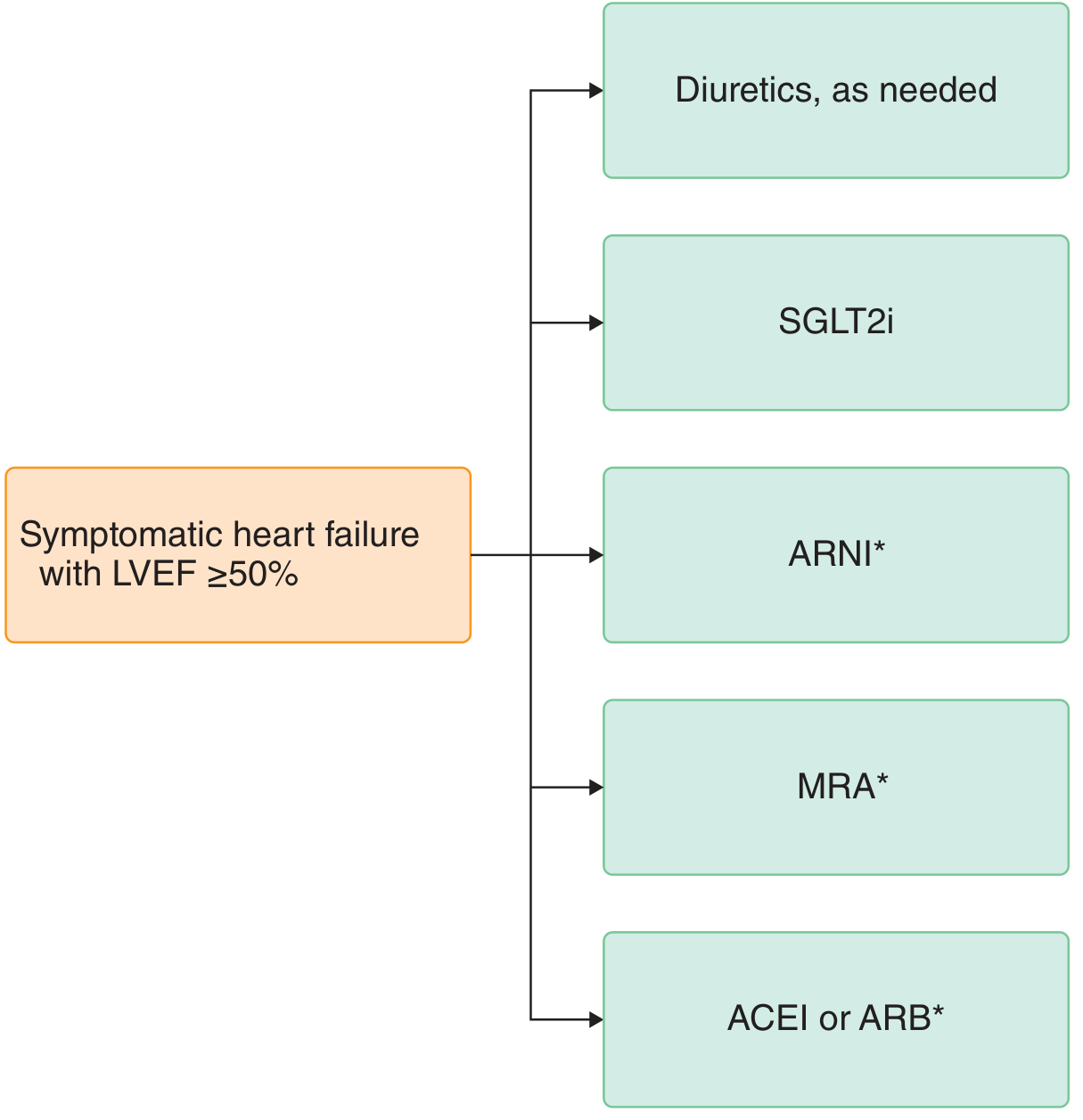
1. General Principles
The historical challenge of HFpEF treatment is that trials of agents proven in HFrEF (ACE inhibitors, ARBs, beta-blockers, digoxin, spironolactone) have largely failed to show mortality benefit in HFpEF. However, the landscape has changed substantially with SGLT2 inhibitors and now finerenone, and is evolving further with GLP-1/GIP agonists in obese patients.
The four foundational pillars of management are:
- Congestion control (diuretics)
- Disease-modifying pharmacotherapy (SGLT2i as first-line, MRA as second)
- Comorbidity management (BP, AF, obesity, diabetes, ischemia)
- Lifestyle modification (exercise, weight loss)
- Harrison's Principles of Internal Medicine 22E, p. 2031
- Goldman-Cecil Medicine, p. 492
2. Pharmacological Treatment
A. SGLT2 Inhibitors (First-Line, Disease-Modifying)
The current cornerstone of HFpEF pharmacotherapy.
- Dapagliflozin 10 mg once daily (EMPEROR-Preserved trial) and empagliflozin 10 mg once daily (DELIVER trial) both reduce the composite of CV death or worsening HF events.
- Empagliflozin reduced the primary composite endpoint by ~21% in EMPEROR-Preserved; dapagliflozin showed similar benefit in DELIVER.
- Reduces HF hospitalizations and improves symptoms and KCCQ quality-of-life scores.
- Benefit is considered a class effect - the agents are interchangeable.
- Recommended for NYHA class II-III patients with LVEF ≥50%.
Precautions / contraindications:
-
Avoid in type 1 diabetes
-
Caution in type 2 DM with prior diabetic ketoacidosis (DKA)
-
Avoid in pregnancy
-
Hold perioperatively or during prolonged fasting
-
Goldman-Cecil Medicine, p. 491
-
Harrison's 22E, p. 2031
-
B. Mineralocorticoid Receptor Antagonists (MRAs)
Now established as the second pillar for HFpEF (2025 guidelines).
Steroidal MRAs (spironolactone, eplerenone):
- The TOPCAT trial (3,445 patients) failed to show a significant reduction in the primary composite of CV death, aborted cardiac arrest, or HF hospitalization overall - but spironolactone reduced HF hospitalizations by 17%. A post-hoc analysis showed a significant 18% reduction in primary outcome in patients enrolled from the Americas.
- Benefits appear greater in patients with LVEF closer to 50% (HFmrEF range).
Finerenone (non-steroidal MRA) - major 2024/2025 development:
-
The FINEARTS-HF trial demonstrated that finerenone significantly reduced total HF events and CV death in HFpEF patients.
-
Total HF events reduced by ~18% (RR 0.82, 95% CI 0.70-0.94).
-
Benefit was consistent across the full EF spectrum, including EF ≥60% - a subgroup where steroidal MRAs had previously failed.
-
FDA approved finerenone for HF with LVEF ≥40% in July 2025.
-
Hyperkalemia occurred more in the finerenone arm (K+ >5.5 mmol/L: 14.3% vs 6.9%), but hyperkalemia-related hospitalization was low (0.5%).
-
The 2025 CCS/CHFS and JCS/JHFS guidelines now include MRA recommendations for symptomatic HFpEF.
-
Braunwald's Heart Disease, p. 1035
C. ARNI - Sacubitril/Valsartan
- PARAGON-HF trial (4,822 patients with HFpEF, mean age 73, 53% women): 13% reduction in CV mortality + total HF hospitalizations, not statistically significant (p = 0.06).
- Subgroup analyses suggested benefit in:
- Women
- Patients with EF below the median (57%) - essentially HFmrEF range
- PARAGLIDE-HF trial: Greater NTproBNP reduction vs. valsartan alone, but clinical benefit mainly in EF ≤60%.
- FDA has approved sacubitril/valsartan across the full EF spectrum, but "benefits are greatest in those with LVEF below normal."
- Consider in patients with LVEF 41-60%, especially women - Braunwald's, p. 1035; Harrison's 22E, p. 2031
D. ACE Inhibitors / ARBs
- CHARM-Preserved (candesartan): Reduced HF hospitalizations significantly, no mortality benefit.
- I-PRESERVE (irbesartan): No benefit on CV death or HF hospitalization.
- PEP-CHF (perindopril): Early benefit on HF hospitalizations attenuated at longer follow-up.
- Verdict: ACE inhibitors and ARBs are not recommended as primary HFpEF-specific therapy but should be used when indicated for comorbidities (hypertension, CKD, diabetes).
- Harrison's 22E, p. 2031
E. Beta-Blockers
- No dedicated RCT in HFpEF has shown mortality benefit.
- Subgroup analysis of SENIORS trial (nebivolol) in elderly HFpEF patients: no significant CV mortality reduction.
- Indicated for: rate control in atrial fibrillation, symptom management.
- Caution: Excessive heart rate lowering can worsen exercise tolerance (chronotropic incompetence is a key feature of HFpEF).
- Harrison's 22E, p. 2031; Goldman-Cecil Medicine
F. GLP-1 / GIP Receptor Agonists (Obese HFpEF Phenotype)
Major recent development for the obese HFpEF subgroup:
- SUMMIT trial (tirzepatide, dual GIP/GLP-1 agonist): 731 patients with HFpEF + BMI ≥30 kg/m²
- Reduced the composite of CV death or worsening HF events by 38% vs. placebo (HR 0.62, 95% CI 0.41-0.95, p = 0.026).
- This represents direct CV risk reduction beyond weight loss/QoL improvement.
- Semaglutide (STEP-HFpEF trial): Improved symptoms, functional status, and reduced body weight in obese HFpEF - but an HF hospitalization/mortality benefit was not the primary endpoint.
- 2025 CCS/CHFS guidelines now recommend GLP-1 receptor agonist activity drugs for symptomatic patients with LVEF ≥45% and BMI ≥30 kg/m².
- Harrison's 22E lists GLP-1 agonists as improving QoL "irrespective of diabetes mellitus" in obese HFpEF.
G. Diuretics
- Loop diuretics (furosemide, torsemide) are used to maintain euvolemia and relieve congestion symptoms (dyspnea, edema).
- Must be used judiciously - HFpEF patients have a narrow window for optimal volume: even modest overdiuresis can reduce LV filling, cause prerenal azotemia, and worsen symptoms due to the stiff, non-compliant ventricle.
- No mortality benefit demonstrated; purely symptom-focused.
- Braunwald's Heart Disease, p. 1035
H. Agents Shown to be Ineffective
| Agent | Trial / Evidence | Result |
|---|---|---|
| Sildenafil (PDE5 inhibitor) | RELAX trial | No benefit |
| Isosorbide mononitrate | NEAT-HFpEF | Worsened activity levels |
| Digoxin | DIG Ancillary | No mortality benefit; modest HF hospitalization reduction only |
| Ivabradine | - | No benefit on exercise capacity in HFpEF |
| Beta-blockers (as primary therapy) | SENIORS subgroup | No significant CV benefit |
- Harrison's 22E, p. 2031; Goldman-Cecil Medicine
3. Non-Pharmacological / Lifestyle Interventions
Exercise Training
- The only intervention consistently shown to increase exercise capacity (peak VO2) in HFpEF.
- Aerobic exercise improves exercise tolerance and quality of life.
- An AHA/ACC 2023 Scientific Statement specifically endorses supervised exercise training for chronic HFpEF.
- Both aerobic and combined aerobic + resistance training are recommended (NYHA II-III).
- Goodman & Gilman's Pharmacological Basis, p. 1908
Weight Loss / Obesity Management
- Obese HFpEF patients have worse biventricular filling pressures during exercise and worse prognosis.
- Caloric restriction + aerobic exercise provides additive benefit to exercise alone.
- Weight loss reduces filling pressures, improves symptoms and peak VO2.
- Braunwald's Heart Disease, p. 1035
4. Comorbidity Management (Critical)
HFpEF is fundamentally a comorbidity-driven syndrome. Aggressive treatment of the following is mandatory:
| Comorbidity | Target / Approach |
|---|---|
| Hypertension | Tight BP control to guideline targets (<130/80 mmHg); reduces LVH and fibrosis |
| Atrial fibrillation | Rate control (beta-blocker, rate-limiting CCB) or rhythm control; avoids loss of atrial kick in a stiff ventricle |
| Coronary artery disease | Anti-ischemic therapy; revascularization if indicated |
| Diabetes mellitus | Glycemic control (SGLT2i serves dual purpose); reduces microvascular stiffening |
| Obesity | Weight reduction (diet, exercise, GLP-1 agonists) |
| Obstructive sleep apnea | CPAP therapy improves hemodynamics |
| Anemia / iron deficiency | Treat appropriately (IV iron if iron-deficient, regardless of anemia) |
| CKD | Monitor renal function; SGLT2i are renoprotective |
- Harrison's 22E, p. 2031; Fuster and Hurst's The Heart 15th Ed., p. 1540
5. Device Therapy
- No cardiac device has demonstrated unequivocal efficacy specific to HFpEF.
- ICD/CRT: Not indicated unless there is concurrent HFrEF criteria.
- Interatrial shunt devices (e.g., REDUCE LAP-HF trials): Reduce left atrial pressure; results inconclusive so far.
- Pacemakers for chronotropic incompetence: Likely ineffective as a primary strategy (Harrison's 22E).
6. Special Subtypes Requiring Specific Management
Cardiac Amyloidosis (ATTR)
- An increasingly recognized cause of HFpEF (~10-15% of older adults with HFpEF).
- Wild-type ATTR (ATTRwt): Predominantly male, age-related.
- Hereditary ATTR (ATTRh): Val122Ile variant in 3-4% of African Americans.
- Classic findings: low QRS voltage on ECG, "sparkling" myocardium on echo, bilateral carpal tunnel, peripheral neuropathy.
- Treatment: Tafamidis (TTR stabilizer) reduces CV mortality and HF hospitalizations in ATTR-CM (ATTR-ACT trial). Patisiran/inotersen for hereditary ATTR with neuropathy. Standard HFpEF diuretics for symptoms.
- Braunwald's Heart Disease, p. 1035
Hypertrophic Cardiomyopathy (HCM)
- Obstructive HCM can now be treated with mavacamten (cardiac myosin inhibitor), which improves obstruction and symptoms.
7. Emerging and Investigational Therapies (2025-2026)
| Agent | Mechanism | Status |
|---|---|---|
| Finerenone | Non-steroidal MRA | FDA approved July 2025 for LVEF ≥40% |
| Tirzepatide | Dual GIP/GLP-1 agonist | SUMMIT trial positive; CCS 2025 guideline recommendation for obese HFpEF |
| Ziltivekimab | IL-6 inhibitor | HERMES phase 3 trial ongoing (HFpEF + elevated CRP) |
| MariTide | Long-acting GLP-1 agonist | MARITIME-HF phase 3 ongoing (HFpEF + obesity) |
| Baxdrostat + dapagliflozin | Aldosterone synthase inhibitor + SGLT2i | Prevent-HF trial ongoing |
Summary Table: Evidence Hierarchy for HFpEF Pharmacotherapy
| Drug Class | Agent | Evidence Level | Effect |
|---|---|---|---|
| SGLT2 inhibitors | Empagliflozin, Dapagliflozin | Strong (Class I, 2025) | Reduces HF hospitalization + CV death |
| Non-steroidal MRA | Finerenone | Strong (FDA approved 2025) | Reduces HF events across full EF range |
| Steroidal MRA | Spironolactone | Moderate | Reduces HF hospitalization (post-hoc) |
| ARNI | Sacubitril/valsartan | Moderate (benefit in EF <57%, women) | Modest; approved but directional |
| GLP-1/GIP agonists | Tirzepatide, semaglutide | Moderate (obese HFpEF subgroup) | Reduces CV events and symptoms |
| ARBs | Candesartan | Weak | Reduces HF hospitalization only |
| ACEi | Perindopril | Weak | Attenuated long-term benefit |
| Diuretics | Furosemide | Symptomatic | No outcome benefit |
| Beta-blockers | For rate control only | Symptomatic | No primary HFpEF benefit |
| Digoxin | - | Ineffective | No benefit |
| Sildenafil | - | Ineffective | No benefit |
Key takeaway: HFpEF treatment in 2025-2026 has moved from a purely symptom-focused approach to disease modification. SGLT2 inhibitors (empagliflozin/dapagliflozin) are now established first-line therapy. Finerenone (FDA approved July 2025) is the second pillar. For obese patients (BMI ≥30), GLP-1/GIP agonists like tirzepatide now have guideline backing. Aggressive comorbidity control - especially hypertension, AF, obesity, and diabetes - remains the foundation of management. The therapeutic landscape remains active, with trials of IL-6 inhibitors and combination strategies underway.
This is a shared conversation. Sign in to Orris to start your own chat.