
Beta blockers drugs
beta blocker adrenergic receptor pharmacology mechanism
![This pathophysiology diagram illustrates the role of the Beta-2 Adrenergic Receptor (ADRB2) in modulating inflammatory responses during Rhinovirus (RV) infection. The visual is divided into three primary sections: [1] depicts RV particles binding to Intercellular Adhesion Molecule 1 (ICAM-1) on the surface of airway epithelial cells (ECs). [2] demonstrates that ADRB2 activation inhibits the expression of ICAM-1 and the subsequent release of cytokines and chemokines from these epithelial cells. [3] focuses on systemic immune cell modulation, showing that ADRB2 signaling exerts inhibitory effects (indicated by red T-bars) on multiple cell types: in macrophages (Mφ), it suppresses TNF-α, IL-6, IL-1β, and various CCL chemokines; in mast cells (MC), it inhibits TNF-α, histamine, and leukotriene release; in CD4+ T cells, it suppresses IFN-γ production; and in CD8+ T cells, it blocks TNF-α, IFN-γ, and cytolytic activity. The diagram serves as an educational resource for understanding neuro-immune interactions and the therapeutic mechanism of beta-agonists in dampening virus-induced airway inflammation.](https://cdn.orris.care/cdss_images/pmc_clinical_VQA_bdc00632428101dee8d73e300a2b0ae2a72521d5b25266eddbef38d212ed1f84.jpg)
This pathophysiology diagram illustrates the role of the Beta-2 Adrenergic Receptor (ADRB2) in modulating inflammatory responses during Rhinovirus (RV) infection. The visual is divided into three primary sections: [1] depicts RV particles binding to Intercellular Adhesion Molecule 1 (ICAM-1) on the surface of airway epithelial cells (ECs). [2] demonstrates that ADRB2 activation inhibits the expression of ICAM-1 and the subsequent release of cytokines and chemokines from these epithelial cells. [3] focuses on systemic immune cell modulation, showing that ADRB2 signaling exerts inhibitory effects (indicated by red T-bars) on multiple cell types: in macrophages (Mφ), it suppresses TNF-α, IL-6, IL-1β, and various CCL chemokines; in mast cells (MC), it inhibits TNF-α, histamine, and leukotriene release; in CD4+ T cells, it suppresses IFN-γ production; and in CD8+ T cells, it blocks TNF-α, IFN-γ, and cytolytic activity. The diagram serves as an educational resource for understanding neuro-immune interactions and the therapeutic mechanism of beta-agonists in dampening virus-induced airway inflammation.
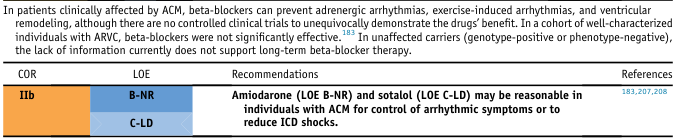
In patients clinically affected by ACM, beta-blockers can prevent adrenergic arrhythmias, exercise-induced arrhythmias, and ventricular remodeling, although there are no controlled clinical trials to unequivocally demonstrate the drugs' benefit. In a cohort of well-characterized individuals with ARVC, beta-blockers were not significantly effective.183 In unaffected carriers (genotype-positive or phenotype-negative), the lack of information currently does not support long-term beta-blocker therapy. <table><thead><tr><th>COR</th><th>LOE</th><th>Recommendations</th><th>References</th></tr></thead><tbody><tr><td rowspan="2">IIb</td><td>B-NR</td><td rowspan="2">Amiodarone (LOE B-NR) and sotalol (LOE C-LD) may be reasonable in individuals with ACM for control of arrhythmic symptoms or to reduce ICD shocks.</td><td>183,207,208</td></tr><tr><td>C-LD</td></tr></tbody></table>
![Recommendation Table 23. Recommendations for beta-adrenergic blocker therapy prior to cardiac surgery with cardiopulmonary bypass
<table><thead><tr><th>Recommendations</th><th>Class<sup>a</sup></th><th>Level<sup>b</sup></th><th>Ref<sup>c</sup></th></tr></thead><tbody><tr><td>It is recommended that chronic users of beta-adrenergic blockers continue their therapy during the perioperative period of cardiac surgery with CPB to prevent postoperative arrhythmias.</td><td>I</td><td>A</td><td>[290, 294, 295]</td></tr><tr><td>Short-term, low-dose oral beta-adrenergic blocker therapy may be considered in naive patients to prevent postoperative arrhythmias in cardiac surgery with CPB.</td><td>IIb</td><td>B</td><td>[297]</td></tr></tbody></table>](https://cdn.orris.care/cdss_images/GLGCA_4542999_1766781117266_28348b58-d6d2-4ca8-b638-c135fbdae742_3c3c133c-fce8-405c-b341-142cdad55107.png)
Recommendation Table 23. Recommendations for beta-adrenergic blocker therapy prior to cardiac surgery with cardiopulmonary bypass <table><thead><tr><th>Recommendations</th><th>Class<sup>a</sup></th><th>Level<sup>b</sup></th><th>Ref<sup>c</sup></th></tr></thead><tbody><tr><td>It is recommended that chronic users of beta-adrenergic blockers continue their therapy during the perioperative period of cardiac surgery with CPB to prevent postoperative arrhythmias.</td><td>I</td><td>A</td><td>[290, 294, 295]</td></tr><tr><td>Short-term, low-dose oral beta-adrenergic blocker therapy may be considered in naive patients to prevent postoperative arrhythmias in cardiac surgery with CPB.</td><td>IIb</td><td>B</td><td>[297]</td></tr></tbody></table>
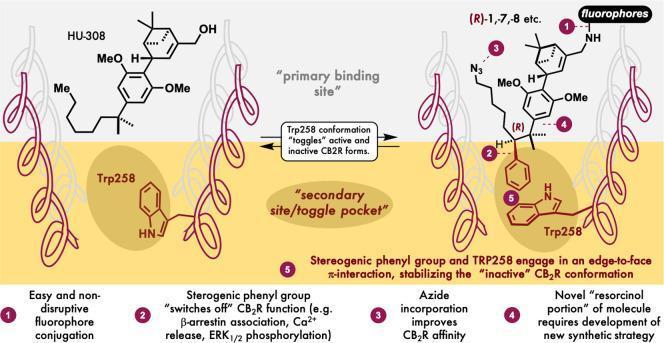
A molecular pharmacology diagram illustrating the conformational switch of the Cannabinoid Receptor 2 (CB2R) between active (left) and inactive (right) states. The visual depicts a G protein-coupled receptor (GPCR) model featuring alpha-helical transmembrane domains. The central mechanism shown is the 'toggle switch' involving the Trp258 residue within a 'secondary site/toggle pocket'. On the left, the agonist HU-308 binds to the primary site, leaving Trp258 in an upright active conformation. On the right, a modified ligand stabilizes the inactive state through a stereogenic phenyl group that engages in an edge-to-face pi-interaction with Trp258, effectively 'switching off' receptor signaling. Key molecular modifications to the ligand for therapeutic development are highlighted: 1) fluorophore conjugation for imaging, 2) stereogenic phenyl group for functional inactivation (e.g., inhibiting beta-arrestin association and ERK1/2 phosphorylation), 3) azide incorporation for improved affinity, and 4) a novel resorcinol moiety. The diagram highlights structural biology concepts in drug design, specifically targeting the active/inactive equilibrium of GPCRs for pain modulation research.
beta blocker drugs classification table propranolol metoprolol atenolol carvedilol

Summary : This figure presents guideline recommendations for the use of beta blockers in patients with heart failure with reduced ejection fraction (HFrEF), including the class of recommendation (COR), level of evidence (LOE), and value statement. table: # Structure : • Three columns: COR, LOE, RECOMMENDATION. • COR: Green cell labeled "1". • LOE: Blue cell labeled "A". • RECOMMENDATION: Two numbered recommendations. # Recommendations : • 1. In patients with HFrEF, with current or previous symptoms, use of one of the three beta blockers proven to reduce mortality (e.g., bisoprolol, carvedilol, sustained-release metoprolol succinate) is recommended to reduce mortality and hospitalizations (references 1-3). • 2. In patients with HFrEF, with current or previous symptoms, beta-blocker therapy provides high economic value (references 4-8). # Value Statement : • "Value Statement: High Value (A)" is noted below the recommendations. # Design Encodings : • COR and LOE are color-coded: green for COR 1, blue for LOE A. • Recommendations are in black text, with references in blue. # Analysis : • The figure provides strong, high-level evidence (COR 1, LOE A) supporting the use of specific beta blockers in HFrEF for both clinical and economic benefit. • The recommendations are clear, with referenced evidence and value statement highlighted for decision-making.

<table><thead><tr><th></th><th>Propranolol</th><th>Metoprolol</th><th>Nadolol</th><th>Atenolol</th><th>Mexiletine</th><th>Quinidine</th><th>Sotalol</th></tr></thead><tbody><tr><th>Use during pregnancy</th><td>Safe</td><td>Safe</td><td>Safe</td><td>Risk</td><td>Caution</td><td>Safe</td><td>Safe</td></tr><tr><th>Use when breastfeeding</th><td>Safe</td><td>Safe</td><td>Caution</td><td>Risk</td><td>Caution</td><td>Safe</td><td>Safe</td></tr></tbody></table> Figure 2 Antiarrhythmic drug safety for commonly used drugs in pregnancy.68,69
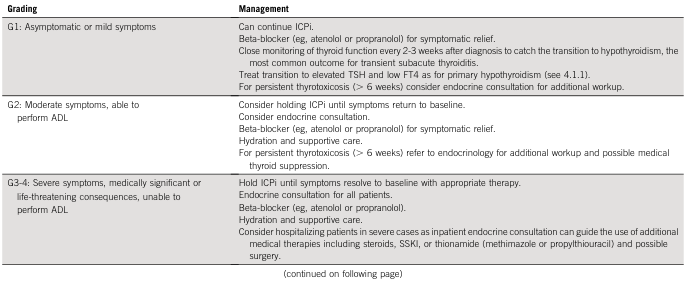
<table> <tr> <th>Grading</th> <th>Management</th> </tr> <tr> <td>G1: Asymptomatic or mild symptoms</td> <td> Can continue ICPI.<br> Beta-blocker (eg, atenolol or propranolol) for symptomatic relief.<br> Close monitoring of thyroid function every 2-3 weeks after diagnosis to catch the transition to hypothyroidism, the most common outcome for transient subacute thyroiditis.<br> Treat transition to elevated TSH and low FT4 as for primary hypothyroidism (see 4.1.1).<br> For persistent thyrotoxicosis (> 6 weeks) consider endocrine consultation for additional workup. </td> </tr> <tr> <td>G2: Moderate symptoms, able to perform ADL</td> <td> Consider holding ICPI until symptoms return to baseline.<br> Consider endocrine consultation.<br> Beta-blocker (eg, atenolol or propranolol) for symptomatic relief.<br> Hydration and supportive care.<br> For persistent thyrotoxicosis (> 6 weeks) refer to endocrinology for additional workup and possible medical thyroid suppression. </td> </tr> <tr> <td>G3-4: Severe symptoms, medically significant or life-threatening consequences, unable to perform ADL</td> <td> Hold ICPI until symptoms resolve to baseline with appropriate therapy.<br> Endocrine consultation for all patients.<br> Beta-blocker (eg, atenolol or propranolol).<br> Hydration and supportive care.<br> Consider hospitalizing patients in severe cases as inpatient endocrine consultation can guide the use of additional medical therapies including steroids, SSKI, or thionamide (methimazole or propylthiouracil) and possible surgery. </td> </tr> </table> <br> (continued on following page)
Beta Blocker Drugs
Mechanism of Action
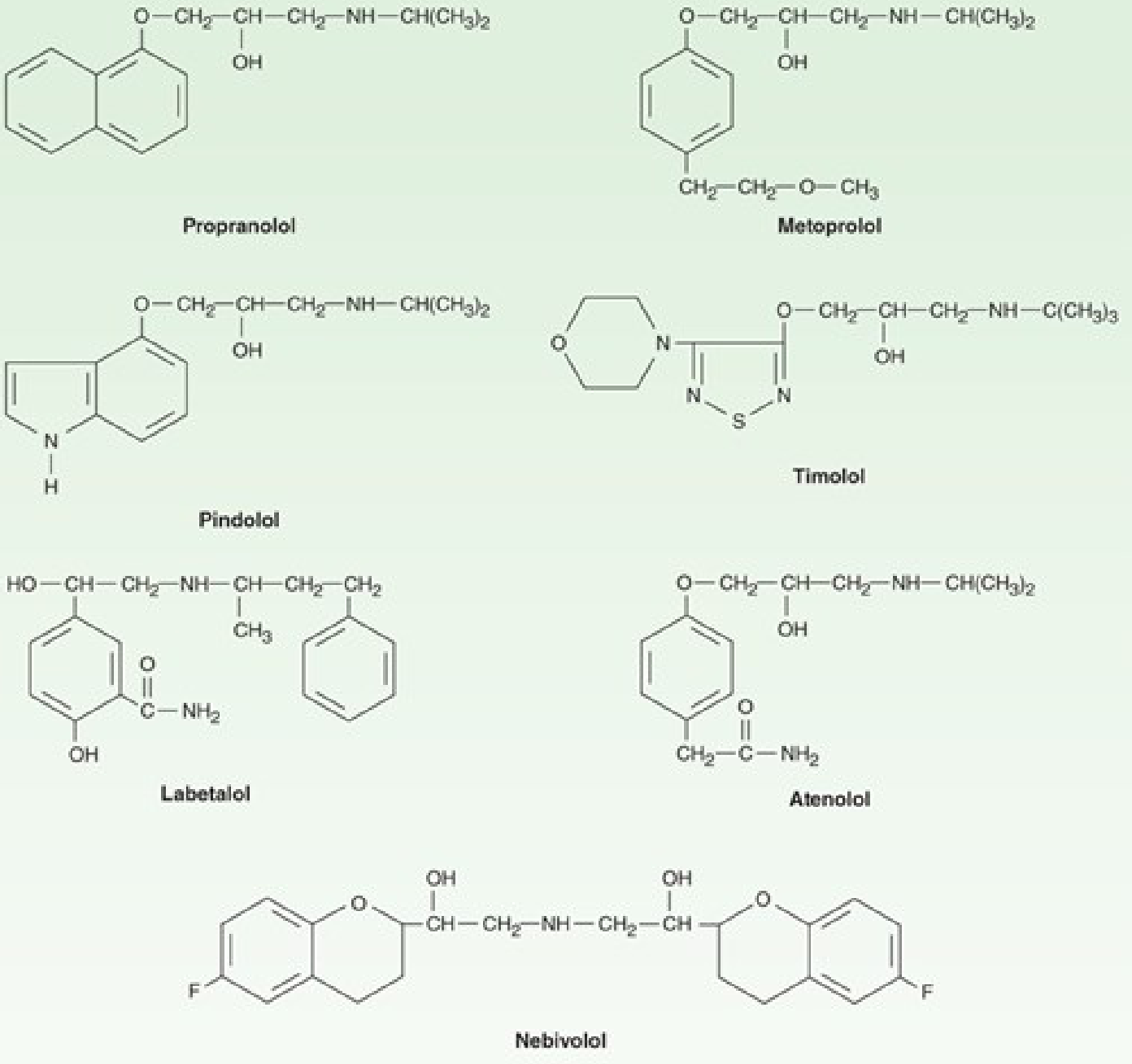
Classification
1. Non-selective (Block both β1 and β2)
| Drug | Notable Properties |
|---|---|
| Propranolol | Prototype; hepatic first-pass metabolism; also blocks some serotonin receptors; lipid-soluble; crosses BBB |
| Nadolol | Renally excreted; long-acting; used in portal hypertension/varices |
| Timolol | Used topically for glaucoma; reduces aqueous humor production |
| Pindolol | Has ISA (partial agonist); less resting bradycardia |
| Sotalol | Also has class III antiarrhythmic action (K+ channel block) |
2. Cardioselective (β1-selective)
| Drug | Notable Properties |
|---|---|
| Metoprolol | Available as tartrate (IR) and succinate (SR); proven mortality benefit in HF; inverse agonist |
| Atenolol | Renally cleared; hydrophilic; avoid in pregnancy (fetal risk) |
| Bisoprolol | Proven mortality benefit in HFrEF |
| Esmolol | Ultra-short-acting (IV only); ideal for acute perioperative arrhythmias |
| Betaxolol | β1-selective; used topically in glaucoma |
| Celiprolol | β1-selective + weak β2 partial agonism; modest bronchodilatory potential |
| Nebivolol | β1-selective + promotes nitric oxide release (vasodilation) |
3. Mixed α/β Blockers (Third Generation)
| Drug | Notable Properties |
|---|---|
| Carvedilol | Blocks β1, β2, and α1; proven benefit in HFrEF; antioxidant properties |
| Labetalol | α/β blockade; useful in hypertensive emergencies and pregnancy-related hypertension (IV form) |
Pharmacokinetics
- Absorption: Most are well absorbed orally. Propranolol has low, dose-dependent bioavailability due to extensive first-pass hepatic metabolism; a long-acting (24-hour) form is available.
- Lipophilic drugs (propranolol): Higher CNS penetration; more fatigue, vivid dreams.
- Hydrophilic drugs (atenolol, nadolol): Renally excreted; less CNS effects.
- Esmolol: Ultra-short half-life (~9 min); rapidly hydrolyzed by red cell esterases.
Pharmacological Effects
Cardiovascular
- Decrease heart rate, contractility, and AV conduction velocity (negative chronotropy, inotropy, dromotropy)
- Lower blood pressure (acutely may raise peripheral resistance slightly, but chronic use lowers it - likely via renin inhibition)
- Reduce myocardial oxygen demand
Respiratory
- β2 blockade increases airway resistance - especially dangerous in asthma
- β1-selective agents have less bronchospastic effect but are not fully safe in asthma
Metabolic
- Impair recovery from hypoglycemia by blocking β2-mediated hepatic glycogenolysis
- Reduce HDL:LDL ratio; raise triglycerides (less so with ISA agents or newer agents like metoprolol, carvedilol, nebivolol)
- Reduce resting energy expenditure - can cause weight gain
Eye
- Reduce intraocular pressure by decreasing aqueous humor production (via ciliary body cAMP reduction)
Clinical Indications
| Indication | Preferred Agents |
|---|---|
| Hypertension | Atenolol, metoprolol, bisoprolol |
| Angina pectoris | Propranolol, metoprolol, atenolol |
| Acute MI / post-MI | Oral metoprolol (within 24h); IV use is now discouraged |
| HFrEF | Metoprolol succinate, bisoprolol, carvedilol (proven mortality reduction, COR I, LOE A) |
| Supraventricular/ventricular arrhythmias | Metoprolol, esmolol (acute), sotalol |
| Atrial flutter/fibrillation (rate control) | Metoprolol, atenolol (increase AV nodal refractoriness) |
| Hypertrophic cardiomyopathy | Propranolol (increases stroke volume by slowing ejection) |
| Aortic dissection | IV beta blockers (reduce aortic wall stress) |
| Glaucoma | Timolol (topical), betaxolol (topical, β1-selective) |
| Hyperthyroidism (symptomatic) | Propranolol (non-selective preferred for tremor) |
| Migraine prophylaxis | Propranolol, atenolol |
| Essential tremor | Propranolol |
| Portal hypertension / esophageal varices | Propranolol, nadolol |
| Pheochromocytoma | Only after alpha-blockade is established first |
| Infantile hemangiomas | Propranolol (oral) |
| Anxiety / performance anxiety | Propranolol |
Adverse Effects / Toxicity
| Effect | Mechanism |
|---|---|
| Bradycardia / heart block | β1 blockade at SA/AV node |
| Bronchoconstriction | β2 blockade in airways |
| Cold extremities / claudication worsening | β2 blockade in peripheral vasculature |
| Raynaud phenomenon worsening | As above |
| Hypoglycemia masking | Suppressed tachycardia + impaired glycogenolysis |
| Fatigue, CNS effects (vivid dreams, depression) | Lipophilic agents crossing BBB |
| Acute cardiac decompensation | Abrupt removal of sympathetic support in HF |
| Metabolic dyslipidemia | ↓ HDL, ↑ triglycerides |
Contraindications
- Absolute: Symptomatic bradycardia, high-degree AV block, cardiogenic shock, decompensated acute HF, severe asthma
- Relative: Moderate COPD, diabetes prone to hypoglycemia, peripheral vascular disease, Raynaud's
Key principle: For asthma, COPD, diabetes, or peripheral vascular disease - prefer β1-selective agents. For resting bradycardia concerns - prefer agents with ISA (pindolol). For HF or hypertension with metabolic concerns - prefer vasodilating agents (carvedilol, nebivolol).