
What is erythroposes stage of erythropoiesis
Reading File
Finding Sources
Finding Sources
Reading File
Reading File
Reading File
Now let me get the detailed stages from the histology textbook which has the most complete coverage:
Reading File
Reading File
Reading File
Reading File
Reading File
Loading Image
Here is a comprehensive overview of the stages of erythropoiesis — the process by which red blood cells are produced.
Stages of Erythropoiesis
Erythropoiesis begins in the bone marrow and takes approximately one week from progenitor cell to mature circulating erythrocyte, involving 3–5 cell divisions.
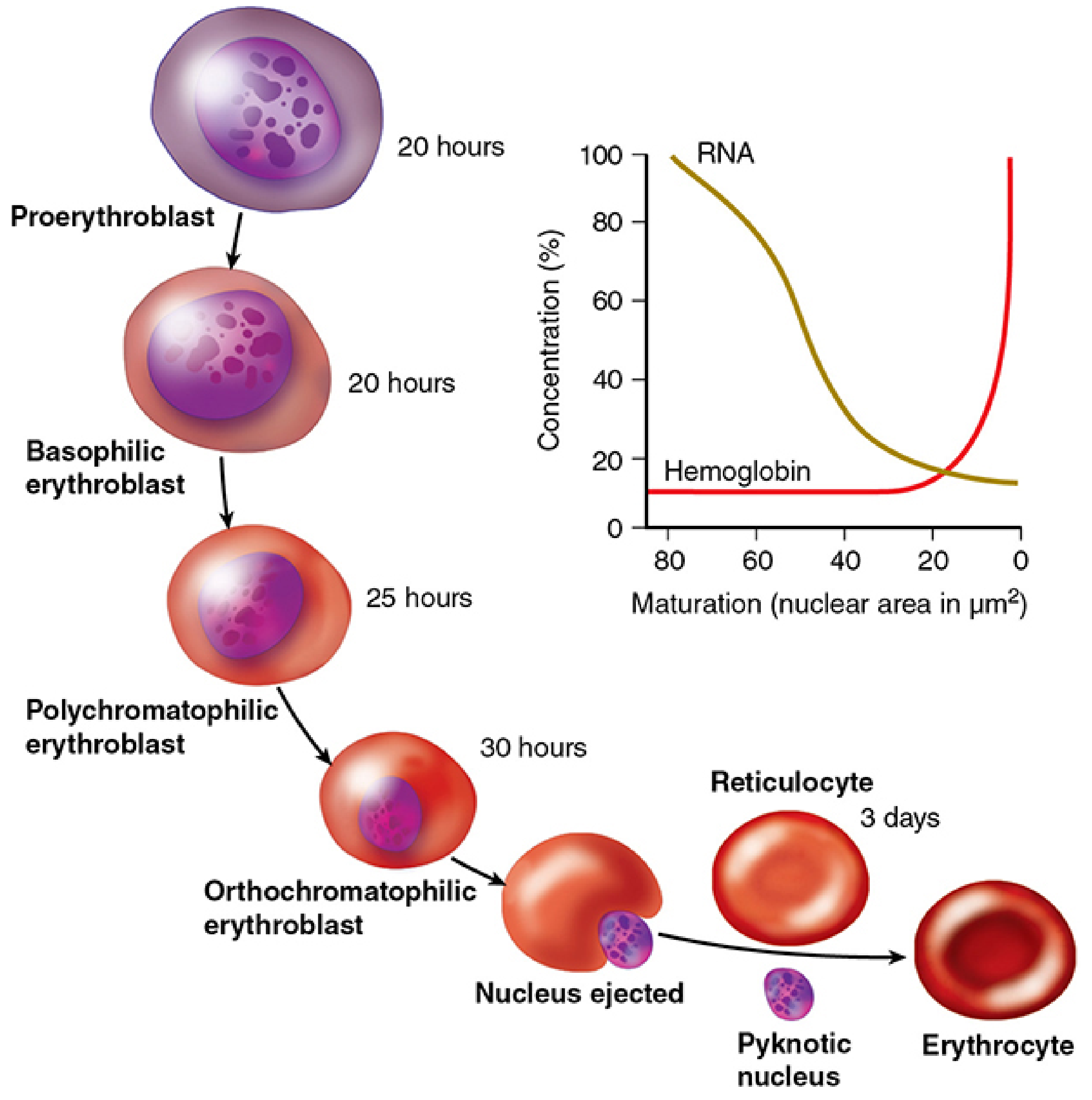
Commitment Phase (Progenitor Cells — not visible by light microscopy)
Before any morphologically recognizable cell appears, the process starts from:
- Hematopoietic Stem Cell (HSC) → Common Myeloid Progenitor (CMP)
- CMP → Megakaryocyte/Erythrocyte Progenitor (MEP), under influence of erythropoietin (EPO), IL-3, and IL-4
- MEP → Erythrocyte-committed Progenitor (ErP), driven by transcription factor GATA-1
- This ErP passes through BFU-E (Burst-Forming Unit–Erythroid) and CFU-E (Colony-Forming Unit–Erythroid) stages
Morphologically Recognizable Stages
1. Proerythroblast (~20 hours)
- Largest erythroid precursor: 12–20 μm in diameter
- Large spherical nucleus with 1–2 visible nucleoli
- Mild cytoplasmic basophilia from free ribosomes
- Hemoglobin (Hgb) synthesis begins
- Capable of mitosis
2. Basophilic Erythroblast (~20 hours)
- Smaller than proerythroblast (10–16 μm)
- Nucleus becomes smaller and progressively more heterochromatic
- Strong cytoplasmic basophilia due to abundant free polyribosomes actively synthesizing Hgb
- As Hgb accumulates, cytoplasm begins to stain with eosin
- Capable of mitosis
3. Polychromatophilic Erythroblast (~25–30 hours)
- Cytoplasm shows both basophilia (ribosomes) and acidophilia (Hgb) — the "mixed color" staining
- May appear gray/lilac overall, or show distinct pink and purple regions
- Nucleus smaller with coarse heterochromatin in a checkerboard pattern
- Last stage capable of mitosis
4. Orthochromatophilic Erythroblast / Normoblast (~48 hours)
- Small, compact, densely stained pyknotic nucleus
- Cytoplasm is strongly eosinophilic (large amount of Hgb)
- Size only slightly larger than a mature erythrocyte
- No longer capable of division
- Late in this stage, the nucleus is ejected (extruded) from the cell
- Small nuclear remnants left behind = Howell-Jolly bodies
5. Reticulocyte / Polychromatophilic Erythrocyte (~3 days)
- Nucleus has been extruded; the cell enters blood sinusoids
- Still retains polyribosomes capable of synthesizing Hgb → mild residual basophilia
- Polyribosomes form a reticular network when stained with brilliant cresyl blue — hence "reticulocyte"
- Resides ~24 hrs in bone marrow, then ~24–48 hrs in peripheral circulation
- Normally 1–2% of circulating red blood cells
- Matures in the spleen, where ribosomes and mRNA are lost
6. Mature Erythrocyte
- Biconcave disc, no nucleus, no organelles
- Fully hemoglobin-loaded
- Lifespan ~120 days
- Senescent erythrocytes are phagocytosed by macrophages in spleen, bone marrow, and liver; heme is recycled → bilirubin → bile
Key Changes Throughout Erythropoiesis
| Feature | Direction of Change |
|---|---|
| Cell size | Decreases ↓ |
| Nuclear size | Decreases ↓ → ejected |
| Nucleoli | Disappear |
| Chromatin density | Increases (pyknosis) |
| Cytoplasmic basophilia (RNA) | Decreases ↓ |
| Hemoglobin | Increases ↑ |
| Mitochondria & organelles | Disappear |
| Mitotic activity | Ceases at orthochromatophilic stage |
Regulation
- Erythropoietin (EPO): A 34-kDa glycoprotein produced by the kidney in response to hypoxia; stimulates proliferation and maturation of ErPs
- GATA-1: Transcription factor essential for commitment to the erythroid lineage
- Vitamins/minerals: Iron (Hgb synthesis), Vitamin B12 and folate (DNA synthesis for cell division)
Sources: Histology: A Text and Atlas with Correlated Cell and Molecular Biology, p. 738–743; Junqueira's Basic Histology, p. 643–645; Basic Medical Biochemistry: A Clinical Approach, p. 1536
This is a shared conversation. Sign in to Orris to start your own chat.