

Focus on only the digestion and explain in class my lecturer wrote the enzymes digestion lipids are polar and lipid non polar I. E the enzyme are soluble but lipid isn't this problem is a dress at small intestine cck is very important in lipids and form micells
Lipid Digestion — Full Breakdown
1. The Core Problem Your Lecturer Described
| Lipases (enzymes) | Dietary lipids (e.g., triglycerides) | |
|---|---|---|
| Solubility | Polar / hydrophilic — soluble in water | Non-polar / hydrophobic — insoluble in water |
| Environment | Aqueous (gut lumen) | Want to clump into large oily droplets |
"The digestion of fats and other lipids poses a special problem because of (a) the insolubility of fats in water, and (b) because lipolytic enzymes, like other enzymes, are soluble in an aqueous medium." — BCH212 notes (your lecturer's document)
2. Where Does Digestion Actually Begin?
- Mouth/stomach: Lingual lipase and gastric lipase hydrolyze ~10% of ingested triglycerides → free fatty acids + glycerol. The stomach's main contribution is mechanical churning to break fat into small droplets.
- Major digestion: The small intestine (duodenum/jejunum) handles ~90% of lipid digestion.
3. CCK — The Key Hormone (Why Your Lecturer Emphasized It)
| CCK Action | Effect |
|---|---|
| Stimulates gallbladder contraction | Bile is squeezed out into the duodenum |
| Relaxes the sphincter of Oddi | The gate to the bile/pancreatic duct opens |
| Stimulates pancreatic acinar cells | Pancreatic lipase + other enzymes secreted |
| Slows gastric emptying | Gives more time for the small intestine to process fat |
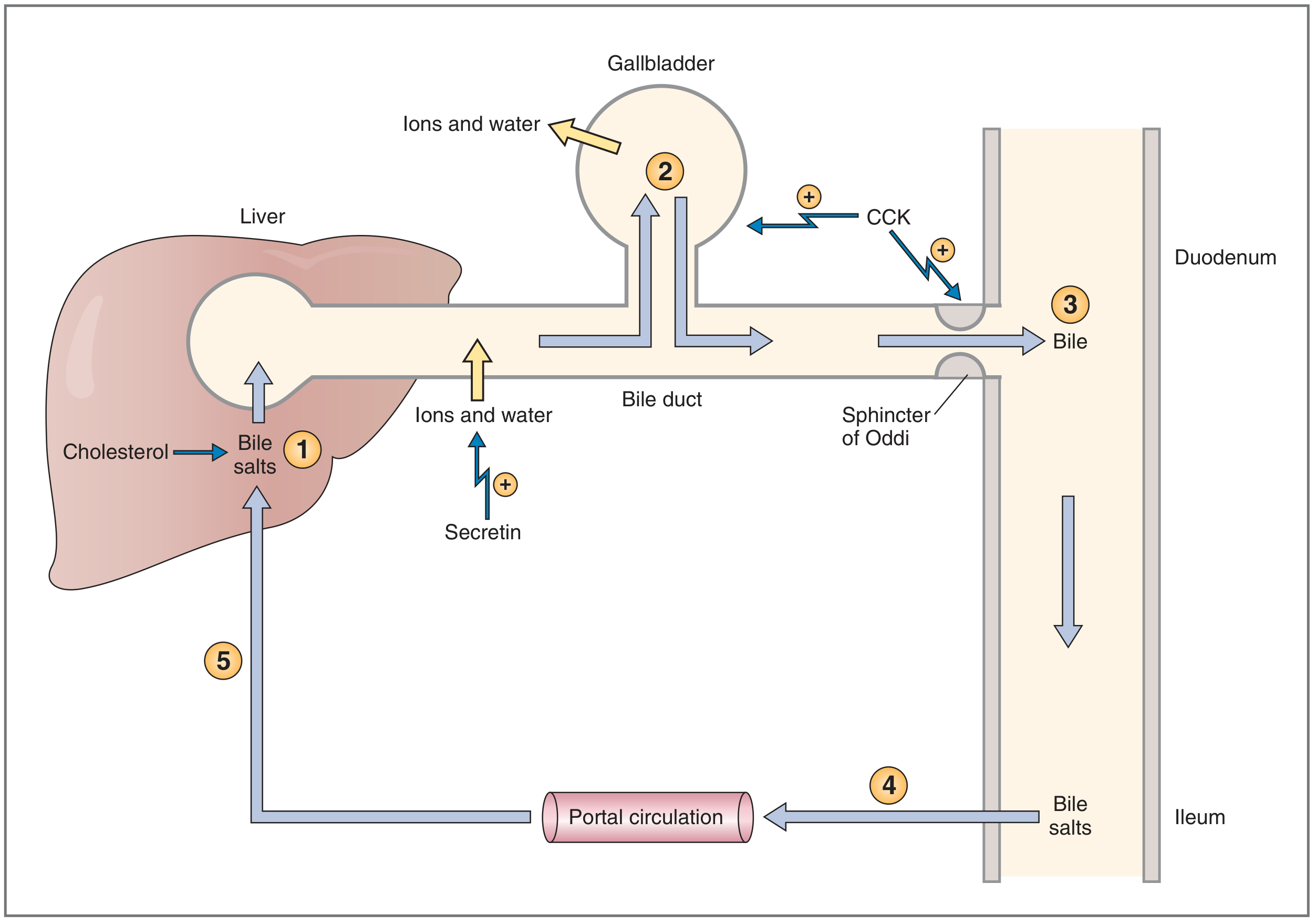
4. How the Problem is Solved: Emulsification and Micelle Formation
Step 1 — Emulsification by Bile Salts
- Bile salts surround fat droplets with their hydrophobic side facing the fat and their hydrophilic side facing the water.
- This breaks fat into millions of tiny droplets (emulsification) — dramatically increasing surface area.
- The negative charges on bile salts repel each other, keeping droplets dispersed rather than re-coalescing.
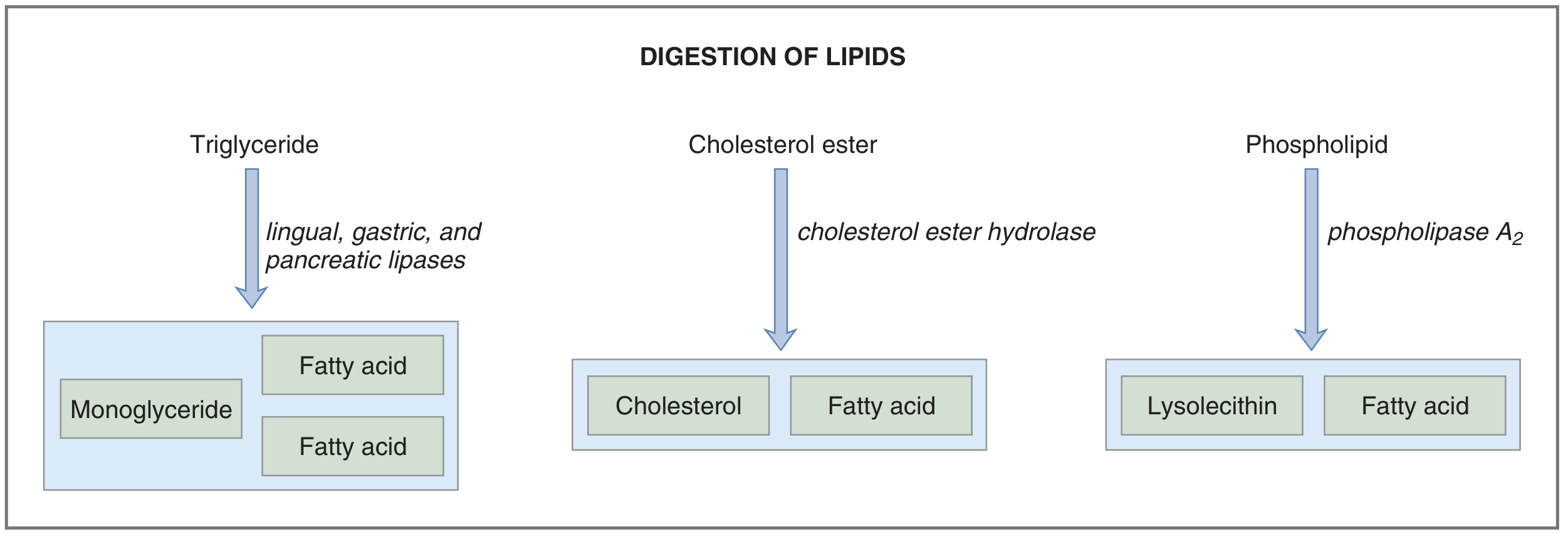
Step 2 — Enzymatic Digestion in the Small Intestine
| Enzyme | Substrate | Products |
|---|---|---|
| Pancreatic lipase (+ colipase) | Triglyceride | 2 fatty acids + 1 monoglyceride |
| Cholesterol ester hydrolase | Cholesterol ester | Cholesterol + fatty acid |
| Phospholipase A₂ | Phospholipid | Lysolecithin + fatty acid |
⚠️ Colipase is essential: Bile salts actually displace pancreatic lipase from the fat surface (inhibiting it). Colipase (activated by trypsin in the lumen) anchors pancreatic lipase back to the interface, restoring its function.
5. Micelle Formation — Solubilizing the Products
- Structure: Cylindrical disks (~50 Å diameter) with a hydrophobic core (lipid products packed inside) and a hydrophilic exterior (bile salts, their charged groups pointing outward into the water).
- Phospholipids also assist — they are amphipathic and pack alongside bile salts in the micelle wall.
- Micelles ferry the lipid products across the aqueous lumen to the brush border of enterocytes.
At the apical membrane, lipids diffuse out of the micelle into the cell down concentration gradients. The bile salts themselves do not enter the cell — they stay in the lumen and are later absorbed in the terminal ileum for recycling (enterohepatic circulation).
6. Absorption and Post-Absorption Packaging
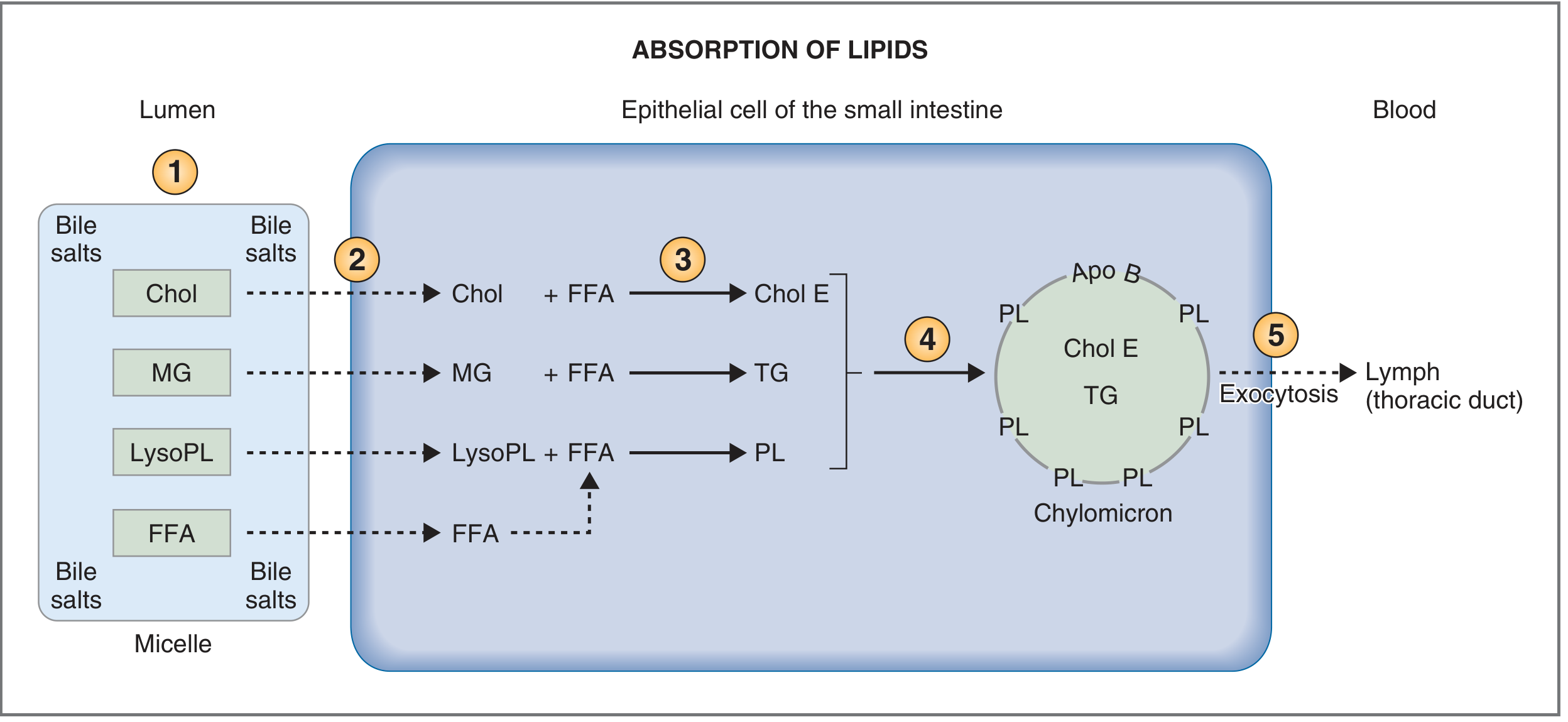
- Fatty acids + monoglycerides → re-esterified back into triglycerides on the smooth ER
- Packaged with cholesterol, phospholipids, and apoprotein B (Apo B) into chylomicrons (~1000 Å)
- Chylomicrons exit via exocytosis into the lacteals (lymph) → thoracic duct → bloodstream
Short- and medium-chain fatty acids (<12 carbons) are water-soluble enough to skip micelle transport — they diffuse directly into portal blood.
7. Summary Flow Chart
Dietary fat (triglyceride — non-polar, insoluble)
↓
[STOMACH] — lingual/gastric lipase (~10%), mechanical churning
↓
[DUODENUM] — fat detected → I-cells release CCK
↓
CCK → gallbladder contracts + sphincter of Oddi opens
→ BILE SALTS enter duodenum
→ PANCREATIC LIPASE + colipase + phospholipase A₂ + cholesterol ester hydrolase secreted
↓
EMULSIFICATION (bile salts surround fat droplets → ↑ surface area)
↓
ENZYMATIC DIGESTION → monoglycerides + fatty acids + cholesterol + lysolecithin
↓
MICELLE FORMATION (bile salts package products → soluble in lumen)
↓
Micelles diffuse to brush border → lipids diffuse INTO enterocyte
↓
Re-esterification → Chylomicron assembly → lymph → blood
- The polarity problem (enzyme polar, lipid non-polar) is solved by emulsification (increases surface area) then micelle formation (solubilizes products).
- CCK is the master regulator: triggers both bile release AND pancreatic enzyme secretion simultaneously.
- Colipase is critical — without it, bile salts would inhibit pancreatic lipase.
- Bile salts are recycled in the terminal ileum via enterohepatic circulation — they are not absorbed with the fat.
- Chylomicrons go to lymph, not portal blood (except short/medium chain FAs).
What do you suggest? Should I just, should I just, like, do you suggest just pass just passing this in this? Like, for example, just holding it the way it is written in that note, then when I enter into the main digestive, should I be able to like do it as of now, like, even meet the my cells later, as of now, do you think it should be my main concern, or should I just easily know what those are?
My honest suggestion:
What you MUST know solidly right now (non-negotiable):
-
The core problem — enzymes are polar (water-soluble), lipids are non-polar. This is the why behind everything else. If you understand this one idea, the rest makes sense automatically.
-
CCK — what triggers it (fat + protein in duodenum), what it does (gallbladder contracts, sphincter of Oddi opens, pancreatic enzymes released). This comes up in almost every lipid question.
-
The sequence: Fat enters duodenum → CCK released → bile salts emulsify → lipase digests → micelles carry products → absorbed into enterocyte → chylomicron → lymph.
Micelles — should they be your main concern right now?
| Topic | Priority now |
|---|---|
| Why emulsification is needed | ✅ High |
| CCK role | ✅ High |
| Pancreatic lipase + colipase | ✅ High |
| Micelle structure (what's inside, what's outside) | 🟡 Medium — know the concept, not every detail |
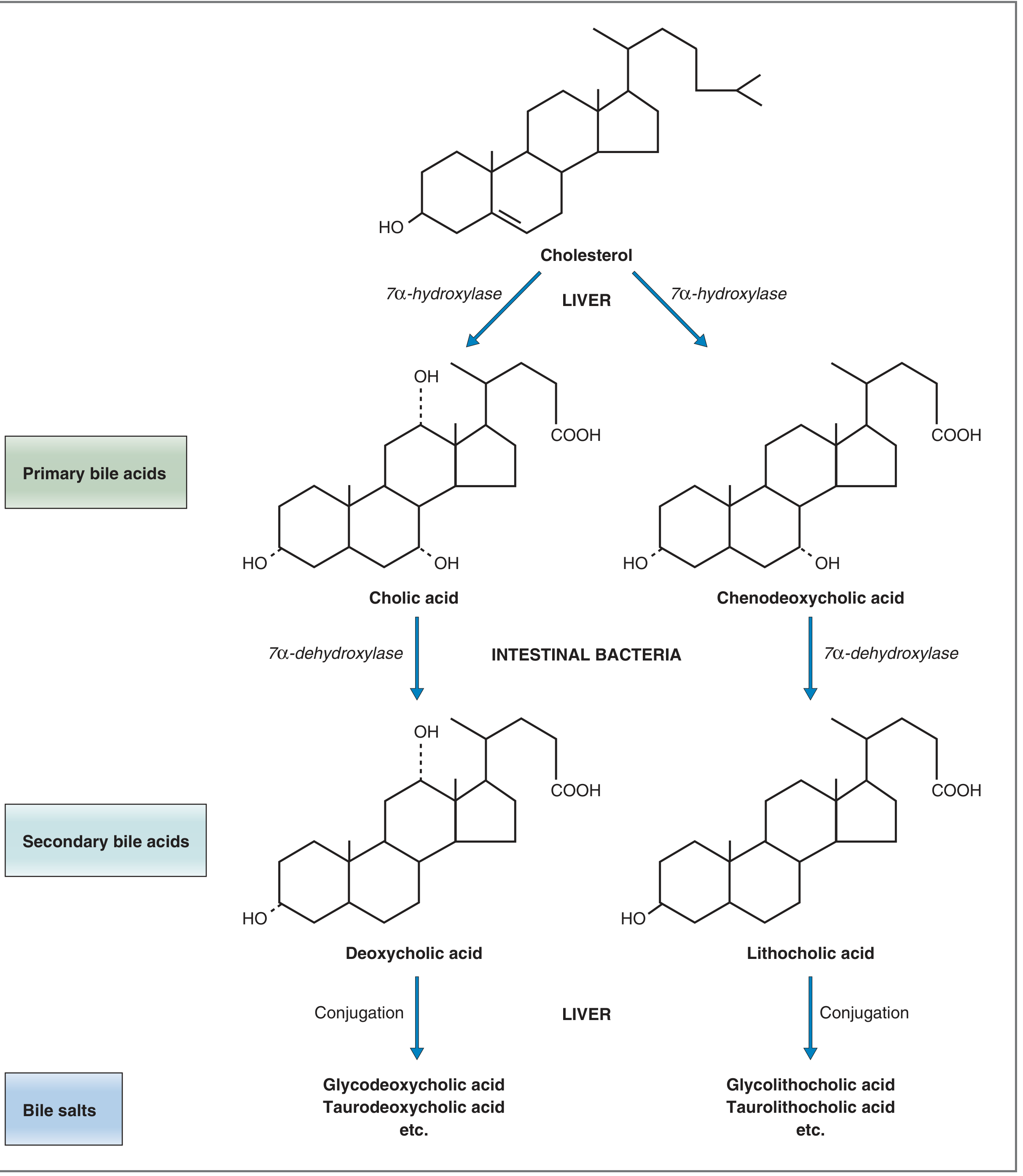
| Bile acid synthesis (primary/secondary/conjugation) | 🟡 Medium — know it exists, detail comes later |
| Chylomicron composition (Apo B, exact %) | 🔴 Low — fine print, worry later |
Practical advice:
- Read your notes once for the logic, not to memorize word-for-word.
- Tell the story out loud — can you explain it to someone without looking? That's your test.
- When your lecturer gets to deeper metabolism (beta-oxidation, lipoprotein transport), the foundation you build now will carry you. Students who memorized without understanding always struggle at that stage.
He discusses the digestion and absorption later do you think I should just know that fat and insoluble enzyme work in a aqueous medium and it is solved by emulsification
Fat is insoluble + enzymes work in aqueous medium → problem → solved by emulsification
Think of it like this:
So your current job is just three things:
- Fat is non-polar → insoluble in water
- Lipases are polar → only work in aqueous environment
- Emulsification bridges the two → makes fat accessible to enzymes
Put it in a proper sentence for me then so I can read and go futhur using my hand out and note

Number it pls like seperate them