
Generate image excercise for frozen shoulder
A clear, medically accurate illustrated guide showing exercises for frozen shoulder (adhesive capsulitis). Include the following exercises with labeled diagrams and step-by-step instructions: 1) Pendulum stretch - person leaning forward swinging arm in circles, 2) Towel stretch - person using a towel behind their back to pull the affected arm upward, 3) Finger walk - person facing a wall walking fingers up the wall, 4) Cross-body reach - person pulling one arm across the chest, 5) Armpit stretch - person using a shelf to stretch the shoulder. Clean medical illustration style with arrows showing movement direction, exercise names as headings, brief instructions under each, and a title "Frozen Shoulder Exercises" at the top.
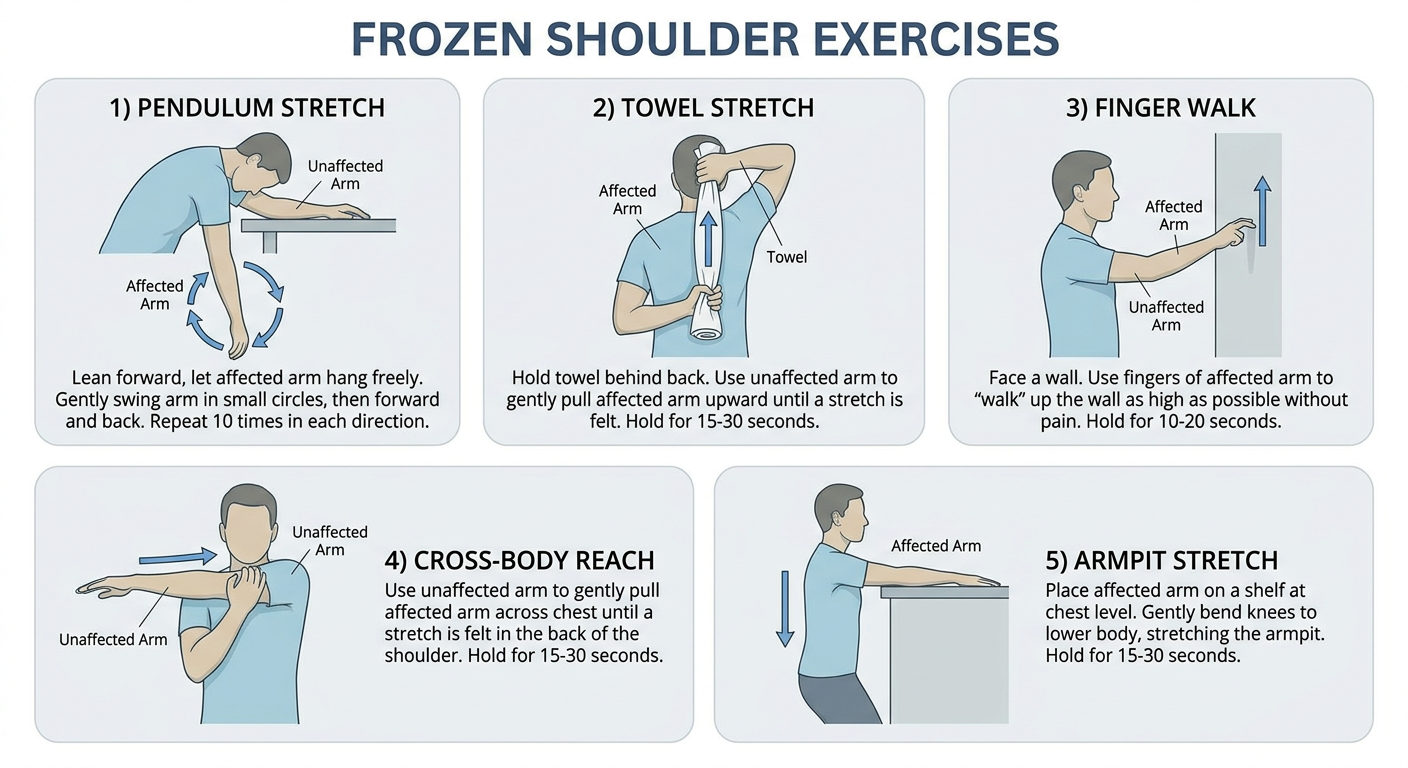
- Pendulum Stretch - Lean forward and let the arm hang, then gently swing it in small circles to loosen the joint capsule.
- Towel Stretch - Use a towel behind your back to gently pull the affected arm upward, improving internal rotation.
- Finger Wall Walk - Face a wall and "walk" your fingers up as high as comfortable, stretching the shoulder progressively.
- Cross-Body Reach - Pull the affected arm across the chest with the opposite hand to stretch the posterior capsule.
- Armpit Stretch - Use a shelf or ledge to gently bend the knees and stretch the shoulder into abduction.
- Perform each exercise 10-20 repetitions, 1-2 times daily.
- Work within a pain-free range - mild discomfort is okay, sharp pain is not.
- Consistency over weeks/months is key, as frozen shoulder recovery is gradual.
- Warm up the shoulder with a heating pad for 10-15 minutes before exercising.
Any other exercises?
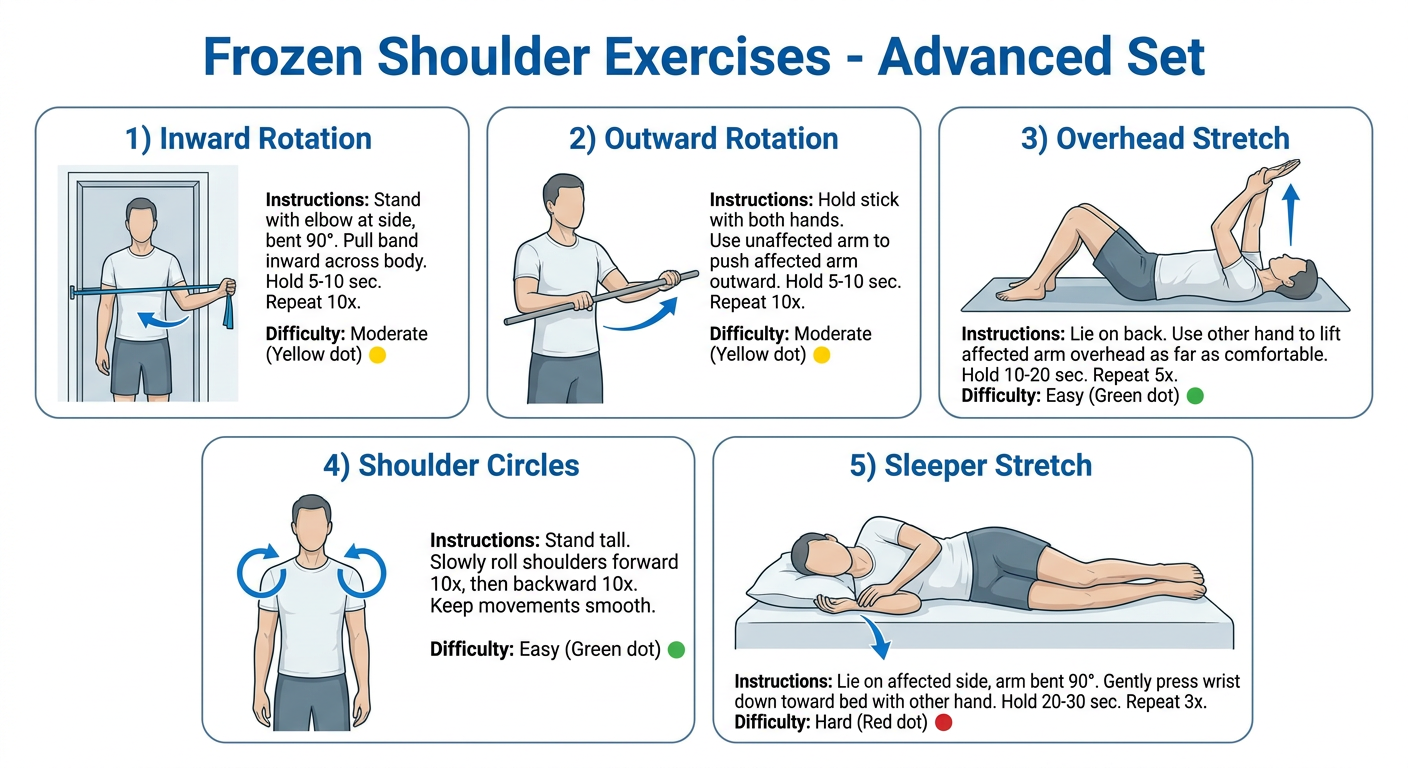
A clear medically accurate illustrated guide showing additional exercises for frozen shoulder rehabilitation. Include these exercises with labeled diagrams and instructions: 1) Inward rotation - person using a door frame or elastic band rotating arm inward toward belly, 2) Outward rotation - person holding a stick or band rotating arm outward away from body, 3) Overhead stretch - person lying on back raising arm overhead with assistance from other hand, 4) Shoulder circles - standing upright doing slow forward and backward shoulder rolls, 5) Sleeper stretch - person lying on side with arm bent, gently pressing wrist down toward the bed to stretch posterior capsule. Clean medical illustration style with movement arrows, exercise names as headings, brief instructions, difficulty level indicators, and title "Frozen Shoulder Exercises - Advanced Set" at the top.
-
Inward Rotation (Internal Rotation) - With elbow bent at 90°, use a resistance band or door frame to rotate the forearm inward toward your belly. Strengthens and mobilizes the subscapularis.
-
Outward Rotation (External Rotation) - With elbow bent at 90°, use a stick or band to rotate the forearm outward away from the body. This targets the infraspinatus and teres minor - often the most restricted movement in frozen shoulder.
-
Supine Overhead Stretch - Lying on your back, use your unaffected arm or a stick to gently guide the affected arm overhead. Gravity assists the stretch and relaxes muscle guarding.
-
Shoulder Circles - Standing upright, perform slow controlled forward and backward shoulder rolls. Great as a warm-up and for loosening the whole shoulder girdle.
-
Sleeper Stretch - Lie on the affected side with the arm bent at 90°. Gently press the wrist down toward the mattress with your other hand. One of the most effective stretches for the posterior capsule - a common source of stiffness.
- Start with the first set (pendulum, wall walk, etc.) before these.
- The sleeper stretch and rotation exercises are especially important for restoring full range.
- Aim for 30-second holds on stretches, 3 sets each.
- Progress slowly - frozen shoulder typically takes 6-18 months to fully resolve with consistent rehab.