
Why ketone bodies are used in starvation in muscle, brain, and heart?
Reading File
Now let me search the medical library for ketone bodies and starvation metabolism.
Finding Sources
Finding Sources
Good results. Let me now read the most relevant sections in parallel.
Reading File
Reading File
Reading File
Excellent content. Now let me get the biochemical mechanism - specifically how ketone bodies are oxidized in these tissues, and also search for the specific advantages.
Finding Sources
Finding Sources
Reading File
Reading File
I now have comprehensive textbook content. Let me fetch the key diagrams to include in the answer.
Loading Image
Loading Image
I now have all the information needed for a thorough, well-illustrated answer. Here it is:
Ketone Bodies in Starvation: Why Muscle, Brain, and Heart Use Them
Background: What Are Ketone Bodies?
Ketone bodies are three water-soluble molecules produced by the liver from acetyl-CoA derived primarily from fatty acid beta-oxidation:
- Acetoacetate (the primary one)
- 3-Hydroxybutyrate (beta-hydroxybutyrate) - the most abundant in blood during starvation
- Acetone - a metabolic dead end (exhaled, not used for energy)
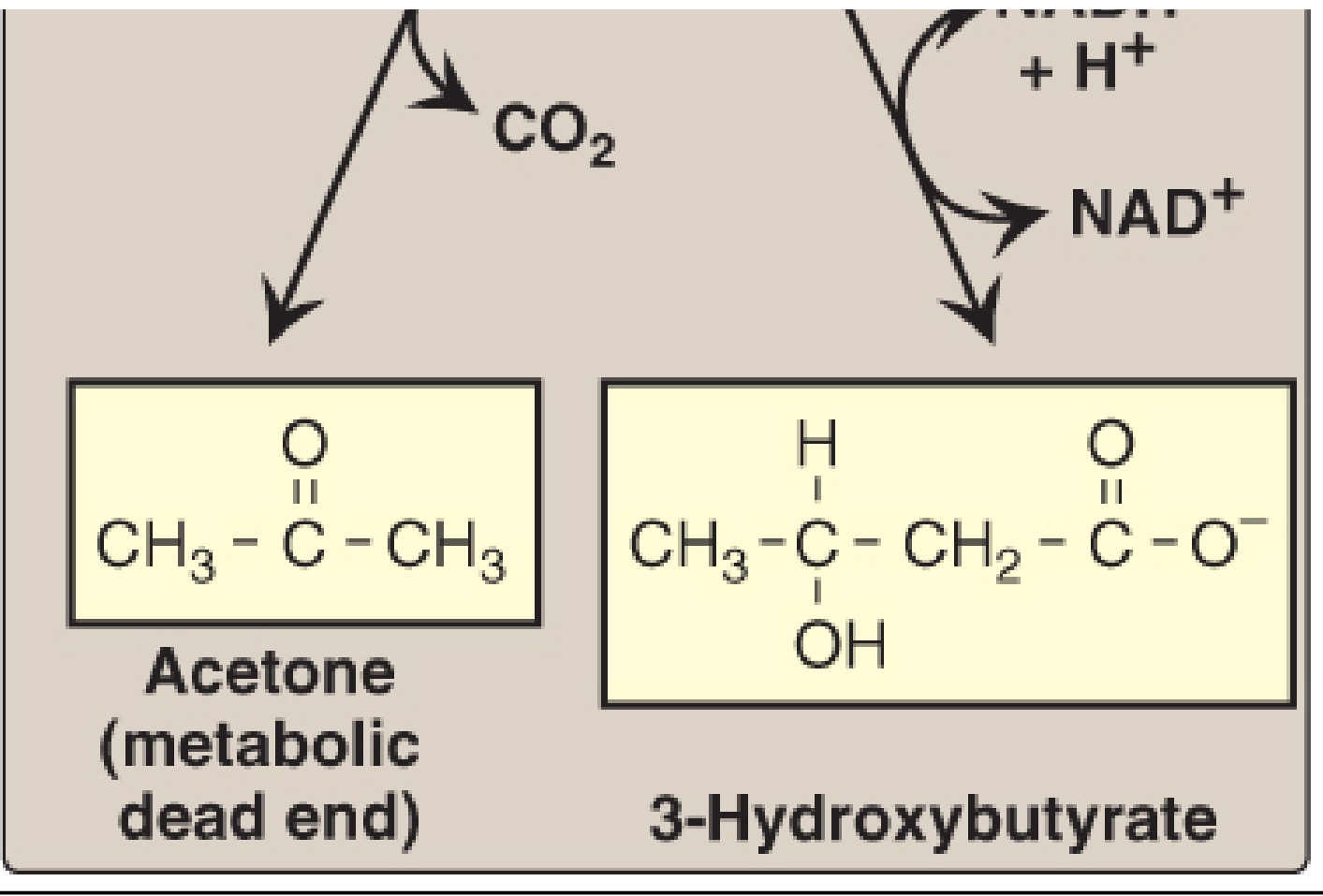
Why Ketone Bodies Rise During Starvation
During the first 3-7 days of fasting, the drop in insulin and rise in glucagon trigger several changes:
- Adipose tissue lipolysis accelerates, releasing free fatty acids (FFAs) into blood
- The liver takes up FFAs and runs beta-oxidation at a rate exceeding its own energy needs
- Excess acetyl-CoA in the liver is channeled into ketogenesis via the HMG-CoA pathway
- The liver peaks at ~100 g/day of ketone body production by day 3 of a fast
Plasma ketone bodies rise from negligible in the fed state to ~2.9 mmol/L at 40 hours and ~4.5 mmol/L after 7 days starvation, as shown in [Harper's Illustrated Biochemistry, 32nd Ed](book reference), while glucose only falls modestly (5.5 → 3.5 mmol/L).
How Peripheral Tissues Use Ketone Bodies (Ketolysis)
The liver produces but cannot use ketone bodies - it lacks thiophorase (succinyl-CoA:acetoacetate CoA transferase). All other mitochondria-containing tissues use the following pathway:
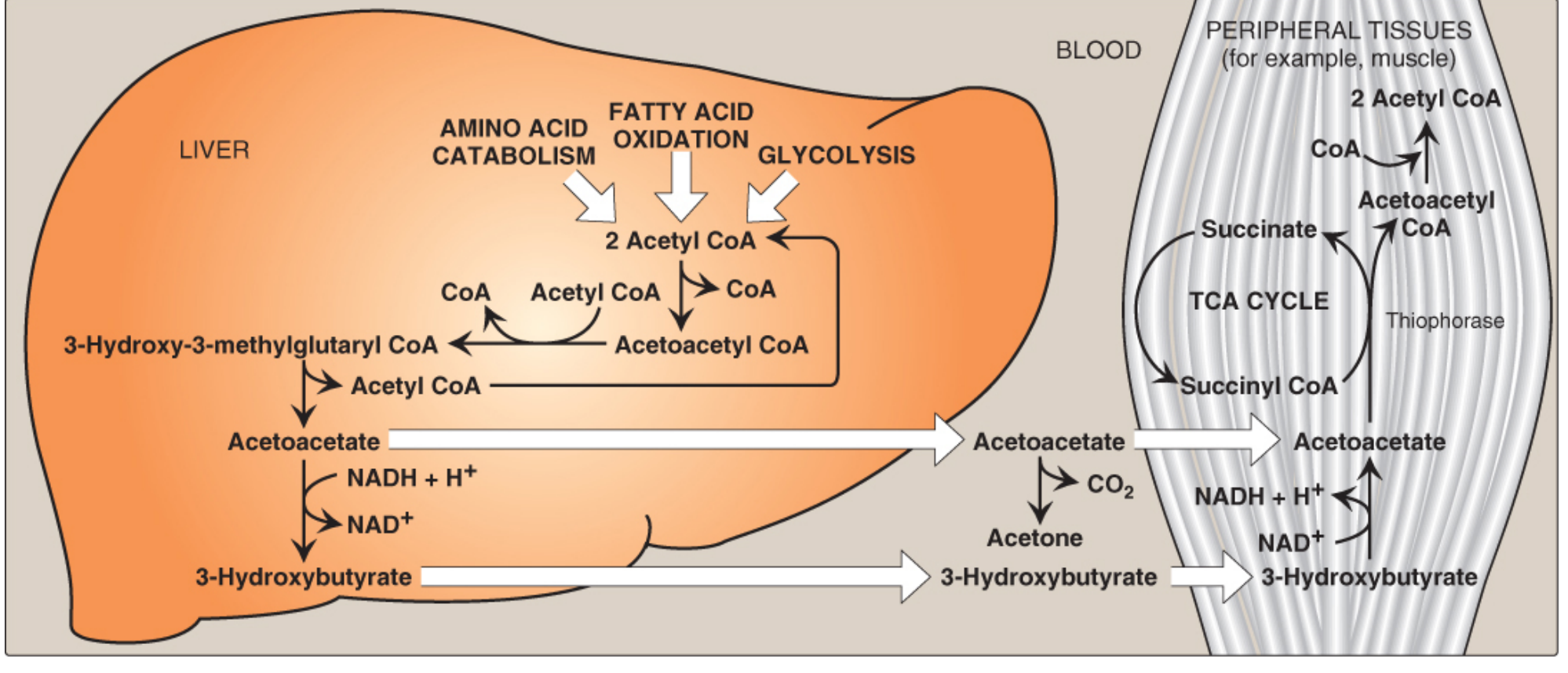
Step-by-step ketolysis:
- 3-Hydroxybutyrate → Acetoacetate: catalyzed by 3-hydroxybutyrate dehydrogenase, generating NADH
- Acetoacetate → Acetoacetyl-CoA: CoA is transferred from succinyl-CoA by thiophorase. This "costs" a succinyl-CoA from the TCA cycle (bypassing the GTP-generating step - one reason the liver cannot afford to do this)
- Acetoacetyl-CoA → 2 Acetyl-CoA: split by thiolase
- 2 Acetyl-CoA → TCA cycle → ATP
Energy yield: 1 mol acetoacetate → 19 ATP; 1 mol 3-hydroxybutyrate → 21.5 ATP
(Biochemistry, Lippincott Illustrated Reviews 8th Ed; Harper's Illustrated Biochemistry 32nd Ed)
Tissue-Specific Reasons
1. Skeletal Muscle
- Muscle preferentially takes up FFAs during fasting, but cannot fully meet energy demands by beta-oxidation alone
- Ketone bodies supplement FFA oxidation when ketone body levels rise in blood
- Importantly, when muscle uses ketone bodies heavily, it reduces its glucose consumption, sparing glucose for the brain and RBCs
- During prolonged starvation, skeletal muscle actually reduces its ketone body uptake (due to low insulin), allowing blood ketone levels to keep rising to eventually supply the brain
(Harper's Illustrated Biochemistry, 32nd Ed, p. 156)
2. Brain
- The brain normally cannot use fatty acids because long-chain fatty acids cannot cross the blood-brain barrier
- Glucose is its usual primary fuel
- However, ketone bodies are small, water-soluble, and freely cross the blood-brain barrier - making them the only fat-derived fuel the brain can use
- After 3-5 days of starvation, the brain starts using ketone bodies significantly; by 7 days, ketone bodies can meet >50% of the brain's energy requirements, reducing glucose demand from ~120 g/day to ~40 g/day
- This is the single most important adaptive advantage: by using ketone bodies, the brain drastically reduces its glucose requirement, so less muscle protein needs to be broken down for gluconeogenesis, sparing body protein and prolonging survival
(Basic Medical Biochemistry 6th Ed, p. 1036; Medical Physiology, p. 1738)
3. Heart Muscle
- The heart is an oxidative powerhouse that runs almost entirely on aerobic metabolism
- It uses ketone bodies very efficiently - heart and skeletal muscle are actually the primary consumers of ketone bodies at moderate ketone levels
- The heart preferentially uses whatever oxidative substrate is most available: fed state → glucose; early fasting → FFAs; prolonged starvation → ketone bodies + FFAs
- Ketone bodies enter directly into the TCA cycle via acetyl-CoA and provide continuous high-efficiency energy for the non-stop cardiac workload
(Harper's Illustrated Biochemistry 32nd Ed; Schwartz's Principles of Surgery 11th Ed)
The Big Picture: Why This Matters for Survival
| Adaptation | Consequence |
|---|---|
| Brain shifts to ketone bodies | Glucose demand falls from ~120 g/day to ~40 g/day |
| Less glucose needed | Hepatic gluconeogenesis decreases |
| Less gluconeogenesis | Less muscle protein is broken down for amino acid substrates |
| Protein is spared | Vital organ function (including the heart) is preserved longer |
| Fat stores are consumed instead | Survival extended from ~10 days (if only protein) to weeks-months |
The shift to ketone body use in these three tissues is therefore a coordinated survival mechanism. It allows the body to "run on fat" while protecting the two most vital protein-rich organs - the brain (which needs a constant fuel source) and the heart (which needs constant oxidative ATP). Starvation deaths typically occur when fat stores are finally depleted and the body must again rely heavily on protein, causing cardiac and diaphragm muscle failure.
(Medical Physiology; Basic Medical Biochemistry 6th Ed)
Energetics in aerobic glycolysis and anaerobic glycolysis.
Finding Sources
Finding Sources
Finding Sources
Reading File
Good start. Now let me read the dedicated glycolysis sections from Lippincott and Basic Medical Biochemistry in parallel for the most complete energetics coverage.
Reading File
Reading File
Reading File
Reading File
Reading File
Finding Sources
Excellent - I now have the complete ATP table and all key content. Let me fetch the key diagrams.
Loading Image
Loading Image
I now have everything needed. Here is the comprehensive answer:
Energetics of Aerobic vs. Anaerobic Glycolysis
Glycolysis is a 10-step cytosolic pathway that breaks down one glucose molecule into two pyruvate molecules. The fate of pyruvate - and of the NADH generated along the way - determines whether the process is aerobic or anaerobic, and this distinction dramatically affects ATP yield.
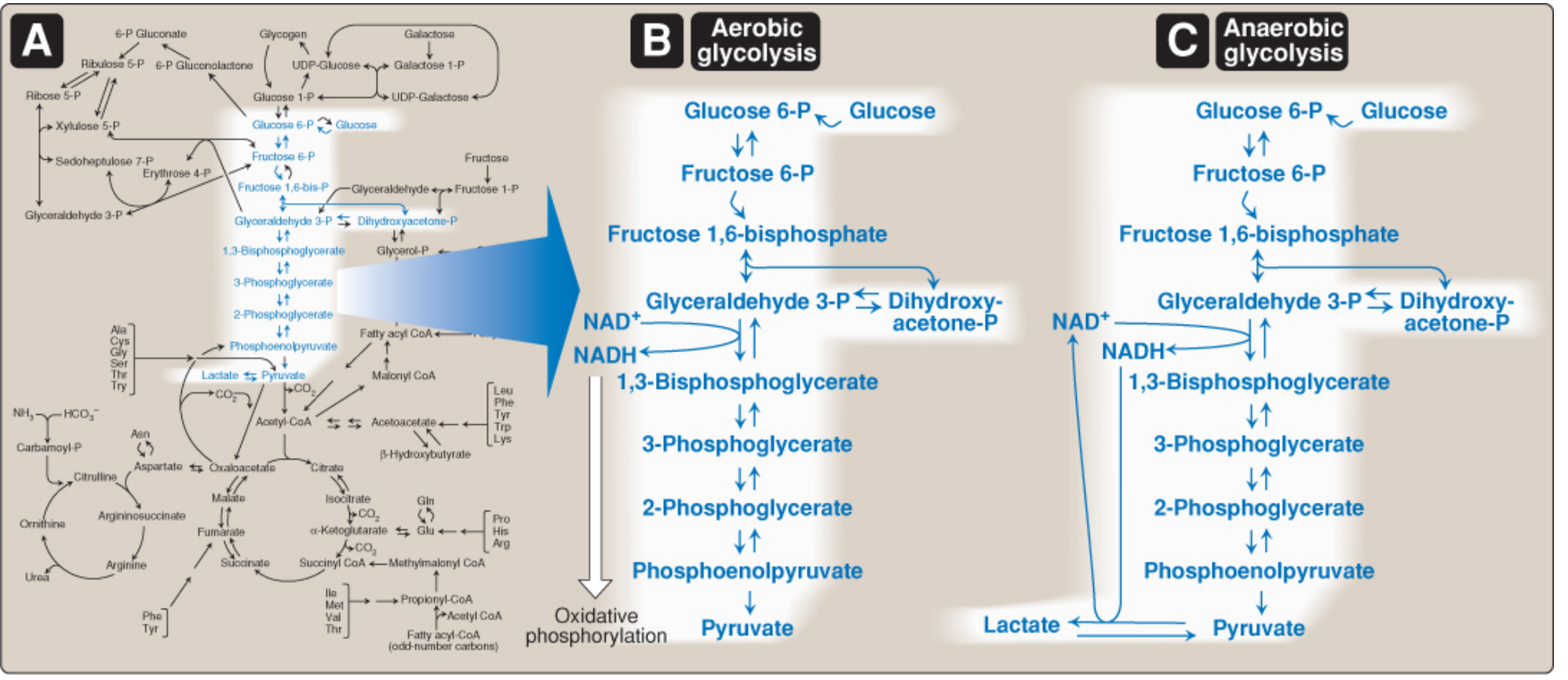
The Two Phases of Glycolysis (Common to Both)
Phase 1 - Investment Phase (ATP Consumed): Steps 1-5
Two ATP molecules are spent to phosphorylate glucose and trap it inside the cell:
| Step | Reaction | ATP Change |
|---|---|---|
| Step 1 | Glucose → Glucose-6-phosphate (Hexokinase) | -1 ATP |
| Step 3 | Fructose-6-phosphate → Fructose-1,6-bisphosphate (PFK-1) | -1 ATP |
| Total investment | -2 ATP |
Phase 2 - Payoff Phase (ATP Produced): Steps 6-10
After aldolase splits fructose-1,6-bisphosphate into two triose phosphates, each is processed, yielding ATP and NADH:
| Step | Reaction | ATP Change (per glucose) |
|---|---|---|
| Step 7 | 1,3-Bisphosphoglycerate → 3-Phosphoglycerate (Phosphoglycerate kinase) | +2 ATP (substrate-level) |
| Step 10 | Phosphoenolpyruvate → Pyruvate (Pyruvate kinase) | +2 ATP (substrate-level) |
| Step 6 | Glyceraldehyde-3-P → 1,3-BPG (G3P dehydrogenase) | +2 NADH (cytosolic) |
| Gross payoff | +4 ATP + 2 NADH |
Net at this stage (before pyruvate fate): 4 - 2 = +2 ATP (substrate-level) + 2 cytosolic NADH
(Medical Physiology; Harper's Illustrated Biochemistry 32nd Ed)
Anaerobic Glycolysis
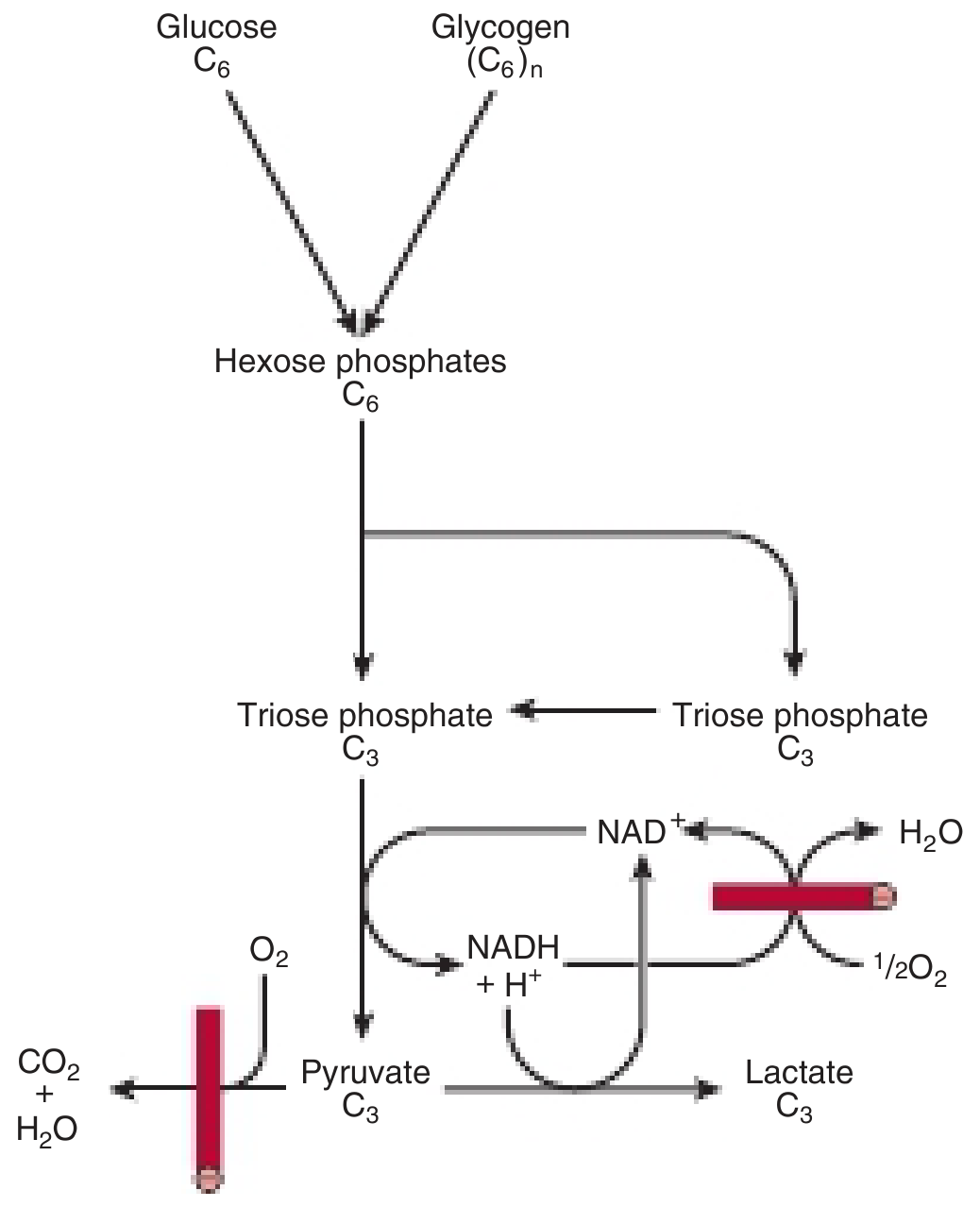
Condition: No oxygen (or no mitochondria, e.g., RBCs)
The problem: The 2 cytosolic NADH produced at step 6 must be reoxidized back to NAD+ for glycolysis to continue. Without mitochondria or O2, oxidative phosphorylation cannot do this.
The solution: Pyruvate acts as an electron acceptor. Lactate dehydrogenase (LDH) reduces pyruvate to lactate, reoxidizing NADH → NAD+:
Pyruvate + NADH + H⁺ → Lactate + NAD⁺
This regenerates the NAD+ needed for step 6 to keep running, at the cost of diverting pyruvate away from the TCA cycle.
Net reaction:
Glucose + 2 ADP + 2 Pᵢ → 2 Lactate + 2 ATP + 2 H₂O + 2 H⁺
ATP yield = 2 ATP per glucose (substrate-level phosphorylation only)
The 2 cytosolic NADH are used up reducing pyruvate to lactate - they contribute zero ATP in anaerobic conditions.
(Basic Medical Biochemistry 6th Ed, p. 803)
Aerobic Glycolysis
Condition: Oxygen is available and mitochondria are present.
What's different: Pyruvate is NOT reduced to lactate. Instead:
- The 2 cytosolic NADH are shuttled into mitochondria (via the malate-aspartate shuttle or glycerophosphate shuttle) and oxidized by the electron transport chain
- Pyruvate enters the mitochondria, is converted to acetyl-CoA (pyruvate dehydrogenase), and feeds the TCA cycle
ATP from cytosolic NADH depends on the shuttle used:
| Shuttle | Mitochondrial product | ATP per NADH | Total from 2 NADH |
|---|---|---|---|
| Malate-aspartate shuttle | NADH (mitochondrial) | 2.5 ATP | +5 ATP |
| Glycerophosphate shuttle | FADH₂ | 1.5 ATP | +3 ATP |
Net ATP yield from glycolysis alone (aerobic):
| Component | ATP |
|---|---|
| Substrate-level phosphorylation | +4 |
| Investment (hexokinase + PFK-1) | -2 |
| 2 cytosolic NADH via malate-aspartate shuttle | +5 |
| Total (malate shuttle) | +7 ATP |
| Total (glycerophosphate shuttle) | +5 ATP |
(Medical Physiology, p. 1738; Harper's Illustrated Biochemistry 32nd Ed, Table 17-1)
Complete Aerobic Glucose Oxidation (for context)
When pyruvate proceeds through pyruvate dehydrogenase + TCA cycle + oxidative phosphorylation, the total yield from one glucose is:
| Pathway | ATP |
|---|---|
| Glycolysis (substrate-level) | +4 (net +2) |
| Glycolysis NADH (malate shuttle) | +5 |
| Pyruvate dehydrogenase (2 NADH) | +5 |
| TCA cycle (per glucose) | +25 |
| Grand total | ~30-32 ATP |
(Harper's Illustrated Biochemistry 32nd Ed, Table 17-1)
Summary Comparison Table
| Feature | Anaerobic Glycolysis | Aerobic Glycolysis |
|---|---|---|
| Oxygen required | No | Yes |
| Location | Cytosol only | Cytosol (+ mitochondria for NADH) |
| End product | Lactate | Pyruvate (→ TCA cycle) |
| NADH fate | Reduces pyruvate to lactate | Oxidized in ETC via shuttle |
| NAD+ regeneration | By LDH in cytosol | By ETC in mitochondria |
| ATP yield (glycolysis alone) | 2 ATP | 5-7 ATP |
| ATP mechanism | Substrate-level only | Substrate-level + oxidative phosphorylation |
| Speed | Faster | Slower |
| Cells that rely on it | RBCs, renal medulla, hypoxic muscle | Most aerobic tissues |
| Byproduct | Lactic acid (→ acidosis) | CO₂ + H₂O |
Key concept: Anaerobic glycolysis produces much less ATP per glucose (2 vs 5-7 from glycolysis alone, or 2 vs 30-32 for complete oxidation), so cells under anaerobic conditions must consume glucose at a much higher rate to sustain the same ATP output. This is reflected in the Pasteur effect - glycolysis runs faster under anaerobic than aerobic conditions because the cell increases glucose throughput to compensate for the reduced ATP yield per molecule.
(Lippincott's Illustrated Reviews Biochemistry 8th Ed; Harper's Illustrated Biochemistry 32nd Ed)
Explain 3 ATP in Glycogen breakdown.
When glycogen is broken down, glucose enters glycolysis as glucose-1-phosphate → glucose-6-phosphate, bypassing the hexokinase step that normally costs 1 ATP. So only 1 ATP is spent (at PFK-1), not 2. Net substrate-level ATP = 4 - 1 = 3 ATP, instead of the usual 2 from free glucose.
Searching sources...
Finding Sources
Finding Sources
Reading File
Finding Sources
Finding Sources
Loading Image
The diagram and textbook content perfectly illustrate the concept. Here is the full explanation:
Why Glycogen Breakdown Yields 3 ATP (Instead of 2)
The key is how glycogen enters glycolysis compared to free glucose.
The Entry Point Difference
Free Glucose entering glycolysis:
Step 1 - Hexokinase phosphorylates glucose using ATP:
Glucose + ATP → Glucose-6-phosphate + ADP (costs 1 ATP)
Step 3 - PFK-1 phosphorylates fructose-6-phosphate using ATP:
Fructose-6-P + ATP → Fructose-1,6-bisphosphate + ADP (costs 1 ATP)
Total investment = -2 ATP
Payoff = +4 ATP (substrate-level from steps 7 and 10)
Net = 4 - 2 = 2 ATP
Glycogen entering glycolysis:
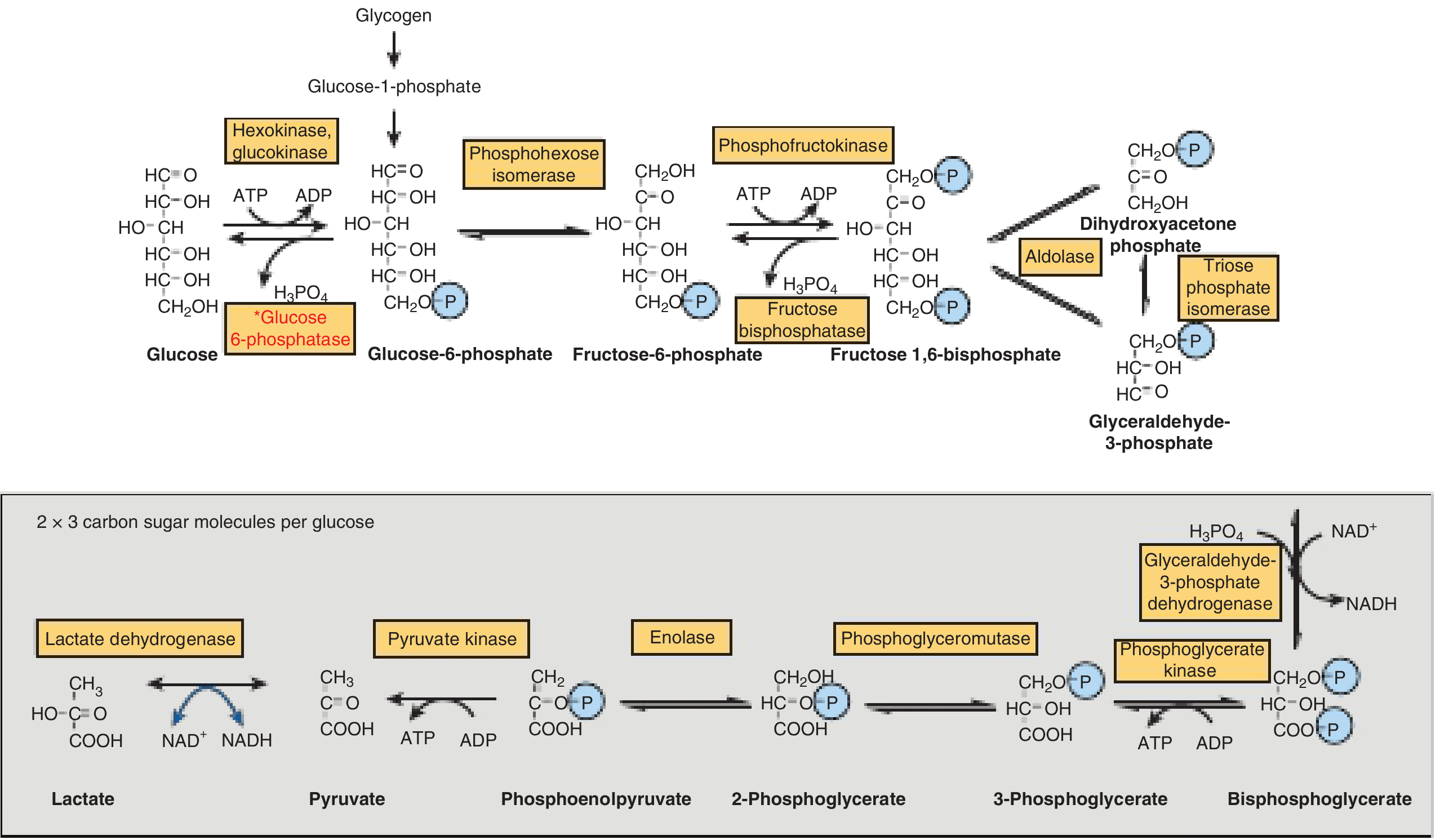
Glycogen is broken down by glycogen phosphorylase in a reaction called phosphorolysis:
Glycogen(n residues) + Inorganic phosphate (Pᵢ) → Glucose-1-phosphate + Glycogen(n-1 residues)
Notice: no ATP is consumed here - inorganic phosphate (Pᵢ), not ATP, is used as the phosphate donor. The glycosidic bond energy drives the phosphorylation.
Glucose-1-phosphate is then converted to Glucose-6-phosphate by phosphoglucomutase (no ATP cost):
Glucose-1-phosphate → Glucose-6-phosphate
Glucose-6-phosphate enters glycolysis directly at step 2, completely bypassing hexokinase (step 1).
Step 3 - PFK-1 still consumes ATP as usual:
Fructose-6-P + ATP → Fructose-1,6-bisphosphate + ADP (costs 1 ATP)
Total investment = -1 ATP (only PFK-1; hexokinase step is skipped)
Payoff = +4 ATP (unchanged)
Net = 4 - 1 = 3 ATP
Side-by-Side Comparison
| Free Glucose | Glycogen-derived glucose | |
|---|---|---|
| Step 1 (Hexokinase) | -1 ATP (used) | 0 ATP (bypassed - already phosphorylated) |
| Step 3 (PFK-1) | -1 ATP | -1 ATP |
| Step 7 (Phosphoglycerate kinase) | +2 ATP | +2 ATP |
| Step 10 (Pyruvate kinase) | +2 ATP | +2 ATP |
| Net ATP (anaerobic) | 2 ATP | 3 ATP |
Why This Matters
This 1 extra ATP is physiologically significant during anaerobic conditions in muscle (e.g., intense exercise), where ATP is urgently needed and every molecule counts. As Harper's states:
"There is a considerable advantage in using glycogen rather than glucose for anaerobic glycolysis in muscle, since the product of glycogen phosphorylase is glucose-1-phosphate, which is interconvertible with glucose-6-phosphate. This saves the ATP that would otherwise be used by hexokinase, increasing the net yield of ATP from 2 to 3 per glucose." - Harper's Illustrated Biochemistry 32nd Ed
Important caveat: Harper's also notes that "the initial formation of glycogen requires ATP" - so in a net whole-body sense, the glucose had to be invested into glycogen first (costing ATP). The 3 ATP advantage only applies at the moment of rapid glycogen breakdown, when ATP is in short supply and glycogen is being drawn down from pre-existing stores.
The Mechanism in One Line
Glycogen phosphorylase uses free inorganic phosphate (not ATP) to cleave glycogen, delivering glucose already phosphorylated at C-1. After isomerization to glucose-6-phosphate, it bypasses hexokinase entirely - saving 1 ATP and raising the net anaerobic glycolytic yield from 2 to 3 ATP per glucose unit.
This is a shared conversation. Sign in to Orris to start your own chat.