
Types of hysterectomy and process
Reading File
Now let me search the medical library for hysterectomy content in parallel:
Finding Sources
Searching the Web
types of hysterectomy surgical procedure overview 2024
Good results. Let me now read the key sections from Berek & Novak's Gynecology and Sabiston Surgery in parallel:
Reading File
Reading File
Reading File
Good content from Sabiston. Let me read the continuation of the Sabiston hysterectomy section for the vaginal and supracervical content, and also the radical hysterectomy section from Berek & Novak:
Reading File
Reading File
Reading File
Let me read more of the Sabiston vaginal hysterectomy and radical hysterectomy sections, plus the Wertheim/radical classification from Berek:
Reading File
Finding Sources
I now have rich content from both Sabiston (surgery) and Berek & Novak (gynecology). Let me fetch the key surgical diagram image to include in the answer:
Loading Image
Reading File
I now have comprehensive content from authoritative surgical and gynecology textbooks. Let me compile the full answer.
Hysterectomy: Types and Surgical Process
A hysterectomy is the surgical removal of the uterus. It is the most common major gynecologic operation performed for both benign and malignant conditions. Classification is based on two axes: (1) what tissue is removed and (2) the surgical route/approach.
Part 1: Classification by Extent of Tissue Removed
1. Subtotal (Supracervical) Hysterectomy
- The uterine body (corpus) is removed, but the cervix is left in place.
- This is the least preferred option but sometimes driven by surgical necessity (e.g., severe adhesions near the cervix) or patient preference.
- Because the cervix remains, cervical cancer screening must continue per guidelines.
- Contraindicated if there is malignant or pre-malignant disease of the uterus or cervix.
- Sabiston Textbook of Surgery, p. 2800
2. Total Hysterectomy
- Removes both the uterine corpus and the cervix, but leaves the ovaries intact.
- The most commonly performed type for benign disease (fibroids, dysfunctional uterine bleeding, adenomyosis, prolapse).
- Can be done via open (abdominal), vaginal, laparoscopic, or robotic routes.
- Sabiston Textbook of Surgery, p. 2799
3. Total Hysterectomy + Bilateral Salpingo-Oophorectomy (BSO)
- Removes the uterus, cervix, both ovaries, and both fallopian tubes.
- Indicated when there is ovarian pathology, BRCA mutation carrier status, or malignancy.
- In women under 50, elective BSO carries increased long-term cardiovascular and neurologic morbidity, especially without hormone replacement therapy.
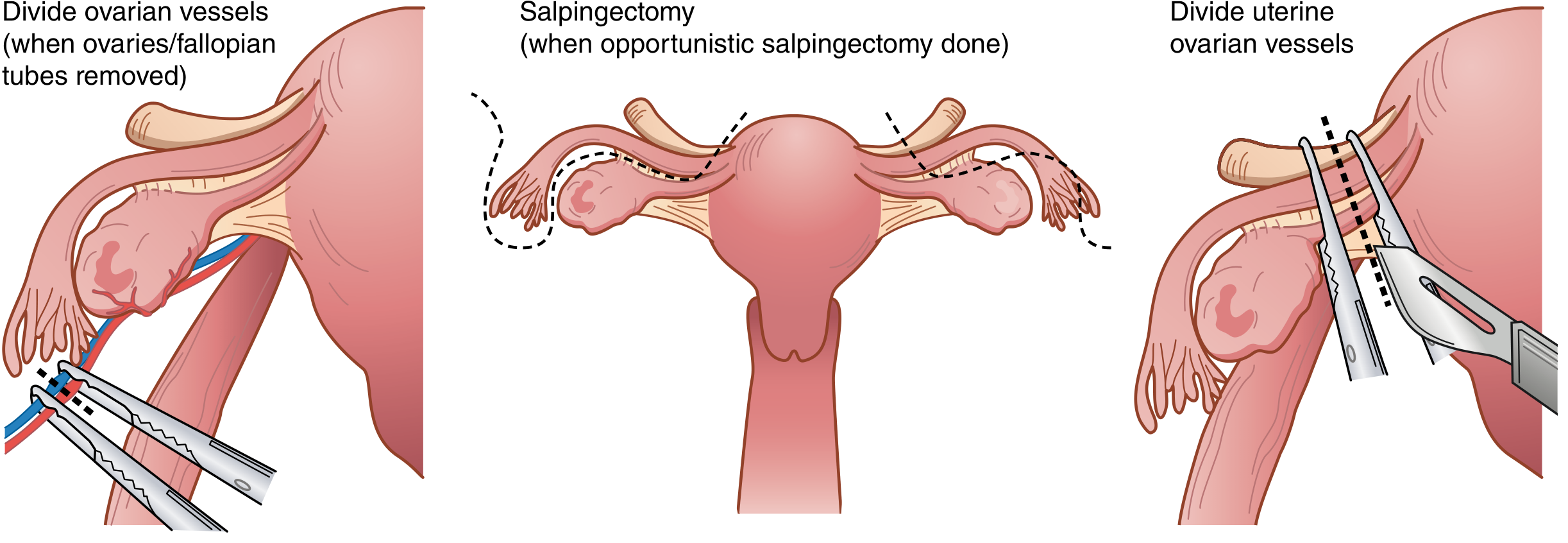
- Opportunistic salpingectomy (tubes only, preserving ovaries) is now routinely recommended at the time of hysterectomy to reduce the risk of ovarian cancer, even when oophorectomy is not indicated.
- Sabiston Textbook of Surgery, p. 2801
4. Radical Hysterectomy (Wertheim's Hysterectomy)
- Removes the uterus, cervix, upper portion of the vagina (~2 cm vaginal cuff), parametria (tissue surrounding the cervix), cardinal ligaments, uterosacral ligaments, and pelvic lymph nodes.
- Primarily used for cervical cancer and occasionally for endometrial cancer with cervical involvement.
- Nerve-sparing radical hysterectomy preserves the inferior hypogastric plexus and is associated with improved bladder function and sexual outcomes compared to traditional radical hysterectomy.
- Berek & Novak's Gynecology, p. 904
Part 2: Classification by Surgical Route/Approach
1. Total Abdominal Hysterectomy (TAH) - Open
- Performed via a low transverse (Pfannenstiel) or vertical midline incision.
- Incision type is chosen based on indication, body habitus, prior surgical history, and size of pathology.
- Has higher complication rates and longer recovery than vaginal or laparoscopic approaches.
- Now reserved for cases where minimally invasive approaches are not safe or feasible (e.g., cardiopulmonary disease precluding laparoscopy, suspected malignancy requiring morcellation to be avoided, grossly distorted anatomy).
- Sabiston Textbook of Surgery, p. 2799-2800
2. Vaginal Hysterectomy (VH)
- One of the oldest gynecologic operations; surgical steps are largely unchanged since its introduction.
- Preferred route when feasible - associated with less morbidity and shorter hospital stays than abdominal hysterectomy.
- Steps (in brief):
- Patient placed in high lithotomy position; paracervical block with dilute vasopressin or lidocaine-epinephrine.
- Circumferential incision around the cervix at the vaginal-cervical junction, with downward traction using a tenaculum.
- Posterior cul-de-sac entered sharply; uterosacral ligaments clamped, divided, ligated (tagged for later cuff repair).
- Anterior dissection: bladder reflected upward off cervix; anterior peritoneum incised and right-angle retractor placed.
- Serial bilateral clamping, division, and ligation of cardinal ligaments and uterine vessels, progressively delivering the uterus inferiorly.
- Cornual pedicles (round ligament, fallopian tube, uteroovarian ligament) clamped, divided, and doubly ligated.
- Hemostasis checked at all pedicle sites.
- Vaginal cuff closure: angle stitches incorporating uterosacral ligaments; cuff closed horizontally with delayed absorbable suture.
- Steps are in reverse order compared to abdominal hysterectomy (colpotomy first, cornual pedicles last).
- Sabiston Textbook of Surgery, p. 2800-2801
3. Laparoscopic Hysterectomy (LH)
- Encompasses several subtypes:
- LAVH (Laparoscopic-Assisted Vaginal Hysterectomy): laparoscopy facilitates upper pedicle dissection; vaginal component completes the remainder; uterine artery ligation done vaginally.
- TLH (Total Laparoscopic Hysterectomy): entire procedure completed laparoscopically including uterine artery ligation; specimen delivered vaginally.
- LSH (Laparoscopic Supracervical Hysterectomy): uterine fundus removed laparoscopically; cervix remains; uterus removed via morcellation or contained extraction.
- Usually uses electrosurgical vessel-sealing devices and mechanical cutting systems; sutures, clips, and linear staplers may also be used.
- Complication rates of LH and VH are now similar, both lower than open abdominal hysterectomy.
- Patients can be safely discharged within hours of surgery for both VH and LH.
- LH shows less postoperative pain, faster recovery, and better quality-of-life scores (including sexual activity) than laparotomy at 6 weeks and 12 months.
- LH offers no advantage over VH when vaginal hysterectomy is feasible - it is best viewed as a replacement for laparotomy, not for VH.
- Berek & Novak's Gynecology, p. 1297
4. Robot-Assisted Laparoscopic Hysterectomy
- Uses the da Vinci (or equivalent) robotic platform to assist the laparoscopic procedure.
- Hospital readmission rates are comparable to or lower than standard laparoscopic hysterectomy.
- Higher procedural costs than standard laparoscopy; cost is reduced when reusable instruments are used.
- Berek & Novak's Gynecology, p. 1297
Part 3: Steps of Total Abdominal Hysterectomy (TAH) - Detailed
The standard steps, as described in Sabiston and illustrated in the figure below:
| Step | Action |
|---|---|
| 1 | Identify and divide round ligaments (clamp laterally, ligate with absorbable suture, divide medially) |
| 2 | Incise anterior leaf of broad ligament medially toward internal cervical os to develop bladder flap |
| 3 | If BSO: incise posterior leaves of broad ligament, identify ureters, doubly clamp and divide ovarian vessels in infundibulopelvic ligament |
| 4 | If ovaries retained: clamp across uteroovarian vessels bilaterally, divide and ligate |
| 5 | Incise remaining posterior broad ligament to skeletonize uterine vessels along lateral uterus |
| 6 | Dissect bladder off cervix sharply (Metzenbaum scissors or electrocautery), retract inferiorly |
| 7 | Curved Heaney or Zeppelin clamp across uterine vessels at level of internal cervical os; cut and suture-ligate |
| 8 | Straight clamp on remaining cardinal and uterosacral ligaments, divide and ligate |
| 9 | Incise vagina circumferentially to excise specimen |
| 10 | Close vaginal cuff with delayed absorbable suture (figure-of-eight or interrupted) |
Part 4: Common Indications
| Condition | Route Preference |
|---|---|
| Uterine fibroids (large) | TAH or TLH |
| Abnormal uterine bleeding / adenomyosis | VH or TLH |
| Uterine prolapse | VH preferred |
| Endometriosis | TLH |
| Cervical cancer (stages IA2-IIA) | Radical hysterectomy |
| Endometrial cancer | TLH + BSO + sentinel node biopsy |
| Recurrent high-grade CIN | TAH or TLH (last resort) |
| Chronic pelvic pain (selected cases, after 6 months of pain with no correctable pathology) | VH or TLH preferred |
Part 5: Postoperative Considerations
- Cystoscopy at the end of hysterectomy is now advocated by many gynecologic surgery organizations to assess bladder and ureteral integrity (especially ureteral efflux).
- Sentinel lymph node (SLN) mapping with indocyanine green (ICG) injected into the cervix is the preferred lymph node staging strategy in early-stage endometrial cancer, replacing full lymphadenectomy in many settings.
- Hormonal replacement: after bilateral oophorectomy in women under 50, HRT is strongly recommended to mitigate cardiovascular and neurologic risk.
Sources:
- Sabiston Textbook of Surgery, Chapter 120, pp. 2799-2801
- Berek & Novak's Gynecology, pp. 1297, 904
This is a shared conversation. Sign in to Orris to start your own chat.