
MALARIA GUIDELINES
Reading File
Malaria guidelines cover diagnosis, treatment by species and severity, chemoprophylaxis, and special populations. Let me search the medical library and current guidelines in parallel.
Searching sources...
Finding Sources
Searching PubMed
"malaria" AND "treatment guidelines"
Searching the Web
WHO malaria treatment guidelines 2024 2025
Good. Now let me read the key textbook sections on malaria (Rosen's Emergency Medicine and Robbins pathology for clinical management + pathology) in parallel with a more focused content search.
Reading File
Reading File
Finding Sources
Excellent data coming in. Now let me read the pharmacology sections (Goldman-Cecil and Katzung) for treatment details, and the Park's Preventive Medicine for the diagnostic flowchart.
Reading File
Reading File
Reading File
Excellent content. Now let me get the severe malaria treatment, chemoprophylaxis, and the Goldman-Cecil section on treatment by species - all in parallel.
Reading File
Finding Sources
Finding Sources
Now let me get the Harrison's chemoprophylaxis section and the life cycle/pathology images, plus the Goldman-Cecil chemoprophylaxis table.
Reading File
Reading File
Loading Image
I now have comprehensive data from multiple authoritative sources. Let me compile the complete malaria guidelines response.
Malaria: Comprehensive Clinical Guidelines
Sources: Goldman-Cecil Medicine, Harrison's Principles of Internal Medicine 22e (2025), Katzung's Basic & Clinical Pharmacology 16e, Goodman & Gilman's Pharmacological Basis of Therapeutics, Robbins & Kumar Basic Pathology, Park's Textbook of Preventive Medicine, WHO Guidelines for Malaria (August 2025), Rosen's Emergency Medicine
1. Etiology and Life Cycle
Malaria is caused by five Plasmodium species transmitted by female Anopheles mosquitoes (dusk-to-dawn feeders):
| Species | Key Feature |
|---|---|
| P. falciparum | Most dangerous - causes severe/cerebral malaria, high fatality |
| P. vivax | Relapsing - hypnozoites in liver; can cause severe disease |
| P. ovale | Relapsing - hypnozoites in liver; oval RBCs with Schüffner dots |
| P. malariae | Quartan fever; associated with nephrotic syndrome |
| P. knowlesi | Zoonotic (Southeast Asia); elongated intraerythrocytic trophozoites |
Life Cycle
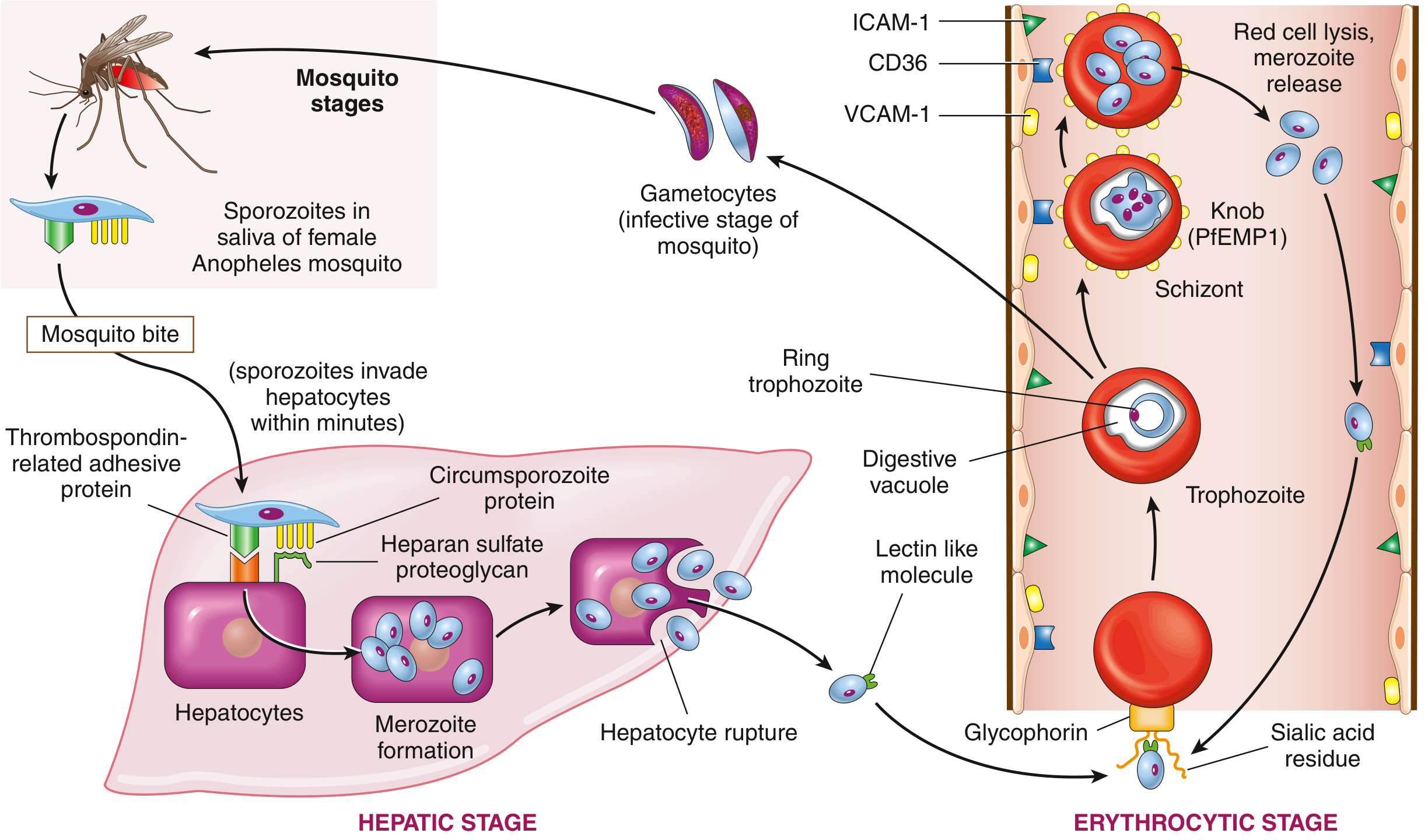
P. falciparum life cycle. Sporozoites invade hepatocytes via thrombospondin-related adhesive protein and circumsporozoite protein. After 1-4 weeks, merozoites are released and enter RBCs via glycophorin. PfEMP1 (knob protein) causes sequestration by binding ICAM-1, VCAM-1, CD36 on endothelium - the basis of severe disease. - Robbins & Kumar Basic Pathology
Other transmission routes (non-vector): blood transfusion, shared needles, organ transplantation, perinatal (mother to fetus), "airport malaria."
2. Clinical Presentation
Classic Fever Periodicity
- Tertian (48 h cycle): P. vivax, P. ovale, P. falciparum
- Quartan (72 h cycle): P. malariae
- Early in illness, fever is often continuous rather than cyclical
Common Symptoms
Fever (not always present initially), headache, myalgia, nausea, vomiting, diarrhea, rigors, splenomegaly, anemia
Incubation Period
- P. falciparum: typically 7-14 days; >90% of infected travelers present within 1-2 months of return
- Other species: may present months to >1 year after exposure (due to hepatic dormancy)
3. Diagnosis
A. Thick Blood Smear (Gold Standard)
- Giemsa-stained; best sensitivity; used in high-endemic areas
- Allows parasite density count (vs. leukocytes)
- Does NOT show erythrocyte morphology well
B. Thin Blood Smear
- Preferred where malaria is uncommon; better for species identification
- Species morphology clues:
- P. falciparum: ring forms only (mature stages sequestered); banana-shaped gametocytes
- P. vivax / P. ovale: enlarged RBCs, Schüffner dots; P. ovale has ovoid cells
- P. malariae / P. knowlesi: elongated band-form trophozoites
C. Rapid Diagnostic Tests (RDTs)
- Histidine-rich protein 2 (HRP2): P. falciparum specific
- Lactate dehydrogenase (LDH) / aldolase: detects all species
- Caution: HRP2 gene deletions in parts of South America and Horn of Africa may give false negatives
D. PCR
- Most sensitive and specific; useful for low-density infections and species confirmation
Rule: If malaria is suspected, repeat blood smears every 12-24 hours for up to 3 sets before excluding the diagnosis - Goldman-Cecil Medicine
4. Treatment
4A. Uncomplicated P. falciparum Malaria (Chloroquine-Resistant Areas)
Artemisinin-based combination therapy (ACT) is the global standard of care for uncomplicated falciparum malaria. Monotherapy with artemisinins is strongly discouraged due to resistance selection.
WHO-Recommended ACT Regimens (adults):
| Regimen | Dosing | Notes |
|---|---|---|
| Artemether-lumefantrine (Coartem) | 4 tabs twice daily x 3 days | FDA-approved; first-line in USA and most African countries |
| Artesunate-amodiaquine (ASAQ) | 200/540 mg daily x 3 days | First-line in many African countries |
| Artesunate-mefloquine | 4 mg/kg artesunate + 8 mg/kg mefloquine daily x 3 days | Southeast Asia and South America; limited by CNS side effects |
| Dihydroartemisinin-piperaquine (DHA-PPQ) | 4/18 mg/kg daily x 3 days | Highly effective; resistance emerging in SE Asia |
| Artesunate-pyronaridine (Pyramax) | Weight-based x 3 days | Newer; no known resistance to either component |
Alternative (chloroquine-resistant, no ACT available):
- Quinine sulfate 650 mg TDS x 3-7 days + doxycycline 100 mg BD x 7 days
- OR Quinine + clindamycin 600 mg BD x 7 days (in pregnancy)
- OR Atovaquone-proguanil (Malarone) 4 tabs daily x 3 days
Gametocyte clearance (P. falciparum):
-
Single dose primaquine 0.25 mg/kg on Day 1/2 to reduce transmission (WHO 2024/2025 update - G6PD testing NOT required at this low dose, except in pregnant women)
-
Katzung's Basic & Clinical Pharmacology 16e, Goldman-Cecil Medicine
4B. Uncomplicated P. falciparum - Chloroquine-Sensitive Areas
(Central America west of Panama Canal, Haiti, Dominican Republic, most of Middle East)
- Chloroquine phosphate 1 g po, then 500 mg at 6, 24, and 48 hours
4C. P. vivax and P. ovale Malaria (Relapsing Malaria)
-
Blood-stage treatment:
- Chloroquine 25 mg/kg divided over 3 days (where sensitive)
- ACT is also effective for vivax malaria
-
Anti-relapse (radical cure) - eliminates hypnozoites:
- Check G6PD status first (primaquine/tafenoquine cause hemolysis in G6PD deficiency)
- G6PD-normal: Primaquine 0.5 mg/kg/day x 14 days, OR 7 days (WHO 2024 update)
- Tafenoquine (single dose 300 mg for adults) - G6PD testing mandatory; contraindicated if <30% normal G6PD activity
- G6PD-deficient: Primaquine 0.75 mg/kg once weekly x 8 weeks (with supervision)
Primaquine is contraindicated in pregnancy, infants, and G6PD-deficient patients - Park's Textbook of Preventive Medicine
4D. P. malariae Malaria
- Chloroquine alone (no radical cure needed - no hypnozoites)
4E. Mixed Infections
- Treat as P. falciparum if falciparum is one of the species
5. Severe / Complicated Malaria
WHO Criteria for Severe Malaria (P. falciparum)
- Cerebral malaria (impaired consciousness, seizures, coma - GCS <11)
- Severe anemia (Hb <7 g/dL or Hct <20%)
- Respiratory distress / pulmonary edema (ARDS)
- Acute kidney injury (creatinine >265 µmol/L)
- Hypoglycemia (<2.2 mmol/L)
- Circulatory collapse / shock
- Abnormal bleeding / DIC
- Hyperparasitemia (>5% parasitized RBCs in non-immune patients)
- Jaundice with organ dysfunction
- Hemoglobinuria (blackwater fever)
Treatment of Severe Malaria
IV artesunate is the treatment of choice - superior to quinine for severe malaria (lower mortality, faster parasite clearance, better tolerability):
| Agent | Dose | Notes |
|---|---|---|
| IV artesunate (first-line) | 2.4 mg/kg IV at 0, 12, 24 h; then daily x 2 more days | FDA-approved; replace IV quinine in USA since 2019 |
| IV quinine dihydrochloride (alternative) | 20 mg/kg loading over 4 h; then 10 mg/kg every 8 h | Requires cardiac monitoring; not available in USA |
| IM artemether (alternative) | 3.2 mg/kg IM loading; then 1.6 mg/kg/day | Where IV unavailable |
After IV therapy: transition to full oral ACT or oral quinine + doxycycline/clindamycin once patient can tolerate oral medications.
Adjunctive management:
-
Airway/breathing support if ARDS
-
IV glucose for hypoglycemia
-
Exchange transfusion (controversial; may be considered for hyperparasitemia >10%)
-
Anticonvulsants for seizures (IV benzodiazepines)
-
Dialysis for AKI
-
Avoid: corticosteroids (harmful in cerebral malaria), aspirin, heparin
-
Adams & Victor's Neurology, Goldman-Cecil Medicine, Murray & Nadel Respiratory Medicine
6. Malaria in Special Populations
Pregnancy
| Trimester | P. falciparum | P. vivax |
|---|---|---|
| 1st trimester | Quinine + clindamycin (7 days) | Chloroquine |
| 2nd & 3rd trimester | ACT (artemether-lumefantrine preferred) | Chloroquine |
- Primaquine and tafenoquine are contraindicated in pregnancy
- ACTs are the treatment of choice in 2nd/3rd trimester (WHO 2025)
Children
- Same ACT regimens as adults (weight-based dosing)
- Artemether-lumefantrine: NOT for infants <5 kg or <1 month of age
- Severe malaria in children: IV artesunate (same as adults)
HIV Co-infection
- Drug interactions: Artemether-lumefantrine with some antiretrovirals (especially ritonavir-boosted regimens) - check interactions
- Atovaquone-proguanil absorption may be affected
7. Chemoprophylaxis
Personal protective measures first: DEET-containing repellents (20-50%), permethrin-treated clothing, insecticide-treated bed nets, indoor residual spraying.
Approved Prophylactic Drugs (CDC/WHO):
| Drug | Regimen | Area of Use | Advantages | Disadvantages |
|---|---|---|---|---|
| Atovaquone-proguanil (Malarone) | 1 tab daily starting 1-2 days before travel; stop 7 days after | All areas incl. resistant | Stop only 7 days post-travel; active against tissue schizonts | Daily; cost; GI side effects |
| Doxycycline | 100 mg daily starting 1-2 days before travel; stop 4 weeks after | All areas incl. resistant | Cheap; effective | Daily; photosensitivity; esophagitis; avoid in pregnancy/children <8 yr; stop 4 weeks post-travel |
| Mefloquine | 1 tab weekly starting 2-3 weeks before travel; stop 4 weeks after | Most areas (NOT SE Asia where resistant) | Weekly; long track record | Neuropsychiatric side effects; contraindicated in seizure disorders, psychiatric illness, cardiac conduction abnormalities |
| Chloroquine | 500 mg weekly starting 1-2 weeks before travel; stop 4 weeks after | Areas with chloroquine-sensitive malaria only | Weekly; safe in pregnancy | Very limited geographic applicability |
| Primaquine | 0.5 mg/kg daily | Areas where P. vivax predominates | Provides radical cure | G6PD testing mandatory; daily |
| Tafenoquine (Arakoda) | 200 mg weekly | Approved in USA/Australia | Weekly; single post-travel dose | G6PD testing mandatory |
Key rule: If a traveler develops malaria despite taking prophylaxis, that specific drug should NOT be used for treatment - Red Book 2021
8. Prevention (Public Health / WHO Programs)
Vector Control
- Long-lasting insecticidal nets (LLINs) - recommended for all at-risk populations
- Indoor Residual Spraying (IRS) - WHO updated guidance includes new insecticides: chlorfenapyr, isocycloseram; reduced emphasis on DDT (WHO Guidelines, August 2025)
- Spatial repellents/emanators - newly recommended by WHO based on recent evidence (2025)
Chemoprevention in Endemic Populations
- Intermittent Preventive Treatment in Pregnancy (IPTp): Sulfadoxine-pyrimethamine (SP) given to pregnant women at each ANC visit after 1st trimester
- Seasonal Malaria Chemoprevention (SMC): Monthly ACT or SP + amodiaquine during high-transmission season in Sahel region children <5 years
- Perennial Malaria Chemoprevention (PMC): Replaces IPTi (infants); SP used in infants at routine vaccine contacts
- School-aged children (IPTsc): Emerging recommendation with new data
Malaria Vaccines (WHO 2025)
- RTS,S/AS01 (Mosquirix): Recommended for moderate-to-high transmission areas; confirmed to save child lives (new evidence May 2026 per WHO)
- R21/Matrix-M: Second approved malaria vaccine; high impact in wider rollout confirmed 2026
- Note: These vaccines are for endemic-country use; not currently approved for travelers
9. Artemisinin Resistance (Critical Emerging Concern)
- Partial artemisinin resistance: mediated by kelch13 (K13) propeller domain mutations
- First identified in Cambodia/SE Asia (2008-2012); now spreading
- Delayed parasite clearance after artemisinin therapy is the hallmark
- Failures of artesunate-mefloquine and DHA-piperaquine now documented in SE Asia
- Recently identified in East Africa - major global concern (Katzung 16e)
- WHO response: enhanced surveillance, partner drug optimization, elimination of monotherapy sales
10. Summary Algorithm
Suspected Malaria
│
├── Blood smear / RDT → Positive?
│         │
│         ├── Yes: Species identification
│         │
│         └── No but high suspicion → Repeat q12-24h x 3 sets; PCR
│
├── P. falciparum or mixed?
│         │
│         ├── SEVERE (any WHO criterion) → IV Artesunate
│         │
│         └── UNCOMPLICATED
│                   ├── Chloroquine-resistant area → ACT (artemether-lumefantrine)
│                   └── Chloroquine-sensitive area → Chloroquine
│
├── P. vivax / P. ovale → Chloroquine + Primaquine (after G6PD test)
│
└── P. malariae → Chloroquine alone
Key References:
- Goldman-Cecil Medicine International Edition - Treatment tables 316-1, 316-2
- Harrison's Principles of Internal Medicine 22e (2025) - Malaria Prevention, Ch. 231
- Katzung's Basic & Clinical Pharmacology 16e - Ch. 52 (Antiprotozoal Drugs)
- Goodman & Gilman's Pharmacological Basis of Therapeutics - Ch. 18
- Park's Textbook of Preventive and Social Medicine - National Drug Policy for Malaria
- Robbins & Kumar Basic Pathology - Pathogenesis (PfEMP1 / ICAM-1 sequestration)
- Rosen's Emergency Medicine - Travel history framework, clinical approach
- WHO Guidelines for Malaria, 13 August 2025 - most current global guidance (updated vector control, G6PD-guided radical cure, PMC, spatial repellents)
Recent evidence note: A 2025 systematic review/meta-analysis (PMID 41239453) on primaquine dosing for P. vivax confirms efficacy and tolerability of the 0.5 mg/kg/day x 7-14 day regimen, consistent with WHO 2024 updated guidance.
This is a shared conversation. Sign in to Orris to start your own chat.