
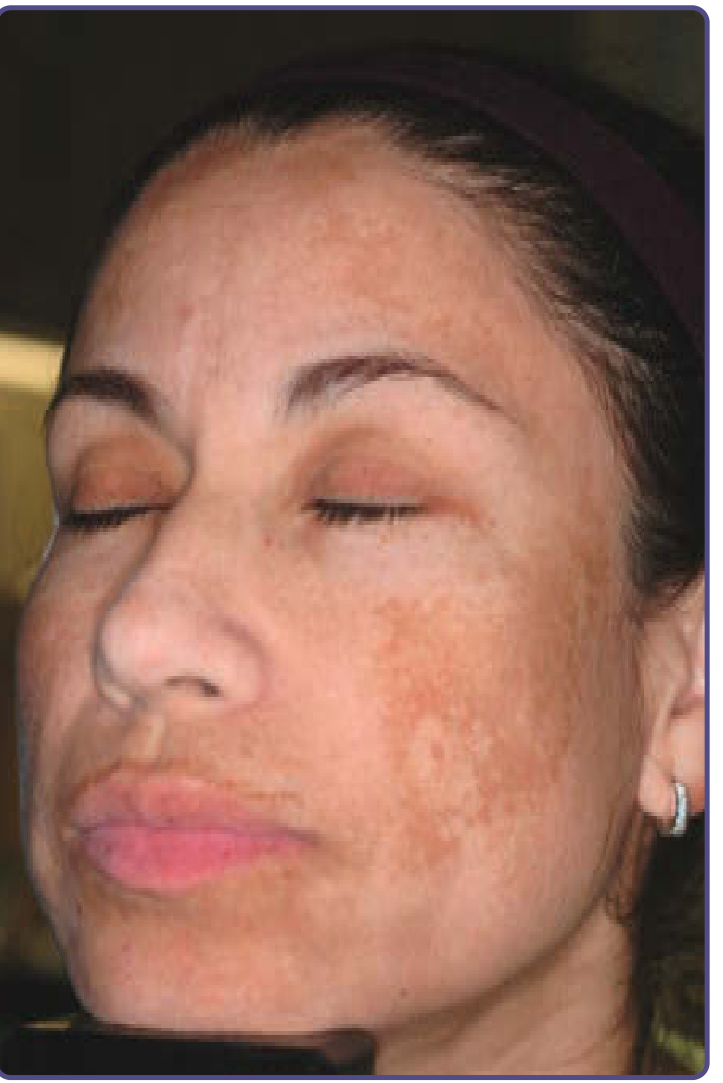
58-year-old female presented with brownish discoloration of the forehead. Her facial skin is fair, but her forehead has brownish discoloration. It is uniform discoloration from right to left and from top to bottom. Bottom area is up to the eyebrow. No papules, no eruptions, no pettechia, not purpura, no history of trauma, no swelling, no redness, no other symptoms. Patient says she had a history of prolonged exposure to sun in the last couple of days.
melasma forehead uniform brown discoloration sun exposure diagnosis treatment
Clinical Assessment: Melasma (Centrofacial Pattern)
Why This Fits
| Feature | This Patient | Melasma Profile |
|---|---|---|
| Age/Sex | 58-year-old female | Predominantly premenopausal/perimenopausal women |
| Location | Forehead, bilateral, uniform | Centrofacial pattern - forehead is primary site |
| Border | Up to eyebrows (sparing periorbital) | Melasma classically spares periorbital skin |
| Color | Uniform brownish | Light-brown to dark-brown macular pigmentation |
| Morphology | No papules, no eruptions | Pure macular pigmentation - no primary lesions |
| Trigger | Prolonged sun exposure | Sun exposure is the primary trigger |
Pathophysiology
Differential Diagnoses to Consider
- Postinflammatory hyperpigmentation (PIH): Requires a prior inflammatory event (eczema, acne, trauma) - absent here
- Drug-induced hyperpigmentation: Certain medications (phenytoin, amiodarone, tetracyclines) - no drug history mentioned; must be asked
- Addison's disease: Diffuse hyperpigmentation but also involves mucous membranes, non-sun-exposed areas, and is accompanied by systemic symptoms (fatigue, hypotension)
- Contact/photocontact dermatitis: Typically associated with redness and pruritus before pigmentation, often patchy
- Phytophotodermatitis: History of plant/citrus exposure + sun; usually streaky/geometric pattern
Recommended Workup
- Wood's lamp examination: Epidermal melasma (most common) shows enhancement under Wood's lamp; dermal melasma does not enhance. Most cases show mixed epidermal and dermal melanin.
- Hormone history: Oral contraceptive use, HRT, thyroid dysfunction
- Medication review: Phenytoin, finasteride (and other potential culprits)
- Dermoscopy: Can help characterize depth and differentiate from mimics
Management
- Broad-spectrum sunscreen (UVA + UVB coverage, SPF 30+) applied daily
- Physical sunscreens (zinc oxide, titanium dioxide) preferred; visible light protection is also needed since visible light can trigger pigmentation
- Sunscreen alone modestly improves melasma AND enhances the efficacy of bleaching agents
- Hydroquinone 2-4% - gold standard tyrosinase inhibitor; available OTC at 2%, prescription at 4%
- Kligman's formula (triple combination): hydroquinone + tretinoin + mild topical corticosteroid - the most effective topical regimen available. Twice-weekly maintenance application is effective.
- Tretinoin alone reduces melasma but is less effective than hydroquinone as monotherapy
- Azelaic acid (tyrosinase inhibitor)
- Kojic acid (inhibits tyrosinase via copper chelation)
- Tranexamic acid (topical or oral - plasmin inhibition + antioxidant mechanism)
- Arbutin
- Methimazole
Key Counseling Points for This Patient
- Sun avoidance and year-round photoprotection are non-negotiable - melasma worsens with every UV exposure
- This is a chronic, relapsing condition - not a single-treatment cure
- Prognosis is generally favorable with consistent photoprotection and appropriate topical therapy
- Enquire about menopausal hormone use, as HRT is a known exacerbating factor; discontinuation rarely clears pigmentation quickly but is still worth discussing
What if it is untreated, that is, she uses only sunscreens, but no treatments like hydroquinone? What is the prognosis of melasma?
melasma prognosis natural history sunscreen
melasma sunscreen photoprotection treatment
PMID: 35229368
PMID: 35906506
Prognosis of Melasma with Sunscreen Only (No Active Treatment)
1. Melasma is a Chronic, Relapsing Disorder
"Melasma is a complex and therapeutically challenging disorder... While treatment regimens boast varying degrees of improvement, recurrence is the norm despite recommended measures such as strict sun protection."
"Melasma is a prevalent chronic relapsing pigmentary disorder... there is currently no curative treatment available for melasma."
2. What Sunscreen Alone Actually Does
- Prevents worsening: By blocking UV light (the primary trigger), sunscreen prevents new melanin stimulation and slows progression
- Modest improvement over time: Broad-spectrum sunscreen use can lessen melasma severity on its own, but the improvement is limited compared to active depigmenting agents
- Enhances any future treatment: If the patient later starts hydroquinone or other agents, sunscreen dramatically amplifies their efficacy
"The majority of melasma patients do not adequately follow photoprotection recommendations... Intensive use of a broad-spectrum sunscreen can prevent melasma in high-risk individuals, can lessen melasma severity... and can reduce relapses - but does not eliminate the underlying pathology."
3. The Problem of Visible Light and UVA1
4. The Dermal Melanin Problem
- More persistent
- Slower to fade
- More resistant to any treatment
5. What to Expect Over Time Without Treatment
| Timeframe | Likely Outcome with Sunscreen Only |
|---|---|
| Short-term (weeks-months) | Pigmentation stabilizes; may lighten slightly if sun is avoided strictly |
| With continued incidental sun exposure | Pigmentation recurs or deepens each summer/sun exposure |
| Long-term (years) | Chronic persistence; some cases may partially fade in winter months but darken again seasonally - a "waxing and waning" pattern |
| Post-menopause | Modest spontaneous improvement is possible as estrogen levels decline, but pigmentation typically does not disappear completely |
6. Quality of Life Impact
"The negative impact on quality of life has been documented repeatedly in the literature; consequently, symptoms of depression and anxiety need to be explored by the treating clinician."
Bottom Line for This Patient
- No cure and likely no significant lightening
- Seasonal fluctuation - darker in summer, slightly lighter in winter
- Gradual persistence of dermal melanin over years that becomes progressively harder to treat
- Partial natural improvement after menopause is possible but unreliable and incomplete
Cause of melasma
Causes of Melasma
1. Ultraviolet and Visible Light (Primary Trigger)
- Melasma affects the face - exclusively sun-exposed areas - and worsens predictably in summer
- Melasma patients have a lower minimal erythema dose (MED) to UV, meaning their skin responds to UV at lower intensities than normal
- They pigment more easily and more intensely with UV exposure
- Solar elastosis (UV-induced dermal damage) is more marked in melasma-affected skin than in adjacent unaffected facial skin
- The condition spontaneously lightens in winter when UV exposure is reduced
- Melasma skin shows reduced WIF-1 (Wnt inhibitory factor-1, a Wnt antagonist) expression
- This leads to increased Wnt signaling, which directly stimulates melanogenesis (melanin production)
- Visible light - particularly high-energy visible light (HEVL, the blue-violet spectrum) - and long-wave UVA1 have also been specifically implicated, especially in darker-skinned individuals. This is why standard sunscreens that only block UVB/short-UVA can be insufficient.
- Increased vascular endothelial growth factor (VEGF) and increased vascularity in lesional epidermis suggest a vascular component to pathogenesis as well - Fitzpatrick's Dermatology, p. 1409
2. Female Sex Hormones (Second Most Important Trigger)
| Hormonal State | Effect |
|---|---|
| Pregnancy | Common trigger ("mask of pregnancy" / chloasma); usually resolves after delivery |
| Oral contraceptive (OC) use | Strong association; importantly, stopping OCs rarely clears the pigmentation - it can persist for many years |
| Hormone replacement therapy (HRT) | Triggers or worsens melasma at menopause |
| Other endocrinologic disorders | Can be associated (e.g. thyroid dysfunction) |
3. Genetic Predisposition
- Strong racial/ethnic clustering: predominantly affects East, West, and Southeast Asians; Hispanics; and Black individuals - especially those with Fitzpatrick skin types IV-V living in high UV-intensity regions
- Up to 30% of middle-aged Asian females have subtle melasma detectable under UV examination
- There is an association between the number of melanocytic nevi (a marker of melanocyte proliferative activity) and the development of melasma
- Family history is common - suggesting a significant hereditary component
4. Drugs
- Phenytoin (anti-epileptic)
- Finasteride (in males - a rare but documented cause)
- Phototoxic drug reactions (e.g. tetracyclines, amiodarone) can cause similar facial pigmentation and may overlap with melasma
5. Age and Cumulative Sun Damage
- Prevalence increases with age in both men and women
- Cumulative UV exposure over a lifetime progressively sensitizes facial melanocytes
- Older patients tend to have a greater proportion of dermal melanin (deposited in dermal melanophages), which is more resistant to treatment
Summary Diagram of Causation
Genetic predisposition (skin type IV-V, family history)
         +
UV light / visible light  →  WIF-1 ↓ → Wnt ↑ → Melanogenesis ↑
         +                                              ↓
Female hormones (pregnancy,                    Hyperactive melanocytes
 OCP, HRT)                                             ↓
         +                               Excess melanin in epidermis
Drugs (phenytoin, finasteride)              ± dermis (melanophages)
                                                        ↓
                                              MELASMA (brown patches)
Why Melasma Is Hard to Eradicate
Can this condition be just a sunburn? How do you differentiate?
Can This Be a Sunburn? Differentiating Melasma from Sunburn/Sun Tan
What a Sunburn Actually Looks Like
- Erythema (redness) - the defining feature, peaking at 12-24 hours after exposure
- Tenderness/pain - the skin hurts to touch
- Edema - especially on the face and extremities
- In severe cases: blistering, chills, fever, nausea, tachycardia, hypotension
- Desquamation - peeling about 1 week later, even in areas that did not blister
- Color is red to pink, not brown
What About Post-Sun Tanning?
| Phase | Timing | Mechanism | Color |
|---|---|---|---|
| Immediate pigment darkening (IPD) | Within hours | Redistribution/oxidation of pre-existing melanin | Transient gray-brown; fades quickly |
| Delayed tanning | Begins 2-3 days after exposure, peaks ~3 days | New melanin synthesis (UVB-induced DNA damage → CPD formation → melanogenesis) | Brown; lasts 10-14 days |
Side-by-Side Comparison
| Feature | Sunburn / Sun Tan | This Patient's Presentation |
|---|---|---|
| Primary color | Red (acute), then fading brown tan | Brownish - no red phase reported |
| Redness | Yes (defining feature) | Absent |
| Pain / tenderness | Yes | Absent |
| Swelling / edema | Common on face | Absent |
| Peeling | Expected ~1 week later | Absent |
| Duration | Tan fades in 10-14 days without further exposure | Melasma persists and does not fade on its own |
| Distribution | Diffuse on all sun-exposed surfaces (whole face, neck, arms) | Confined to forehead with clear lower border at eyebrows; rest of face fair - highly selective |
| Border sharpness | Gradual, corresponds to clothing lines | Melasma borders are sharply demarcated |
| Pre-existing skin | Normal baseline skin pigmentation | Fair baseline skin - the forehead stands out discretely |
| Pattern | Uniform across all exposed areas | Uniform within a specific anatomical zone (forehead), sparing periorbital area |
The Key Differentiating Point: The Distribution
Sunburn as a Trigger, Not the Cause
Bedside Test: Wood's Lamp
- Melasma (epidermal type): pigmentation is accentuated/enhanced under Wood's lamp
- Suntan: no significant enhancement under Wood's lamp
- Dermal melasma: no accentuation (but still melasma)
There is no issue on the eyebrows. It's only in the forehead, and there is no redness, itching, swelling, scaling, and she says that it comes and goes every year during the summer period.
How This New History Refines the Diagnosis
1. "Comes and goes every year during summer" - This is the Hallmark of Melasma
"Melasma is a chronic and relapsing condition with exacerbations during pregnancy, sun or visible light exposure, and with certain hormonal treatments."
2. "No issue on the eyebrows" - Confirms Periorbital Sparing
3. No Redness, No Itching, No Swelling, No Scaling - Rules Out All Inflammatory Differentials
| Condition | Why Now Ruled Out |
|---|---|
| Sunburn | Always has erythema and tenderness - absent here |
| Contact dermatitis | Requires erythema, itch, and often scaling |
| Photocontact / phototoxic dermatitis | Erythema and burning are defining features |
| Seborrheic dermatitis | Has scaling and redness, forehead is a common site but scaling is mandatory |
| Tinea versicolor | Has fine scaling; usually trunk > face |
| Lichen planus pigmentosus | Has an inflammatory phase with violaceous lesions |
| Riehl's melanosis (pigmented contact dermatitis) | History of erythema, burning precedes pigmentation |
4. Confirmed Diagnosis: Melasma, Centrofacial Pattern
| Clinical Feature | Significance |
|---|---|
| 58-year-old female | Classic demographic |
| Uniform brown discoloration, forehead only | Centrofacial pattern |
| Sharp lower border at eyebrow line | Periorbital sparing - characteristic |
| Eyebrows themselves unaffected | Confirms selectivity of melanocyte involvement |
| No papules, redness, itch, swelling, scaling | Pure macular pigmentation, no inflammation |
| Triggered by sun exposure | UV is the primary precipitant |
| Recurs every summer, fades in winter | Chronic seasonal relapsing course - the definitive feature |
What This Seasonal Pattern Also Tells You Clinically
- The pigmentation is likely still predominantly epidermal (not yet deeply dermal), since it is still capable of fading in winter. Dermal melasma tends to be more persistent year-round.
- This is a favorable prognostic sign - epidermal melasma responds better to topical therapy.
- However, each successive summer cycle risks driving more melanin into the dermis (melanophages), making it progressively harder to treat over time. This is the argument for not waiting too long to start treatment.
Management Implication of This Pattern
- Year-round broad-spectrum tinted sunscreen (iron oxide-containing, to block visible/HEVL) - not just in summer
- Pre-emptive topical treatment starting before or at the beginning of summer, rather than waiting for pigmentation to appear
- Maintenance therapy in winter to prevent deepening of dermal deposition over years