
explain variations and anomalities of mandibular central and lateral incisors
Reading File
Now let me search the library database and web simultaneously for comprehensive coverage.
Finding Sources
Finding Sources
Searching the Web
mandibular central lateral incisor variations anomalies dental anatomy
Let me search the library more broadly and extract more detailed content from the web sources.
Finding Sources
Finding Sources
Reading Web Page
http://samples.jblearning.com/9781284224818/9781284218251_CH…
Good — I found a textbook reference. Let me read the embryology textbook block with fusion/gemination images and also search for more anomaly detail in the library.
Reading File
Finding Sources
Finding Sources
I have the key textbook image. Let me fetch it and also search for more anomaly content.
Loading Image
Finding Sources
Finding Sources
I now have excellent material. Let me compile a comprehensive answer.
Variations and Anomalies of Mandibular Central and Lateral Incisors
Overview
Mandibular incisors are the smallest and simplest teeth in the permanent dentition, and as a group they show the least morphologic variation of any tooth type. Nevertheless, clinically significant variations and anomalies do occur, and their recognition matters for endodontics, orthodontics, and oral surgery.
Normal Morphology — Baseline for Comparison
Mandibular Central Incisor
| Feature | Description |
|---|---|
| Size | Smallest tooth in entire dentition (mesiodistally) |
| Symmetry | Nearly perfectly bilaterally symmetrical — extremely difficult to distinguish right from left |
| Incisal edge | Perpendicular to the long axis |
| Crown | Very narrow relative to crown height |
| Root | Single, flattened mesiodistally; deep longitudinal grooves on mesial and distal surfaces |
Mandibular Lateral Incisor
| Feature | Description |
|---|---|
| Size | Slightly larger than the central in all dimensions (unique — opposite of maxillary pattern) |
| Symmetry | Asymmetrical; crown appears to tilt slightly distally on its root |
| Incisal edge | Slopes downward distally (shorter on the distal) |
| Contact points | Mesial contact more incisal than distal contact |
| Incisal aspect | Incisal edge shows a distolingual twist — corresponds to the curvature of the mandibular arch (right side twists clockwise; left side counterclockwise) |
| Cingulum | Slightly off-center to the distal |
Variations (Normal Range Differences)
1. Crown Size and Proportions
- Both teeth show a narrow mesiodistal width relative to crown height — this narrowness is most extreme in the central incisor.
- Slight macrodontia (oversized crown) or microdontia (undersized crown) may occur without being a true anomaly.
2. Incisal Edge Wear and Symmetry
- Incisal edges wear with age; uneven attrition can mimic or obscure morphologic traits.
- The central incisor's hallmark bilateral symmetry is occasionally disrupted by slightly asymmetric developmental lobes.
3. Ethnic/Population Variations
- In some Mongoloid (East Asian) populations, the cingulum of mandibular incisors bears a short, deep cervicoincial groove on the lingual surface. This groove is a caries-prone site and is considered a racial trait rather than a pathologic anomaly.
- Shovel-shaped incisors (prominent marginal ridges) are far more prevalent in maxillary incisors but can occasionally appear in mandibular teeth in the same populations.
4. Root Form Variations
- The normal root is single with a flattened oval cross-section and longitudinal grooves mesially and distally.
- A clinically important variant: two root canals (bifurcated canals) occur in 11–40% of mandibular incisors depending on the study population. Most commonly the root retains a single apex but contains two separate canals (Type III Vertucci classification). This is radiographically subtle and a major source of endodontic treatment failure if unrecognized.
Developmental Anomalies
1. Fusion (Synodontia)
The most clinically significant anomaly specific to mandibular incisors.
- Definition: Union of two adjacent tooth germs by dentin (and sometimes enamel) during development, producing a single enlarged tooth structure.
- Most common site in the mandible: Fusion of the central and lateral incisor — both deciduous and permanent dentitions affected.
- Clinical consequence: The fused tooth occupies the space of two teeth, so the dental arch shows one fewer tooth than expected. This can cause spacing problems, malocclusion, and endodontic complexity (the fused tooth may have one or two root canals).
- Primary dentition: Fusion of primary mandibular central and lateral incisors is relatively common and may be associated with absence of the underlying permanent successor.
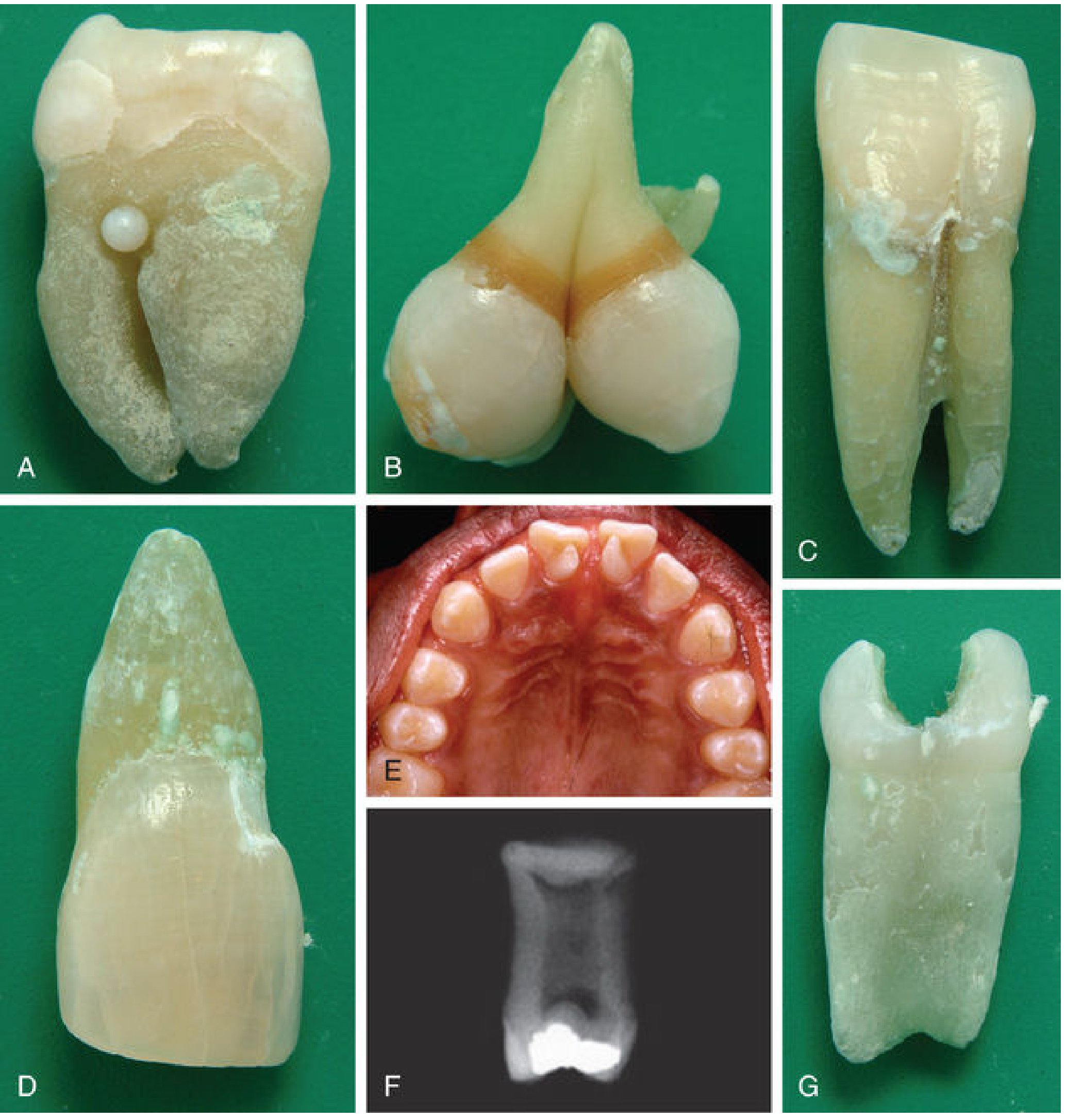
2. Gemination
- Definition: Incomplete division of a single tooth germ attempting to form two teeth; results in a bifid crown on a single root with a single pulp chamber.
- Appears as a large, notched, or grooved crown.
- Differs from fusion in that the tooth count remains normal (gemination = same number of teeth, fusion = one fewer).
- Less common in mandibular incisors than in maxillary teeth but does occur.
3. Congenital Missing (Hypodontia / Agenesis)
- Mandibular central incisor agenesis is a recognized anomaly, though less common than missing maxillary lateral incisors.
- May be isolated or part of a syndrome (e.g., associated with other hypodontia patterns).
- When a mandibular central incisor is congenitally absent, the lateral incisor may drift medially, partially disguising the gap.
4. Peg-Shaped Incisors
- Classically described for maxillary lateral incisors but can occur in mandibular laterals.
- Small, conical, or tapering crown form significantly smaller than normal.
- Represents a form of microdontia with shape alteration.
5. Supernumerary Mandibular Incisors
- An extra (mesiodens-equivalent in the mandible) or additional incisor can erupt or remain impacted between or adjacent to normal incisors.
- Creates crowding, root resorption of adjacent teeth, and midline shift.
- Must be differentiated radiographically from gemination.
6. Dens Invaginatus (Dens in Dente)
- Primarily described in maxillary lateral incisors but rare cases in mandibular incisors are reported.
- The enamel organ invaginates into the developing crown, creating an inner chamber connected to the oral environment — a ready pathway for pulp infection even in an unerupted tooth.
- Radiographically shows a "tooth within a tooth" appearance.
7. Talon Cusp
- An accessory cusp projecting from the cingulum area on the lingual surface.
- More common in maxillary incisors; rare but documented in mandibular incisors.
- Can interfere with occlusion and trigger pulp symptoms if the talon is prominent.
8. Root Anomalies
- Dilaceration: Abrupt angulation or bend in the root, usually from trauma to the deciduous predecessor during root development.
- Short roots (microdont root): Abnormally short root length predisposing to mobility and early tooth loss.
- Accessory root: Very rare in incisors but documented in literature (more common in canines and molars).
9. Lateral Incisor Merged with the Canine
- A rare anomaly in which the mandibular lateral incisor is merged or fused distally to the canine rather than to the central incisor.
- Results in an abnormal arch contour and asymmetric tooth count.
Clinical Significance Summary
| Anomaly | Key Clinical Impact |
|---|---|
| Fusion (central + lateral) | Missing tooth in arch count; endodontic complexity; spacing/orthodontic issues |
| Two root canals | Endodontic failure if second canal missed |
| Congenital agenesis | Orthodontic space management required |
| Dens invaginatus | Early pulp necrosis risk |
| Gemination | Aesthetic/orthodontic problem; root canal may be complex |
| Supernumerary incisor | Crowding, root resorption, impaction |
| Cervicoincial lingual groove (ethnic variant) | Caries susceptibility at groove site |
| Dilaceration | Difficult extraction; poor prognosis for orthodontic movement |
Sources:
- The Developing Human: Clinically Oriented Embryology, Fig. 19.19 — fusion of permanent and primary mandibular incisors, gemination, dens invaginatus
- Morphology of the Permanent Incisors, JB Learning (Wheeler's Dental Anatomy, 10th ed.) — crown morphology, ethnic variations, anomaly list
- University of Mosul Lecture 10 — Dental Anatomy (Mandibular Lateral Incisors)
This is a shared conversation. Sign in to Orris to start your own chat.