
Anti hypertensive drugs classification
Reading File
Now let me search the medical library for antihypertensive drug classifications.
Finding Sources
Finding Sources
Good finds. Let me now read the key sections from Lippincott Pharmacology (which has the antihypertensive drugs figure/summary) and Brenner & Rector's Kidney (which has the pharmacologic classification table).
Reading File
Reading File
Let me now read the Lippincott chapter on antihypertensive drugs more fully, which will have the classification organized neatly.
Reading File
Finding Sources
Excellent. Let me now read Katzung's classification section and the Lippincott detailed drug sections - these are the best pharmacology references.
Reading File
Reading File
Let me now read the full Lippincott antihypertensive section to get all drug classes and their details.
Reading File
I now have enough content to write a comprehensive answer. Let me also fetch the calcium channel blockers comparison diagram image.
Loading Image
I now have comprehensive content from Lippincott Pharmacology and Brenner & Rector's. Here is the full, well-organized answer:
Classification of Antihypertensive Drugs
Antihypertensive drugs lower blood pressure by reducing cardiac output, peripheral vascular resistance, or both. Most current guidelines divide them into the following major classes:
1. Diuretics
Reduce blood volume and, long-term, peripheral resistance.
| Subclass | Key Drugs | Mechanism |
|---|---|---|
| Thiazides | Hydrochlorothiazide, Chlorthalidone, Indapamide, Metolazone | Block Na⁺/Cl⁻ cotransporter in distal tubule |
| Loop diuretics | Furosemide, Bumetanide, Torsemide, Ethacrynic acid | Block Na⁺/K⁺/2Cl⁻ in thick ascending limb |
| K⁺-sparing | Spironolactone, Eplerenone (aldosterone antagonists); Amiloride, Triamterene (ENaC blockers) | Retain K⁺, excrete Na⁺ |
Thiazides are the preferred first-step diuretic for hypertension. Loop diuretics are used when GFR is reduced or edema is present.
2. ACE Inhibitors (ACEIs)
Block conversion of angiotensin I → angiotensin II; also prevent bradykinin breakdown (causing the characteristic dry cough).
Classification by chemical structure (Brenner & Rector's):
- Sulfhydryl group: Captopril
- Carboxyl group: Enalapril, Lisinopril, Ramipril, Benazepril, Fosinopril, Quinapril, Trandolapril
- Phosphinyl group: Fosinopril
Effects: Reduce Ang II-mediated vasoconstriction and aldosterone secretion, reduce peripheral resistance, preserve GFR, reduce SNS activity.
Key adverse effects: Dry cough (bradykinin accumulation), angioedema, hyperkalemia, teratogenicity (contraindicated in pregnancy).
3. Angiotensin II Receptor Blockers (ARBs)
Block AT₁ receptors directly - same hemodynamic effects as ACEIs but no cough (bradykinin not affected).
Drugs: Losartan, Valsartan, Irbesartan, Candesartan, Olmesartan, Telmisartan, Azilsartan.
ACEIs and ARBs should not be combined (dual RAAS blockade increases risk of hypotension, hyperkalemia, and renal failure without added benefit).
4. Renin Inhibitors (Direct)
- Aliskiren - the only approved direct renin inhibitor. Acts earliest in the RAAS cascade (upstream of ACEIs and ARBs). Can cause diarrhea, cough, and angioedema. Contraindicated in pregnancy. Not to be combined with ACEIs or ARBs.
5. Calcium Channel Blockers (CCBs)
Block L-type voltage-gated Ca²⁺ channels. Three chemical classes with distinct pharmacology:
| Class | Drug(s) | Cardiac Effects | Vascular Effects |
|---|---|---|---|
| Diphenylalkylamines | Verapamil | Strong negative inotropy/chronotropy/dromotropy | Moderate vasodilation |
| Benzothiazepines | Diltiazem | Moderate cardiac depression | Moderate vasodilation |
| Dihydropyridines (DHPs) | Nifedipine, Amlodipine, Felodipine, Nicardipine, Isradipine, Nisoldipine | Minimal cardiac effect | Potent vasodilation |
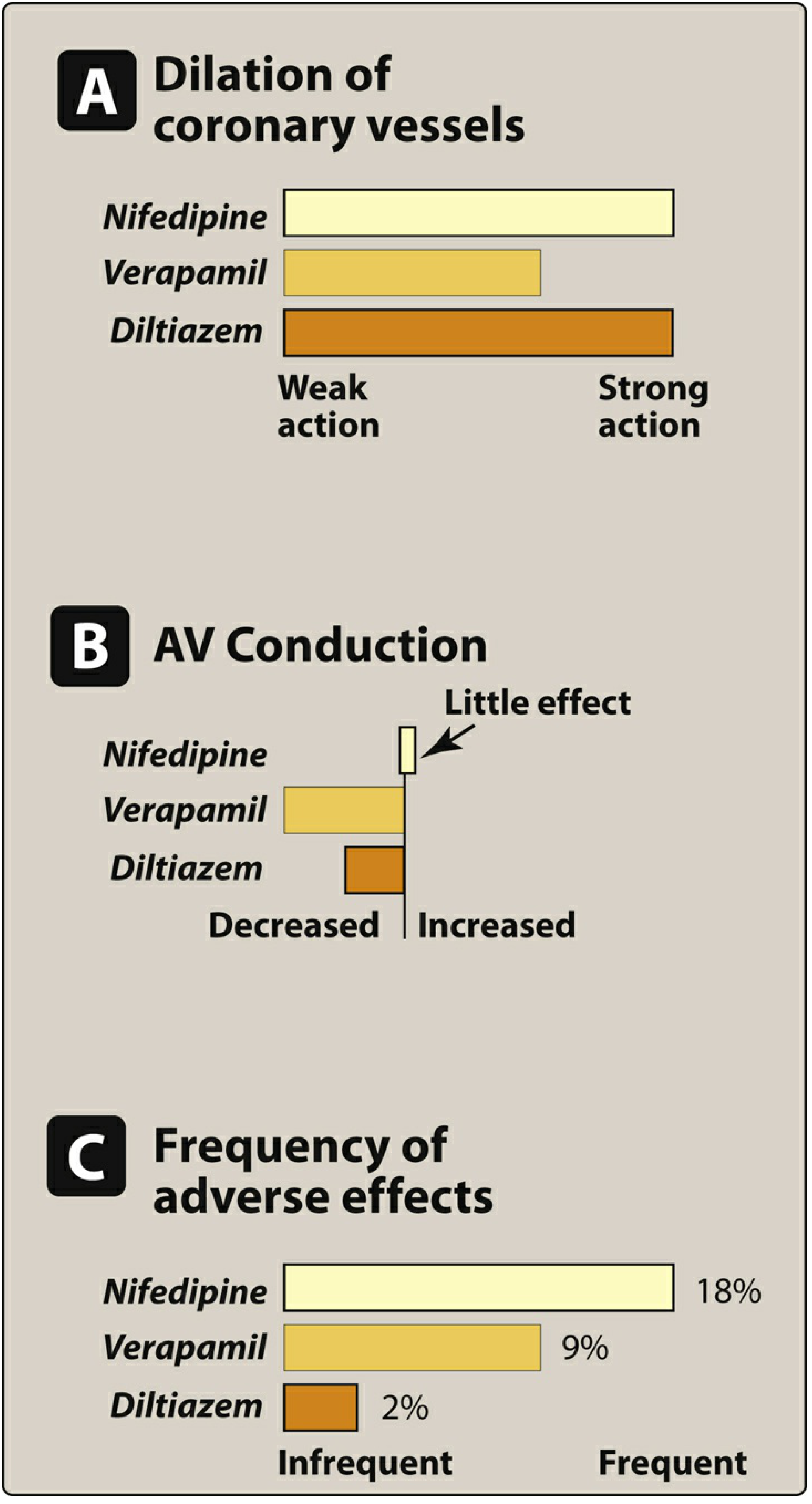
- DHPs are preferred in hypertension because they are predominantly vasodilatory with less cardiac depression.
- Verapamil and diltiazem are also used in supraventricular arrhythmias.
- Amlodipine is one of the most widely used because of its long half-life and favorable side-effect profile.
6. Beta-Blockers (β-Adrenoceptor Antagonists)
Reduce heart rate and cardiac output; also decrease renin release.
| Subtype | Drugs | Selectivity |
|---|---|---|
| Non-selective (β₁ + β₂) | Propranolol, Nadolol, Timolol | Block both receptors |
| Cardioselective (β₁) | Atenolol, Metoprolol, Bisoprolol, Betaxolol, Acebutolol | Preferentially β₁ |
| Mixed α + β blockers | Carvedilol, Labetalol | Block α₁ + β (vasodilation + cardiac depression) |
Beta-blockers are particularly useful in hypertension co-existing with heart failure (carvedilol, bisoprolol, metoprolol succinate), post-MI, or angina. They are less preferred as monotherapy in elderly patients without a compelling indication.
7. Alpha-Adrenoceptor Blockers
α₁-Blockers (Selective)
- Prazosin, Doxazosin, Terazosin - block postsynaptic α₁ receptors → peripheral vasodilation.
- Cause first-dose hypotension (especially prazosin). Useful in patients with hypertension + BPH.
α₂-Agonists (Centrally Acting)
- Clonidine, Methyldopa - stimulate central α₂ receptors → reduce sympathetic outflow.
- Clonidine is also used for opioid withdrawal; methyldopa is the drug of choice in pregnancy-induced hypertension.
- Rebound hypertension occurs with abrupt clonidine withdrawal.
8. Vasodilators (Direct-Acting)
Act directly on vascular smooth muscle to cause relaxation.
| Drug | Mechanism | Notes |
|---|---|---|
| Hydralazine | Opens K⁺ channels → hyperpolarization → arteriolar dilation | IV used in hypertensive emergencies in pregnancy; can cause lupus-like syndrome |
| Minoxidil | Opens K⁺ channels → arteriolar dilation | Most powerful oral vasodilator; causes hirsutism, fluid retention; requires diuretic + beta-blocker co-therapy |
| Nitroprusside | Releases NO → dilates arteries AND veins | IV only; used in hypertensive emergencies; cyanide toxicity at high/prolonged doses |
| Fenoldopam | Selective DA₁ agonist → renal and systemic vasodilation | IV; increases renal perfusion; used in hypertensive emergencies |
| Diazoxide | Opens K⁺ channels → vasodilation | IV bolus; rarely used now |
9. Summary: Mechanism-Based Classification
| Mechanism | Drug Classes |
|---|---|
| Reduce blood volume | Diuretics |
| Block RAAS | ACEIs, ARBs, Direct renin inhibitors |
| Block Ca²⁺ entry | CCBs |
| Reduce cardiac output | Beta-blockers |
| Reduce sympathetic outflow | Central α₂-agonists (clonidine, methyldopa) |
| Block α₁ peripheral receptors | α₁-blockers |
| Direct smooth muscle relaxation | Hydralazine, Minoxidil, Nitroprusside, Fenoldopam |
First-Line Drug Selection (JNC 8 / Current Guidelines)
- Most patients: Thiazide diuretic, ACEI or ARB, or CCB (DHP) as first-line.
- Black patients: CCB or thiazide preferred (ACEIs/ARBs less effective as monotherapy).
- Diabetic nephropathy: ACEI or ARB (renoprotective).
- Heart failure with reduced EF: ACEI/ARB + beta-blocker + aldosterone antagonist.
- Post-MI: Beta-blocker + ACEI.
- Pregnancy: Methyldopa, labetalol, nifedipine (hydralazine for emergencies); ACEIs/ARBs are contraindicated.
Sources: Lippincott Illustrated Reviews: Pharmacology, Ch. 8 | Brenner and Rector's The Kidney, Table 49.1 | Harrison's Principles of Internal Medicine 22E
This is a shared conversation. Sign in to Orris to start your own chat.