
Bones in hands and body
The human body has 206 bones in total, and the hands contain 27 bones each (54 total for both hands). Let me pull up detailed anatomical information from the medical library.
Searching sources...
Reading File
Finding Sources
Finding Sources
Finding Sources
Finding Sources
Searching the Web
bones of the human hand anatomy carpals metacarpals phalanges complete list
Reading File
Reading File
Loading Image
Now let me get the textbook diagram of the hand and a full body skeleton overview:
Loading Image
Finding Sources
I now have excellent textbook content and images. Here is the full answer:
Bones of the Human Body
The adult human body has 206 bones total - 80 in the axial skeleton and 126 in the appendicular skeleton (extremities). - Miller's Review of Orthopaedics
The Human Skeleton at a Glance
Axial Skeleton (80 bones)
The axial skeleton forms the central axis of the body:
| Region | Bones | Count |
|---|---|---|
| Skull (cranium + face) | Frontal, parietal (×2), temporal (×2), occipital, sphenoid, ethmoid; facial bones (mandible, maxilla, zygomatic, etc.) | 22 |
| Vertebral column | Cervical (7), Thoracic (12), Lumbar (5), Sacrum (1 fused), Coccyx (1 fused) | 26 |
| Ribs | 12 pairs (true, false, floating) | 24 |
| Sternum | Manubrium, body, xiphoid process | 3 |
| Hyoid | Hyoid bone (neck) | 1 |
| Auditory ossicles | Malleus, incus, stapes (×2 ears) | 6 |
| Total | ~80 |
Appendicular Skeleton (126 bones)
Forms the limbs and their girdles:
| Region | Count |
|---|---|
| Shoulder girdle (clavicles + scapulae) | 4 |
| Arms (humerus, radius, ulna ×2) | 6 |
| Hands (27 per hand × 2) | 54 |
| Pelvic girdle (hip bones) | 2 |
| Legs (femur, tibia, fibula, patella ×2) | 8 |
| Feet (26 per foot × 2) | 52 |
| Total | ~126 |
Bones of the Hand (27 per hand)
Here is the detailed textbook diagram from Gray's Anatomy for Students:
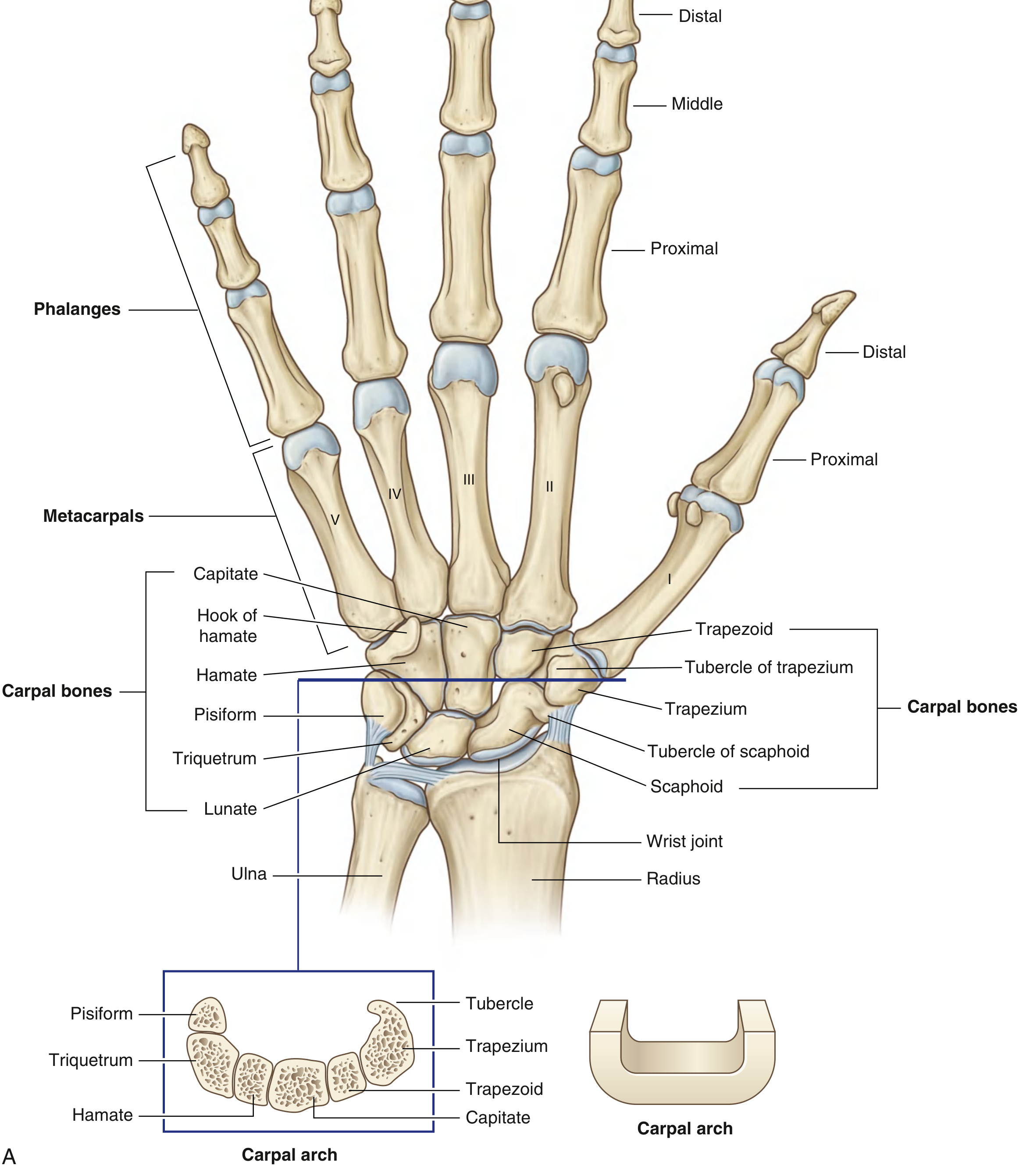
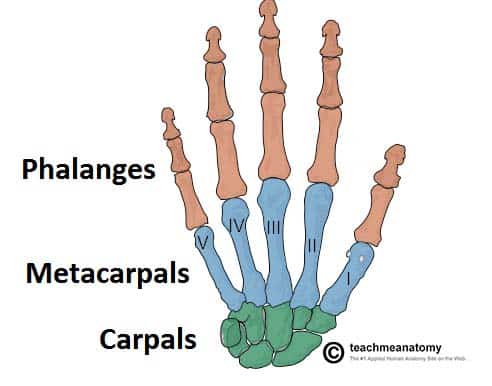
The 27 hand bones are divided into 3 groups:
1. Carpal Bones (8 bones) - The Wrist
Arranged in two rows:
Proximal row (closer to forearm):
- Scaphoid - boat-shaped; most commonly fractured carpal (fall on outstretched hand)
- Lunate - moon-shaped
- Triquetrum - triangular
- Pisiform - pea-shaped; sits on top of triquetrum
Distal row (closer to palm):
- Trapezium - saddle-shaped; articulates with the thumb
- Trapezoid - smallest in distal row
- Capitate - largest carpal bone; central position
- Hamate - has a hook-like projection (hook of hamate)
Memory mnemonic: "She Looks Too Pretty, Try To Catch Her" (Scaphoid, Lunate, Triquetrum, Pisiform, Trapezium, Trapezoid, Capitate, Hamate)
The carpal bones form an arch (the carpal arch/tunnel). The flexor retinaculum spans across the arch, creating the carpal tunnel through which tendons and the median nerve pass. - Gray's Anatomy for Students, p. 914
2. Metacarpal Bones (5 bones) - The Palm
Numbered I to V (thumb to little finger). Each has:
- A base (articulates with carpals)
- A shaft/body
- A head (forms the knuckles when fingers are flexed)
| Metacarpal | Digit |
|---|---|
| I | Thumb |
| II | Index finger |
| III | Middle finger |
| IV | Ring finger |
| V | Little finger |
3. Phalanges (14 bones) - The Fingers
- Thumb (digit I): 2 phalanges - proximal + distal
- Fingers II-V: 3 phalanges each - proximal, middle, distal
Each phalanx has a base, shaft, and head. - Gray's Anatomy for Students, p. 915
Total per hand: 8 carpals + 5 metacarpals + 14 phalanges = 27 bones
Key Clinical Points
- Scaphoid fracture - the most common carpal fracture; at risk for avascular necrosis because blood supply enters distally and runs proximally
- Boxer's fracture - fracture of the 5th metacarpal neck (from punching with a closed fist)
- Carpal tunnel syndrome - compression of the median nerve within the carpal tunnel (pain/numbness in thumb, index, middle fingers)
- Colles' fracture - distal radius fracture (just proximal to the hand) from a fall on an outstretched hand
Here is a helpful video walkthrough of hand and wrist bone anatomy:
Anatomy of the body
Human anatomy is the study of the structure of the human body, covering all organ systems from the skeletal and muscular to the nervous and cardiovascular systems. Let me pull up comprehensive textbook content and diagrams.
Searching sources...
Asking for Preferences
Human anatomy is a vast subject. Which area would you like to focus on?
A full body overview - great choice. Let me pull detailed content from the medical library across all major systems simultaneously.
Searching sources...
Finding Sources
Finding Sources
Searching the Web
human body anatomy all organ systems overview diagram
Finding Sources
Finding Sources
Finding Sources
Finding Sources
Finding Sources
Loading Image
Reading File
Loading Image
Loading Image
Finding Sources
Reading File
I now have excellent content from Gray's Anatomy for Students plus diagrams. Let me compile the comprehensive full-body anatomy overview.
Human Body Anatomy - Full Overview
Human anatomy is the scientific study of the structure and organization of the human body. It spans from the microscopic (cells and tissues) to the macroscopic (organs and organ systems).
1. Levels of Organization
The body is organized into increasing levels of complexity:
| Level | Description | Example |
|---|---|---|
| Chemical | Atoms and molecules | DNA, proteins, water |
| Cellular | Basic unit of life | Neuron, red blood cell |
| Tissue | Group of similar cells | Muscle tissue, nervous tissue |
| Organ | Two or more tissue types working together | Heart, lungs, stomach |
| Organ System | Group of organs with a shared function | Cardiovascular system |
| Organism | All systems working together | The human body |
There are 4 primary tissue types in the body:
- Epithelial - covers surfaces, lines cavities, forms glands
- Connective - supports, binds, and protects (bone, blood, fat, cartilage)
- Muscle - produces movement (skeletal, cardiac, smooth)
- Nervous - transmits electrical signals (neurons and glia)
2. Anatomical Position, Planes & Directional Terms
The anatomical position is the universal reference for describing body structures: standing upright, feet together, face forward, palms facing forward with fingers straight.
Gray's Anatomy for Students, p. 18
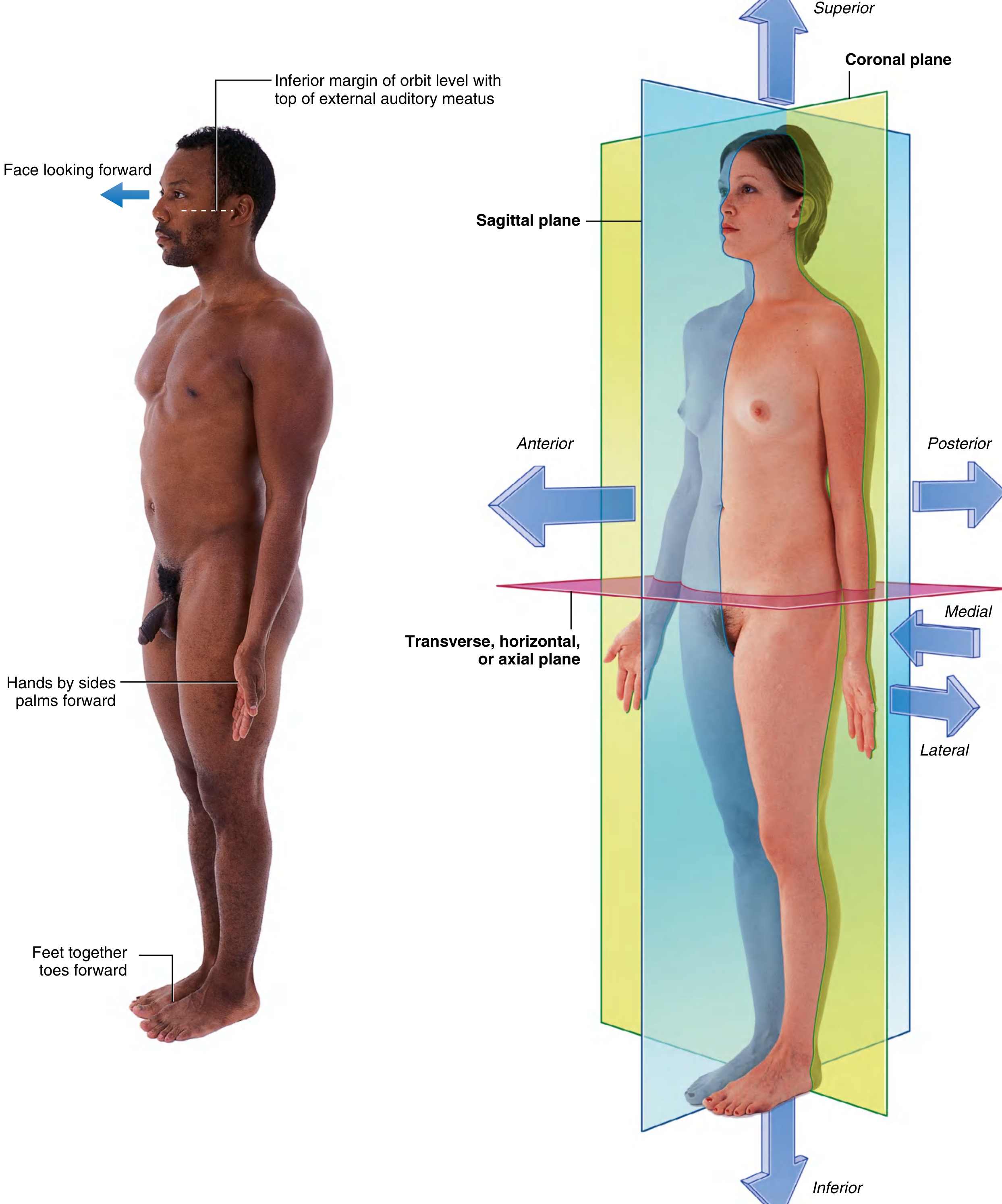
The 3 Anatomical Planes
| Plane | Orientation | Divides body into |
|---|---|---|
| Coronal (Frontal) | Vertical | Anterior (front) and posterior (back) |
| Sagittal | Vertical, perpendicular to coronal | Right and left halves |
| Transverse (Axial) | Horizontal | Superior (upper) and inferior (lower) |
Key Directional Terms
| Term | Meaning | Example |
|---|---|---|
| Anterior / Posterior | Front / Back | Nose is anterior to ears |
| Superior / Inferior | Above / Below | Head is superior to shoulders |
| Medial / Lateral | Toward midline / Away from midline | Thumb is lateral to little finger |
| Proximal / Distal | Closer to / Farther from origin | Hand is distal to elbow |
| Superficial / Deep | Toward surface / Away from surface | Skin is superficial to muscle |
3. Body Regions
The body is divided into major regions:
- Head & Neck - cranial, facial, cervical regions
- Thorax - chest region containing heart and lungs
- Abdomen - contains digestive organs; divided into 9 regions or 4 quadrants
- Pelvis - contains reproductive organs, bladder, rectum
- Upper limbs - shoulder, arm, forearm, hand
- Lower limbs - thigh, leg, ankle, foot
4. The 11 Major Organ Systems
🦴 1. Skeletal System
- Bones: 206 total (80 axial + 126 appendicular)
- Functions: Support, protection, movement, mineral storage, blood cell production
- Key structures: Skull, vertebral column, ribs, sternum, limb bones
- Axial skeleton: Skull + vertebral column + rib cage
- Appendicular skeleton: Shoulder girdle, arms, pelvic girdle, legs
💪 2. Muscular System
- ~600 named muscles in the body
- 3 types:
- Skeletal muscle - voluntary, attached to bones, striated
- Cardiac muscle - involuntary, found only in the heart, striated
- Smooth muscle - involuntary, found in walls of organs and vessels
- Functions: Movement, posture, heat production, organ function
❤️ 3. Cardiovascular System
- Heart: 4-chambered pump (2 atria + 2 ventricles); located in the mediastinum
- Blood vessels:
- Arteries - carry blood away from heart (oxygenated, except pulmonary artery)
- Veins - carry blood toward heart (deoxygenated, except pulmonary vein)
- Capillaries - site of gas/nutrient exchange
- Functions: Transport O₂, nutrients, hormones; remove CO₂ and waste; immune defense
- Two circuits:
- Pulmonary circulation - heart → lungs → heart
- Systemic circulation - heart → body → heart
🫁 4. Respiratory System
- Upper airway: Nasal cavity, pharynx, larynx
- Lower airway: Trachea → bronchi → bronchioles → alveoli (gas exchange site)
- Lungs: Right lung (3 lobes), Left lung (2 lobes - smaller due to cardiac notch)
- Functions: O₂ intake, CO₂ removal, pH regulation, vocalization
🧠 5. Nervous System
- Central Nervous System (CNS): Brain + spinal cord
- Brain regions: Cerebrum, cerebellum, brainstem (midbrain, pons, medulla)
- Peripheral Nervous System (PNS): Cranial nerves (12 pairs) + spinal nerves (31 pairs)
- Somatic - voluntary motor and sensory
- Autonomic - involuntary; sympathetic ("fight or flight") and parasympathetic ("rest and digest")
- Functions: Sensory input, integration, motor output, higher cognition
🧪 6. Endocrine System
- Glands and hormones that regulate body functions through the bloodstream
- Key glands: Hypothalamus, pituitary (master gland), thyroid, parathyroid, adrenal, pancreas (endocrine part), gonads (testes/ovaries), pineal
- Functions: Growth, metabolism, reproduction, stress response, homeostasis
🍽️ 7. Digestive System
- Alimentary canal (GI tract): Mouth → pharynx → esophagus → stomach → small intestine (duodenum, jejunum, ileum) → large intestine (cecum, colon, rectum) → anus
- Accessory organs: Liver, gallbladder, pancreas (exocrine part), salivary glands
- Functions: Ingestion, digestion, absorption of nutrients, elimination of waste
🚰 8. Urinary System
- Organs: Kidneys (×2), ureters (×2), urinary bladder, urethra
- Nephron - functional unit of the kidney (~1 million per kidney)
- Functions: Filter blood, produce urine, regulate water/electrolyte balance, acid-base balance, blood pressure, erythropoietin production
🛡️ 9. Immune & Lymphatic System
- Lymphatic vessels drain excess interstitial fluid back to blood
- Lymphoid organs: Lymph nodes, spleen, thymus, tonsils, bone marrow
- Cells: T-lymphocytes, B-lymphocytes, macrophages, NK cells
- Functions: Immune defense, fat absorption (lacteals in gut), fluid balance
🌿 10. Integumentary System
- Skin - largest organ (~1.5-2 m²); two layers: epidermis (outer) + dermis (inner)
- Accessory structures: Hair, nails, sweat glands, sebaceous glands
- Functions: Protection from environment, temperature regulation, sensation, vitamin D synthesis, fluid retention
🧬 11. Reproductive System
- Male: Testes (sperm + testosterone), epididymis, vas deferens, seminal vesicles, prostate, urethra, penis
- Female: Ovaries (eggs + estrogen/progesterone), fallopian tubes, uterus, vagina, external genitalia
- Functions: Gametogenesis, hormone production, sexual reproduction, pregnancy (female)
5. Body Cavities
The body contains major fluid-filled cavities that house and protect organs:
| Cavity | Location | Contents | Membrane |
|---|---|---|---|
| Cranial | Skull | Brain | Meninges |
| Spinal | Vertebral column | Spinal cord | Meninges |
| Thoracic | Chest | Heart, lungs, esophagus | Pleura (lungs), Pericardium (heart) |
| Abdominal | Abdomen | Stomach, intestines, liver, kidneys | Peritoneum |
| Pelvic | Pelvis | Bladder, rectum, reproductive organs | Peritoneum |
6. Homeostasis
All organ systems work together to maintain homeostasis - a stable internal environment. Key regulated variables include:
- Body temperature (~37°C)
- Blood pH (7.35-7.45)
- Blood glucose (70-100 mg/dL fasting)
- Blood pressure (~120/80 mmHg)
- Fluid and electrolyte balance
Homeostasis is maintained through negative feedback loops - when a variable deviates from its set point, the body responds to bring it back.
This full-body overview draws from Gray's Anatomy for Students and Miller's Review of Orthopaedics. For a deep dive into any specific system, just ask!
This is a shared conversation. Sign in to Orris to start your own chat.