

1000898104.jpg
Marks like papules on left hand near Palm with burning sensation pain feeling like stabbing. No history of fever vitally stable patient
analyse_media
Reading File
The image shows a dense, grouped cluster of small vesicles/papules on the dorsal forearm near the palm. Now searching the medical library for herpes zoster and grouped vesicular eruptions.
Finding Sources
Finding Sources
Searching PubMed
"herpes zoster" hand treatment
Reading File
Reading File
Reading File
Finding Sources
Reading File
Reading File
I now have enough information for a thorough clinical answer. Let me also quickly fetch the reference zoster image from the textbook.
Loading Image
Clinical Assessment: Herpes Zoster (Shingles)
Most Likely Diagnosis: Herpes Zoster (VZV Reactivation)
The clinical picture is highly consistent with herpes zoster ("shingles"):
| Feature | This Patient | Herpes Zoster |
|---|---|---|
| Lesion morphology | Dense cluster of small dome-shaped vesicles/papules | Grouped vesicles on erythematous base |
| Arrangement | Herpetiform (tightly grouped) | Dermatomal, clustered |
| Location | Left hand/near palm (distal extremity) | Less common distally but recognized |
| Symptoms | Burning + stabbing pain | Burning, lancinating, or boring pain |
| Fever | Absent | Often absent in immunocompetent |
| Vitals | Stable | Usually stable |
The image shows a well-defined cluster of 1-3 mm translucent vesicular papules on an erythematous base over the dorsal forearm/wrist, with a linear scratch-like red mark through the center. This grouped/herpetiform distribution is the hallmark of VZV.
Compare with the classic textbook image of Herpes Zoster (Fitzpatrick's Dermatology):
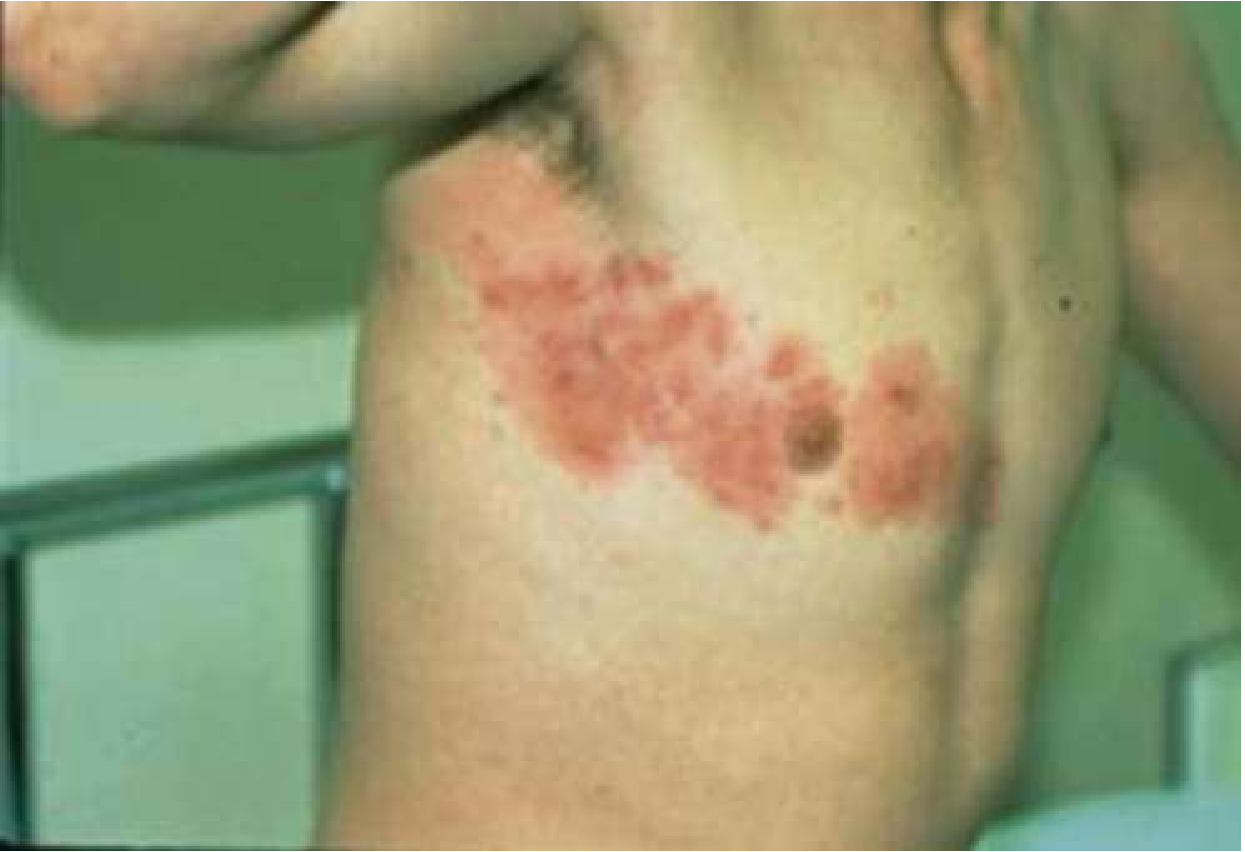
Pathophysiology
Herpes zoster results from reactivation of varicella-zoster virus (VZV) that has remained dormant in a sensory ganglion following prior chickenpox infection. The virus travels down the sensory nerve (axonal/intraneural spread) to the skin within that dermatome. The hand/wrist involvement here suggests reactivation from a cervical (C6/C7/C8) dorsal root ganglion. - Fitzpatrick's Dermatology, Vol 1-2
Clinical Features Explained
- Burning/stabbing pain: VZV causes acute neuritis. Pain and paresthesia in the dermatome often precede the rash by 1-10 days (prodrome) and is described as "sharp, dull, burning, boring, or lancinating." - Rosen's Emergency Medicine
- No fever: Typical in immunocompetent, vitally stable patients. Fever suggests disseminated disease.
- Grouped vesicles: Closely packed vesicles on erythematous skin, evolving from macules/papules → vesicles (Day 1-2) → pustules (Day 3) → crusts (Day 7-10). - Fitzpatrick's Dermatology
Differentials to Keep in Mind
- Herpes Simplex (HSV-1/2) - Can cause grouped vesicles but typically recurs in the same spot; less commonly on the hand dorsum; usually smaller area
- Dyshidrotic eczema (pompholyx) - Small vesicles on palms/fingers but bilateral, associated with sweating/atopy, no dermatomal pain
- Insect bite reaction - Possible but lesions lack the characteristic grouped/herpetiform pattern and neuritic pain
- Contact dermatitis - Possible but no itching mentioned and the neuritic burning is against it
The neuritic burning/stabbing quality and the herpetiform grouped vesicle cluster together make herpes zoster the leading diagnosis by far.
Management
Step 1 - Start Antiviral Therapy (within 72 hours for best effect, up to 7 days still beneficial):
| Drug | Dose | Duration |
|---|---|---|
| Valacyclovir (preferred - better bioavailability) | 1000 mg TID | 7 days |
| Famciclovir | 500 mg TID | 7 days |
| Acyclovir | 800 mg 5x/day | 7 days |
All three are FDA-approved and equally effective at reducing severity and duration. Valacyclovir/famciclovir are preferred due to simpler dosing. - Dermatology 2-Volume Set 5e; Rosen's Emergency Medicine
Step 2 - Pain Management:
- Acute pain: NSAIDs or paracetamol for mild; consider opioids for severe
- Neuropathic component: Gabapentin or pregabalin (also reduces risk of postherpetic neuralgia)
- Topical: Burrow's solution compresses help dry lesions
Step 3 - Wound Care:
- Keep lesions clean and dry
- Avoid rupturing vesicles to prevent secondary infection
- Cover lesions to prevent spread to immunocompromised contacts or pregnant/unvaccinated individuals (lesions are contagious until crusted)
Step 4 - Evaluate for Risk Factors:
- Is this patient immunocompromised? (HIV, malignancy, steroids)
- Age? Zoster in young patients (<40 years) warrants investigation for underlying immunosuppression
- Any ocular symptoms or tip-of-nose involvement? (Hutchinson sign - warrants urgent ophthalmology review)
Red Flags - Escalate If:
- Dissemination (lesions outside single dermatome, >20 lesions outside the affected dermatome)
- Eye involvement (zoster ophthalmicus)
- Motor weakness in the affected limb (Ramsay Hunt variant if ear/face involved)
- Immunocompromised patient - consider IV acyclovir
Key Complication to Counsel About
Postherpetic Neuralgia (PHN): Pain persisting >3 months after rash heals. Occurs in ~15% of patients, more common in the elderly. Early antiviral treatment is the best prevention. - Rosen's Emergency Medicine
Disclaimer: This is a clinical decision-support analysis based on the provided image and history. Final diagnosis and treatment decisions should be made by the treating clinician with full clinical context, examination, and applicable investigations.
This is a shared conversation. Sign in to Orris to start your own chat.