
Psoriasis
Reading File
Now I'll search the medical library and PubMed in parallel for comprehensive psoriasis coverage.
Finding Sources
Searching PubMed
"psoriasis"[MeSH Terms] AND treatment
Searching the Web
psoriasis 2025 2026 updated guidelines treatment biologics
Now let me read the primary psoriasis section from Fitzpatrick's and Andrews' dermatology textbooks in parallel.
Reading File
Reading File
Good content from Andrews'. Let me read more from Andrews' and the Fitzpatrick's main psoriasis section in parallel.
Reading File
Reading File
Excellent - I have rich content from both Fitzpatrick's and Andrews'. Let me fetch a few key clinical images to include in the answer.
Loading Image
Loading Image
Loading Image
I now have comprehensive material from Fitzpatrick's and Andrews' dermatology, plus the latest guidelines and PubMed evidence. Here is the full answer:
Psoriasis
Definition & Overview
Psoriasis is a common, chronic, recalcitrant inflammatory skin disease characterized by discrete erythematous plaques with adherent micaceous (silvery) scales. It affects approximately 2-3% of the world's population and is now recognized as a systemic inflammatory disease - not merely a skin disorder - with significant metabolic, cardiovascular, and articular comorbidities. - Fitzpatrick's Dermatology, p. 227
Pathogenesis
The modern understanding centers on a dysregulated immune axis involving Th1 and Th17 T-cell subsets:
- Keratinocyte hyperproliferation: Basal keratinocyte transit time is markedly reduced, driving epidermal thickening (acanthosis) and hyperkeratosis.
- Th1/Th17 axis: The inflammatory infiltrate is predominantly Th1- and Th17-polarized memory T cells, plus neutrophils, macrophages, and dendritic cells.
- Key cytokines: TNF-α, IL-17, and IL-23 are the primary drivers. Dermal dendritic cells co-produce TNF-α and IL-23; IL-23 promotes Th17 differentiation; IL-17 drives neutrophilic inflammation and keratinocyte gene expression changes.
- IL-23 structure: It is a heterodimer of IL-23-specific p19 and p40 (shared with IL-12, the Th1-promoting cytokine) - this explains why anti-p40 antibodies target both pathways.
- Chemokines: CXCL8 (IL-8) attracts neutrophils to form Munro abscesses; various chemokines recruit lymphocytes (epidermotropism). - Fitzpatrick's, p. 213-228
The central role of T lymphocytes was confirmed by the efficacy of cyclosporine (calcineurin inhibitor), denileukin diftitox (IL-2 receptor-directed cytotoxin), and alefacept (CD2-binding agent) in clearing psoriasis. - Fitzpatrick's, p. 228
Clinical Features
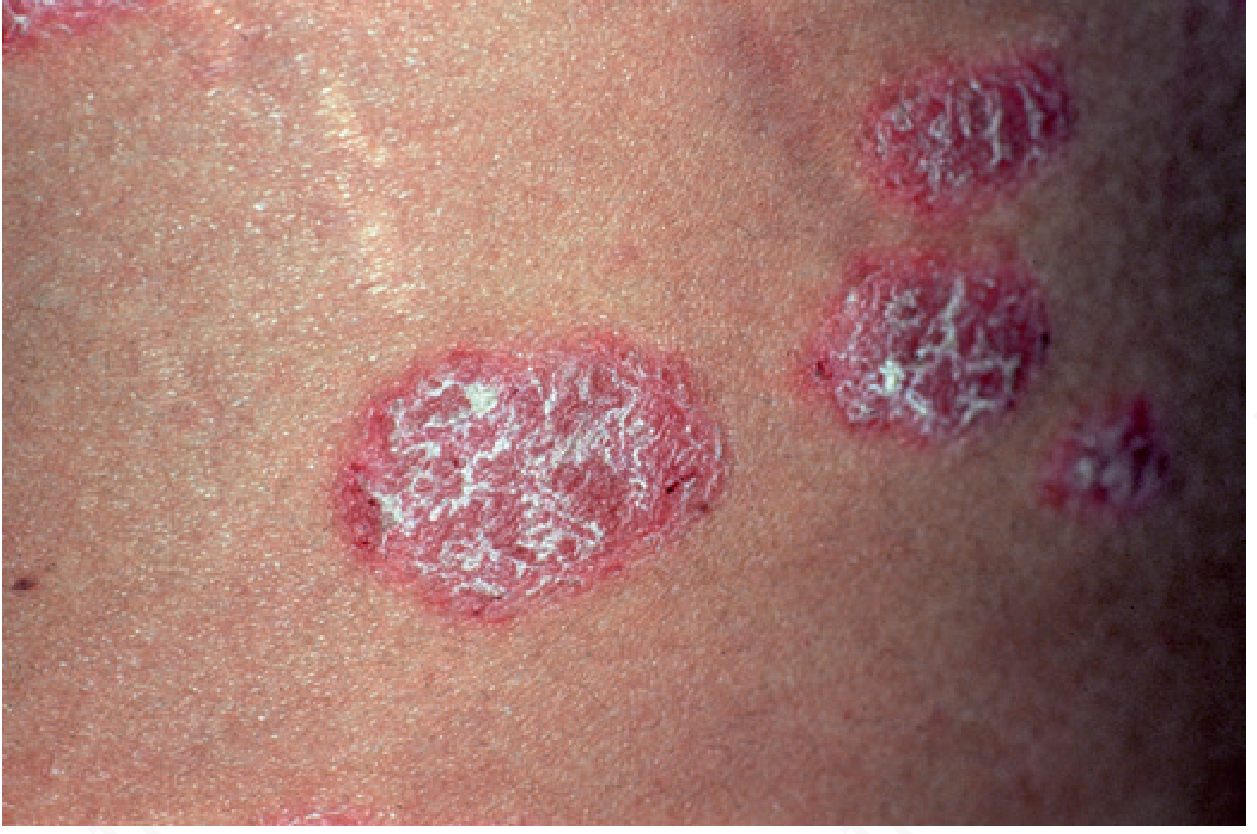
Psoriasis presents as circumscribed, erythematous, dry, scaling plaques - symmetrically distributed with a predilection for:
- Scalp
- Nails
- Extensor surfaces (elbows, knees)
- Umbilical region
- Sacrum
Key signs:
- Auspitz sign: Removal of scales reveals pinpoint bleeding points (dilated capillary loops in the superficial dermis)
- Koebner (isomorphic) phenomenon: New lesions at sites of skin trauma
- Scales: Micaceous (peel in layers), looser peripherally, adherent centrally
Symptoms include pruritus and burning; lesions increase in size by peripheral extension and coalescence. - Andrews' Diseases of the Skin, p. 230
Morphological Variants
| Variant | Description |
|---|---|
| Plaque (psoriasis vulgaris) | Most common; stable, chronic plaques on trunk/extremities |
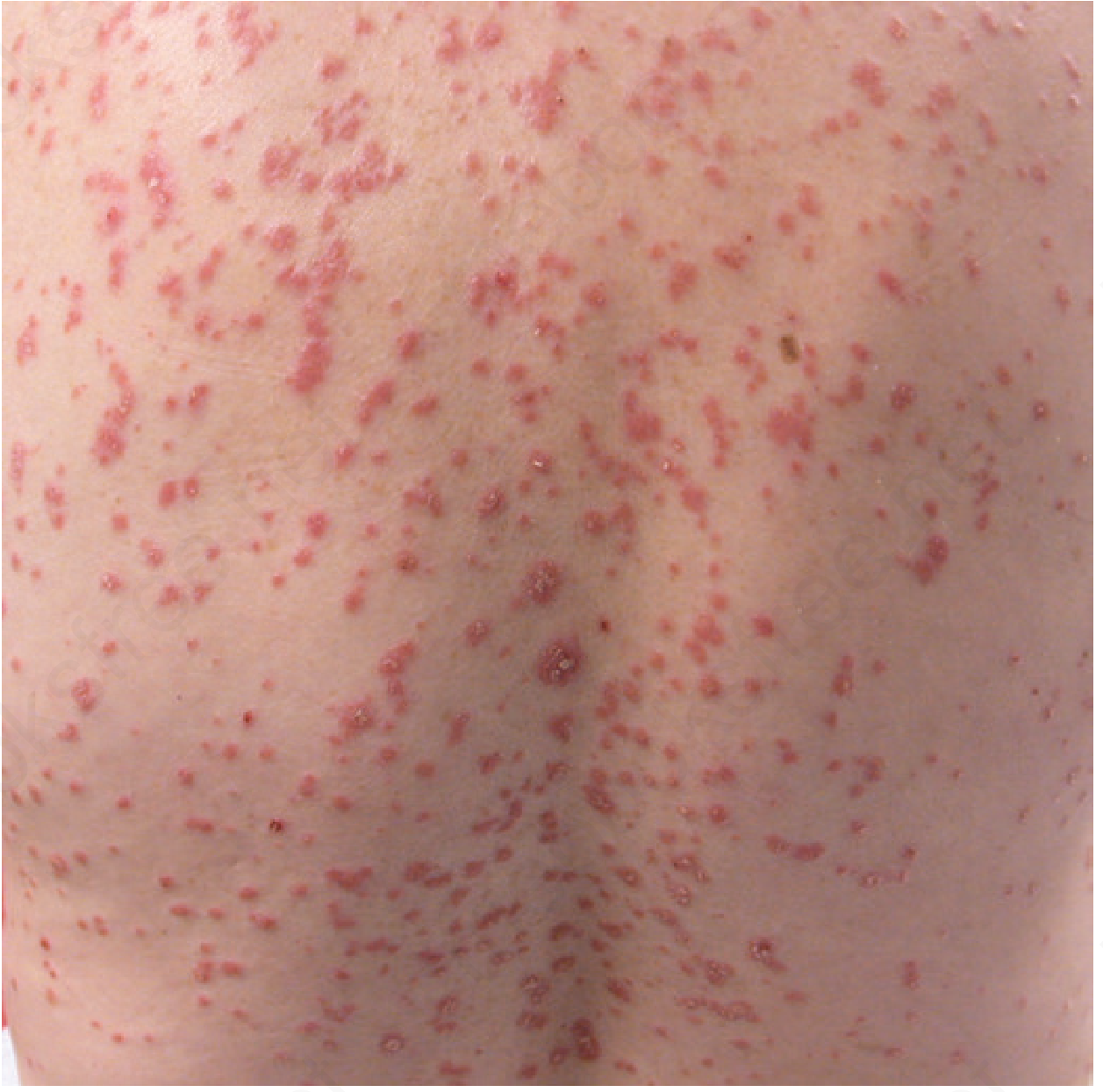
| Guttate | Droplike lesions; sudden onset; often post-streptococcal |
| Inverse | Intertriginous areas (axillae, groin, submammary); lacks scale due to moisture |
| Pustular (localized) | Palms and soles; chronic |
| Pustular (generalized, von Zumbusch) | Acute; fever, erythroderma, hypocalcemia, cachexia; life-threatening |
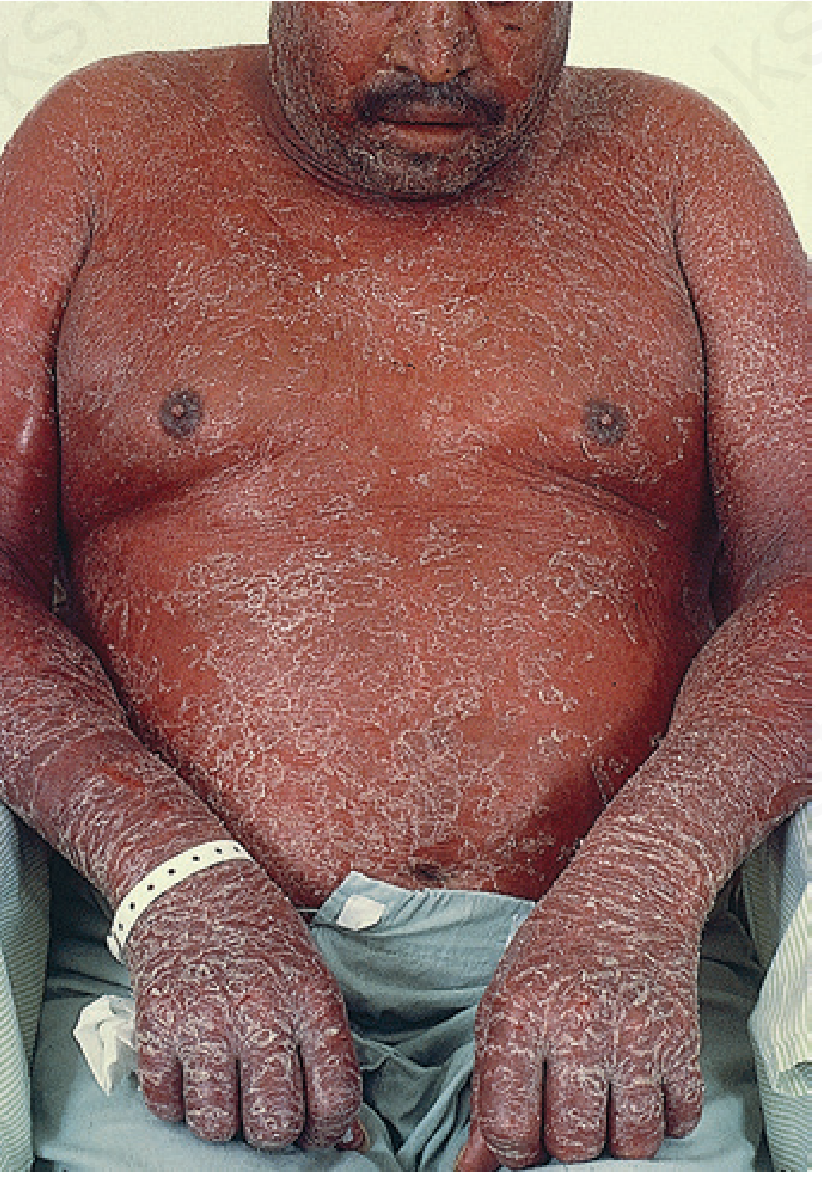
| Erythrodermic | >90% BSA involvement; systemic toxicity; temperature dysregulation |
| Psoriasis ostracea | Thick, oyster-shell-like lamellar plaques |
| Acrodermatitis continua (Hallopeau) | Acral pustular plaques; nail loss (anonychia) |
| Impetigo herpetiformis | Pustular psoriasis of pregnancy |
Andrews' Diseases of the Skin, p. 230-232
Guttate psoriasis:
Classic plaque psoriasis:
Erythrodermic psoriasis:
Histopathology
| Feature | Description |
|---|---|
| Acanthosis | Epidermal thickening (hyperplasia) |
| Parakeratosis | Nuclei retained in stratum corneum |
| Munro microabscesses | Neutrophilic collections in stratum corneum |
| Spongiform pustule of Kogoj | Neutrophils in spinous layer (pustular psoriasis) |
| Dilated capillary loops | Extend into superficial dermis - explains Auspitz sign |
| Reduced granular layer | Absent or thinned stratum granulosum |
| Lymphocytic infiltrate | Predominantly Th1/Th17 memory T cells in dermis |
Nail Changes (Psoriatic Nails)
Present in ~50% of patients; virtually universal in psoriatic arthritis. Features include:
- Pitting (most common)
- Onycholysis ("oil drop" or salmon patch sign)
- Subungual hyperkeratosis
- Leukonychia
- Splinter hemorrhages
Psoriatic Arthritis (PsA)
Occurs in ~30% of psoriasis patients. Five patterns:
- Asymmetric oligoarthritis (most common)
- Symmetric polyarthritis (resembles RA)
- Distal interphalangeal predominant
- Arthritis mutilans (severe, destructive)
- Axial (sacroiliitis/spondylitis)
PEST questionnaire is used for annual joint screening before irreversible damage occurs.
Triggering/Exacerbating Factors
- Infections: Streptococcal pharyngitis (guttate), HIV
- Drugs: Beta-blockers, lithium, antimalarials (chloroquine), NSAIDs, corticosteroid withdrawal, iodides, terbinafine
- Trauma (Koebner phenomenon)
- Stress
- Alcohol and smoking
- Obesity
Treatment
Severity Assessment (PASI/BSA/DLQI)
- Mild: BSA <10%, PASI <10, DLQI <10
- Moderate-to-severe: BSA >10%, PASI >10, or DLQI >10
1. Topical Therapy (Mild Disease)
| Agent | Mechanism/Notes |
|---|---|
| Topical corticosteroids | First-line; high-potency (clobetasol 0.05%) for thick plaques |
| Calcipotriene (Vitamin D analog) | Inhibits keratinocyte proliferation; often combined with steroids |
| Coal tar | Antiproliferative; useful for scalp/nails |
| Tazarotene (retinoid) | Normalizes differentiation |
| Calcineurin inhibitors | Tacrolimus/pimecrolimus for inverse/facial psoriasis |
2. Phototherapy (Moderate Disease)
- Narrowband UVB (NB-UVB): First-line phototherapy; safe in pregnancy
- PUVA (Psoralen + UVA): More effective but higher skin cancer risk
- Excimer laser (308 nm): Localized resistant plaques
3. Conventional Systemic Agents
| Drug | Notes |
|---|---|
| Methotrexate | Weekly dosing; monitor LFTs; teratogenic; first-line systemic |
| Cyclosporine | Rapid onset; nephrotoxic long-term; not for >1-2 years |
| Acitretin | Drug of choice for generalized pustular psoriasis; teratogenic |
| Apremilast | PDE4 inhibitor; oral; avoids lab monitoring |
4. Biologics (Moderate-to-Severe Disease)
TNF-α inhibitors:
- Etanercept, adalimumab, infliximab, certolizumab
- Historical first-line biologics; still widely used; avoid in TB/demyelinating disease
IL-12/23 inhibitor (anti-p40):
- Ustekinumab - effective for both skin and PsA; useful in IBD patients
IL-17 inhibitors:
- Secukinumab, ixekizumab, bimekizumab (also inhibits IL-17F)
- Highest efficacy in plaque psoriasis; avoid in IBD
IL-23 inhibitors (anti-p19):
- Guselkumab, risankizumab, tildrakizumab
- Among the most effective agents; favorable dosing intervals; safe in IBD
Updated 2025-2026 guidance: The 2026 German S3 guideline (updated from EuroGuiDerm) and new French guidelines now position biologics (especially IL-17 and IL-23 inhibitors) as first-line options for moderate-to-severe disease, equivalent to methotrexate, with biosimilars making this economically feasible. IL-17 inhibitors are recommended against in psoriasis with concurrent IBD; TNF inhibitors, IL-12/23, and IL-23 inhibitors are preferred in that setting.
Generalized Pustular Psoriasis
- Acitretin is the drug of choice; isotretinoin also effective
- Cyclosporine, methotrexate, and biologics are alternatives
- Dapsone 50-100 mg/day in some cases
- Andrews' Diseases of the Skin, p. 232
Comorbidities
Psoriasis is a systemic disease. Key associations:
- Cardiovascular disease (increased MI, stroke risk - related to systemic inflammation)
- Metabolic syndrome (obesity, dyslipidemia, hypertension, T2DM)
- Psoriatic arthritis (~30%)
- Inflammatory bowel disease (Crohn's, UC)
- Non-alcoholic fatty liver disease
- Depression and anxiety (significant QoL impact)
- Uveitis
Recent Evidence (2024-2025)
A 2025 Cochrane network meta-analysis (PMID 40767824) on systemic pharmacological treatments for chronic plaque psoriasis confirmed that IL-17 and IL-23 inhibitors achieve the highest rates of PASI 90/100 clearance among available agents. A 2026 study in BJD found that initiating biologics as first-line systemic treatment (rather than stepping through conventional agents first) is associated with greater clinical improvement.
Note: The Cochrane network meta-analysis (PMID 40767824, published August 2025) may update hierarchy of treatment efficacy - if selecting a biologic, IL-17/IL-23 inhibitors rank highest for skin clearance.
Sources:
- Fitzpatrick's Dermatology in General Medicine, 9th ed., pp. 213-230
- Andrews' Diseases of the Skin: Clinical Dermatology, pp. 230-232
- 2026 German S3 Guideline (EuroGuiDerm)
- Cochrane NMA 2025 - Systemic treatments for plaque psoriasis (PMID 40767824)
This is a shared conversation. Sign in to Orris to start your own chat.