

u pls teach me according to the paper setter of neet2027 from ncert
The image shows UNIT 5: Human Physiology with 6 topics. Which one do you want to start with?
🫁 UNIT 5 - Breathing & Respiration
NEET 2027 | NCERT-Based | Complete Notes
1. RESPIRATORY ORGANS IN ANIMALS (Recall Only)
| Animal | Respiratory Organ |
|---|---|
| Insects | Tracheae (tracheal system) |
| Fish | Gills |
| Frogs | Lungs + Moist skin (cutaneous) |
| Reptiles / Birds / Mammals | Lungs |
NEET tip: Frog does cutaneous respiration - direct NEET MCQ target!
2. HUMAN RESPIRATORY SYSTEM - STRUCTURE
Parts (Upper to Lower):
- Trachea - supported by C-shaped cartilaginous rings (incomplete posteriorly to allow food passage in oesophagus)
- Epiglottis - prevents entry of food into trachea during swallowing
- Alveoli - functional unit of lungs; site of gas exchange; walls are one cell thick (squamous epithelium)
- Lungs are covered by pleural membranes (double layered); pleural fluid reduces friction
- Right lung has 3 lobes; Left lung has 2 lobes (to accommodate heart)
NEET tip: "3 lobes right, 2 lobes left" is a direct 1-marker.
3. MECHANISM OF BREATHING
Inspiration (Active process)
- Diaphragm contracts → flattens downward
- External intercostal muscles contract → ribs move up and out
- Thoracic volume increases → lung volume increases → pressure decreases (below atmospheric)
- Air flows IN
Expiration (Passive at rest)
- Diaphragm relaxes → domes upward
- Internal intercostal muscles contract (in forced expiration)
- Thoracic volume decreases → pressure increases (above atmospheric)
- Air flows OUT
Key law: Inspiration occurs when intrapulmonary pressure < atmospheric pressure. Expiration when intrapulmonary pressure > atmospheric pressure.
4. RESPIRATORY VOLUMES & CAPACITIES (MEGA NEET TOPIC - 3-4 marks expected)
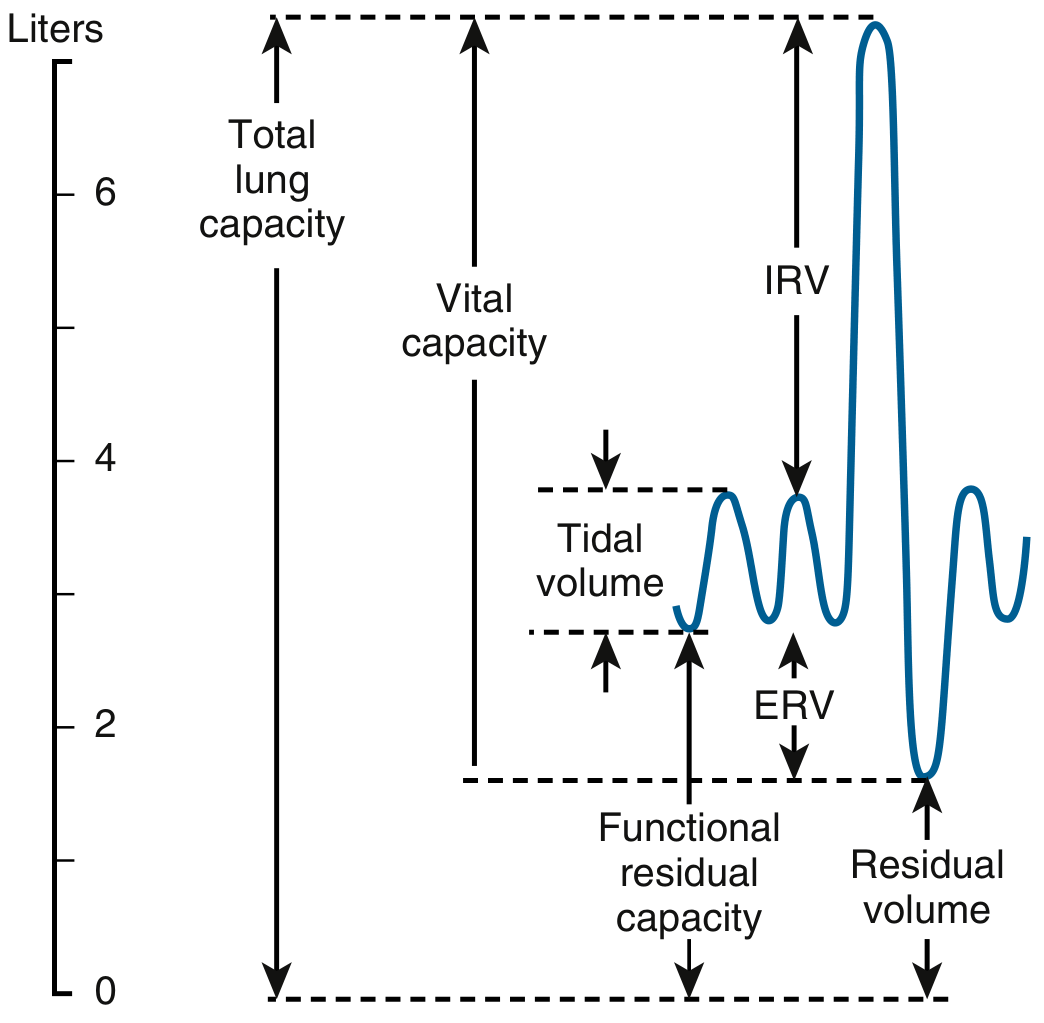
Four Primary Volumes:
| Volume | Full Name | Value | Definition |
|---|---|---|---|
| TV | Tidal Volume | 500 mL | Air inspired/expired per normal breath |
| IRV | Inspiratory Reserve Volume | 2500-3000 mL | Extra air inhaled after normal inspiration |
| ERV | Expiratory Reserve Volume | 1000-1100 mL | Extra air expelled after normal expiration |
| RV | Residual Volume | 1100-1200 mL | Air left in lungs after forceful expiration |
Four Capacities (sum of 2 or more volumes):
| Capacity | Formula | Value | Key Point |
|---|---|---|---|
| IC (Inspiratory Capacity) | TV + IRV | ~3500 mL | Total air breathable after normal expiration |
| FRC (Functional Residual Capacity) | ERV + RV | ~2300 mL | Air remaining after normal expiration |
| VC (Vital Capacity) | IRV + TV + ERV | ~4600 mL | Maximum breathable air |
| TLC (Total Lung Capacity) | VC + RV | ~5800 mL | Total lung air at max inspiration |
NEET 2027 expected MCQ: "Which volume cannot be measured by spirometry?" → RV (Residual Volume) - because it can never be fully expelled!
5. EXCHANGE OF GASES
Where does exchange happen?
- Alveoli ↔ Blood (External respiration / Alveolar gas exchange)
- Blood ↔ Tissues (Internal respiration / Tissue gas exchange)
Partial Pressure Values (MEMORISE THESE):
| Gas | Alveoli (pO₂/pCO₂) | Oxygenated Blood | Deoxygenated Blood | Tissues |
|---|---|---|---|---|
| O₂ | 104 mmHg | 95 mmHg | 40 mmHg | 40 mmHg |
| CO₂ | 40 mmHg | 40 mmHg | 45 mmHg | 45 mmHg |
- O₂ moves: Alveoli → Blood → Tissues (high to low partial pressure)
- CO₂ moves: Tissues → Blood → Alveoli (high to low partial pressure)
NEET tip: Gases always move from HIGH partial pressure to LOW - simple diffusion!
6. TRANSPORT OF GASES
Transport of Oxygen:
- 97% transported as oxyhaemoglobin (HbO₂) - bound to haemoglobin in RBCs
- 3% dissolved in plasma
- ↑ CO₂ (Bohr effect)
- ↑ Temperature
- ↓ pH (more acidic)
- ↑ 2,3-DPG (at tissues - helps release O₂ to cells) ✓
Transport of CO₂:
| Form | Percentage |
|---|---|
| As bicarbonate (HCO₃⁻) in plasma | 70% (most important) |
| As carbaminohaemoglobin (HbCO₂) | 20-25% |
| Dissolved in plasma | 7% |
NEET 2027 expected MCQ: "What % of CO₂ is transported as bicarbonate?" → 70%
7. REGULATION OF RESPIRATION
- Respiratory centre is located in the medulla oblongata (primary centre)
- Pneumotaxic centre in pons - moderates respiratory rate
- Chemoreceptors in medulla, carotid body, aortic body respond to:
- ↑ CO₂ / ↑ H⁺ ions → stimulates breathing (most powerful trigger)
- ↓ O₂ (hypoxia) → stimulates peripheral chemoreceptors only
NEET tip: CO₂ is the PRIMARY driver of breathing - not oxygen!
8. DISORDERS OF RESPIRATION
| Disorder | Key Facts for NEET |
|---|---|
| Asthma | Inflammation + spasm of bronchioles; wheezing sound; triggered by allergens |
| Emphysema | Destruction of alveolar walls → reduced surface area for exchange; caused mainly by smoking; barrel chest |
| Occupational Respiratory Disorders | Silicosis (silica dust - stone workers), Asbestosis (asbestos fibres - miners), Siderosis (iron particles) |
NEET 2027 expected MCQ: "Which disorder involves destruction of alveolar walls?" → Emphysema "Silicosis is caused by?" → Silicon dioxide dust in stone cutting/mining workers.
QUICK REVISION - Most Likely NEET MCQ Points
- Tidal Volume = 500 mL (also called 6-8 mL/kg)
- RV = 1100-1200 mL - cannot be measured by spirometer
- Normal breathing rate = 12-16 breaths/min
- Epiglottis = prevents food from entering trachea
- Alveoli = site of gas exchange; lined by squamous epithelium
- Inspiration = active process; Expiration = passive (at rest)
- O₂ carried mainly as oxyhaemoglobin (97%)
- CO₂ carried mainly as bicarbonate (70%)
- Respiratory centre = medulla oblongata
- Emphysema caused by smoking → alveolar wall destruction
- Right lung = 3 lobes; Left lung = 2 lobes
- Trachea has C-shaped cartilage rings (incomplete posteriorly)
think u r paper setter of neet 2027..and i am ur studendent i need to get 360/360 in biology
Got it! As your paper setter, I'll teach you ONLY what gets asked — exact lines, exact values, exact traps. How do you want to proceed? · Where do you want to start from Unit 5?
NEET 2027 biology syllabus unit 1 diversity living world chapter wise NTA
i have exam on this topic
🎯 NEET 2027 | UNIT 5: HUMAN PHYSIOLOGY
Paper Setter Mode ON - Target: 360/360 in Biology
My rule as your paper setter: I will teach you ONLY what I would test. Every line below is either a direct MCQ or the concept behind one. No fluff. Let's go.
📘 TOPIC 1: BREATHING & RESPIRATION
1.1 Respiratory Organs in Animals (Recall Only)
| Animal | Organ | Trap |
|---|---|---|
| Insects | Tracheae | Do NOT say lungs |
| Earthworm | Moist skin (cutaneous) | Same as frog's secondary method |
| Fish | Gills | |
| Frog | Lungs + moist skin | Frog does BOTH - classic trap! |
| Reptiles/Birds/Mammals | Lungs |
1.2 Human Respiratory System
- Trachea has incomplete C-shaped cartilage rings (open side faces oesophagus)
- Epiglottis = cartilage flap, prevents food entering trachea
- Right lung = 3 lobes | Left lung = 2 lobes (left has cardiac notch for heart)
- Alveoli walls = simple squamous epithelium (1 cell thick for fast diffusion)
- Lungs covered by pleural membranes (double layer); fluid between them reduces friction
1.3 Mechanism of Breathing
| Process | What Happens | Key Point |
|---|---|---|
| Inspiration | Diaphragm contracts + flattens; External intercostals contract; Ribs move up+out | ACTIVE process |
| Expiration | Diaphragm relaxes; Ribs move down+in | PASSIVE at rest; ACTIVE in forced expiration |
1.4 Respiratory Volumes - THE BIGGEST NEET TOPIC HERE
FOUR VOLUMES (memorise ALL values):
| Volume | Value | Definition | My Trap MCQ |
|---|---|---|---|
| TV (Tidal Volume) | 500 mL | Normal breathing volume per breath | "Normal inspiration" = 500 mL |
| IRV (Inspiratory Reserve) | 2500-3000 mL | EXTRA air after normal inspiration | Biggest of all primary volumes |
| ERV (Expiratory Reserve) | 1000-1100 mL | EXTRA air expelled after normal expiration | |
| RV (Residual Volume) | 1100-1200 mL | Stays after forceful expiration | CANNOT be measured by spirometer |
FOUR CAPACITIES (= sums of volumes):
| Capacity | Formula | Value | Memory Trick |
|---|---|---|---|
| IC | TV + IRV | ~3500 mL | Inspiratory = what you breathe IN maximally |
| FRC | ERV + RV | ~2300 mL | What remains after normal expiration |
| VC (Vital Capacity) | IRV + TV + ERV | ~4600 mL | Maximum you can move in/out |
| TLC | VC + RV | ~5800 mL | Total air the lung can hold |
🔴 Paper setter's favourite MCQ: "Which cannot be measured by spirometry?" → RV and all capacities containing RV (FRC, TLC)
1.5 Exchange of Gases
Partial Pressures (MUST MEMORISE ALL 4 numbers):
| Alveoli | Arterial blood | Tissues | |
|---|---|---|---|
| pO₂ | 104 mmHg | 95 mmHg | 40 mmHg |
| pCO₂ | 40 mmHg | 40 mmHg | 45 mmHg |
- O₂: Alveoli → Blood (104 → 40 mmHg pressure gradient)
- CO₂: Tissues → Blood → Alveoli (45 → 40 mmHg gradient)
1.6 Transport of Gases
Oxygen Transport:
- 97% as Oxyhaemoglobin (HbO₂) in RBCs
- 3% dissolved in plasma
- 1 Hb molecule binds 4 O₂ molecules (one per haem)
Bohr Effect (paper setter LOVES this):
High CO₂ / High H⁺ / High Temp at TISSUES → Hb releases O₂ easily ✓ Low CO₂ / Low H⁺ / Low Temp at LUNGS → Hb picks up O₂ easily ✓
CO₂ Transport:
| Form | % | Trap |
|---|---|---|
| Bicarbonate (HCO₃⁻) in plasma | 70% | Most important form |
| Carbaminohaemoglobin (HbCO₂) | 20-25% | Binds to PROTEIN part, not haem |
| Dissolved in plasma | 7% | Smallest fraction |
🔴 Trap: CO₂ binds to globin (protein) part of Hb, not the haem. O₂ binds to haem (Fe²⁺).
1.7 Regulation of Breathing
- Respiratory rhythm centre = Medulla oblongata (primary)
- Pneumotaxic centre = Pons (modulates/limits inspiration)
- CO₂ rise = STRONGEST stimulus to breathe
- Chemoreceptors (medulla + carotid body + aortic arch) respond to ↑CO₂, ↓pH
1.8 Respiratory Disorders
| Disorder | Cause | Pathology | NEET Clue Word |
|---|---|---|---|
| Asthma | Allergens | Bronchiole inflammation + spasm | "Wheezing" |
| Emphysema | Smoking (mainly) | Alveolar wall destruction → ↓surface area | "Barrel chest" |
| Silicosis | Silicon dioxide dust | Stone cutters, miners | "Occupational" |
| Asbestosis | Asbestos fibres | Lungs scarred | "Miners/ship workers" |
📘 TOPIC 2: BODY FLUIDS & CIRCULATION
2.1 Composition of Blood
- Plasma = 55% of blood | Formed elements = 45%
- Plasma = 90-92% water + proteins (fibrinogen, globulins, albumins)
- RBC (Erythrocytes): No nucleus in mature RBC | Life span = 120 days
- WBC (Leucocytes): Has nucleus | Life span = 13-20 days
- Platelets (Thrombocytes): No nucleus | Life span = 1-4 days
Blood Cells - Normal Counts:
| Cell | Normal Count |
|---|---|
| RBC | 5-5.5 million/mm³ |
| WBC | 6000-8000/mm³ |
| Platelets | 1.5-3.5 lakh/mm³ |
2.2 Blood Groups (ABO + Rh)
ABO System:
| Blood Group | Antigen on RBC | Antibody in Plasma | Can Donate to | Can Receive from |
|---|---|---|---|---|
| A | A | Anti-B | A, AB | A, O |
| B | B | Anti-A | B, AB | B, O |
| AB | A + B | None | AB only | All (Universal recipient) |
| O | None | Anti-A + Anti-B | All (Universal donor) | O only |
🔴 Trap: "Universal donor" = O | "Universal recipient" = AB
Rh System:
- Rh+ (positive) = Rh antigen present | Rh- (negative) = absent
- Erythroblastosis foetalis = Rh- mother + Rh+ father → baby is Rh+ → mother makes anti-Rh antibodies → 2nd pregnancy baby is attacked
2.3 Coagulation of Blood
- Platelets aggregate at wound → Thromboplastin released
- Prothrombin → Thrombin (activated by Ca²⁺ + thromboplastin)
- Fibrinogen → Fibrin (insoluble mesh = clot)
🔴 Trap: Fibrinogen is soluble → Fibrin is insoluble. Vitamin K is needed for clotting factors synthesis.
2.4 Human Heart - Structure
- 4-chambered: 2 atria (thin wall) + 2 ventricles (thick wall)
- Right ventricle wall thinner than Left ventricle (pumps blood to body against more resistance)
- SA node = Sinoatrial node = Pacemaker of heart (right atrium wall)
- AV node (Atrioventricular node) = between atria and ventricles; delays impulse
- Bundle of His → Purkinje fibres (conduct to ventricular walls)
2.5 Cardiac Cycle
| Phase | Duration | Event |
|---|---|---|
| Atrial systole | 0.1 sec | Atria contract → blood into ventricles |
| Ventricular systole | 0.3 sec | Ventricles contract → blood out |
| Joint diastole | 0.4 sec | All chambers relax |
| Total | 0.8 sec | = 1 heartbeat |
- Heart rate = 72 beats/min
- Stroke volume = 70 mL
- Cardiac output = HR × SV = 72 × 70 = ~5 L/min
Heart Sounds:
- "Lubb" (1st sound) = AV valves (Mitral + Tricuspid) close → ventricular systole begins
- "Dupp" (2nd sound) = Semilunar valves (Pulmonary + Aortic) close → ventricular diastole
🔴 Trap: Lubb = AV valves close | Dupp = Semilunar valves close
2.6 ECG (Electrocardiogram)
| Wave | What it represents |
|---|---|
| P wave | Atrial depolarization (atrial contraction) |
| QRS complex | Ventricular depolarization (ventricular contraction) |
| T wave | Ventricular repolarization (ventricular relaxation) |
🔴 Trap: There is NO wave for atrial repolarization (hidden in QRS complex).
2.7 Double Circulation
- Pulmonary circulation: Right ventricle → Pulmonary artery → Lungs → Pulmonary vein → Left atrium
- Systemic circulation: Left ventricle → Aorta → Body → Vena cava → Right atrium
🔴 Trap: Pulmonary artery carries deoxygenated blood (only artery to carry deoxygenated). Pulmonary vein carries oxygenated blood (only vein to carry oxygenated).
2.8 Circulatory Disorders
| Disorder | Key Fact |
|---|---|
| Hypertension | BP > 120/80 (chronic high BP) |
| Coronary Artery Disease | Atherosclerosis (fat deposits) in coronary arteries |
| Angina Pectoris | Chest pain due to insufficient O₂ to heart muscle |
| Heart Failure | Heart cannot pump blood effectively; "congestive heart failure" |
📘 TOPIC 3: EXCRETORY PRODUCTS & THEIR ELIMINATION
3.1 Modes of Excretion
| Mode | Nitrogenous Waste | Animals | Solubility/Water needed |
|---|---|---|---|
| Ammonotelism | Ammonia | Aquatic: fish, tadpole | Highly toxic, needs lots of water |
| Ureotelism | Urea | Humans, frogs, mammals | Moderately toxic |
| Uricotelism | Uric acid | Birds, reptiles, insects | Least toxic, least water (excreted as paste) |
🔴 Trap: Frog tadpole = ammonotelic; adult frog = ureotelic (metamorphosis changes excretion!)
3.2 Human Nephron - Structure
- Kidney = ~1 million nephrons each
- Bowman's capsule surrounds Glomerulus (tuft of capillaries) = site of ultrafiltration
- Proximal Convoluted Tubule (PCT) → Loop of Henle → Distal Convoluted Tubule (DCT) → Collecting Duct
Ultrafiltration:
- Blood filtered at glomerulus under pressure
- Glomerular Filtrate = plasma minus proteins
- GFR (Glomerular Filtration Rate) = 125 mL/min = 180 L/day
- Final urine = only 1.5 L/day (99% reabsorbed!)
3.3 Urine Formation - 3 Steps:
🔴 Trap: Glucose is completely reabsorbed in PCT under normal conditions. It appears in urine (glucosuria) only when blood glucose > renal threshold (~180 mg/dL).
3.4 Regulation of Kidney Function
| Hormone | Source | Action |
|---|---|---|
| ADH (Antidiuretic hormone / Vasopressin) | Posterior pituitary | ↑ water reabsorption in DCT + collecting duct |
| Aldosterone | Adrenal cortex | ↑ Na⁺ reabsorption → water follows |
| ANF (Atrial Natriuretic Factor) | Heart atria | ↑ Na⁺ excretion → decreases blood pressure |
| Renin | JG cells of kidney | Activates Angiotensin I → II → aldosterone |
🔴 Trap: ADH absence = Diabetes Insipidus (large volumes of dilute urine, NOT sweet). Different from Diabetes Mellitus (sweet urine, due to insulin).
3.5 Excretory Disorders
| Disorder | Definition | Key NEET Word |
|---|---|---|
| Uraemia | High urea in blood | Kidney failure |
| Renal calculi | Stones in kidney/ureter | "Kidney stones" |
| Nephritis | Inflammation of kidney | |
| Renal failure | Kidney stops functioning | Needs dialysis |
📘 TOPIC 4: LOCOMOTION & MOVEMENT
4.1 Types of Movement
- Amoeboid - pseudopodia (WBCs, Amoeba)
- Ciliary - cilia (tracheal lining, oviduct)
- Muscular - skeletal muscles
4.2 Skeletal Muscle Structure - Sliding Filament Theory
- A band (dark) = Myosin (thick filaments) | I band (light) = Actin only (thin filaments)
- H zone = middle of A band (only myosin)
- Z line = boundary of sarcomere
- M line = middle of H zone
During Contraction:
- A band = unchanged (constant)
- I band = shortens
- H zone = shortens/disappears
- Sarcomere = shortens
🔴 Trap: A band does NOT change length during contraction. Only I band and H zone shorten. This is the most repeated NEET trap!
Contractile proteins:
- Actin (thin filament) + Tropomyosin + Troponin (regulatory)
- Myosin (thick filament) = has ATPase enzyme activity
- Nerve impulse → ACh at neuromuscular junction
- Ca²⁺ released from Sarcoplasmic Reticulum
- Ca²⁺ binds Troponin → Tropomyosin moves away from active sites
- Myosin head binds actin → cross bridge forms → power stroke → filaments slide
4.3 Skeletal System
| Region | Number of Bones |
|---|---|
| Skull | 22 (8 cranial + 14 facial) |
| Vertebral column | 26 (7C + 12T + 5L + 1S + 1Coccyx) |
| Ribs | 12 pairs = 24 |
| Sternum | 1 |
🔴 Trap: True ribs = 1-7 (attached to sternum directly). False ribs = 8-10. Floating ribs = 11-12 (not attached to sternum at all).
4.4 Muscular & Skeletal Disorders
| Disorder | Key Fact |
|---|---|
| Myasthenia Gravis | Autoimmune; antibodies block ACh receptors at NMJ → muscle weakness |
| Muscular Dystrophy | Genetic; progressive degeneration of skeletal muscle |
| Tetany | Low Ca²⁺ → continuous muscle spasm |
| Arthritis | Joint inflammation |
| Osteoporosis | ↓ Bone mass/density; fractures easily; common in post-menopausal women |
| Gout | Excess uric acid deposits in joints (especially big toe) |
🔴 Trap: Tetany ≠ Tetanus. Tetany = Ca²⁺ deficiency. Tetanus = bacterial toxin (Clostridium tetani).
📘 TOPIC 5: NEURAL CONTROL & COORDINATION
5.1 Neuron Structure
- Cell body (Cyton/Soma) - contains nucleus, Nissl granules
- Dendrites - receive impulses (short, branched)
- Axon - transmit impulse away from cell body
- Axon terminals/synaptic knobs - end of axon; release neurotransmitters
- Myelin sheath - made of Schwann cells; insulates axon; Nodes of Ranvier = gaps between myelin
5.2 Types of Neurons
| Type | Function |
|---|---|
| Sensory (Afferent) | From receptor TO CNS |
| Motor (Efferent) | From CNS TO effector (muscle/gland) |
| Interneuron (Association) | Within CNS |
5.3 Nerve Impulse
- Resting potential = -70 mV (inside negative due to Na⁺ outside, K⁺ inside)
- Action potential = depolarization: Na⁺ rushes IN through Na⁺ channels → inside becomes positive (+30 mV)
- Repolarization = K⁺ flows OUT → membrane returns to -70 mV
- Saltatory conduction = impulse jumps from node to node in myelinated fibres (FASTER)
🔴 Trap: Myelinated fibres conduct FASTER than non-myelinated. Saltatory conduction occurs in MYELINATED fibres only.
5.4 Synapse
- Electrical signal → chemical signal at synapse
- Neurotransmitter released from pre-synaptic membrane
- Crosses synaptic cleft → binds receptor on post-synaptic membrane
- Common neurotransmitters: Acetylcholine (ACh), Noradrenaline, Dopamine, Serotonin
5.5 CNS - Brain Regions & Functions
| Region | Function | NEET Test Point |
|---|---|---|
| Cerebrum | Intelligence, memory, voluntary movements | Largest part |
| Cerebellum | Balance, posture, coordination | "Hind brain" |
| Medulla oblongata | Breathing, heart rate, vomiting, swallowing | Connects to spinal cord |
| Hypothalamus | Thermoregulation, hunger, sleep, emotions | Controls pituitary |
| Thalamus | Relay station for sensory signals |
🔴 Trap: Cerebellum damage = loss of balance and coordination (not intelligence or memory)
📘 TOPIC 6: CHEMICAL COORDINATION & REGULATION
6.1 Endocrine Glands - Location Map
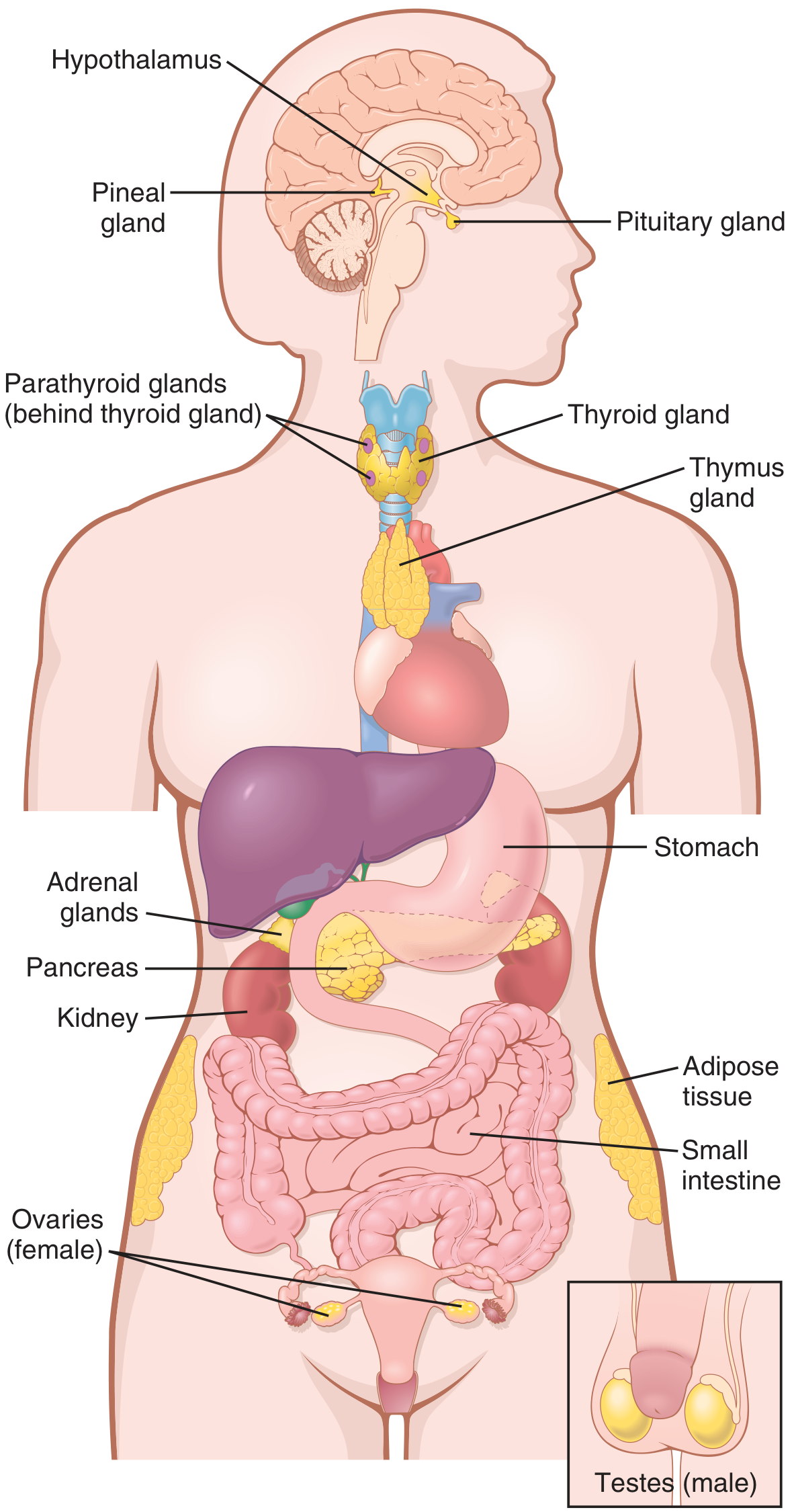
6.2 Hormones - Gland by Gland (Paper Setter Special)
Hypothalamus:
- Produces Releasing hormones (RH) and Inhibiting hormones (IH) - control pituitary
- e.g., GnRH, TRH, CRH, GHRH
Pituitary (Master gland):
| Lobe | Hormone | Function | Disorder |
|---|---|---|---|
| Anterior | GH (Growth Hormone) | Bone/muscle growth | Excess in adult = Acromegaly; child = Gigantism; deficiency = Dwarfism |
| Anterior | TSH | Stimulates thyroid | |
| Anterior | ACTH | Stimulates adrenal cortex | |
| Anterior | FSH, LH | Gonadotropins | |
| Anterior | Prolactin | Milk production | |
| Posterior | ADH (Vasopressin) | Water reabsorption | Deficiency = Diabetes Insipidus |
| Posterior | Oxytocin | Uterine contractions; milk ejection |
Thyroid:
- T₃ (Triiodothyronine) + T₄ (Thyroxine) → regulate metabolism, need Iodine
- Calcitonin → lowers blood Ca²⁺
- Deficiency of iodine → Goitre (enlarged thyroid)
- Hypothyroidism in child = Cretinism (stunted mental + physical growth)
- Hyperthyroidism = Exophthalmic goitre / Graves' disease (protruding eyes)
Parathyroid (on back of thyroid, 4 glands):
- PTH (Parathormone) → raises blood Ca²⁺ (opposite to calcitonin)
- Deficiency → Tetany
Adrenal Glands (on top of kidneys):
| Part | Hormone | Function |
|---|---|---|
| Cortex | Glucocorticoids (Cortisol) | Stress response; anti-inflammatory |
| Cortex | Mineralocorticoids (Aldosterone) | Na⁺/K⁺ balance |
| Cortex | Gonadocorticoids (Sex hormones) | |
| Medulla | Adrenaline + Noradrenaline | Fight or flight response |
- Addison's disease = Adrenal cortex hypofunction → low cortisol, low aldosterone → fatigue, low BP, hyperpigmentation
Pancreas (both endocrine + exocrine):
- Islets of Langerhans:
- α cells → Glucagon (raises blood sugar)
- β cells → Insulin (lowers blood sugar) → deficiency = Diabetes Mellitus
Gonads:
- Testes: Testosterone (male secondary sexual characters)
- Ovaries: Estrogen + Progesterone
Pineal Gland:
- Melatonin → regulates sleep-wake cycle (circadian rhythm)
🔴 Trap: Pineal gland secretes melatonin, NOT melanin. Melanin is the skin pigment made by melanocytes.
6.3 Hormone Action Mechanism
- Protein hormones (Peptide) e.g. Insulin, GH → cannot cross cell membrane → bind to surface receptors → use second messenger (cAMP)
- Steroid hormones e.g. Cortisol, Testosterone → lipid soluble → cross membrane → act on nuclear receptors → alter gene expression
6.4 Disorders Summary for NEET
| Disorder | Hormone | Gland | Type |
|---|---|---|---|
| Dwarfism | ↓ GH | Pituitary | Hypo |
| Gigantism | ↑ GH (child) | Pituitary | Hyper |
| Acromegaly | ↑ GH (adult) | Pituitary | Hyper |
| Diabetes Insipidus | ↓ ADH | Posterior pituitary | Hypo |
| Cretinism | ↓ Thyroid (child) | Thyroid | Hypo |
| Myxoedema | ↓ Thyroid (adult) | Thyroid | Hypo |
| Goitre | ↓ Iodine → ↑ TSH | Thyroid | - |
| Exophthalmic goitre | ↑ Thyroid | Thyroid | Hyper |
| Addison's disease | ↓ Cortisol | Adrenal cortex | Hypo |
| Cushing's syndrome | ↑ Cortisol | Adrenal cortex | Hyper |
| Diabetes Mellitus | ↓ Insulin | Pancreas β cells | Hypo |
🔥 PAPER SETTER'S FINAL PREDICTED MCQs - UNIT 5
Teri preparation plan: Revise these notes daily for 3 days. Then try past 10 years PYQs from this unit - you'll see EVERY question maps to something above. Want me to now test you with MCQs on any specific topic from this unit? 🎯That's your complete Unit 5: Human Physiology taught exactly the way I'd set the paper.
- Day 1 - Read the full notes once, cover to cover
- Day 2 - Close the notes, write down all values and tables from memory
- Day 3 - Attempt the 12 predicted MCQs at the bottom without looking
- Day 4 - Do PYQs from 2017-2024 on this unit (every question maps to something above)
- "Test me" - I'll fire 20 MCQs at you in exam style
- "Explain [topic]" - Any topic you want deeper
- "Next unit" - We move to Unit 1 (Diversity in Living World) and build from there chapter by chapter
- "Which topics have max questions in NEET?" - I'll give you the priority order for the full syllabus

i need summary
📋 SUMMARY: Breathing & Respiration
NEET 2027 | One-Page Revision Sheet
🫁 1. RESPIRATORY ORGANS (Recall Only)
| Animal | Organ |
|---|---|
| Insects | Tracheae |
| Fish | Gills |
| Frog | Lungs + Moist skin |
| Birds/Mammals | Lungs |
🫁 2. HUMAN RESPIRATORY SYSTEM
- Trachea = C-shaped incomplete cartilage rings
- Right lung = 3 lobes | Left lung = 2 lobes
- Alveoli = simple squamous epithelium (1 cell thick)
🫁 3. MECHANISM OF BREATHING
| Process | Muscles | Volume | Pressure | Air |
|---|---|---|---|---|
| Inspiration | Diaphragm contracts + External intercostals | ↑ | ↓ | Flows IN |
| Expiration | Diaphragm relaxes (passive at rest) | ↓ | ↑ | Flows OUT |
🫁 4. RESPIRATORY VOLUMES & CAPACITIES
| Volume/Capacity | Value | Formula |
|---|---|---|
| TV (Tidal Volume) | 500 mL | - |
| IRV | 2500-3000 mL | - |
| ERV | 1000-1100 mL | - |
| RV | 1100-1200 mL | Cannot be measured by spirometer ⚠️ |
| VC (Vital Capacity) | ~4600 mL | IRV + TV + ERV |
| IC | ~3500 mL | TV + IRV |
| FRC | ~2300 mL | ERV + RV |
| TLC | ~5800 mL | VC + RV |
🫁 5. EXCHANGE OF GASES
| Gas | Alveoli | Blood | Tissues |
|---|---|---|---|
| pO₂ | 104 mmHg | 95 mmHg | 40 mmHg |
| pCO₂ | 40 mmHg | 40 mmHg | 45 mmHg |
🫁 6. TRANSPORT OF GASES
- 97% as Oxyhaemoglobin (HbO₂)
- 3% dissolved in plasma
- 1 Hb = binds 4 O₂ molecules
| Form | % |
|---|---|
| Bicarbonate HCO₃⁻ in plasma | 70% ← most |
| Carbaminohaemoglobin (HbCO₂) | 20-25% |
| Dissolved in plasma | 7% |
CO₂ binds globin (protein) part of Hb. O₂ binds haem (Fe²⁺) part. ⚠️
🫁 7. REGULATION OF RESPIRATION
- Respiratory rhythm centre = Medulla oblongata
- Pneumotaxic centre = Pons (limits inspiration)
- Strongest stimulus to breathe = rise in CO₂ (not O₂ fall)
🫁 8. DISORDERS
| Disorder | Cause | Clue Word |
|---|---|---|
| Asthma | Allergens → bronchiole spasm | Wheezing |
| Emphysema | Smoking → alveolar wall destruction | Barrel chest, ↓ surface area |
| Silicosis | Silicon dioxide dust (miners/stone cutters) | Occupational |
| Asbestosis | Asbestos fibres | Occupational |
🔴 TOP 5 PAPER SETTER TRAPS
- RV cannot be measured by spirometer (never fully expelled)
- A band does NOT change during muscle contraction
- Pulmonary artery carries deoxygenated blood (only artery to do so)
- CO₂ main transport = bicarbonate (70%), NOT carbaminoHb
- Emphysema = alveolar wall destruction | Asthma = bronchiole spasm
✅ This entire chapter = approximately 3-4 marks in NEET every year. Memorise the values in bold - those are direct 1-mark questions. Ready for the next topic? Say "Next"!
ncert one liner for these topics
📌 NCERT ONE-LINERS: Breathing & Respiration
NEET 2027 | Every line = 1 potential MCQ
🔵 RESPIRATORY ORGANS
- Insects breathe through tracheae (tracheal system).
- Aquatic animals like fish use gills for respiration.
- Earthworm and frog use moist skin (cutaneous) for respiration.
- Adult frog uses both lungs and moist skin; tadpole uses gills.
- Higher vertebrates (reptiles, birds, mammals) use lungs.
🔵 HUMAN RESPIRATORY SYSTEM
- The respiratory tract begins at the nostrils and ends at the alveoli.
- Larynx is also called the voice box; contains vocal cords.
- Epiglottis is a cartilaginous flap that prevents food from entering the trachea.
- Trachea is supported by incomplete C-shaped cartilaginous rings (open side faces oesophagus).
- Right lung has 3 lobes; left lung has 2 lobes (to accommodate heart).
- Lungs are covered by a double-layered membrane called the pleural membrane.
- Pleural fluid reduces friction between the lungs and thoracic wall.
- Alveoli are the primary sites of gas exchange in humans.
- Alveolar walls are made of simple squamous epithelium (one cell thick).
- The lungs are situated in the thoracic cavity surrounded by ribs.
🔵 MECHANISM OF BREATHING
- Breathing is also called pulmonary ventilation.
- Inspiration is an active process; expiration is passive at rest.
- During inspiration, the diaphragm contracts and flattens.
- During inspiration, external intercostal muscles contract → ribs move upward and outward.
- Inspiration occurs when intrapulmonary pressure falls below atmospheric pressure.
- Expiration occurs when intrapulmonary pressure rises above atmospheric pressure.
- Normal breathing rate in humans = 12–16 breaths per minute.
- The pressure difference between atmosphere and lungs during breathing = 1–3 mmHg.
- Forced expiration involves contraction of internal intercostal muscles and abdominal muscles.
🔵 RESPIRATORY VOLUMES
- Tidal Volume (TV) = volume of air inspired or expired in one normal breath = 500 mL.
- Inspiratory Reserve Volume (IRV) = additional air inspired after normal inspiration = 2500–3000 mL.
- Expiratory Reserve Volume (ERV) = additional air expired after normal expiration = 1000–1100 mL.
- Residual Volume (RV) = air remaining in lungs after maximum expiration = 1100–1200 mL.
- RV cannot be measured by a spirometer (can never be fully expelled).
- Vital Capacity (VC) = IRV + TV + ERV = ~4600 mL.
- Total Lung Capacity (TLC) = VC + RV = ~5800 mL.
- Inspiratory Capacity (IC) = TV + IRV = ~3500 mL.
- Functional Residual Capacity (FRC) = ERV + RV = ~2300 mL.
- A person can breathe in maximum ~3500 mL after normal expiration (= IC).
🔵 EXCHANGE OF GASES
- Partial pressure of O₂ in alveoli = 104 mmHg; in deoxygenated blood = 40 mmHg.
- Partial pressure of CO₂ in alveoli = 40 mmHg; in deoxygenated blood = 45 mmHg.
- pO₂ in tissues = 40 mmHg; pCO₂ in tissues = 45 mmHg.
- Gases always diffuse from region of higher partial pressure to lower partial pressure.
- O₂ moves: alveoli → blood → tissues.
- CO₂ moves: tissues → blood → alveoli.
- Solubility of CO₂ is 20–25 times higher than O₂ in blood.
- Gas exchange surface in alveoli is thin (< 1 mm) to allow rapid diffusion.
🔵 TRANSPORT OF GASES
- 97% of O₂ is transported as oxyhaemoglobin (HbO₂) in RBCs.
- 3% of O₂ is transported in dissolved form in plasma.
- One molecule of haemoglobin binds 4 molecules of O₂ (one per haem group).
- O₂ binds to the haem (Fe²⁺) part of haemoglobin.
- The Bohr effect: ↑CO₂ or ↑H⁺ decreases affinity of Hb for O₂ (O₂ released to tissues).
- 70% of CO₂ is transported as bicarbonate ions (HCO₃⁻) in plasma.
- 20–25% of CO₂ is transported as carbaminohaemoglobin (HbCO₂).
- 7% of CO₂ is dissolved directly in plasma.
- CO₂ binds to the globin (protein) part of haemoglobin — NOT the haem.
- Chloride shift (Hamburger's phenomenon): HCO₃⁻ exits RBC → Cl⁻ enters RBC to maintain electrical neutrality.
- Enzyme carbonic anhydrase in RBCs catalyses: CO₂ + H₂O ⇌ H₂CO₃ ⇌ H⁺ + HCO₃⁻.
- At lungs, low CO₂ → reaction reverses → CO₂ released → exhaled.
🔵 REGULATION OF RESPIRATION
- Respiratory rhythm centre is located in the medulla oblongata.
- Pneumotaxic centre in the pons moderates the function of respiratory rhythm centre.
- Rise in CO₂ (not fall in O₂) is the primary/strongest stimulus for breathing.
- Chemoreceptors in medulla, carotid body, and aortic arch detect changes in CO₂ and H⁺.
- A small rise in CO₂ or H⁺ in blood significantly increases breathing rate.
- Oxygen levels affect breathing only when pO₂ drops very significantly (hypoxia).
🔵 DISORDERS OF RESPIRATION
- Asthma = inflammation and spasm of bronchioles; caused by allergens; produces wheezing sound.
- Emphysema = chronic disorder where alveolar walls are destroyed → reduced gas exchange surface area.
- Main cause of emphysema = cigarette smoking.
- Emphysema patients develop a barrel-shaped chest due to air trapping.
- Occupational respiratory disorders are caused by long-term inhalation of dust particles.
- Silicosis = caused by inhalation of silicon dioxide (silica) dust (stone cutters, miners).
- Asbestosis = caused by inhalation of asbestos fibres (shipyard/mine workers).
- Siderosis = caused by inhalation of iron dust particles.
- In all occupational disorders, inflammation of lung tissues leads to fibrosis over time.
🔥 BONUS - MOST REPEATED NEET ONE-LINERS
| # | One-Liner |
|---|---|
| ★ | RV = cannot be measured by spirometer |
| ★ | O₂ binds haem; CO₂ binds globin |
| ★ | CO₂ mainly travels as HCO₃⁻ (70%) |
| ★ | Primary stimulus for breathing = CO₂ rise |
| ★ | Emphysema = alveolar wall destruction by smoking |
| ★ | Respiratory centre = medulla oblongata |
| ★ | Right lung = 3 lobes; Left = 2 lobes |
| ★ | Inspiration = active; Expiration = passive |
| ★ | Normal TV = 500 mL; TLC = 5800 mL |
| ★ | 1 Hb binds 4 O₂ molecules |
📌 69 one-liners = the entire chapter. If you can recall all 69 without looking, this chapter is done for NEET 2027. Want me to do the same for Body Fluids & Circulation next? Just say "Next topic"! 🎯
pls prepare pdf of notes and mcqs
ls /home/daytona/workspace/ 2>/dev/null || mkdir -p /home/daytona/workspace
mkdir -p /home/daytona/workspace/neet2027 && python3 -c "import reportlab; print('reportlab ok')" && python3 -c "from reportlab.lib.pagesizes import A4; print('A4 ok')"
~/neet2027/make_pdf.py
from reportlab.lib.pagesizes import A4
from reportlab.lib import colors
from reportlab.lib.styles import getSampleStyleSheet, ParagraphStyle
from reportlab.lib.units import cm
from reportlab.platypus import (SimpleDocTemplate, Paragraph, Spacer, Table,
                                 TableStyle, HRFlowable, PageBreak, KeepTogether)
from reportlab.lib.enums import TA_CENTER, TA_LEFT, TA_JUSTIFY
from reportlab.platypus import ListFlowable, ListItem

OUTPUT = "/home/daytona/workspace/neet2027/NEET2027_Breathing_Respiration.pdf"

doc = SimpleDocTemplate(
    OUTPUT, pagesize=A4,
    rightMargin=1.8*cm, leftMargin=1.8*cm,
    topMargin=1.8*cm, bottomMargin=1.8*cm
)

# ── Colour palette ──────────────────────────────────────────────
C_DARK   = colors.HexColor("#1a237e")   # deep indigo  (headings)
C_MED    = colors.HexColor("#1565c0")   # blue         (sub-headings)
C_ACCENT = colors.HexColor("#e53935")   # red          (trap / star lines)
C_GREEN  = colors.HexColor("#2e7d32")   # green        (MCQ correct)
C_BG1    = colors.HexColor("#e8eaf6")   # light indigo bg
C_BG2    = colors.HexColor("#fff9c4")   # light yellow bg (traps)
C_BG3    = colors.HexColor("#e8f5e9")   # light green  (one-liners)
C_BLACK  = colors.HexColor("#212121")
C_GREY   = colors.HexColor("#616161")
C_WHITE  = colors.white

styles = getSampleStyleSheet()

def S(name, **kw):
    return ParagraphStyle(name, **kw)

# ── Custom styles ────────────────────────────────────────────────
TITLE = S("TITLE", fontName="Helvetica-Bold", fontSize=20, textColor=C_WHITE,
          alignment=TA_CENTER, spaceAfter=4)
SUBTITLE = S("SUBTITLE", fontName="Helvetica", fontSize=11, textColor=C_WHITE,
             alignment=TA_CENTER, spaceAfter=2)
H1 = S("H1", fontName="Helvetica-Bold", fontSize=14, textColor=C_WHITE,
        spaceBefore=10, spaceAfter=4, leftIndent=0)
H2 = S("H2", fontName="Helvetica-Bold", fontSize=11, textColor=C_MED,
        spaceBefore=8, spaceAfter=3)
H3 = S("H3", fontName="Helvetica-Bold", fontSize=10, textColor=C_DARK,
        spaceBefore=5, spaceAfter=2)
BODY = S("BODY", fontName="Helvetica", fontSize=9, textColor=C_BLACK,
         leading=14, spaceAfter=2, alignment=TA_JUSTIFY)
BULLET = S("BULLET", fontName="Helvetica", fontSize=9, textColor=C_BLACK,
           leading=13, leftIndent=14, spaceAfter=2)
TRAP = S("TRAP", fontName="Helvetica-BoldOblique", fontSize=9,
         textColor=C_ACCENT, leading=13, leftIndent=10, spaceAfter=2)
ONELINER = S("ONELINER", fontName="Helvetica", fontSize=8.5, textColor=C_BLACK,
             leading=13, leftIndent=8, spaceAfter=1)
MCQ_Q = S("MCQ_Q", fontName="Helvetica-Bold", fontSize=9.5, textColor=C_DARK,
          leading=14, spaceBefore=6, spaceAfter=2)
MCQ_OPT = S("MCQ_OPT", fontName="Helvetica", fontSize=9, textColor=C_BLACK,
            leading=12, leftIndent=16, spaceAfter=1)
MCQ_ANS = S("MCQ_ANS", fontName="Helvetica-Bold", fontSize=9,
            textColor=C_GREEN, leading=12, leftIndent=16, spaceAfter=4)
FOOTER  = S("FOOTER", fontName="Helvetica-Oblique", fontSize=8,
            textColor=C_GREY, alignment=TA_CENTER)

# ── Helper flowables ─────────────────────────────────────────────
def colored_header(text, sub=""):
    data = [[Paragraph(text, TITLE)]]
    if sub:
        data.append([Paragraph(sub, SUBTITLE)])
    t = Table(data, colWidths=[17.4*cm])
    t.setStyle(TableStyle([
        ("BACKGROUND", (0,0), (-1,-1), C_DARK),
        ("ROUNDEDCORNERS", [6]),
        ("TOPPADDING", (0,0), (-1,-1), 10),
        ("BOTTOMPADDING", (0,0), (-1,-1), 10),
        ("LEFTPADDING", (0,0), (-1,-1), 10),
        ("RIGHTPADDING", (0,0), (-1,-1), 10),
    ]))
    return t

def section_banner(text):
    t = Table([[Paragraph(text, H1)]], colWidths=[17.4*cm])
    t.setStyle(TableStyle([
        ("BACKGROUND", (0,0), (-1,-1), C_MED),
        ("TOPPADDING", (0,0), (-1,-1), 6),
        ("BOTTOMPADDING", (0,0), (-1,-1), 6),
        ("LEFTPADDING", (0,0), (-1,-1), 10),
    ]))
    return t

def trap_box(text):
    t = Table([[Paragraph("⚠️  PAPER SETTER TRAP: " + text, TRAP)]], colWidths=[17.4*cm])
    t.setStyle(TableStyle([
        ("BACKGROUND", (0,0), (-1,-1), C_BG2),
        ("BOX", (0,0), (-1,-1), 1, C_ACCENT),
        ("TOPPADDING", (0,0), (-1,-1), 5),
        ("BOTTOMPADDING", (0,0), (-1,-1), 5),
        ("LEFTPADDING", (0,0), (-1,-1), 8),
    ]))
    return t

def simple_table(headers, rows, col_w=None):
    data = [headers] + rows
    if col_w is None:
        col_w = [17.4*cm / len(headers)] * len(headers)
    styled_data = []
    for i, row in enumerate(data):
        styled_row = []
        for cell in row:
            if i == 0:
                styled_row.append(Paragraph(str(cell),
                    S("TH", fontName="Helvetica-Bold", fontSize=8.5,
                      textColor=C_WHITE, leading=12)))
            else:
                styled_row.append(Paragraph(str(cell),
                    S("TD", fontName="Helvetica", fontSize=8.5,
                      textColor=C_BLACK, leading=12)))
        styled_data.append(styled_row)
    t = Table(styled_data, colWidths=col_w)
    ts = TableStyle([
        ("BACKGROUND", (0,0), (-1,0), C_DARK),
        ("ROWBACKGROUNDS", (0,1), (-1,-1), [C_WHITE, C_BG1]),
        ("GRID", (0,0), (-1,-1), 0.5, colors.HexColor("#9fa8da")),
        ("TOPPADDING", (0,0), (-1,-1), 4),
        ("BOTTOMPADDING", (0,0), (-1,-1), 4),
        ("LEFTPADDING", (0,0), (-1,-1), 6),
        ("VALIGN", (0,0), (-1,-1), "MIDDLE"),
    ])
    t.setStyle(ts)
    return t

def hr():
    return HRFlowable(width="100%", thickness=0.5,
                      color=colors.HexColor("#c5cae9"), spaceAfter=4)

def sp(n=6):
    return Spacer(1, n)

# ════════════════════════════════════════════════════════════════
# BUILD CONTENT
# ════════════════════════════════════════════════════════════════
story = []

# ── COVER ────────────────────────────────────────────────────────
story.append(sp(40))
story.append(colored_header(
    "NEET 2027 | UNIT 5: HUMAN PHYSIOLOGY",
    "Breathing & Respiration — Complete Notes + MCQs"
))
story.append(sp(10))
cover_info = [
    ["Chapter", "Breathing & Respiration (NCERT Class 11, Ch 17)"],
    ["Exam", "NEET 2027"],
    ["Expected Marks", "3–4 marks (direct from this chapter)"],
    ["Includes", "Full Notes · 69 NCERT One-Liners · 25 MCQs with Answers"],
]
ci_table = Table(cover_info, colWidths=[5*cm, 12.4*cm])
ci_table.setStyle(TableStyle([
    ("BACKGROUND", (0,0), (0,-1), C_BG1),
    ("FONTNAME", (0,0), (0,-1), "Helvetica-Bold"),
    ("FONTNAME", (1,0), (1,-1), "Helvetica"),
    ("FONTSIZE", (0,0), (-1,-1), 9.5),
    ("GRID", (0,0), (-1,-1), 0.5, colors.HexColor("#9fa8da")),
    ("TOPPADDING", (0,0), (-1,-1), 6),
    ("BOTTOMPADDING", (0,0), (-1,-1), 6),
    ("LEFTPADDING", (0,0), (-1,-1), 8),
]))
story.append(ci_table)
story.append(PageBreak())

# ════════════════════════════════════
# PART 1: COMPLETE NOTES
# ════════════════════════════════════
story.append(section_banner("PART 1: COMPLETE NOTES"))
story.append(sp(8))

# --- 1. RESPIRATORY ORGANS ---
story.append(Paragraph("1. RESPIRATORY ORGANS IN ANIMALS (Recall Only)", H2))
story.append(hr())
headers = ["Animal", "Respiratory Organ", "Special Note"]
rows = [
    ["Insects", "Tracheae (tracheal system)", "—"],
    ["Earthworm", "Moist skin (cutaneous)", "—"],
    ["Fish", "Gills", "—"],
    ["Frog (tadpole)", "Gills", "Ammonotelic"],
    ["Frog (adult)", "Lungs + Moist skin", "Ureotelic — changes at metamorphosis!"],
    ["Reptiles / Birds / Mammals", "Lungs", "—"],
]
story.append(simple_table(headers, rows, [4*cm, 6*cm, 7.4*cm]))
story.append(sp(4))
story.append(trap_box("Adult frog uses BOTH lungs + moist skin. Tadpole uses gills — classic NEET trap!"))
story.append(sp(8))

# --- 2. HUMAN RESPIRATORY SYSTEM ---
story.append(Paragraph("2. HUMAN RESPIRATORY SYSTEM — STRUCTURE", H2))
story.append(hr())
story.append(Paragraph(
    "<b>Pathway:</b> Nostrils → Nasal cavity → Pharynx → Larynx → "
    "Trachea → Primary Bronchi → Bronchioles → <b>Alveoli</b>", BODY))
story.append(sp(4))
key_points = [
    ("Trachea", "Supported by <b>incomplete C-shaped cartilage rings</b> (open side faces oesophagus)"),
    ("Epiglottis", "Cartilage flap; prevents food entry into trachea"),
    ("Lung lobes", "<b>Right = 3 lobes; Left = 2 lobes</b> (cardiac notch on left for heart)"),
    ("Alveoli wall", "<b>Simple squamous epithelium</b> (one cell thick) for rapid gas exchange"),
    ("Pleural membrane", "Double-layered; pleural fluid reduces friction"),
    ("Larynx", "Voice box; contains vocal cords"),
]
kp_rows = [[k, v] for k, v in key_points]
story.append(simple_table(["Structure", "Key Fact"], kp_rows, [4*cm, 13.4*cm]))
story.append(sp(8))

# --- 3. MECHANISM OF BREATHING ---
story.append(Paragraph("3. MECHANISM OF BREATHING", H2))
story.append(hr())
mech_rows = [
    ["Inspiration", "Diaphragm contracts + flattens;\nExternal intercostals contract;\nRibs move up + outward",
     "↑ Volume → ↓ Pressure", "ACTIVE process"],
    ["Expiration\n(at rest)", "Diaphragm relaxes (domes up);\nRibs move down + inward",
     "↓ Volume → ↑ Pressure", "PASSIVE process"],
    ["Forced\nExpiration", "Internal intercostals +\nAbdominal muscles contract",
     "↓↓ Volume", "ACTIVE process"],
]
story.append(simple_table(["Process", "Muscles", "Volume/Pressure", "Type"],
                           mech_rows, [3*cm, 5.5*cm, 4.5*cm, 4.4*cm]))
story.append(sp(4))
story.append(trap_box("Normal expiration is PASSIVE. Only FORCED expiration is active."))
story.append(sp(8))

# --- 4. RESPIRATORY VOLUMES ---
story.append(Paragraph("4. RESPIRATORY VOLUMES & CAPACITIES", H2))
story.append(hr())
vol_rows = [
    ["TV — Tidal Volume", "500 mL", "—", "Air per normal breath"],
    ["IRV — Inspiratory Reserve Volume", "2500–3000 mL", "—", "Extra air after normal inspiration"],
    ["ERV — Expiratory Reserve Volume", "1000–1100 mL", "—", "Extra air after normal expiration"],
    ["RV — Residual Volume", "1100–1200 mL", "—", "Cannot be measured by spirometer ⚠️"],
    ["IC — Inspiratory Capacity", "~3500 mL", "TV + IRV", "Max air breathed in from FRC"],
    ["FRC — Functional Residual Capacity", "~2300 mL", "ERV + RV", "Air after normal expiration"],
    ["VC — Vital Capacity", "~4600 mL", "IRV + TV + ERV", "Maximum movable air"],
    ["TLC — Total Lung Capacity", "~5800 mL", "VC + RV", "Max air in lungs"],
]
story.append(simple_table(["Volume / Capacity", "Value", "Formula", "Definition"],
                           vol_rows, [5.5*cm, 2.5*cm, 3*cm, 6.4*cm]))
story.append(sp(4))
story.append(trap_box("RV, FRC, and TLC cannot be measured by a spirometer (all contain RV)."))
story.append(sp(8))

# --- 5. EXCHANGE OF GASES ---
story.append(Paragraph("5. EXCHANGE OF GASES", H2))
story.append(hr())
pp_rows = [
    ["pO₂", "104 mmHg", "95 mmHg", "40 mmHg", "40 mmHg"],
    ["pCO₂", "40 mmHg", "40 mmHg", "45 mmHg", "45 mmHg"],
]
story.append(simple_table(
    ["Gas", "Alveoli", "Arterial Blood", "Venous Blood", "Tissues"],
    pp_rows, [2.5*cm, 3*cm, 3.5*cm, 3.5*cm, 4.9*cm]))
story.append(sp(4))
story.append(Paragraph("• Gases diffuse from <b>HIGH → LOW</b> partial pressure (simple diffusion).", BULLET))
story.append(Paragraph("• O₂ moves: Alveoli → Blood → Tissues. CO₂ moves: Tissues → Blood → Alveoli.", BULLET))
story.append(Paragraph("• CO₂ solubility in blood is <b>20–25 times higher</b> than O₂.", BULLET))
story.append(sp(8))

# --- 6. TRANSPORT OF GASES ---
story.append(Paragraph("6. TRANSPORT OF GASES", H2))
story.append(hr())
story.append(Paragraph("<b>A. Oxygen Transport:</b>", H3))
o2_rows = [
    ["As Oxyhaemoglobin (HbO₂) in RBCs", "97%", "Binds to HAEM (Fe²⁺) part of Hb"],
    ["Dissolved in plasma", "3%", "Minor fraction"],
]
story.append(simple_table(["Form", "%", "Note"], o2_rows, [7*cm, 3*cm, 7.4*cm]))
story.append(sp(4))
story.append(Paragraph("• 1 Hb molecule binds <b>4 O₂ molecules</b> (one per haem group).", BULLET))
story.append(Paragraph("• <b>Bohr Effect:</b> ↑CO₂ / ↑H⁺ / ↑Temp at tissues → Hb releases O₂ more easily.", BULLET))
story.append(sp(4))
story.append(Paragraph("<b>B. CO₂ Transport:</b>", H3))
co2_rows = [
    ["Bicarbonate ions (HCO₃⁻) in plasma", "70%", "MOST IMPORTANT form ★"],
    ["Carbaminohaemoglobin (HbCO₂)", "20–25%", "Binds to GLOBIN (protein) part"],
    ["Dissolved in plasma", "7%", "Smallest fraction"],
]
story.append(simple_table(["Form", "%", "Note"], co2_rows, [7*cm, 3*cm, 7.4*cm]))
story.append(sp(4))
story.append(trap_box(
    "O₂ binds HAEM (Fe²⁺). CO₂ binds GLOBIN (protein). Never mix these up!"))
story.append(sp(4))
story.append(Paragraph(
    "• <b>Chloride Shift (Hamburger's phenomenon):</b> HCO₃⁻ exits RBC → Cl⁻ enters RBC "
    "to maintain electrical neutrality.", BULLET))
story.append(Paragraph(
    "• Enzyme <b>carbonic anhydrase</b> in RBCs: CO₂ + H₂O ⇌ H₂CO₃ ⇌ H⁺ + HCO₃⁻", BULLET))
story.append(sp(8))

# --- 7. REGULATION ---
story.append(Paragraph("7. REGULATION OF RESPIRATION", H2))
story.append(hr())
reg_rows = [
    ["Respiratory rhythm centre", "Medulla oblongata", "Primary breathing centre"],
    ["Pneumotaxic centre", "Pons", "Moderates inspiration; limits respiratory rate"],
    ["Chemoreceptors", "Medulla, Carotid body, Aortic arch",
     "Detect ↑CO₂, ↓pH → stimulate breathing"],
]
story.append(simple_table(["Centre", "Location", "Function"],
                           reg_rows, [5*cm, 5*cm, 7.4*cm]))
story.append(sp(4))
story.append(trap_box(
    "PRIMARY stimulus for breathing = RISE IN CO₂, not fall in O₂!"))
story.append(sp(8))

# --- 8. DISORDERS ---
story.append(Paragraph("8. DISORDERS OF RESPIRATION", H2))
story.append(hr())
dis_rows = [
    ["Asthma", "Allergens", "Bronchiole inflammation + spasm", "Wheezing"],
    ["Emphysema", "Cigarette smoking (mainly)",
     "Alveolar wall destruction → ↓ gas exchange surface", "Barrel chest"],
    ["Silicosis", "Silicon dioxide dust (miners, stone cutters)",
     "Lung tissue fibrosis", "Occupational"],
    ["Asbestosis", "Asbestos fibres (mine/ship workers)",
     "Lung tissue fibrosis", "Occupational"],
    ["Siderosis", "Iron dust particles", "Lung tissue inflammation", "Occupational"],
]
story.append(simple_table(["Disorder", "Cause", "Pathology", "Key Word"],
                           dis_rows, [3*cm, 5*cm, 6*cm, 3.4*cm]))
story.append(PageBreak())

# ════════════════════════════════════
# PART 2: 69 NCERT ONE-LINERS
# ════════════════════════════════════
story.append(section_banner("PART 2: 69 NCERT ONE-LINERS (Every Line = 1 MCQ)"))
story.append(sp(8))

sections_oneliners = [
    ("RESPIRATORY ORGANS", [
        "Insects breathe through tracheae (tracheal system).",
        "Aquatic animals like fish use gills for respiration.",
        "Earthworm and frog use moist skin (cutaneous) for respiration.",
        "Adult frog uses both lungs and moist skin; tadpole uses gills.",
        "Higher vertebrates (reptiles, birds, mammals) use lungs.",
    ]),
    ("HUMAN RESPIRATORY SYSTEM", [
        "The respiratory tract begins at the nostrils and ends at the alveoli.",
        "Larynx is also called the voice box; contains vocal cords.",
        "Epiglottis is a cartilaginous flap that prevents food from entering the trachea.",
        "Trachea is supported by incomplete C-shaped cartilaginous rings (open side faces oesophagus).",
        "Right lung has 3 lobes; left lung has 2 lobes (to accommodate heart). ★",
        "Lungs are covered by a double-layered membrane called the pleural membrane.",
        "Pleural fluid reduces friction between the lungs and thoracic wall.",
        "Alveoli are the primary sites of gas exchange in humans.",
        "Alveolar walls are made of simple squamous epithelium (one cell thick).",
        "The lungs are situated in the thoracic cavity surrounded by ribs.",
    ]),
    ("MECHANISM OF BREATHING", [
        "Breathing is also called pulmonary ventilation.",
        "Inspiration is an active process; expiration is passive at rest. ★",
        "During inspiration, the diaphragm contracts and flattens.",
        "During inspiration, external intercostal muscles contract → ribs move upward and outward.",
        "Inspiration occurs when intrapulmonary pressure falls below atmospheric pressure.",
        "Expiration occurs when intrapulmonary pressure rises above atmospheric pressure.",
        "Normal breathing rate in humans = 12–16 breaths per minute.",
        "Pressure difference during breathing = 1–3 mmHg.",
        "Forced expiration involves contraction of internal intercostal muscles and abdominal muscles.",
    ]),
    ("RESPIRATORY VOLUMES & CAPACITIES", [
        "Tidal Volume (TV) = volume of air inspired or expired in one normal breath = 500 mL. ★",
        "Inspiratory Reserve Volume (IRV) = additional air inspired after normal inspiration = 2500–3000 mL.",
        "Expiratory Reserve Volume (ERV) = additional air expired after normal expiration = 1000–1100 mL.",
        "Residual Volume (RV) = air remaining in lungs after maximum expiration = 1100–1200 mL.",
        "RV cannot be measured by a spirometer. ★",
        "Vital Capacity (VC) = IRV + TV + ERV = ~4600 mL. ★",
        "Total Lung Capacity (TLC) = VC + RV = ~5800 mL.",
        "Inspiratory Capacity (IC) = TV + IRV = ~3500 mL.",
        "Functional Residual Capacity (FRC) = ERV + RV = ~2300 mL.",
    ]),
    ("EXCHANGE OF GASES", [
        "Partial pressure of O₂ in alveoli = 104 mmHg; in deoxygenated blood = 40 mmHg. ★",
        "Partial pressure of CO₂ in alveoli = 40 mmHg; in deoxygenated blood = 45 mmHg. ★",
        "pO₂ in tissues = 40 mmHg; pCO₂ in tissues = 45 mmHg.",
        "Gases always diffuse from region of higher partial pressure to lower partial pressure.",
        "O₂ moves: alveoli → blood → tissues.",
        "CO₂ moves: tissues → blood → alveoli.",
        "Solubility of CO₂ is 20–25 times higher than O₂ in blood.",
        "Gas exchange surface in alveoli is thin to allow rapid diffusion.",
    ]),
    ("TRANSPORT OF GASES", [
        "97% of O₂ is transported as oxyhaemoglobin (HbO₂) in RBCs. ★",
        "3% of O₂ is transported in dissolved form in plasma.",
        "One molecule of haemoglobin binds 4 molecules of O₂ (one per haem group). ★",
        "O₂ binds to the haem (Fe²⁺) part of haemoglobin. ★",
        "Bohr effect: ↑CO₂ or ↑H⁺ decreases affinity of Hb for O₂ (O₂ released to tissues).",
        "70% of CO₂ is transported as bicarbonate ions (HCO₃⁻) in plasma. ★",
        "20–25% of CO₂ is transported as carbaminohaemoglobin (HbCO₂).",
        "7% of CO₂ is dissolved directly in plasma.",
        "CO₂ binds to the globin (protein) part of haemoglobin — NOT the haem. ★",
        "Chloride shift (Hamburger's phenomenon): HCO₃⁻ exits RBC → Cl⁻ enters RBC.",
        "Enzyme carbonic anhydrase in RBCs catalyses: CO₂ + H₂O ⇌ H₂CO₃ ⇌ H⁺ + HCO₃⁻.",
        "At lungs, low CO₂ → reaction reverses → CO₂ released → exhaled.",
    ]),
    ("REGULATION OF RESPIRATION", [
        "Respiratory rhythm centre is located in the medulla oblongata. ★",
        "Pneumotaxic centre in the pons moderates the function of respiratory rhythm centre.",
        "Rise in CO₂ (not fall in O₂) is the primary stimulus for breathing. ★",
        "Chemoreceptors in medulla, carotid body, and aortic arch detect changes in CO₂ and H⁺.",
        "A small rise in CO₂ or H⁺ in blood significantly increases breathing rate.",
        "Oxygen levels affect breathing only when pO₂ drops very significantly (hypoxia).",
    ]),
    ("DISORDERS OF RESPIRATION", [
        "Asthma = inflammation and spasm of bronchioles; caused by allergens; produces wheezing sound.",
        "Emphysema = chronic disorder where alveolar walls are destroyed → reduced gas exchange. ★",
        "Main cause of emphysema = cigarette smoking. ★",
        "Emphysema patients develop a barrel-shaped chest due to air trapping.",
        "Occupational respiratory disorders are caused by long-term inhalation of dust particles.",
        "Silicosis = caused by inhalation of silicon dioxide (silica) dust (stone cutters, miners). ★",
        "Asbestosis = caused by inhalation of asbestos fibres (shipyard/mine workers).",
        "Siderosis = caused by inhalation of iron dust particles.",
        "In all occupational disorders, inflammation of lung tissues leads to fibrosis over time.",
    ]),
]

counter = 1
for sec_title, lines in sections_oneliners:
    story.append(Paragraph(sec_title, H3))
    for line in lines:
        is_star = "★" in line
        style = ParagraphStyle(
            "OL_STAR" if is_star else "OL_NORM",
            fontName="Helvetica-Bold" if is_star else "Helvetica",
            fontSize=8.5,
            textColor=C_ACCENT if is_star else C_BLACK,
            leading=13, leftIndent=8, spaceAfter=1
        )
        story.append(Paragraph(f"{counter}. {line}", style))
        counter += 1
    story.append(sp(6))

story.append(PageBreak())

# ════════════════════════════════════
# PART 3: 25 MCQs
# ════════════════════════════════════
story.append(section_banner("PART 3: 25 PREDICTED MCQs — NEET 2027 STYLE"))
story.append(sp(8))

mcqs = [
    {
        "q": "Q1. Which of the following volumes CANNOT be measured by a spirometer?",
        "opts": ["A) Tidal Volume", "B) Inspiratory Reserve Volume",
                 "C) Expiratory Reserve Volume", "D) Residual Volume"],
        "ans": "D) Residual Volume",
        "exp": "RV stays in the lungs even after maximum expiration, so a spirometer cannot measure it."
    },
    {
        "q": "Q2. The maximum amount of air a person can breathe in after a normal expiration is called:",
        "opts": ["A) Vital Capacity", "B) Total Lung Capacity",
                 "C) Inspiratory Capacity", "D) Functional Residual Capacity"],
        "ans": "C) Inspiratory Capacity (TV + IRV = ~3500 mL)",
        "exp": "IC = TV + IRV = amount of air that can be inspired from FRC position."
    },
    {
        "q": "Q3. CO₂ is transported in the blood MAINLY as:",
        "opts": ["A) Carbaminohaemoglobin", "B) Bicarbonate ions (HCO₃⁻)",
                 "C) Dissolved in plasma", "D) Oxyhaemoglobin"],
        "ans": "B) Bicarbonate ions (HCO₃⁻) — 70%",
        "exp": "70% as HCO₃⁻, 20–25% as carbaminoHb, 7% dissolved."
    },
    {
        "q": "Q4. CO₂ binds to which part of the haemoglobin molecule?",
        "opts": ["A) Haem (Fe²⁺) group", "B) Globin (protein) chain",
                 "C) Both haem and globin", "D) Neither — dissolved only"],
        "ans": "B) Globin (protein) chain",
        "exp": "O₂ binds haem (Fe²⁺); CO₂ binds the protein (globin) part."
    },
    {
        "q": "Q5. The primary/strongest stimulus for increasing the rate of breathing is:",
        "opts": ["A) Fall in O₂ level", "B) Rise in CO₂ level",
                 "C) Rise in O₂ level", "D) Fall in CO₂ level"],
        "ans": "B) Rise in CO₂ level",
        "exp": "CO₂ rise (and H⁺ rise) is the primary driver of breathing rate."
    },
    {
        "q": "Q6. The respiratory rhythm centre responsible for the basic breathing pattern is located in:",
        "opts": ["A) Pons", "B) Cerebellum",
                 "C) Medulla oblongata", "D) Hypothalamus"],
        "ans": "C) Medulla oblongata",
        "exp": "Pneumotaxic centre in pons only modulates; primary centre is medulla."
    },
    {
        "q": "Q7. Which of the following has the highest partial pressure of O₂?",
        "opts": ["A) Venous blood", "B) Tissues",
                 "C) Alveolar air", "D) Arterial blood"],
        "ans": "C) Alveolar air (pO₂ = 104 mmHg)",
        "exp": "Alveolar pO₂ = 104 mmHg > arterial blood 95 mmHg > tissues 40 mmHg."
    },
    {
        "q": "Q8. During the Bohr effect, increased CO₂ in tissues causes haemoglobin to:",
        "opts": ["A) Bind more O₂", "B) Release more O₂",
                 "C) Bind CO₂ at haem group", "D) Increase its pH"],
        "ans": "B) Release more O₂",
        "exp": "Bohr effect: ↑CO₂/↑H⁺ at tissues → Hb affinity for O₂ ↓ → O₂ released."
    },
    {
        "q": "Q9. Right lung of humans has how many lobes?",
        "opts": ["A) 1", "B) 2", "C) 3", "D) 4"],
        "ans": "C) 3 lobes",
        "exp": "Right lung = 3 lobes; Left lung = 2 lobes (cardiac notch accommodates heart)."
    },
    {
        "q": "Q10. Which enzyme catalyses the conversion of CO₂ to bicarbonate inside RBCs?",
        "opts": ["A) Pepsin", "B) Carbonic anhydrase",
                 "C) Phosphodiesterase", "D) ATPase"],
        "ans": "B) Carbonic anhydrase",
        "exp": "Carbonic anhydrase: CO₂ + H₂O ⇌ H₂CO₃ ⇌ H⁺ + HCO₃⁻."
    },
    {
        "q": "Q11. Vital Capacity of the lungs is:",
        "opts": ["A) TV + IRV", "B) IRV + TV + ERV",
                 "C) IRV + TV + ERV + RV", "D) TV + ERV"],
        "ans": "B) IRV + TV + ERV (~4600 mL)",
        "exp": "VC does NOT include RV. TLC = VC + RV."
    },
    {
        "q": "Q12. Tidal volume in a normal healthy adult at rest is approximately:",
        "opts": ["A) 250 mL", "B) 500 mL", "C) 1000 mL", "D) 2500 mL"],
        "ans": "B) 500 mL",
        "exp": "TV = 500 mL (approximately 6–8 mL/kg body weight)."
    },
    {
        "q": "Q13. The chloride shift during CO₂ transport involves:",
        "opts": [
            "A) Cl⁻ moving out of RBC as HCO₃⁻ moves in",
            "B) Cl⁻ moving into RBC as HCO₃⁻ moves out",
            "C) Na⁺ moving out of RBC",
            "D) K⁺ moving into RBC"
        ],
        "ans": "B) Cl⁻ moving into RBC as HCO₃⁻ moves out",
        "exp": "Hamburger's phenomenon: HCO₃⁻ exits → Cl⁻ enters to maintain electrical neutrality."
    },
    {
        "q": "Q14. Emphysema primarily involves destruction of:",
        "opts": ["A) Bronchioles", "B) Alveolar walls",
                 "C) Tracheal rings", "D) Pleural membrane"],
        "ans": "B) Alveolar walls",
        "exp": "Emphysema = alveolar wall destruction → reduced surface area → chronic dyspnoea."
    },
    {
        "q": "Q15. Silicosis is an occupational disease caused by inhalation of:",
        "opts": ["A) Coal dust", "B) Asbestos fibres",
                 "C) Iron particles", "D) Silicon dioxide dust"],
        "ans": "D) Silicon dioxide dust",
        "exp": "Silicosis affects miners, stone cutters who inhale silica (SiO₂) dust."
    },
    {
        "q": "Q16. What happens to alveolar air partial pressure of CO₂ during normal breathing?",
        "opts": [
            "A) pCO₂ alveoli = 45 mmHg",
            "B) pCO₂ alveoli = 40 mmHg",
            "C) pCO₂ alveoli = 104 mmHg",
            "D) pCO₂ alveoli = 95 mmHg"
        ],
        "ans": "B) pCO₂ alveoli = 40 mmHg",
        "exp": "Alveolar pCO₂ = 40 mmHg; tissue pCO₂ = 45 mmHg (gradient drives CO₂ out)."
    },
    {
        "q": "Q17. Which of the following DOES NOT form part of Vital Capacity?",
        "opts": ["A) IRV", "B) TV", "C) ERV", "D) RV"],
        "ans": "D) RV (Residual Volume)",
        "exp": "VC = IRV + TV + ERV. RV is only in TLC = VC + RV."
    },
    {
        "q": "Q18. The condition in which alveolar walls are intact but bronchioles are inflamed/spastic is:",
        "opts": ["A) Emphysema", "B) Silicosis",
                 "C) Asthma", "D) Asbestosis"],
        "ans": "C) Asthma",
        "exp": "Asthma = bronchiole spasm + inflammation. Emphysema = alveolar wall destruction."
    },
    {
        "q": "Q19. In which structure does exchange of O₂ and CO₂ take place between blood and air?",
        "opts": ["A) Bronchioles", "B) Trachea",
                 "C) Alveoli", "D) Pleural cavity"],
        "ans": "C) Alveoli",
        "exp": "Alveoli are the functional units for gas exchange; walls are 1 cell thick."
    },
    {
        "q": "Q20. During inspiration, the intrapulmonary pressure:",
        "opts": [
            "A) Rises above atmospheric pressure",
            "B) Equals atmospheric pressure",
            "C) Falls below atmospheric pressure",
            "D) Becomes zero"
        ],
        "ans": "C) Falls below atmospheric pressure",
        "exp": "Thoracic volume ↑ → lung volume ↑ → pressure ↓ → air flows in."
    },
    {
        "q": "Q21. What percentage of O₂ is carried in dissolved form in plasma?",
        "opts": ["A) 97%", "B) 20%", "C) 3%", "D) 7%"],
        "ans": "C) 3%",
        "exp": "97% as HbO₂; only 3% dissolved in plasma."
    },
    {
        "q": "Q22. Which of the following is an example of occupational respiratory disorder caused by asbestos fibres?",
        "opts": ["A) Silicosis", "B) Siderosis",
                 "C) Asbestosis", "D) Emphysema"],
        "ans": "C) Asbestosis",
        "exp": "Asbestosis = asbestos fibres; Silicosis = silica; Siderosis = iron dust."
    },
    {
        "q": "Q23. The trachea in humans is kept open by:",
        "opts": [
            "A) Complete rings of hyaline cartilage",
            "B) Incomplete C-shaped cartilaginous rings",
            "C) Elastic fibres only",
            "D) Smooth muscle rings"
        ],
        "ans": "B) Incomplete C-shaped cartilaginous rings",
        "exp": "Open (posterior) side of the C faces the oesophagus to allow food bolus passage."
    },
    {
        "q": "Q24. Which of the following statements about the Bohr effect is CORRECT?",
        "opts": [
            "A) High O₂ decreases Hb affinity for O₂",
            "B) High CO₂ increases Hb affinity for O₂",
            "C) High CO₂ decreases Hb affinity for O₂",
            "D) Low CO₂ decreases Hb affinity for O₂"
        ],
        "ans": "C) High CO₂ decreases Hb affinity for O₂",
        "exp": "Bohr effect: ↑CO₂ → ↑H⁺ → Hb releases O₂ to active tissues."
    },
    {
        "q": "Q25. The pneumotaxic centre that regulates breathing is located in:",
        "opts": ["A) Medulla oblongata", "B) Cerebellum",
                 "C) Pons", "D) Hypothalamus"],
        "ans": "C) Pons",
        "exp": "Pneumotaxic centre in pons limits inspiratory duration; primary rhythm centre is medulla."
    },
]

for i, mcq in enumerate(mcqs):
    # question block
    q_data = [[Paragraph(mcq["q"], MCQ_Q)]]
    q_t = Table(q_data, colWidths=[17.4*cm])
    q_t.setStyle(TableStyle([
        ("BACKGROUND", (0,0), (-1,-1), C_BG1 if i%2==0 else C_WHITE),
        ("TOPPADDING", (0,0), (-1,-1), 5),
        ("BOTTOMPADDING", (0,0), (-1,-1), 3),
        ("LEFTPADDING", (0,0), (-1,-1), 8),
        ("BOX", (0,0), (-1,-1), 0.5, colors.HexColor("#9fa8da")),
    ]))
    items = [q_t]
    for opt in mcq["opts"]:
        is_ans = opt == mcq["ans"] or mcq["ans"].startswith(opt[:3])
        items.append(Paragraph(opt, MCQ_ANS if is_ans else MCQ_OPT))
    exp_style = ParagraphStyle("EXP", fontName="Helvetica-Oblique", fontSize=8.5,
                               textColor=C_GREY, leading=12, leftIndent=16, spaceAfter=6)
    items.append(Paragraph(f"✔ Explanation: {mcq['exp']}", exp_style))
    items.append(hr())
    story.append(KeepTogether(items))

# ── BACK PAGE ────────────────────────────────────────────────────
story.append(PageBreak())
story.append(sp(30))
t = Table([[Paragraph("ALL THE BEST FOR NEET 2027! 🎯", TITLE),]],
          colWidths=[17.4*cm])
t.setStyle(TableStyle([
    ("BACKGROUND", (0,0), (-1,-1), C_ACCENT),
    ("TOPPADDING", (0,0), (-1,-1), 18),
    ("BOTTOMPADDING", (0,0), (-1,-1), 18),
    ("LEFTPADDING", (0,0), (-1,-1), 10),
]))
story.append(t)
story.append(sp(10))
story.append(Paragraph(
    "Chapter: Breathing & Respiration | Unit 5: Human Physiology | "
    "Prepared for NEET 2027 | NCERT Class 11 Biology",
    FOOTER))

# ── BUILD ────────────────────────────────────────────────────────
doc.build(story)
print("PDF created:", OUTPUT)
cd /home/daytona/workspace/neet2027 && python3 make_pdf.py
ls -lh /home/daytona/workspace/neet2027/NEET2027_Breathing_Respiration.pdf
NEET2027 Breathing Respiration
PDF Document · PDF
📄 What's inside the PDF:
| Section | Content |
|---|---|
| Cover Page | Chapter info, exam details, what's included |
| Part 1 - Full Notes | All 8 topics with color-coded tables, trap boxes |
| Part 2 - 69 NCERT One-Liners | Every line = 1 direct MCQ, star-marked high-priority ones |
| Part 3 - 25 MCQs | NEET 2027 style questions with correct answers highlighted in green + explanations |
- Body Fluids & Circulation
- Excretory Products & Elimination
- Locomotion & Movement
- Neural Control & Coordination
- Chemical Coordination & Regulation
pdf is not working .
python3 -c " from reportlab.pdfgen import canvas from reportlab.lib.pagesizes import A4 c = canvas.Canvas('/home/daytona/workspace/neet2027/test.pdf', pagesize=A4) c.drawString(100, 750, 'Test PDF') c.save() print('basic canvas ok') "
python3 -c "import subprocess; r = subprocess.run(['pandoc','--version'], capture_output=True, text=True); print(r.stdout[:80])"
~/neet2027/build_pdf.py
"""
Builds NEET 2027 Breathing & Respiration PDF using only reportlab canvas.
No Platypus / Table objects – pure canvas drawing = maximum compatibility.
"""

from reportlab.pdfgen import canvas
from reportlab.lib.pagesizes import A4
from reportlab.lib import colors

W, H = A4          # 595.27 x 841.89 pts
LM   = 40          # left  margin
RM   = W - 40      # right margin
TM   = H - 40      # top   margin
BM   = 50          # bottom margin
CW   = RM - LM     # content width

OUT  = "/home/daytona/workspace/neet2027/NEET2027_Breathing_Respiration.pdf"

# ── colours ──────────────────────────────────────────────────────
DARK   = colors.HexColor("#1a237e")
BLUE   = colors.HexColor("#1565c0")
RED    = colors.HexColor("#c62828")
GREEN  = colors.HexColor("#1b5e20")
LGREY  = colors.HexColor("#eceff1")
LYELL  = colors.HexColor("#fff9c4")
LGREEN = colors.HexColor("#e8f5e9")
LBLUE  = colors.HexColor("#e8eaf6")
WHITE  = colors.white
BLACK  = colors.HexColor("#212121")
GREY   = colors.HexColor("#757575")


class PDF:
    def __init__(self, path):
        self.c   = canvas.Canvas(path, pagesize=A4)
        self.c.setTitle("NEET 2027 – Breathing & Respiration")
        self.c.setAuthor("NEET 2027 Paper Setter Notes")
        self.y   = TM
        self._pg = 1

    # ── page management ──────────────────────────────────────────
    def new_page(self):
        self._footer()
        self.c.showPage()
        self._pg += 1
        self.y = TM

    def _footer(self):
        self.c.saveState()
        self.c.setFont("Helvetica-Oblique", 7)
        self.c.setFillColor(GREY)
        self.c.drawCentredString(W/2, 28,
            f"NEET 2027 | Breathing & Respiration | Page {self._pg}")
        self.c.setStrokeColor(GREY)
        self.c.setLineWidth(0.3)
        self.c.line(LM, 36, RM, 36)
        self.c.restoreState()

    def need(self, pts):
        if self.y - pts < BM:
            self.new_page()

    # ── drawing primitives ────────────────────────────────────────
    def rect_fill(self, x, y, w, h, fill, stroke=None, radius=4):
        self.c.saveState()
        self.c.setFillColor(fill)
        if stroke:
            self.c.setStrokeColor(stroke)
            self.c.roundRect(x, y, w, h, radius, fill=1, stroke=1)
        else:
            self.c.roundRect(x, y, w, h, radius, fill=1, stroke=0)
        self.c.restoreState()

    def hline(self, y=None, color=LGREY, width=0.5):
        self.c.saveState()
        self.c.setStrokeColor(color)
        self.c.setLineWidth(width)
        yy = y if y is not None else self.y
        self.c.line(LM, yy, RM, yy)
        self.c.restoreState()

    def text(self, txt, x, y, font="Helvetica", size=9, color=BLACK, align="left"):
        self.c.saveState()
        self.c.setFont(font, size)
        self.c.setFillColor(color)
        if align == "center":
            self.c.drawCentredString(x, y, txt)
        elif align == "right":
            self.c.drawRightString(x, y, txt)
        else:
            self.c.drawString(x, y, txt)
        self.c.restoreState()

    # ── wrapped text ──────────────────────────────────────────────
    def wrap_text(self, txt, x, y, max_w, font="Helvetica", size=9,
                  color=BLACK, line_h=13):
        """Draws wrapped text, returns final y position."""
        from reportlab.pdfbase.pdfmetrics import stringWidth
        words = str(txt).split()
        line  = ""
        cy    = y
        self.c.saveState()
        self.c.setFont(font, size)
        self.c.setFillColor(color)
        for w in words:
            test = (line + " " + w).strip()
            if stringWidth(test, font, size) <= max_w:
                line = test
            else:
                if line:
                    self.c.drawString(x, cy, line)
                    cy -= line_h
                line = w
        if line:
            self.c.drawString(x, cy, line)
            cy -= line_h
        self.c.restoreState()
        return cy

    # ── high-level blocks ─────────────────────────────────────────
    def banner(self, title, subtitle="", big=False):
        """Full-width coloured banner."""
        h   = 50 if big else 28
        self.need(h + 10)
        by  = self.y - h
        self.rect_fill(LM, by, CW, h, DARK)
        fs  = 16 if big else 11
        ty  = by + h/2 - fs/2 + (8 if subtitle else 0)
        self.text(title, LM + CW/2, ty, "Helvetica-Bold", fs, WHITE, "center")
        if subtitle:
            self.text(subtitle, LM + CW/2, by + 8,
                      "Helvetica-Oblique", 8.5, WHITE, "center")
        self.y = by - 8

    def section_bar(self, txt):
        self.need(26)
        by = self.y - 22
        self.rect_fill(LM, by, CW, 22, BLUE)
        self.text(txt, LM + 8, by + 7, "Helvetica-Bold", 10, WHITE)
        self.y = by - 6

    def sub_head(self, txt):
        self.need(18)
        self.y -= 4
        self.text(txt, LM, self.y, "Helvetica-Bold", 9.5, DARK)
        self.y -= 14
        self.hline(self.y, BLUE, 0.4)
        self.y -= 4

    def bullet(self, txt, indent=10, color=BLACK, bold=False):
        from reportlab.pdfbase.pdfmetrics import stringWidth
        font = "Helvetica-Bold" if bold else "Helvetica"
        approx_lines = max(1, int(len(txt) * 5.5 / (CW - indent - 12)) + 1)
        self.need(approx_lines * 13 + 4)
        bx = LM + indent
        self.text("•", bx - 8, self.y, font, 9, color)
        ny = self.wrap_text(txt, bx, self.y, CW - indent - 12,
                            font, 9, color, 13)
        self.y = ny - 2

    def trap_box(self, txt):
        from reportlab.pdfbase.pdfmetrics import stringWidth
        approx_lines = max(1, int(len(txt)*5.5/(CW-24))+1)
        bh = approx_lines * 13 + 14
        self.need(bh + 6)
        by = self.y - bh
        self.rect_fill(LM, by, CW, bh, LYELL, RED, 4)
        self.c.saveState()
        self.c.setFont("Helvetica-Bold", 8.5)
        self.c.setFillColor(RED)
        label = "PAPER SETTER TRAP: "
        lw = stringWidth(label, "Helvetica-Bold", 8.5)
        self.c.drawString(LM+8, by+bh-14, label)
        self.c.setFont("Helvetica", 8.5)
        self.c.setFillColor(BLACK)
        self.wrap_text(txt, LM+8+lw, by+bh-14, CW-16-lw,
                       "Helvetica", 8.5, BLACK, 13)
        self.c.restoreState()
        self.y = by - 6

    def oneliner(self, num, txt, star=False):
        from reportlab.pdfbase.pdfmetrics import stringWidth
        approx = max(1, int(len(txt)*5.2/(CW-20))+1)
        self.need(approx * 12 + 4)
        bg = LGREEN if star else WHITE
        h  = approx * 12 + 6
        by = self.y - h
        self.rect_fill(LM, by, CW, h, bg)
        font  = "Helvetica-Bold" if star else "Helvetica"
        color = GREEN  if star else BLACK
        num_txt = f"{num}."
        self.c.saveState()
        self.c.setFont("Helvetica-Bold", 8.5)
        self.c.setFillColor(BLUE)
        self.c.drawString(LM+4, by+h-12, num_txt)
        self.c.restoreState()
        nw = stringWidth(num_txt, "Helvetica-Bold", 8.5) + 6
        self.wrap_text(txt, LM+4+nw, by+h-12, CW-nw-8, font, 8.5, color, 12)
        if star:
            self.text("★", RM-14, by+h-12, "Helvetica-Bold", 9, RED)
        self.y = by - 1

    def table(self, headers, rows, col_widths):
        """Simple grid table."""
        row_h = 16
        all_rows = [headers] + rows
        # estimate wrapped heights per row
        from reportlab.pdfbase.pdfmetrics import stringWidth
        heights = []
        for ri, row in enumerate(all_rows):
            max_lines = 1
            for ci, cell in enumerate(row):
                cw = col_widths[ci] - 8
                words = str(cell).split()
                line = ""
                lines = 1
                fs = 8
                for w in words:
                    test = (line+" "+w).strip()
                    if stringWidth(test, "Helvetica", fs) <= cw:
                        line = test
                    else:
                        lines += 1
                        line = w
                max_lines = max(max_lines, lines)
            heights.append(max_lines * 11 + 8)

        total_h = sum(heights)
        self.need(total_h + 6)

        cy = self.y
        for ri, row in enumerate(all_rows):
            rh = heights[ri]
            cx = LM
            for ci, cell in enumerate(row):
                cw = col_widths[ci]
                bg = DARK if ri == 0 else (LBLUE if ri%2==1 else WHITE)
                self.c.saveState()
                self.c.setFillColor(bg)
                self.c.setStrokeColor(colors.HexColor("#9fa8da"))
                self.c.setLineWidth(0.4)
                self.c.rect(cx, cy - rh, cw, rh, fill=1, stroke=1)
                font  = "Helvetica-Bold" if ri == 0 else "Helvetica"
                color = WHITE if ri == 0 else BLACK
                self.c.setFont(font, 8)
                self.c.setFillColor(color)
                # wrap inside cell
                words = str(cell).split()
                line  = ""
                ly    = cy - 10
                for w in words:
                    from reportlab.pdfbase.pdfmetrics import stringWidth as sw
                    test = (line+" "+w).strip()
                    if sw(test, font, 8) <= cw - 8:
                        line = test
                    else:
                        self.c.drawString(cx+4, ly, line)
                        ly -= 11
                        line = w
                if line:
                    self.c.drawString(cx+4, ly, line)
                self.c.restoreState()
                cx += cw
            cy -= rh

        self.y = cy - 6

    def mcq(self, num, question, opts, answer, explanation, shaded):
        """Render a single MCQ block."""
        from reportlab.pdfbase.pdfmetrics import stringWidth
        # estimate height
        q_lines = max(1, int(len(question)*5.5/(CW-8))+1)
        opt_lines = sum(max(1, int(len(o)*5/(CW-24))+1) for o in opts)
        exp_lines = max(1, int(len(explanation)*5/(CW-8))+1)
        total_h = (q_lines+1)*13 + opt_lines*12 + exp_lines*12 + 28
        self.need(total_h + 10)

        bx = LM
        by = self.y - total_h
        # background
        bg = LBLUE if shaded else WHITE
        self.rect_fill(bx, by, CW, total_h, bg, colors.HexColor("#9fa8da"), 4)

        ty = self.y - 8
        # question
        q_txt = f"Q{num}. {question}"
        ty = self.wrap_text(q_txt, bx+6, ty, CW-12, "Helvetica-Bold", 9, DARK, 13) - 2

        # options
        for opt in opts:
            is_ans = opt.startswith(answer[:2])
            font   = "Helvetica-Bold" if is_ans else "Helvetica"
            color  = GREEN if is_ans else BLACK
            prefix = "✔ " if is_ans else "   "
            ty = self.wrap_text(prefix + opt, bx+18, ty, CW-26, font, 8.5, color, 12) - 1

        ty -= 3
        self.hline(ty, GREY, 0.3)
        ty -= 10
        self.wrap_text("Exp: " + explanation, bx+6, ty, CW-12,
                       "Helvetica-Oblique", 8, GREY, 11)
        self.y = by - 8


# ════════════════════════════════════════════════════════════════
p = PDF(OUT)

# ══════════════════ COVER ═══════════════════════════════════════
p.y -= 60
p.banner("NEET 2027 — UNIT 5: HUMAN PHYSIOLOGY",
         "Breathing & Respiration  |  Complete Notes + 69 One-Liners + 25 MCQs",
         big=True)
p.y -= 10

info = [
    ["Chapter", "Breathing & Respiration (NCERT Class 11, Ch 17)"],
    ["Exam Target", "NEET 2027"],
    ["Expected Marks", "3–4 marks (direct from this chapter every year)"],
    ["Contents", "Full Notes  +  69 NCERT One-Liners  +  25 MCQs with Answers"],
]
p.table(["Field", "Details"], info, [4.5*72/2.54, 13.4*72/2.54])
p.new_page()

# ══════════════════ PART 1: NOTES ═══════════════════════════════
p.banner("PART 1: COMPLETE NOTES")
p.y -= 4

# 1. Respiratory organs
p.sub_head("1. RESPIRATORY ORGANS IN ANIMALS (Recall Only)")
p.table(
    ["Animal", "Organ", "Special Note"],
    [
        ["Insects", "Tracheae", "—"],
        ["Earthworm", "Moist skin", "—"],
        ["Fish", "Gills", "—"],
        ["Frog (tadpole)", "Gills", "Ammonotelic"],
        ["Frog (adult)", "Lungs + Moist skin", "Ureotelic — changes at metamorphosis!"],
        ["Reptiles/Birds/Mammals", "Lungs", "—"],
    ],
    [3.5*28.35, 4.5*28.35, 7.3*28.35]
)
p.trap_box("Adult frog uses BOTH lungs + moist skin. Tadpole uses gills — classic NEET trap!")

# 2. Human respiratory system
p.sub_head("2. HUMAN RESPIRATORY SYSTEM — STRUCTURE")
p.bullet("Pathway: Nostrils -> Nasal cavity -> Pharynx -> Larynx -> Trachea -> Bronchi -> Bronchioles -> Alveoli")
p.table(
    ["Structure", "Key Fact"],
    [
        ["Trachea", "Incomplete C-shaped cartilage rings (open side faces oesophagus)"],
        ["Epiglottis", "Cartilage flap; prevents food entry into trachea"],
        ["Lung lobes", "Right = 3 lobes | Left = 2 lobes (cardiac notch for heart)"],
        ["Alveoli wall", "Simple squamous epithelium — 1 cell thick for rapid gas exchange"],
        ["Pleural membrane", "Double-layered; pleural fluid reduces friction"],
        ["Larynx", "Voice box; contains vocal cords"],
    ],
    [4*28.35, 11.3*28.35]
)
p.trap_box("Right lung = 3 lobes. Left lung = 2 lobes. This is a direct 1-mark MCQ every year!")

# 3. Mechanism
p.sub_head("3. MECHANISM OF BREATHING")
p.table(
    ["Process", "Muscles Active", "Volume/Pressure", "Type"],
    [
        ["Inspiration", "Diaphragm contracts + flattens; External intercostals contract; Ribs move up+out", "Volume UP; Pressure DOWN", "ACTIVE"],
        ["Expiration (rest)", "Diaphragm relaxes; Ribs move down+in", "Volume DOWN; Pressure UP", "PASSIVE"],
        ["Forced Expiration", "Internal intercostals + Abdominal muscles", "Volume DOWN further", "ACTIVE"],
    ],
    [2.8*28.35, 5.8*28.35, 4*28.35, 2.7*28.35]
)
p.trap_box("Normal expiration is PASSIVE. Only FORCED expiration is active!")

# 4. Volumes
p.sub_head("4. RESPIRATORY VOLUMES & CAPACITIES")
p.table(
    ["Volume/Capacity", "Value", "Formula", "Key Point"],
    [
        ["TV — Tidal Volume", "500 mL", "—", "Air per normal breath"],
        ["IRV — Inspiratory Reserve", "2500-3000 mL", "—", "Extra air after normal inspiration"],
        ["ERV — Expiratory Reserve", "1000-1100 mL", "—", "Extra air after normal expiration"],
        ["RV — Residual Volume", "1100-1200 mL", "—", "CANNOT be measured by spirometer!"],
        ["IC — Inspiratory Capacity", "~3500 mL", "TV + IRV", "Max air from FRC"],
        ["FRC — Functional Residual", "~2300 mL", "ERV + RV", "Air after normal expiration"],
        ["VC — Vital Capacity", "~4600 mL", "IRV+TV+ERV", "Maximum movable air"],
        ["TLC — Total Lung Capacity", "~5800 mL", "VC + RV", "Max air in lungs"],
    ],
    [4.5*28.35, 2.5*28.35, 3*28.35, 5.3*28.35]
)
p.trap_box("RV, FRC, and TLC CANNOT be measured by spirometer — all contain RV.")

p.new_page()

# 5. Exchange
p.sub_head("5. EXCHANGE OF GASES")
p.table(
    ["Gas", "Alveoli", "Arterial Blood", "Venous Blood", "Tissues"],
    [
        ["pO2", "104 mmHg", "95 mmHg", "40 mmHg", "40 mmHg"],
        ["pCO2", "40 mmHg", "40 mmHg", "45 mmHg", "45 mmHg"],
    ],
    [2.5*28.35, 3*28.35, 3.5*28.35, 3.5*28.35, 3.3*28.35]
)
p.bullet("Gases diffuse from HIGH -> LOW partial pressure (simple diffusion).")
p.bullet("O2 moves: Alveoli -> Blood -> Tissues. CO2 moves: Tissues -> Blood -> Alveoli.")
p.bullet("CO2 solubility in blood is 20-25 times higher than O2.")

# 6. Transport
p.sub_head("6. TRANSPORT OF GASES")
p.table(
    ["Form", "% of O2", "Note"],
    [
        ["Oxyhaemoglobin (HbO2) in RBCs", "97%", "Binds to HAEM (Fe2+) part of Hb"],
        ["Dissolved in plasma", "3%", "Minor fraction"],
    ],
    [7*28.35, 2.5*28.35, 6*28.35]
)
p.bullet("1 Hb molecule binds 4 O2 molecules (one per haem group).")
p.bullet("Bohr Effect: High CO2 / High H+ / High Temp at tissues -> Hb releases O2.")
p.y -= 4
p.table(
    ["Form", "% of CO2", "Note"],
    [
        ["Bicarbonate ions (HCO3-) in plasma", "70%", "MOST IMPORTANT form"],
        ["Carbaminohaemoglobin (HbCO2)", "20-25%", "Binds to GLOBIN (protein) part"],
        ["Dissolved in plasma", "7%", "Smallest fraction"],
    ],
    [7*28.35, 2.5*28.35, 6*28.35]
)
p.trap_box("O2 binds HAEM (Fe2+). CO2 binds GLOBIN (protein). Never mix these up!")
p.bullet("Chloride Shift (Hamburger's phenomenon): HCO3- exits RBC -> Cl- enters RBC.")
p.bullet("Carbonic anhydrase in RBCs: CO2 + H2O = H2CO3 = H+ + HCO3-.")

# 7. Regulation
p.sub_head("7. REGULATION OF RESPIRATION")
p.table(
    ["Centre", "Location", "Function"],
    [
        ["Respiratory rhythm centre", "Medulla oblongata", "PRIMARY breathing centre"],
        ["Pneumotaxic centre", "Pons", "Limits inspiration; modulates rate"],
        ["Chemoreceptors", "Medulla + Carotid + Aortic arch", "Detect rise in CO2 and H+"],
    ],
    [4*28.35, 4*28.35, 7.3*28.35]
)
p.trap_box("PRIMARY stimulus for breathing = RISE IN CO2 (not fall in O2)!")

# 8. Disorders
p.sub_head("8. DISORDERS OF RESPIRATION")
p.table(
    ["Disorder", "Cause", "Pathology", "Keyword"],
    [
        ["Asthma", "Allergens", "Bronchiole inflammation + spasm", "Wheezing"],
        ["Emphysema", "Cigarette smoking", "Alveolar wall destruction; reduced gas exchange surface", "Barrel chest"],
        ["Silicosis", "SiO2 dust (miners)", "Lung fibrosis", "Occupational"],
        ["Asbestosis", "Asbestos fibres", "Lung fibrosis", "Occupational"],
        ["Siderosis", "Iron dust", "Lung inflammation", "Occupational"],
    ],
    [2.8*28.35, 3.8*28.35, 5.9*28.35, 2.8*28.35]
)

p.new_page()

# ══════════════════ PART 2: ONE-LINERS ══════════════════════════
p.banner("PART 2: 69 NCERT ONE-LINERS  (starred = highest NEET priority)")
p.y -= 4

sections = [
    ("RESPIRATORY ORGANS", [
        (1,  "Insects breathe through tracheae (tracheal system).", False),
        (2,  "Aquatic animals like fish use gills for respiration.", False),
        (3,  "Earthworm and frog use moist skin (cutaneous) for respiration.", False),
        (4,  "Adult frog uses BOTH lungs and moist skin; tadpole uses gills.", True),
        (5,  "Higher vertebrates (reptiles, birds, mammals) use lungs.", False),
    ]),
    ("HUMAN RESPIRATORY SYSTEM", [
        (6,  "The respiratory tract begins at the nostrils and ends at the alveoli.", False),
        (7,  "Larynx is also called the voice box; contains vocal cords.", False),
        (8,  "Epiglottis is a cartilaginous flap that prevents food from entering the trachea.", True),
        (9,  "Trachea is supported by incomplete C-shaped cartilaginous rings (open side faces oesophagus).", True),
        (10, "Right lung has 3 lobes; left lung has 2 lobes (to accommodate the heart).", True),
        (11, "Lungs are covered by a double-layered membrane called the pleural membrane.", False),
        (12, "Pleural fluid reduces friction between the lungs and thoracic wall.", False),
        (13, "Alveoli are the primary sites of gas exchange in humans.", True),
        (14, "Alveolar walls are made of simple squamous epithelium (one cell thick).", True),
        (15, "The lungs are situated in the thoracic cavity surrounded by ribs.", False),
    ]),
    ("MECHANISM OF BREATHING", [
        (16, "Breathing is also called pulmonary ventilation.", False),
        (17, "Inspiration is an active process; expiration is passive at rest.", True),
        (18, "During inspiration, the diaphragm contracts and flattens.", True),
        (19, "External intercostal muscles contract during inspiration; ribs move upward and outward.", False),
        (20, "Inspiration occurs when intrapulmonary pressure falls below atmospheric pressure.", True),
        (21, "Expiration occurs when intrapulmonary pressure rises above atmospheric pressure.", False),
        (22, "Normal breathing rate in humans = 12-16 breaths per minute.", False),
        (23, "Pressure difference between atmosphere and lungs during breathing = 1-3 mmHg.", False),
        (24, "Forced expiration involves contraction of internal intercostal and abdominal muscles.", False),
    ]),
    ("RESPIRATORY VOLUMES & CAPACITIES", [
        (25, "Tidal Volume (TV) = volume of air inspired or expired per normal breath = 500 mL.", True),
        (26, "Inspiratory Reserve Volume (IRV) = additional air after normal inspiration = 2500-3000 mL.", True),
        (27, "Expiratory Reserve Volume (ERV) = additional air after normal expiration = 1000-1100 mL.", True),
        (28, "Residual Volume (RV) = air remaining after maximum expiration = 1100-1200 mL.", True),
        (29, "RV cannot be measured by a spirometer — it can never be fully expelled.", True),
        (30, "Vital Capacity (VC) = IRV + TV + ERV = approximately 4600 mL.", True),
        (31, "Total Lung Capacity (TLC) = VC + RV = approximately 5800 mL.", True),
        (32, "Inspiratory Capacity (IC) = TV + IRV = approximately 3500 mL.", False),
        (33, "Functional Residual Capacity (FRC) = ERV + RV = approximately 2300 mL.", False),
    ]),
    ("EXCHANGE OF GASES", [
        (34, "Partial pressure of O2 in alveoli = 104 mmHg; in deoxygenated blood = 40 mmHg.", True),
        (35, "Partial pressure of CO2 in alveoli = 40 mmHg; in deoxygenated blood = 45 mmHg.", True),
        (36, "pO2 in tissues = 40 mmHg; pCO2 in tissues = 45 mmHg.", True),
        (37, "Gases always diffuse from region of higher partial pressure to lower partial pressure.", True),
        (38, "O2 moves: alveoli -> blood -> tissues.", False),
        (39, "CO2 moves: tissues -> blood -> alveoli.", False),
        (40, "Solubility of CO2 in blood is 20-25 times higher than that of O2.", True),
        (41, "Gas exchange surface in alveoli is extremely thin (less than 1 mm) for rapid diffusion.", False),
    ]),
    ("TRANSPORT OF GASES", [
        (42, "97% of O2 is transported as oxyhaemoglobin (HbO2) in RBCs.", True),
        (43, "3% of O2 is transported in dissolved form in plasma.", False),
        (44, "One molecule of haemoglobin binds 4 molecules of O2 (one per haem group).", True),
        (45, "O2 binds to the haem (Fe2+) part of haemoglobin.", True),
        (46, "Bohr effect: High CO2 or H+ decreases affinity of Hb for O2 (O2 released to tissues).", True),
        (47, "70% of CO2 is transported as bicarbonate ions (HCO3-) in plasma.", True),
        (48, "20-25% of CO2 is transported as carbaminohaemoglobin (HbCO2).", True),
        (49, "7% of CO2 is dissolved directly in plasma.", False),
        (50, "CO2 binds to the globin (protein) part of haemoglobin — NOT the haem.", True),
        (51, "Chloride shift (Hamburger's phenomenon): HCO3- exits RBC; Cl- enters to maintain neutrality.", True),
        (52, "Enzyme carbonic anhydrase in RBCs: CO2 + H2O = H2CO3 = H+ + HCO3-.", True),
        (53, "At lungs, low CO2 level reverses the reaction; CO2 is released and exhaled.", False),
    ]),
    ("REGULATION OF RESPIRATION", [
        (54, "Respiratory rhythm centre is located in the medulla oblongata.", True),
        (55, "Pneumotaxic centre in the pons moderates the respiratory rhythm centre.", True),
        (56, "Rise in CO2 (NOT fall in O2) is the primary/strongest stimulus for breathing.", True),
        (57, "Chemoreceptors in medulla, carotid body, and aortic arch detect CO2 and H+ changes.", False),
        (58, "A small rise in CO2 or H+ significantly increases breathing rate.", False),
        (59, "Oxygen levels affect breathing only when pO2 drops very significantly (hypoxia).", False),
    ]),
    ("DISORDERS OF RESPIRATION", [
        (60, "Asthma = inflammation and spasm of bronchioles; caused by allergens; produces wheezing.", True),
        (61, "Emphysema = alveolar walls are destroyed; caused mainly by cigarette smoking.", True),
        (62, "Emphysema leads to reduced gas exchange surface area and barrel-shaped chest.", True),
        (63, "Occupational respiratory disorders are caused by long-term inhalation of dust particles.", False),
        (64, "Silicosis = caused by inhalation of silicon dioxide (silica) dust (stone cutters, miners).", True),
        (65, "Asbestosis = caused by inhalation of asbestos fibres (shipyard/mine workers).", True),
        (66, "Siderosis = caused by inhalation of iron dust particles.", False),
        (67, "In occupational disorders, inflammation of lung tissues leads to fibrosis over time.", False),
        (68, "In asthma, bronchioles are affected (NOT alveoli). In emphysema, alveoli are destroyed.", True),
        (69, "Emphysema is IRREVERSIBLE; alveolar walls once destroyed cannot be regenerated.", True),
    ]),
]

for sec_title, lines in sections:
    p.sub_head(sec_title)
    for num, txt, star in lines:
        p.oneliner(num, txt, star)
    p.y -= 4

p.new_page()

# ══════════════════ PART 3: MCQs ════════════════════════════════
p.banner("PART 3: 25 PREDICTED MCQs — NEET 2027 STYLE")
p.y -= 4

mcqs = [
    (1, "Which of the following volumes CANNOT be measured by a spirometer?",
     ["A) Tidal Volume", "B) Inspiratory Reserve Volume", "C) Expiratory Reserve Volume", "D) Residual Volume"],
     "D", "RV stays in lungs even after max expiration; spirometer cannot measure it."),
    (2, "The maximum amount of air a person can breathe in after a normal expiration is called:",
     ["A) Vital Capacity", "B) Total Lung Capacity", "C) Inspiratory Capacity", "D) Functional Residual Capacity"],
     "C", "IC = TV + IRV = ~3500 mL — air inspired from the FRC position."),
    (3, "CO2 is transported in the blood MAINLY as:",
     ["A) Carbaminohaemoglobin", "B) Bicarbonate ions (HCO3-)", "C) Dissolved in plasma", "D) Oxyhaemoglobin"],
     "B", "70% as HCO3-, 20-25% as carbaminoHb, only 7% dissolved."),
    (4, "CO2 binds to which part of the haemoglobin molecule?",
     ["A) Haem (Fe2+) group", "B) Globin (protein) chain", "C) Both haem and globin equally", "D) It does not bind — only dissolved"],
     "B", "O2 binds haem (Fe2+). CO2 binds the globin (protein) part — classic distinction."),
    (5, "The PRIMARY/strongest stimulus for increasing the rate of breathing is:",
     ["A) Fall in blood O2 level", "B) Rise in blood CO2 level", "C) Rise in blood O2 level", "D) Fall in blood CO2 level"],
     "B", "CO2 rise and H+ rise are the primary drivers; O2 only matters in severe hypoxia."),
    (6, "The respiratory rhythm centre that generates the basic breathing rhythm is located in:",
     ["A) Pons", "B) Cerebellum", "C) Medulla oblongata", "D) Hypothalamus"],
     "C", "Medulla oblongata houses the primary rhythm centre. Pons has pneumotaxic centre."),
    (7, "Which of the following has the HIGHEST partial pressure of O2?",
     ["A) Venous blood (40 mmHg)", "B) Tissues (40 mmHg)", "C) Alveolar air (104 mmHg)", "D) Arterial blood (95 mmHg)"],
     "C", "Alveolar pO2 = 104 mmHg is highest; drives O2 into blood."),
    (8, "During the Bohr effect, increased CO2 in tissues causes haemoglobin to:",
     ["A) Bind more O2", "B) Release more O2", "C) Bind CO2 at haem group", "D) Increase blood pH"],
     "B", "Bohr effect: high CO2/H+ at tissues lowers Hb-O2 affinity; O2 released to active cells."),
    (9, "Right lung of humans has how many lobes?",
     ["A) 1", "B) 2", "C) 3", "D) 4"],
     "C", "Right = 3 lobes. Left = 2 lobes (cardiac notch on left accommodates heart)."),
    (10, "Which enzyme in RBCs catalyses: CO2 + H2O to H2CO3?",
     ["A) Pepsin", "B) Carbonic anhydrase", "C) Phosphodiesterase", "D) ATPase"],
     "B", "Carbonic anhydrase catalyses CO2 + H2O = H2CO3 = H+ + HCO3- inside RBCs."),
    (11, "Vital Capacity of the lungs is defined as:",
     ["A) TV + IRV", "B) IRV + TV + ERV", "C) IRV + TV + ERV + RV", "D) TV + ERV + RV"],
     "B", "VC = IRV + TV + ERV (~4600 mL). It does NOT include RV."),
    (12, "Tidal volume in a normal healthy adult at rest is approximately:",
     ["A) 250 mL", "B) 500 mL", "C) 1000 mL", "D) 2500 mL"],
     "B", "TV = 500 mL — the volume moved in one normal quiet breath."),
    (13, "The chloride shift during CO2 transport involves:",
     ["A) Cl- moving out of RBC as HCO3- moves in", "B) Cl- moving into RBC as HCO3- moves out",
      "C) Na+ moving out of RBC", "D) K+ moving into RBC"],
     "B", "Hamburger's phenomenon: HCO3- exits RBC; Cl- enters to maintain electrical neutrality."),
    (14, "Emphysema primarily involves destruction of:",
     ["A) Bronchioles", "B) Alveolar walls", "C) Tracheal cartilage rings", "D) Pleural membrane"],
     "B", "Emphysema = alveolar wall destruction (mainly from smoking) -> reduced gas exchange."),
    (15, "Silicosis is an occupational disease caused by long-term inhalation of:",
     ["A) Coal dust", "B) Asbestos fibres", "C) Iron particles", "D) Silicon dioxide dust"],
     "D", "Silicosis = SiO2 dust; affects miners and stone cutters."),
    (16, "What is the partial pressure of CO2 in alveolar air during normal breathing?",
     ["A) 45 mmHg", "B) 40 mmHg", "C) 104 mmHg", "D) 95 mmHg"],
     "B", "Alveolar pCO2 = 40 mmHg; tissue pCO2 = 45 mmHg (gradient drives CO2 out of blood)."),
    (17, "Which of the following does NOT form part of Vital Capacity?",
     ["A) IRV", "B) TV", "C) ERV", "D) RV"],
     "D", "VC = IRV + TV + ERV. RV is only part of TLC = VC + RV."),
    (18, "In which condition are the alveolar walls intact but bronchioles are inflamed and spastic?",
     ["A) Emphysema", "B) Silicosis", "C) Asthma", "D) Asbestosis"],
     "C", "Asthma = bronchiole spasm. Emphysema = alveolar wall destruction. Classic trap!"),
    (19, "In which structure does exchange of O2 and CO2 take place between blood and air?",
     ["A) Bronchioles", "B) Trachea", "C) Alveoli", "D) Pleural cavity"],
     "C", "Alveoli are the functional gas exchange units with 1-cell-thick walls."),
    (20, "During inspiration, the intrapulmonary pressure:",
     ["A) Rises above atmospheric", "B) Equals atmospheric pressure",
      "C) Falls below atmospheric pressure", "D) Becomes zero"],
     "C", "Thoracic volume UP -> lung volume UP -> pressure DOWN -> air flows in."),
    (21, "What percentage of O2 is carried in dissolved form in plasma?",
     ["A) 97%", "B) 20%", "C) 3%", "D) 7%"],
     "C", "97% as HbO2; only 3% dissolved in plasma."),
    (22, "Which occupational disorder is caused by inhalation of asbestos fibres?",
     ["A) Silicosis", "B) Siderosis", "C) Asbestosis", "D) Emphysema"],
     "C", "Asbestosis = asbestos; Silicosis = silica; Siderosis = iron dust."),
    (23, "The trachea in humans is kept open (patent) by:",
     ["A) Complete rings of hyaline cartilage", "B) Incomplete C-shaped cartilaginous rings",
      "C) Elastic fibres only", "D) Smooth muscle rings"],
     "B", "C-shape is incomplete posteriorly (faces oesophagus) to allow food bolus passage."),
    (24, "Which of the following statements about the Bohr effect is CORRECT?",
     ["A) High O2 decreases Hb affinity for O2", "B) High CO2 increases Hb affinity for O2",
      "C) High CO2 decreases Hb affinity for O2", "D) Low CO2 decreases Hb affinity for O2"],
     "C", "High CO2 at active tissues lowers Hb-O2 affinity -> O2 released to tissues."),
    (25, "The pneumotaxic centre that helps regulate breathing is located in:",
     ["A) Medulla oblongata", "B) Cerebellum", "C) Pons", "D) Hypothalamus"],
     "C", "Pneumotaxic centre in PONS limits inspiratory duration. Primary centre is medulla."),
]

for num, q, opts, ans, exp in mcqs:
    p.mcq(num, q, opts, ans, exp, shaded=(num%2==0))

# final page
p.new_page()
p.y -= 60
p.banner("ALL THE BEST FOR NEET 2027!", "Score 360/360 in Biology!", big=True)
p.y -= 10
p.text("Chapter: Breathing & Respiration  |  Unit 5: Human Physiology  |  NCERT Class 11",
       W/2, p.y, "Helvetica-Oblique", 8, GREY, "center")

p._footer()
p.c.save()
print("SUCCESS:", OUT)
cd /home/daytona/workspace/neet2027 && python3 build_pdf.py 2>&1
ls -lh /home/daytona/workspace/neet2027/NEET2027_Breathing_Respiration.pdf && python3 -c " from pypdf import PdfReader r = PdfReader('/home/daytona/workspace/neet2027/NEET2027_Breathing_Respiration.pdf') print(f'Pages: {len(r.pages)}') print(f'Page 1 text sample: {r.pages[0].extract_text()[:120]}') "
NEET2027 Breathing Respiration
PDF Document · PDF
📄 What's in the PDF (13 pages):
| Page | Content |
|---|---|
| 1 | Cover page with chapter details |
| 2-5 | Part 1: Full Notes - All 8 topics with colour-coded tables + Trap boxes |
| 6-9 | Part 2: 69 NCERT One-Liners - Green highlighted = highest priority |
| 10-12 | Part 3: 25 MCQs - Green = correct answer, with full explanation |
| 13 | Final motivation page |