
List all the anastomosis in the upper limb. With mnemonics and easy explanation according to MS1 level
Reading File
Now let me search the medical library for upper limb anastomoses.
Finding Sources
Finding Sources
Finding Sources
Finding Sources
Reading File
Reading File
Finding Sources
Finding Sources
Finding Sources
Reading File
Reading File
I now have excellent textbook content. Let me also fetch the key diagrams.
Loading Image
Loading Image
I now have all the information I need from the textbooks and diagrams. Let me compose a comprehensive, MS1-level answer.
Anastomoses of the Upper Limb
An anastomosis is a connection between two arteries (or veins) that allows blood to "bypass" a blocked or ligated vessel. Think of it as a road network - if the main highway is blocked, side roads still get you to your destination. These are clinically important for collateral circulation.
There are 4 main anastomoses in the upper limb:
1. Scapular Anastomosis (Scapular Arcade)
Location: Around the scapula (shoulder blade)
The Big Idea: Connects branches coming down from the neck/subclavian artery with branches coming up from the axillary artery.
| Artery (From Above) | Artery (From Below) |
|---|---|
| Suprascapular a. (from thyrocervical trunk of subclavian) | Circumflex scapular a. (from subscapular a. of axillary) |
| Dorsal scapular a. (from transverse cervical a.) | Same |
Clinical importance: If the axillary artery is ligated or blocked, blood can still reach the arm via this anastomosis. The anastomosis forms an arcade on the posterior surface of the scapula.
Mnemonic: "Supra-Dorsal MEETS Circumflex"
Suprascapular + Dorsal scapular MEET Circumflex scapular = Scapular Arcade
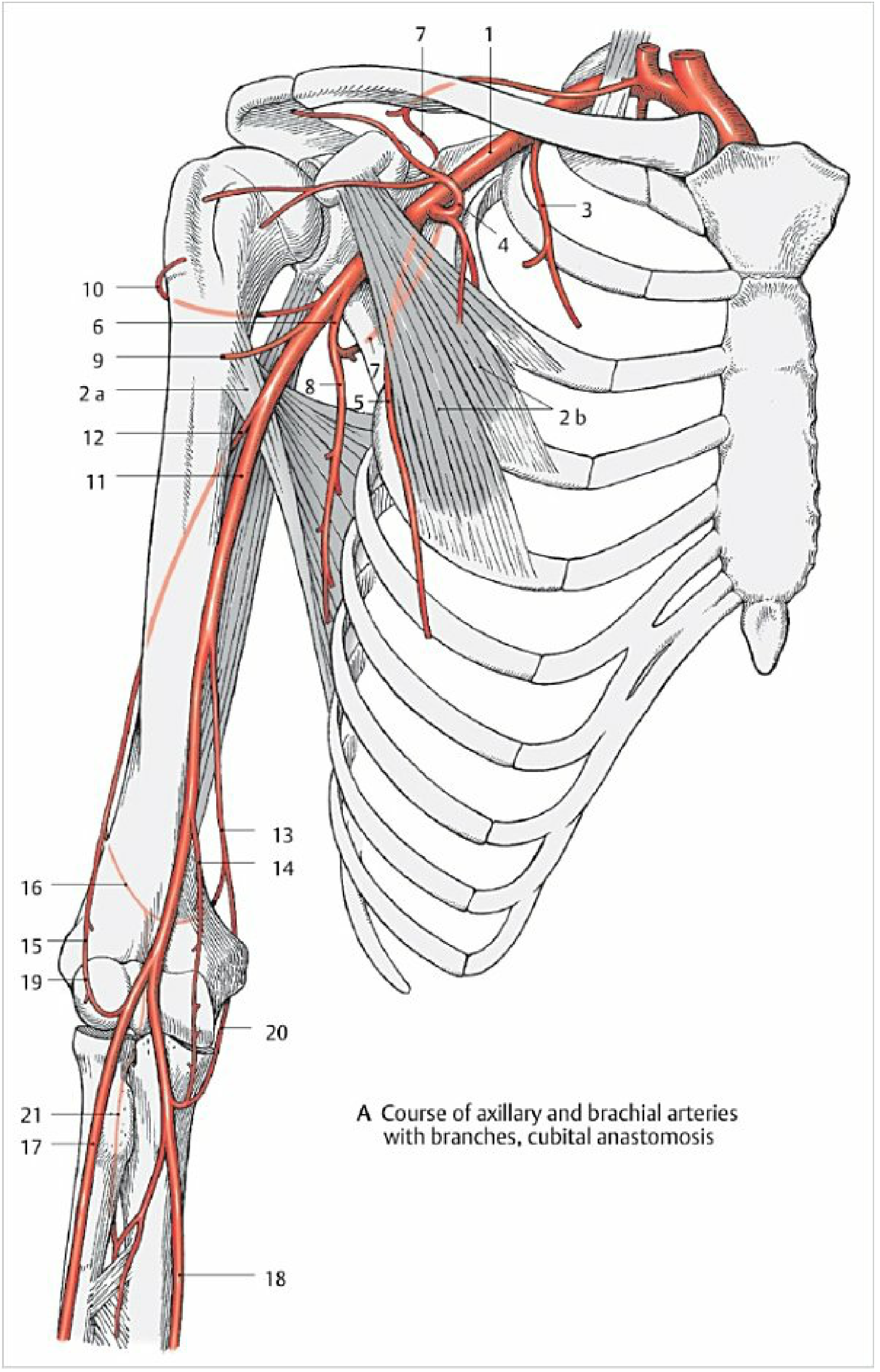
2. Cubital Anastomosis (Arterial Anastomosis Around the Elbow)
Location: Around the elbow joint (cubital fossa area)
The Big Idea: Branches coming down from the brachial artery and profunda brachii meet branches coming up (recurrent) from the radial and ulnar arteries.
Think of it as a ring of vessels around the elbow made of descending branches from above and ascending (recurrent) branches from below.
Branches forming it:
Coming from ABOVE (descending):
| Artery | Source |
|---|---|
| Radial collateral a. | Profunda brachii |
| Middle collateral a. (medial collateral a.) | Profunda brachii |
| Superior ulnar collateral a. | Brachial artery |
| Inferior ulnar collateral a. | Brachial artery |
Coming from BELOW (ascending/recurrent):
| Artery | Source |
|---|---|
| Radial recurrent a. | Radial artery |
| Anterior ulnar recurrent a. | Ulnar artery |
| Posterior ulnar recurrent a. | Ulnar artery |
| Recurrent interosseous a. | Posterior interosseous a. |
Mnemonic: "2 Profs, 2 Brachials + 3 Recurrents + 1 Interosseous"
A simpler way to remember all 8 vessels: "SRIM + RAUPI"
Superior ulnar collateral, Radial collateral, Inferior ulnar collateral, Middle (medial) collateral (these come from ABOVE) Radial recurrent, Anterior ulnar recurrent, Ulnar posterior recurrent, Posterior Interosseous recurrent (these come from BELOW)
Clinical importance:
- The brachial artery can be safely ligated distal to the origin of the profunda brachii because the cubital anastomosis provides collateral flow to the forearm.
- This is also why the radial artery can be harvested as a graft (e.g., for CABG) - the ulnar artery can supply the hand via the anastomosis.
3. Palmar Arches (Anastomosis in the Hand)
There are two palmar arches - both are anastomoses between the radial and ulnar arteries.
A) Superficial Palmar Arch
- Formed mainly by: Ulnar artery (terminal branch) + superficial palmar branch of radial artery
- Location: Superficial to the long flexor tendons, under the palmar aponeurosis
- Level: Projects across the palm at the level of the distal border of the thumb
- Gives rise to: 3 common palmar digital arteries → proper digital arteries
Memory trick: "Ulnar is Superficial" - the Ulnar (letter further right in the alphabet) supplies the Superficial arch.
B) Deep Palmar Arch
- Formed mainly by: Radial artery (terminal branch enters through 1st dorsal interosseous space) + deep palmar branch of ulnar artery
- Location: Deep to the long flexor tendons, on the bases of metacarpals
- Gives rise to: 3-4 palmar metacarpal arteries
Memory trick: "Radial goes Deep" - the Radial (letters earlier in the alphabet) supplies the Deep arch.
Quick Summary Table:
| Arch | Mainly From | Completed By | Location |
|---|---|---|---|
| Superficial | Ulnar a. | Superficial palmar branch of Radial | Superficial to flexors |
| Deep | Radial a. | Deep palmar branch of Ulnar | Deep to flexors, on metacarpal bases |
Mnemonic: "UR Deep, RU Shallow"
Ulnar Radial = the Ulnar is the main contributor to the superficial arch (with Radial completing it) Radial Ulnar = the Radial is the main contributor to the deep arch (with Ulnar completing it)
Clinical importance:
- The Allen's test checks patency of the superficial palmar arch - compress both radial and ulnar arteries, release one, and see if the hand flushes pink (confirms intact arch).
- Important before inserting radial arterial lines or harvesting the radial artery.
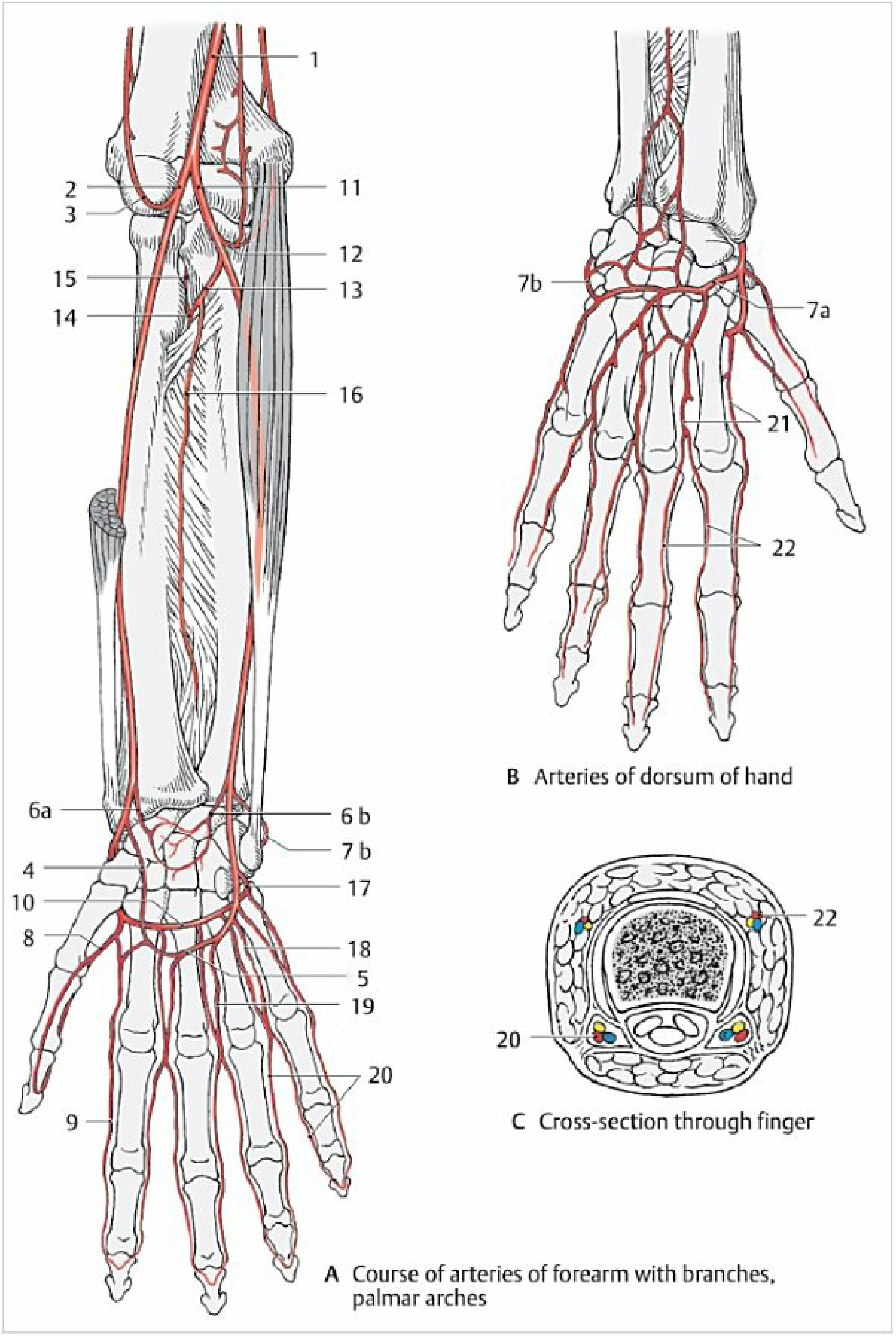
4. Carpal Arches (Wrist Anastomoses)
Two small anastomotic arches at the wrist level:
| Arch | Formed By |
|---|---|
| Palmar (anterior) carpal arch | Palmar carpal branch of radial a. + palmar carpal branch of ulnar a. |
| Dorsal (posterior) carpal arch | Dorsal carpal branch of radial a. + dorsal carpal branch of ulnar a. |
These give rise to the dorsal metacarpal arteries supplying the back of the hand and fingers.
Master Summary Table
| Anastomosis | Location | Connects | Clinical Importance |
|---|---|---|---|
| Scapular arcade | Around scapula | Suprascapular + dorsal scapular (from subclavian) ↔ Circumflex scapular (from axillary) | Collateral if axillary a. ligated |
| Cubital anastomosis | Around elbow | 4 descending branches (brachial/profunda) ↔ 4 recurrent branches (radial/ulnar/interosseous) | Brachial a. can be ligated distal to profunda; radial a. can be harvested |
| Superficial palmar arch | Palm (superficial) | Ulnar a. ↔ radial a. (superficial branch) | Allen's test; ensures hand viability |
| Deep palmar arch | Palm (deep) | Radial a. ↔ ulnar a. (deep branch) | Backup supply to palm |
| Carpal arches | Wrist | Radial ↔ ulnar (palmar and dorsal branches) | Supply dorsal hand; backup at wrist |
The Big Picture Mnemonic: "Shoulder Elbow Wrist Hand"
Scapular arcade → Elbow (cubital) → Wrist (carpal arches) → Hand (palmar arches)
Just go from proximal to distal down the limb - there is an anastomosis at every major region.
Sources: Color Atlas of Human Anatomy Vol. 2 (THIEME), pp. 106-111; General Anatomy and Musculoskeletal System THIEME Atlas, p. 410; Fischer's Mastery of Surgery, p. 6990.
Explain wrist, elbow and shoulder joint.
Searching sources...
Finding Sources
Finding Sources
Finding Sources
Reading File
Reading File
Reading File
Reading File
Reading File
Reading File
Reading File
Now let me fetch the key diagrams for all three joints.
Loading Image
Loading Image
Loading Image
Here is your complete MS1-level breakdown of all three joints.
Joints of the Upper Limb
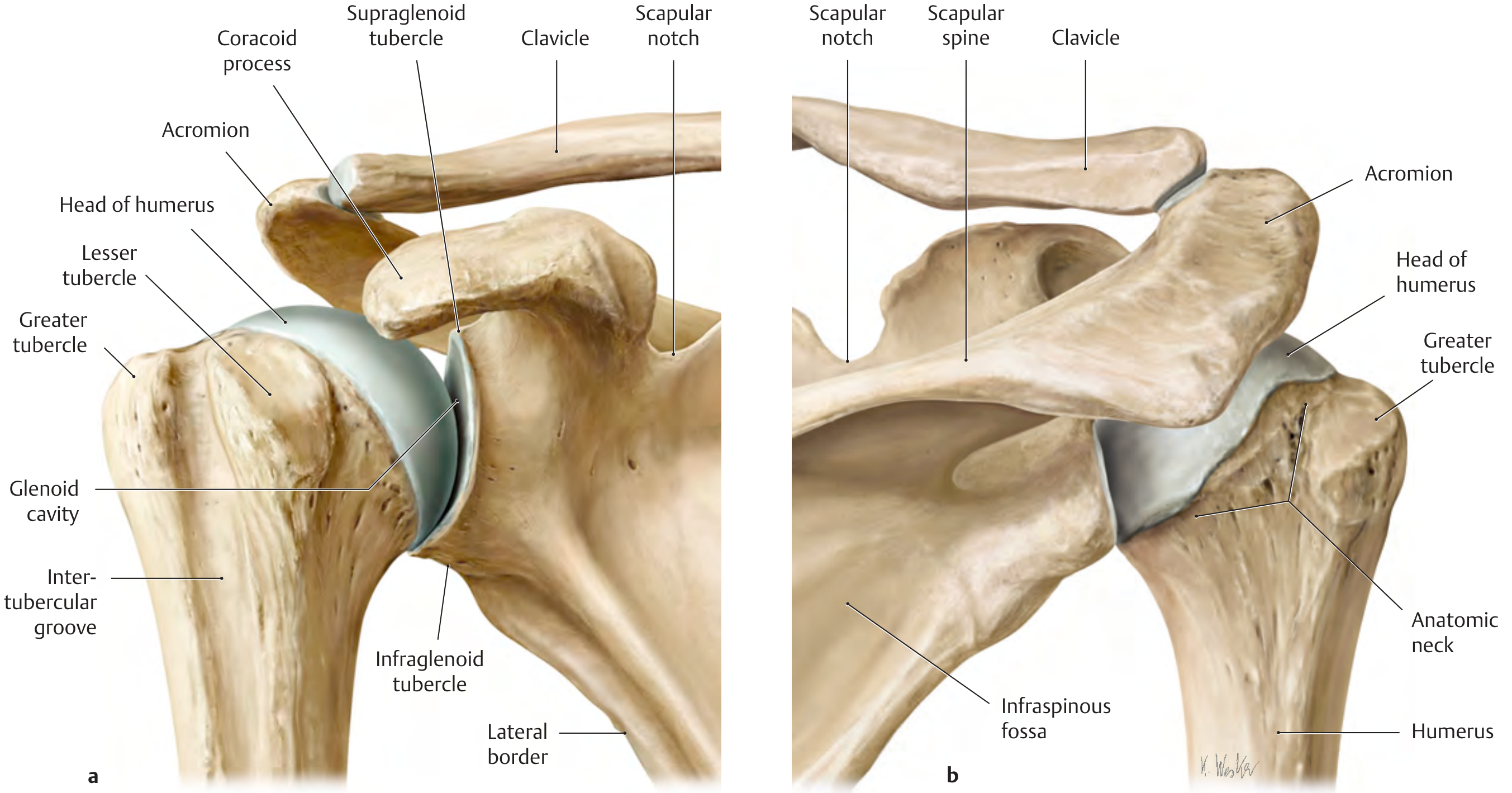
1. SHOULDER JOINT (Glenohumeral Joint)
Type
Ball-and-socket (spheroidal) synovial joint - the most mobile joint in the entire human body, but also the most commonly dislocated (45% of all dislocations).
Articulating Bones
| Surface | Bone |
|---|---|
| Ball (convex) | Head of humerus |
| Socket (concave) | Glenoid cavity of scapula |
Key fact: The glenoid cavity is 3-4x smaller than the humeral head. This gives huge mobility but terrible stability. To compensate, the glenoid is deepened by a ring of fibrocartilage called the glenoid labrum (~5 mm wide at its base).
Easy analogy: A golf ball sitting on a golf tee - it can move freely in all directions, but falls off easily.
Joint Capsule & Ligaments
The capsule is thin and loose posteriorly (allows wide range of motion), and reinforced anteriorly by the glenohumeral ligaments.
| Ligament | Attachment | Function |
|---|---|---|
| Superior glenohumeral | Upper glenoid → intertubercular groove/lesser tubercle | Part of "rotator interval"; stabilizes biceps tendon |
| Middle glenohumeral | Upper glenoid → anatomic neck of humerus | Anterior stability |
| Inferior glenohumeral | Lower glenoid → surgical neck of humerus | Most important! Forms a "hammock" during abduction; key to anteroinferior stability |
| Coracohumeral | Coracoid process → greater and lesser tubercles | Stabilizes the long head of biceps tendon in the groove |
Mnemonic for glenohumeral ligaments: "SIM"
Superior → Inferior → Middle (just remember the 3 GH ligaments)
Rotator Cuff (Primary Stabilizers)
Since ligaments are weak, the rotator cuff muscles are the real stabilizers of the shoulder. Remember: "SITS"
| Letter | Muscle | Action | Nerve |
|---|---|---|---|
| S | Supraspinatus | Abduction (first 15°) | Suprascapular |
| I | Infraspinatus | External rotation | Suprascapular |
| T | Teres minor | External rotation | Axillary |
| S | Subscapularis | Internal rotation | Upper/lower subscapular |
Movements & Ranges
| Movement | Range | Key Muscles |
|---|---|---|
| Flexion | 90° (>90° = elevation) | Deltoid (anterior), Biceps brachii |
| Extension | 40° | Latissimus dorsi, Teres major, Deltoid (posterior) |
| Abduction | 90° (>90° = elevation) | Supraspinatus (first 15°), then Deltoid (acromial) |
| Adduction | 20-40° | Latissimus dorsi, Pectoralis major |
| Internal rotation | 50-95° | Subscapularis (main), Pec major, Teres major |
| External rotation | 40-60° | Infraspinatus, Teres minor |
Blood & Nerve Supply
- Blood: Anterior and posterior circumflex humeral arteries (from axillary a.)
- Nerves: Axillary nerve (C5, C6) - most important; also suprascapular nerve
Clinical Pearls
Shoulder dislocation - almost always anterior (anteroinferior). Mechanism: forced external rotation of the raised arm.
- Bankart lesion = torn-off glenoid labrum (anterior inferior)
- Hill-Sachs lesion = impression fracture of the humeral head (caused by the glenoid rim)
- Complications: axillary nerve injury (test sensation over "regimental badge" area), axillary artery injury, rotator cuff tear
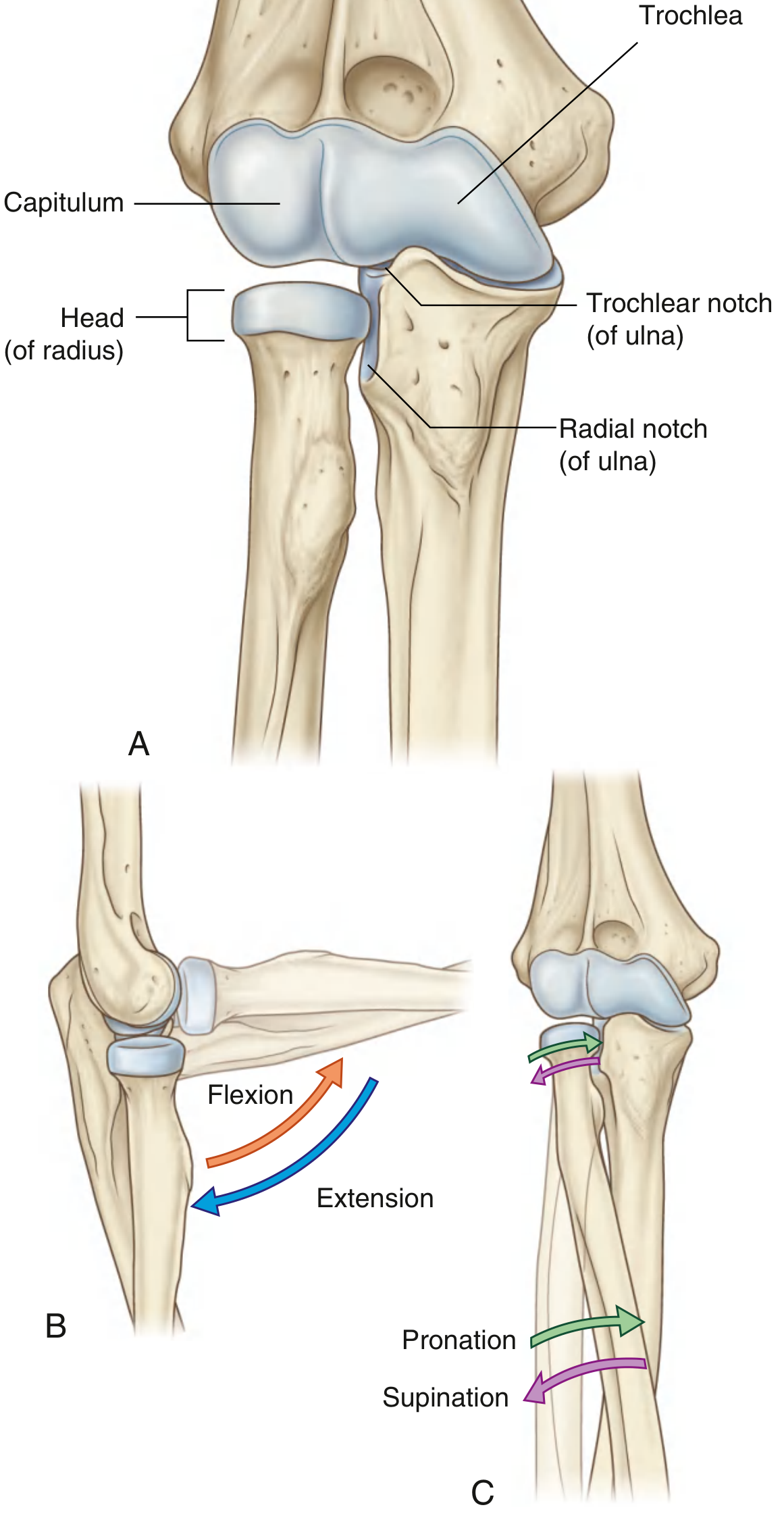
2. ELBOW JOINT
Type
Complex joint = actually 3 articulations sharing ONE synovial cavity. This is the key point examiners love to test.
| Sub-joint | Bones Involved | Joint Type | Movement |
|---|---|---|---|
| Humeroulnar | Trochlea of humerus + Trochlear notch of ulna | Hinge | Flexion / Extension |
| Humeroradial | Capitulum of humerus + Head of radius | Ball & socket | Flexion / Extension |
| Proximal radioulnar | Head of radius + Radial notch of ulna | Pivot | Pronation / Supination |
Mnemonic: "HH + P" - "Two Humeral joints + one Pivot"
Humeroulnar + Humeroradial = hinge movements; Proximal radioulnar = pivot (rotation)
Joint Capsule
- Synovial membrane lines the radial fossa, coronoid fossa, and olecranon fossa
- Fat pads sit over each fossa - they get pushed out when the bony processes move in during flexion/extension
- The capsule is reinforced medially and laterally by collateral ligaments
Ligaments
| Ligament | Attachment | Function |
|---|---|---|
| Medial (ulnar) collateral ligament | Medial epicondyle → coronoid process + olecranon | Resists valgus (outward) stress |
| Lateral (radial) collateral ligament | Lateral epicondyle → annular ligament | Resists varus (inward) stress |
| Annular ligament of radius | Both ends on the radial notch of ulna | Encircles the radial head, allowing it to pivot during pronation/supination |
Key: The annular ligament is a collar around the radial head - it allows the head to spin but keeps it in the radial notch of the ulna.
Movements & Ranges
| Movement | Range |
|---|---|
| Flexion | 0-145° |
| Extension | 0° (can hyperextend up to 10° in females) |
| Pronation | ~75° |
| Supination | ~85° |
Normal carrying angle = ~170° (slight valgus) - slightly greater in women.
Blood & Nerve Supply
- Blood: Anastomotic network around the elbow (cubital anastomosis - as discussed previously)
- Nerves: Mainly radial and musculocutaneous nerves; also ulnar and median
Clinical Pearls
| Condition | Key Point |
|---|---|
| Fat pad sign | Fluid in the joint elevates fat pads → lucent triangles on lateral X-ray; indicates fracture even if the fracture line is invisible |
| Supracondylar fracture | Most common elbow fracture in children; distal fragment displaced posteriorly by triceps → brachial artery can be "bowstrung" over fracture fragment → anterior compartment ischemia → Volkmann's ischemic contracture |
| Pulled elbow (Nursemaid's elbow) | Children under 5 yrs; sharp pull of the hand → radial head subluxes from annular ligament; treated by supination + compression |
| Tennis elbow | Lateral epicondylitis - pain at common extensor origin |
| Golfer's elbow | Medial epicondylitis - pain at common flexor origin |
| Cubital tunnel syndrome | Ulnar nerve compressed behind medial epicondyle → "funny bone" pain + weakness of intrinsic hand muscles |
3. WRIST JOINT (Radiocarpal Joint)
Type
Condyloid (ellipsoid) synovial joint - allows movement in 2 axes (but NOT rotation).
Articulating Bones
| Proximal Surface (Concave) | Distal Surface (Convex) |
|---|---|
| Distal end of radius | Scaphoid |
| Articular disc (over distal ulna) | Lunate |
| (Ulna does NOT directly touch the carpals!) | Triquetrum |
Easy trick to remember the 3 proximal row carpals at the wrist: "SLT" = Scaphoid, Lunate, Triquetrum (the pisiform is excluded as it's a sesamoid)
Key fact: The ulna does NOT directly articulate with the carpals - an articular disc (triangular fibrocartilage complex, TFCC) sits between the distal ulna and the lunate/triquetrum.
The radial styloid extends further distally than the ulnar styloid - this is why you can adduct the hand more than you can abduct it.
Joint Capsule & Ligaments
| Ligament | Position | Function |
|---|---|---|
| Palmar radiocarpal | Anterior | Stronger than dorsal; prevents hyperextension |
| Dorsal radiocarpal | Posterior | Prevents hyperflexion |
| Palmar ulnocarpal | Anterior (ulnar side) | Stabilizes ulnar side |
| Radial collateral | Radial styloid → scaphoid | Lateral stability |
| Ulnar collateral | Ulnar styloid → triquetrum | Medial stability |
Movements
| Movement | Range | Note |
|---|---|---|
| Flexion | ~80° | Mostly at radiocarpal joint |
| Extension | ~70° | Both radiocarpal + intercarpal joints contribute |
| Abduction (radial deviation) | ~20° | Limited by radial styloid |
| Adduction (ulnar deviation) | ~30-40° | Greater because ulnar styloid is shorter |
| Circumduction | Combination of all above |
No rotation at the wrist - rotation (pronation/supination) happens at the radioulnar joints (both proximal and distal).
Blood & Nerve Supply
- Blood: Dorsal and palmar carpal arches (branches of radial and ulnar arteries)
- Nerves: Anterior interosseous nerve (branch of median) and posterior interosseous nerve (branch of radial)
Clinical Pearls
| Condition | Key Point |
|---|---|
| Colles' fracture | Fall on outstretched hand → distal radius fracture → "dinner fork" deformity (dorsal displacement) |
| Scaphoid fracture | Most commonly fractured carpal bone; tenderness in anatomical snuffbox; risk of avascular necrosis (blood supply enters distally, so a proximal fracture cuts off supply) |
| TFCC injury | Triangular fibrocartilage complex tear → ulnar-sided wrist pain |
Master Comparison Table
| Feature | Shoulder | Elbow | Wrist |
|---|---|---|---|
| Joint type | Ball & socket | Complex hinge + pivot | Condyloid (ellipsoid) |
| Bones | Humerus + glenoid of scapula | Humerus + Radius + Ulna | Radius + TFCC + Scaphoid, Lunate, Triquetrum |
| Movements | All (most mobile) | Flex/Ext + Pro/Sup | Flex/Ext + Ab/Adduction |
| Key stabilizer | Rotator cuff (SITS) | Collateral ligaments + Annular lig | Radiocarpal ligaments |
| Common dislocation | Anterior | Posterior (elbow) | Lunate (not "wrist dislocation" per se) |
| Key nerve at risk | Axillary nerve | Ulnar nerve (medial epicondyle) | Median nerve (carpal tunnel) |
| Common fracture | Surgical neck humerus | Supracondylar (children) | Colles' / Scaphoid |
Quick Mnemonic Summary
- Shoulder = "Golf ball on a Tee" - SITS rotator cuff holds it in place
- Elbow = "3 joints in 1 capsule" - Two humeral + One pivot (HH+P)
- Wrist = "SLT" (Scaphoid, Lunate, Triquetrum) meet the radius + TFCC
Sources: Gray's Anatomy for Students (pp. 884-916); THIEME Atlas of Anatomy - General Anatomy and Musculoskeletal System (pp. 283-285, 409-410); Color Atlas of Human Anatomy Vol. 2.Here is a summary of what was covered:
What You Just Learned - 3 Upper Limb Joints at a Glance
Shoulder (Glenohumeral)
- Ball-and-socket; most mobile, least stable
- Head of humerus (ball) + glenoid cavity (socket, deepened by labrum)
- Stabilized by rotator cuff (SITS), not its ligaments
- Most commonly dislocated anteriorly → risk to axillary nerve
Elbow
- 3 joints in 1 capsule - humeroulnar + humeroradial (hinge) + proximal radioulnar (pivot)
- Key ligaments: medial/lateral collateral + annular ligament around radial head
- Fat pad sign = look for a fracture
- Most dangerous complication: brachial artery injury in supracondylar fracture
Wrist (Radiocarpal)
- Condyloid joint - 2 axes only (no rotation here!)
- Radius + TFCC meet SLT (Scaphoid, Lunate, Triquetrum)
- Ulna does NOT directly touch carpals
- Most common fractures: Colles' (distal radius) and scaphoid
This is a shared conversation. Sign in to Orris to start your own chat.